
Students and Staff Grapple With the Sudden Closure of University of the Arts
Administrators announced the closure with little warning on May 31. “It was like a slap in the face or a punch in the gut. It just didn’t feel real.”
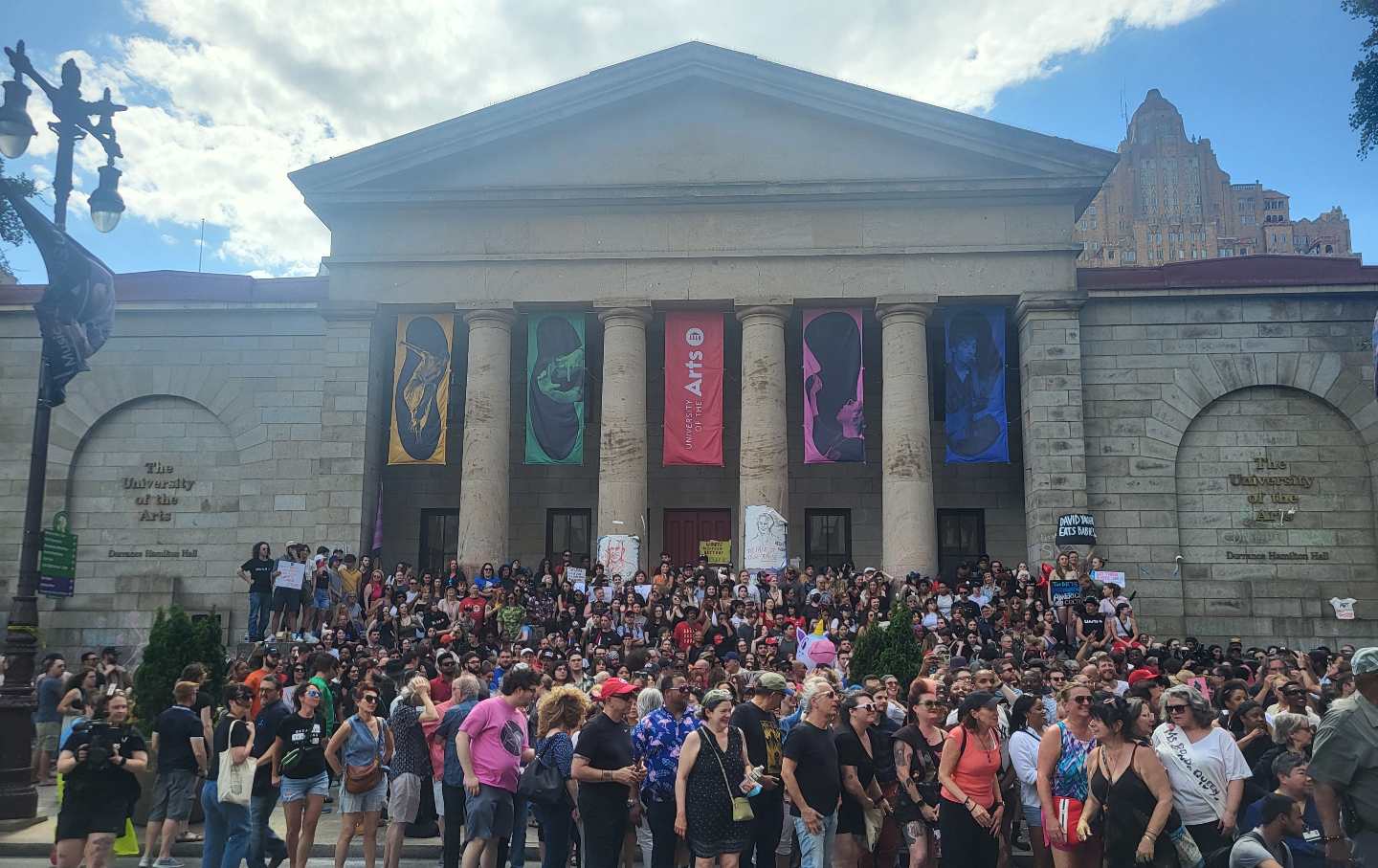
Students rally outside of Hamilton Hall to protest the closing of Pennsylvania’s University of the Arts.
(Lucy Tobier)
On June 7, over 200 students, faculty, and community members rallied outside of Hamilton Hall to protest the closing of Pennsylvania’s University of the Arts. Administrators announced the closure to its faculty, staff, and students with little warning on May 31, e-mailing just hours after The Philadelphia Inquirer broke the news, citing “declining enrollments, declining revenues, and increasing expenses” and “significant, unanticipated expenses.”
“It was like a slap in the face or a punch in the gut. It just didn’t feel real,” said Asher Vagilca, a UArts class of 2025 theater production student. “I don’t think anyone actually thought we would close this soon or at all. I really don’t think anyone knew this was coming, except for the people up top, who decided not to tell us.”
After the closure announcement, UArts President Kerry Walk resigned and three separate lawsuits were filed by faculty and students for insufficient notice of termination—a violation of the Worker Adjustment and Retraining Notification (WARN) Act—and failure to uphold tuition contracts. UArts did not respond to comment requests, but representatives from the Middle States Commission on Higher Education which accredits colleges said they do not know the reasons for and conditions of the closure during a webinar on June 14.
The faculty union organized under the United Academics of Philadelphia, which recently won its first contract after three years of bargaining, is also pushing for payment owed from the past year’s teaching contracts and transparency about what led to the closure. The union filed an Unfair Labor Practice charge over the school’s failure to engage in closure negotiations as stipulated by the union contract.
“As of today, faculty and staff have yet to receive any detailed information on their pay, employment status, or benefits. The cruelty around this ongoing lack of communication from their employer remains disturbing, and the University instead communicates in the media rather than with their community,” read a statement from UAP.
The statement also mentioned the potential merger with nearby Temple University, as the faculty contract requires any successors to engage with the existing union. “Far more than buildings or programs, University of the Arts has always been made up of its devoted faculty, staff, and students. The vibrant UArts community has been kept in the dark,” the statement said. “Any conversations around a potential merger must include all those impacted, and any solution to this crisis must be one in which student, faculty, staff, and the Philadelphia arts community can thrive together.”
In the Musical Theater school, students had been planning fall shows and senior projects, according to Zoe Hollander, a musical theater student at UArts. But after transferring, they won’t be guaranteed the same shows they had at UArts. Although Hollander says there are discussions among students about replanning the performances, nothing is set in stone yet, as uncertainty fills the air without information from officials. The only meaningful support, she says, has come from faculty compiling resource and transfer lists and offering to review students’ resumes and materials.
“I graduated from high school in 2021, so I have already lost my senior year. This is the second time that it’s been ripped away. The pandemic is something unavoidable. That’s a tragedy that affects the entire world,” she said. “This is something that if not could have been avoided, it could have been handled with so much more care to give this community the resources and the respect that they deserve to figure out their next step.”
Hayden Caico, an animation student who graduated weeks ago in May, was shocked by the announcement of closure given the new animation equipment and computers just bought. “It was crazy going from graduation and hearing how much our school is growing and how wonderful things are and all the promises they were gonna make, to finding out two weeks later it’s completely gone,” Caico said.
On June 5, the Middle States Commission on Higher Education called out UArts administrators for insufficient notice of closure and the harm it caused students. Pennsylvania state representatives and senators, the state’s attorney general office, and the Philadelphia City Council have all pledged to investigate the circumstances of the sudden closure, showing a widespread distrust of the administrators.
“I formally was notified that my employment was being terminated through a Zoom meeting at 12:30 today.… There’s been a real black hole of information at the center of this,” said UArts adjunct professor Rick Rein. “Why is this happening suddenly? What did we try to do about it? Would things have been different if the administration had been more open about the state of finances a year ago? It’s really confusing on top of everything else.” According to Jackie Manni, who was the registrar at UArts for over 20 years, the call lasted just 10 minutes for two groups of faculty and staff, and they were given no chance to ask questions.
Although Manni stayed at UArts for over two decades, citing the students and community, she said the pay was well below the national median for similar jobs. When Manni was hired, she was paid $24,000. In 2019, when an administrative assistant was hired, they were also offered $24,000, according to Manni, and there has not been a significant cost of living adjustment in 10 years. She sees the pay and UArts increased use of adjunct faculty positions without security as indicative of the level of respect for arts education. “Society is not valuing education, and especially not in arts,” Manni said.
Popular
“swipe left below to view more authors”Swipe →UArts buildings occupied much of the famous “Avenue of the Arts” on Broad Street. Hollander worries that the closure will impact not just the words of the arts and education but Philadelphia as a whole. “I do think that the community within UArts is very strong and widespread, and I am learning that now more than ever as people are reaching out,” Hollander said. “I think that we will hold each other and I hope that Philadelphia as a whole will catch us during this fall and so far, they have been and it’s been wonderful. I think we’re strong enough to stay in the community, although I don’t know what the impact will be going forward for the loss of future people to be added to that community.”
Manni is continuing to work at UArts through June to send transcripts to students and navigate closure. However, as of June 9, she had not received any additional instructions, and has fielded hundreds of e-mails from panicked students. “It was really sad to have to tell the students that I didn’t know and my hands were tied.”
As currently enrolled students weigh which nearby college to transfer to, they hope to preserve the community that made UArts important to them. Vagilca pointed to the outpour of faculty and city support for students, and said students have been communicating with each other through group chats and the protest at Hamilton Hall. But it’s impossible to replace the UArts community and its impact. “I’ve always been the weird kid. And I didn’t feel like the weird kid here,” they said. “I felt like a person and I felt like people saw me for me.”
More from The Nation
The Bookstore Revolution in Taiwan’s Conservative Heartlands The Bookstore Revolution in Taiwan’s Conservative Heartlands
After Taiwan legalized same-sex marriage, gender-themed bookstores are working to build the social acceptance that the law alone couldn’t deliver.

Jalen Hurts Deserved Better. We All Do. Jalen Hurts Deserved Better. We All Do.
In a country that treats workers as expendable parts, Hurts’s playing through a blood clot is just the highest-profile example of the price workers pay in an oligarchy.
The Terrifying Future of States’ Criminalizing Pregnant People Is Already Here The Terrifying Future of States’ Criminalizing Pregnant People Is Already Here
The idea of charging people who have abortions with murder is gaining traction on the right. But a report finds that people are already being prosecuted for their pregnancy outcom...
The Supreme Court Is Coming for Affirmative Action—Again The Supreme Court Is Coming for Affirmative Action—Again
The high court has just accepted a case that takes aim at efforts to increase diversity at high-performing public schools.
My Family’s Dark, Hidden History With Institutionalization My Family’s Dark, Hidden History With Institutionalization
My great-great-grandfather was the namesake of an infamous institution for the disabled. From long-neglected records of the property, the lives of forgotten people were uncovered....
Smoke and Mirrors: The Right's Latest Attacks Against Trans People Smoke and Mirrors: The Right's Latest Attacks Against Trans People
The MAGA movement is redoubling its attacks on trans healthcare in an attempt to win votes this November.

