
Biden Can No Longer Avoid Questions About His Fitness for a Second Term
A long-simmering debate has boiled to the surface with the special counsel’s report. How the president responds will determine whether he is reelected.
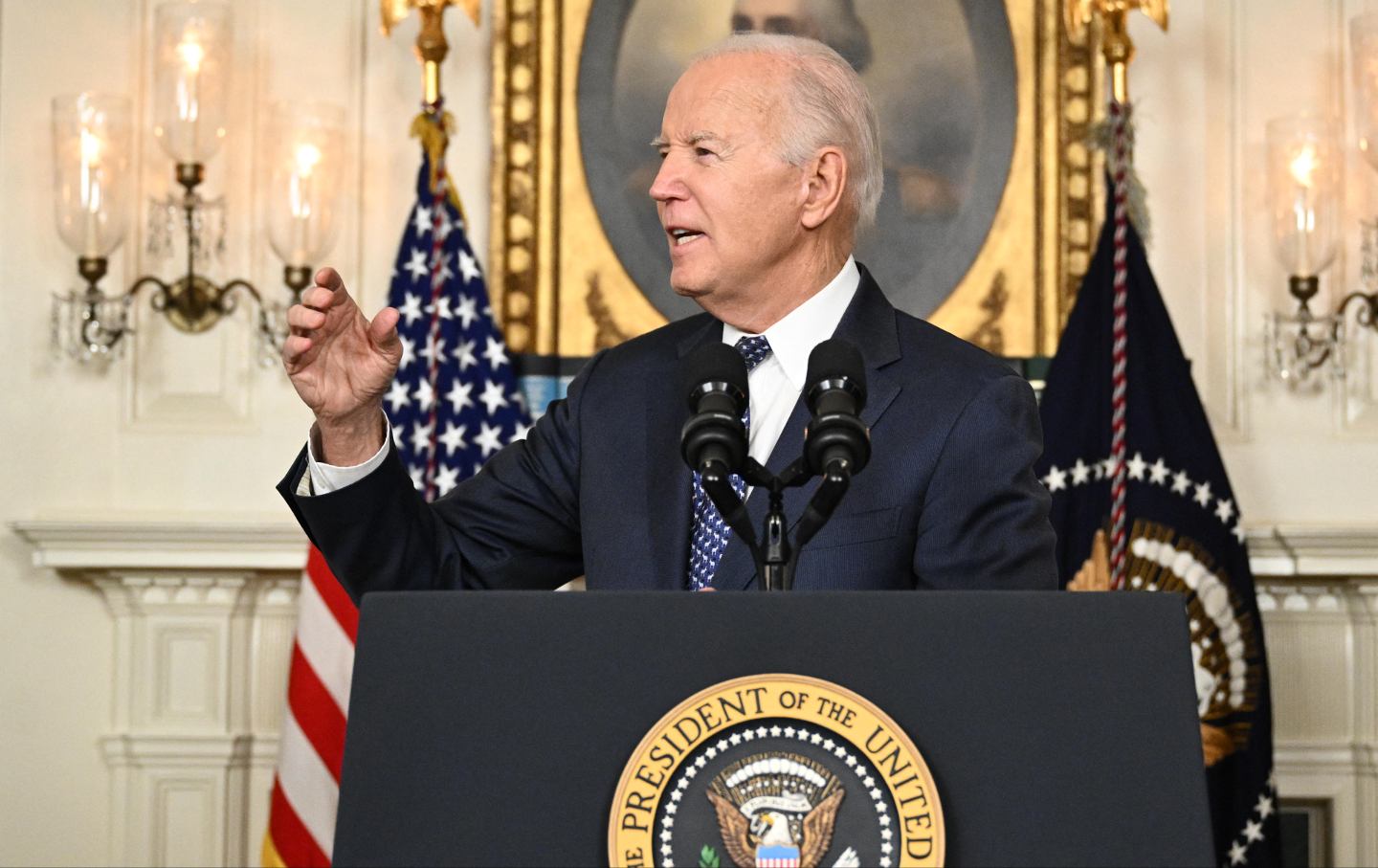
Joe Biden speaking about the Special Counsel report in the Diplomatic Reception Room of the White House in Washington, D.C., on February 8, 2024.
(Mandel Ngan / AFP via Getty Images)Joe Biden is furious at special counsel Robert Hur, and rightly so. In a gratuitous swipe at the president, Hur made an issue of the president’s age on Thursday when he issued a long-awaited report that, while it concluded that Biden should not face criminal charges for mishandling classified documents, still cast the president’s cognitive state in a brutal light.
Biden let that fury show in a combative nighttime press conference where, in a riff on the report’s most instantly notorious phrase, he declared, “I’m well-meaning and I’m an elderly man, and I know what the hell I’m doing.”
Feisty and pugnacious, Biden sparred with reporters who peppered him with unusually personal and aggressive questions. When Fox News reporter Peter Doocy, who often gives the president a hard time, asked, “How bad is your memory?” Biden shot back, “My memory is so bad I let you speak.”
The point of the press conference, which was hastily organized after the release of Hur’s report prompted an immediate frenzy of speculation about Biden’s age and mental fitness, was to shut down a snowballing debate about the president’s capacity to even seek—let alone serve—a second term.
That didn’t happen. A long-simmering argument over the president’s abilities has boiled to the surface, shaking up a campaign that will only get more bitter and contentious as 2024 progresses. What transpired gives us a rough outline of what is to come, just as it leaves no doubt of what Biden must do if he hopes to win a second term.
Republicans were quick to dismiss the president as “weak and sad,” while the cadre of Democrats who have never been particularly enthusiastic about the president suggested that he step aside so that the party could make a late-stage substitution in a race that is already well underway. And the Democrats who expect Biden will be their candidate were fretting about the reality that, as veteran Democratic strategist David Axelrod explained immediately after the Thursday night press conference, “This is a stubborn problem for the campaign going forward.”
Axelrod’s right. This is a challenge the president and his team must rise to if they are going to prevail in 2024. How they do that will go a long way toward determining whether Biden, who remains the all-but-certain Democratic nominee, wins or loses in a November race against Donald Trump, who is equally certain to be his Republican rival—despite a burgeoning discussion, urged on by Nikki Haley, about the former president’s own “declining” mental fitness.
In reality, the debate about Biden’s age was a stubborn problem before Hur released the report, in which he wrote, “We conclude that no criminal charges are warranted in this matter,” but then damningly described the president as “a sympathetic, well-meaning, elderly man with a poor memory” and asserted that, during interviews with the special counsel, Biden had failed to remember the dates of his tenure as vice president and, most painfully, couldn’t recall when his beloved son Beau had died. Biden pointedly, and at times emotionally, rejected Hur’s claims, but they reinforced an impression that has been a lingering challenge for the president.
In an NBC News poll released Tuesday, before Hur released the report, before Biden responded, and before media chaos ensued, 62 percent of Americans indicated that they had “major concerns” about “Joe Biden not having the necessary mental and physical health to be president for a second term.” Another 14 percent said they had minor concerns about whether the 81-year-old president is up to serving four more years. “By party,” NBC noted, “95 percent of Republican voters, 81 percent of independents and 54 percent of Democrats say they have major or moderate concerns about Biden’s fitness for a second term.”
That compared to 48 percent of Americans who said they had major or minor concerns about the prospect that 77-year-old Donald Trump might be too mentally or physically impaired to serve a second term. Notably, a lot more Americans, 71 percent, said they had concerns (61 percent major, 10 percent minor) about “Donald Trump facing four different criminal and civil trials for alleged wrongdoing, including multiple felony charges related to attempts to overturn the 2020 election.”
The Hur report turned the volume up on the age debate, leading Axelrod to say on Thursday evening, “This has become a real thing.”
How real remains to be seen. Republicans were immediately on the attack, with House Republican Conference chair Elise Stefanik (R-N.Y.) labeling Biden a “feeble” man who presided over a “horrific press conference” on Thursday night. Congressional Democrats rallied to the president’s defense, with US Representative Jamie Raskin (D-Md.) announcing, “I just spent an hour with President Biden where he regaled the entire Democratic caucus. All these age-based cheap shots at President Biden show you how desperate they are, while Donald Trump is fumbling around every day.”
Raskin’s response was on point. Hur, who served four years as the Trump-appointed United States Attorney for Maryland and was then named by Attorney General Merrick Garland to oversee the Justice Department’s inquiry into Biden’s handling of classified documents during his time as vice president, played a nasty political game with the report on the inquiry. In a letter to the special counsel, White House counsel Richard Sauber and Biden’s personal lawyer Robert Bauer ripped Hur’s report:
“We do not believe that the report’s treatment of President Biden’s memory is accurate or appropriate. The report uses highly prejudicial language to describe a commonplace occurrence among witnesses: a lack of recall of years-old events.
“Such comments have no place in a Department of Justice report, particularly one that in the first paragraph announces that no criminal charges are ‘warranted’ and that ‘the evidence does not establish Mr. Biden’s guilt.’”
Popular
“swipe left below to view more authors”Swipe →All true.
But this particular debate won’t be resolved with sharp comments from Democratic pundits or letters from lawyers, especially when a special counsel that Biden’s own Justice Department chose—however unwisely—has opted to salt his report with destructive allegations about the president’s mental state. The only person who can assuage the public’s concern is Biden himself.
While there has been plenty of second-guessing about whether he should have faced the press on Thursday night, history will record that the president and his team made the right call. There is no time to waste if Biden wants to put this issue behind him, retain the nomination, and take the fight to Trump in what is sure to be a visceral fall race. The voters will decide whether the president is fit to be the Democratic nominee and to be the president, and Biden should write the narrative of the campaign now, rather than later.
If there were ever a chance that this election wouldn’t feature an open debate about Biden’s age, that prospect has been preempted. Biden can’t hide from this debate. He can’t avoid it. His only choice is to get in front of the American people as much as possible, with more press conferences, more speeches, and more meetings with voters on the campaign trail—telling them, as he did reporters on Thursday night, “My memory’s fine. Take a look at what I’ve done since I became president.” Then he can talk about his accomplishments, to the delight of Democrats and the frustration of Republicans.
“The more he’s out showcasing what he’s fighting for, what he’s achieved…the more they see his vigor and his passion for what he’s working on, the better,” says former Biden White House communications director Kate Bedingfield, who argues that the president must now “put himself out more, not less.”
Of course, Biden will stumble—as he did Thursday night, when, amid the rapid give-and-take with reporters, he referred to Egyptian leader Abdel Fattah El-Sisi as the “president of Mexico.”
But Biden has always been known for his gaffes. Historically, Americans have put his misstatements in perspective and, despite Republican efforts to paint him as inept, or worse, voters have trusted him—as they did in 2020. Biden’s job now, as he seeks a second term, is to be a fully present, fully engaged, and highly active candidate who is prepared to talk himself up and talk his scandal-plagued and 91-times indicted opponent down. That means less time in the White House and more time on the hustings. No avoidance. No excuses. If Joe Biden is going to be the Democratic nominee, and as such the last best alternative to Donald Trump, he owes his party and his country nothing less.
More from The Nation

Mamdani Can No Longer Avoid the Issue of the NYPD Mamdani Can No Longer Avoid the Issue of the NYPD
The mayor has been able to put difficult questions about policing on the back burner—until now.

Why Democratic Leaders Keep Waging War on the Young Why Democratic Leaders Keep Waging War on the Young
The party's silver-haired establishment is caught up in an existential culture war.
The White Man Can Always Take What You Have The White Man Can Always Take What You Have
In this week's Elie v. US, our justice correspondent breaks down the real message of the attacks on Ilhan Omar. Plus: the anti-trans case that will come for us all.

Where Is the Outrage Over Trump’s Racist Targeting of Ilhan Omar? Where Is the Outrage Over Trump’s Racist Targeting of Ilhan Omar?
The establishment press and some Democrats are strangely mute over the president’s flagrant abuse of the legal system.

