The UAW Is Organizing the South
The union announced that more than half the workers at a VW plant in Tennessee have signed union cards. And it’s vowing that this is only the beginning.
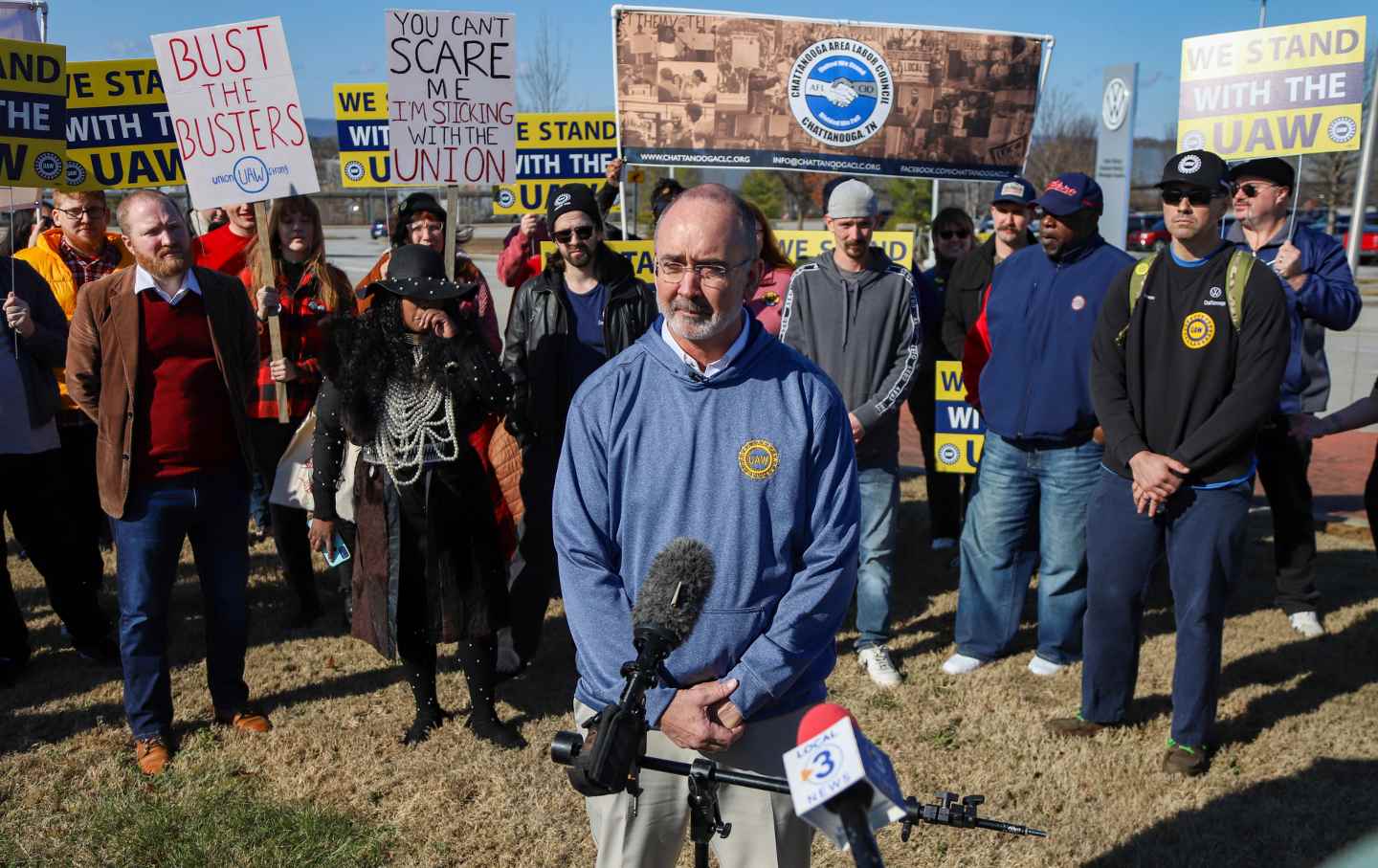
UAW President Shawn Fain speaks to the media in Chattanooga, Tenn., on Monday, December 18, 2023.
(Olivia Ross / Chattanooga Times Free Press via AP)More than half the workers at the sprawling Volkswagen auto assembly plant in Chattanooga, Tenn., have signed cards signaling that they want to be represented by the United Auto Workers union.
And they did so in less than 60 days, revealing a level of enthusiasm that suggests one of the largest nonunion auto plants in the Southeastern United States could produce a major breakthrough in the UAW’s effort to organize workers in parts of the country that have been dominated by anti-union forces for generations.
Everyone knows that the union represents workers at the “Big Three” auto companies—General Motors, Ford, and Stellantis — but many people are unaware that dozens of major auto plants nationwide have no union presence. Those plants are owned by German, Japanese, and Korean automakers that are unionized in their home countries—but not in the United States.
After the UAW won historic contracts with the Detroit automakers last fall, President Shawn Fain announced that the UAW would throw its support behind workers who are organizing 13 nonunion plants across the United States, including those owned by Volkswagen, Toyota, Honda, Hyundai, Nissan, BMW, Mercedes-Benz, Subaru, Mazda, Rivian, Lucid, and Volvo. Billionaire Elon Musk’s embattled Tesla operations were also targeted. It was an audacious move by a union that has been struggling to expand its reach beyond the historic foothold it has had for decades with the Big Three. The UAW has faced especially tough going in the South, where anti-labor “right to work” laws have been on the books since segregation days, and where the fierce anti-union sentiments of politicians such as former South Carolina governor Nikki Haley have been a barrier to organizing by all unions.
But Fain showed confidence, proclaming in November, “Workers across the country, from the West to the Midwest and especially in the South, are reaching out to join our movement and to join the UAW. The money is there. The time is right.” His vow that the union would seek to build on its contract wins from last fall—which secured record wage gains of at least 25 percent over the next four years for workers at Big Three plants—has clearly energized organizing efforts among the more than 4,000 workers at the Chattanooga VW plant where the German corporation began production in 2011 and has resisted previous union drives.
That plant is now the first of the major nonunion factories where the UAW has been able to announce that it has secured majority support among workers who began organizing in the wake of its energetic—and ultimately successful—strike against domestic auto-making companies.
“The excitement has been building, and now that we have reached 50 percent, it is just continuing to grow,” says Zach Costello, a trainer in the VW plant’s Proficiency Room. “Just because we are in the South, it does not mean that our work is worth less, that our benefits should be diminished, or that we don’t have rights. All workers should have a voice, and I hope the success that we’re having here is showing workers across the country what is possible.”
There is still work to be done. Union organizers want to get well above the 50 percent sign-up mark—probably to 70 percent—before pursuing a representation election overseen by the National Labor Relations Board. With that level of support, the union could also demand voluntary recognition by the company.
But crossing the 50 percent line at a plant that is located in a “right to work” state where Republican Governor Bill Lee, an anti-labor zealot, openly participated in efforts to thwart a previous organizing drive at the VW plant, and where the Republican-controlled state legislature just last year passed a new package of anti-union policies, is no small accomplishment. It’s a big deal for the workers at the Chattanooga factory, and it’s being noticed by workers at other plants where organizing drives have begun, including a Mercedes facility in Vance, Ala., which has more than 4,000 employees, and Hyundai’s factory in Montgomery, Ala., which employs roughly 4,000 workers.
On the day that it announced that the majority of VW workers in Chattanooga had signed union cards, the UAW released a video featuring workers such as Moesha Chandler, an assembly worker at the Mercedes-Benz plant, who said, “I’ve been watching you guys grow your support, and I must say that I’m excited at how far you guys have come.” Jeremy Kimbrell, another Mercedes worker, told the VW workers, “Go ahead and let the boss know that time’s up on taking advantage of the workers.… Get your union in and get your contract, and us down here at Mercedes are going to be right behind you.”