The Media Monopoly Crisis
Our new special issue takes on the out-of-control consolidation that is squeezing out independent voices and controlling what we read.
In 1960, when The New Yorker’s press critic A.J. Liebling famously observed that “freedom of the press is guaranteed only to those who own one,” New Yorkers had seven daily newspapers to choose from. And that was just in English. The city also boasted dailies in Arabic, Chinese, Italian, Japanese, Russian, and Spanish—and two in Yiddish. By the time The Nation first surveyed the publishing industry in 1996, New York was down to four English-language dailies and seven publishing houses. Our anatomy that year of what we dubbed “the national entertainment state” focused on the four corporations that, between them, controlled what Americans saw on television. Thanks to the rise of the Internet, when we revisited the topic in 2002, our chart of the “Big Ten” media companies spanned four pages. Yet when we returned four years later, the roster had shrunk to six: Disney (which owned ABC), CBS, General Electric (NBC), News Corp (Fox), Time Warner (CNN), and Viacom (MTV, Paramount, and DreamWorks).
Consolidation has only accelerated since then, with book publishing now down to a Big Five. After Simon & Schuster found its sale to Penguin Random House blocked on antitrust grounds, the private equity firm KKR snatched it up for $1.6 billion earlier this year. Given KKR’s overall portfolio of $86 billion, publishing is a minuscule part of its business. And as Tom Schatz, a historian of Hollywood’s Golden Age, reports in this issue, the fabled Big Six movie studios have been whittled down to two: Disney (with a market capitalization of $169 billion) and Netflix ($198 billion) now dominate film and TV production. But, Schatz explains, thanks to the rise of cord-cutting and the continuing decline of both film studios and cable, those two—along with competitors like Comcast and Sony—find themselves fighting over a shrinking portion of a media landscape dominated by Apple ($2.9 trillion) and Amazon ($1.5 trillion). Now that these behemoths have the corporate muscle to influence not just what gets made but also how it gets distributed and marketed, and—given Jeff Bezos’s ownership of The Washington Post—even how (or whether) it gets reviewed, we felt that a return to the scene of the crime was long overdue.
Media Special Issue
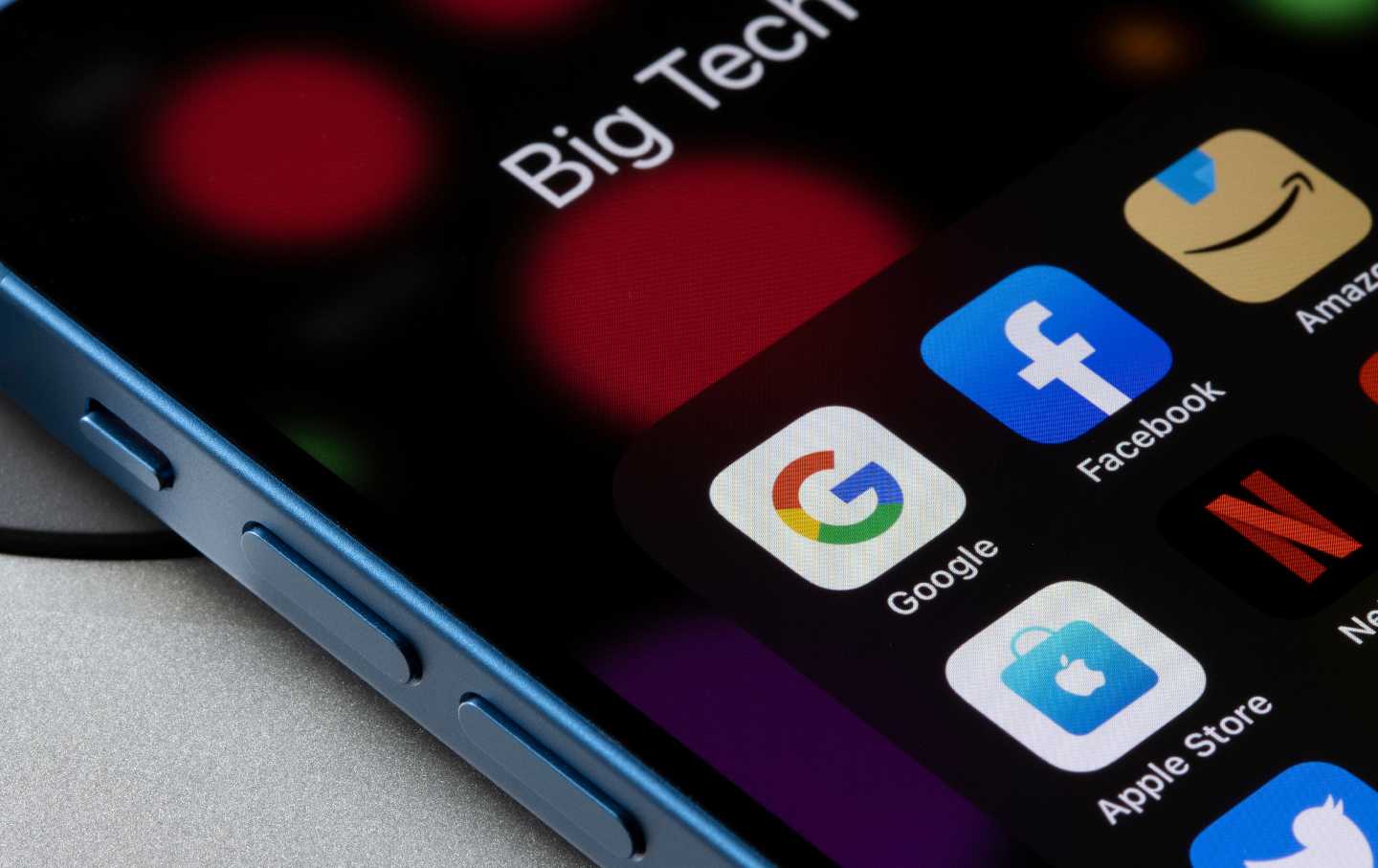
Because this time the big squeeze on independent voices isn’t just a result of corporate mergers involving the means of production. Elon Musk may be widely known—and justly reviled—for what he’s done to Twitter. However, as Siva Vaidhyanathan reports, the reason Musk really matters is that, thanks to the satellite Internet company Starlink—a side project of his aerospace company SpaceX—he controls the digital access of a substantial portion of Earth’s inhabitants. Vaidhyanathan’s three-tiered analysis of the current media landscape—infrastructure, applications (like Google and Facebook), and content—also explains why the underlying corporate structures have become so big that we’ve had to give up trying to capture everything in one neat graphic.
Instead, in the pages that follow, we offer a multitude of perspectives, from Zephyr Teachout’s rogues’ gallery of “Big Unfriendly Tech Giants” to Gene Seymour’s personal history of the rise, decline, and enduring relevance of Black media. The brilliant graphic journalist Colleen Tighe offers an illustrated Internet pilgrim’s progress from the utopian hopes of the early information age to the brutal exigencies of the attention economy, while Vilissa Thompson laments the toll our incredible shrinking industry has taken on efforts to increase diversity and to include marginalized voices.
And this wouldn’t be a Nation special issue without some commonsense radical solutions. Starting at the grass roots, Kelsey McKinney of Defector Media and Aleksander Chan of Discourse Blog offer founders’-eye-view advice on how to start your own media company. John Nichols, who has a fair claim to being Liebling’s successor in covering the carnage of local newspapers—and who notes in these pages that the term “news desert” now applies to some of our biggest cities—outlines an ambitious Marshall Plan for journalistic renewal. Not to mention Bryce Covert’s compelling close-up portrait of FTC chair Lina Khan—a woman with the power to actually do something to break up media monopolies. But then we think of this entire special issue of The Nation as a call to action.