
The Devastating Wars Abroad Are Windfalls for Weapons Manufacturers
Your tax dollars are being squandered in the rush to build and sell ever more weaponry for ongoing wars.

A US Army M1A1 Abrams tank, as will be delivered to Ukraine, is photographed in Grafenwöhr, Bavaria, on July 14, 2023.
(Matthias Merz / Getty)This article originally appeared at TomDispatch.com. To stay on top of important articles like these, sign up to receive the latest updates from TomDispatch.com.
The New York Times headline said it all: “Middle East War Adds to Surge in International Arms Sales.” The conflicts in Gaza, Ukraine, and beyond may be causing immense and unconscionable human suffering, but they are also boosting the bottom lines of the world’s arms manufacturers. There was a time when such weapons sales at least sparked talk of “the merchants of death” or of “war profiteers.” Now, however, is distinctly not that time, given the treatment of the industry by the mainstream media and the Washington establishment, as well as the nature of current conflicts. Mind you, the American arms industry already dominates the international market in a staggering fashion, controlling 45 percent of all such sales globally, a gap only likely to grow more extreme in the rush to further arm allies in Europe and the Middle East in the context of the ongoing wars in those regions.
In his nationally televised address about the Israel-Hamas and Russia-Ukraine wars, President Biden described the American arms industry in remarkably glowing terms, noting that, “just as in World War II, today patriotic American workers are building the arsenal of democracy and serving the cause of freedom.” From a political and messaging perspective, the president cleverly focused on the workers involved in producing such weaponry rather than the giant corporations that profit from arming Israel, Ukraine, and other nations at war. But profit they do and, even more strikingly, much of the revenues that flow to those firms is pocketed as staggering executive salaries and stock buybacks that only boost shareholder earnings further.
President Biden also used that speech as an opportunity to tout the benefits of military aid and weapons sales to the US economy:
“We send Ukraine equipment sitting in our stockpiles. And when we use the money allocated by Congress, we use it to replenish our own stores, our own stockpiles, with new equipment. Equipment that defends America and is made in America. Patriot missiles for air defense batteries, made in Arizona. Artillery shells manufactured in 12 states across the country, in Pennsylvania, Ohio, Texas. And so much more.”
In short, the military-industrial complex is riding high, with revenues pouring in and accolades emanating from the top political levels in Washington. But is it, in fact, an arsenal of democracy? Or is it an amoral enterprise, willing to sell to any nation, whether a democracy, an autocracy, or anything in between?
Arming Current Conflicts
The United States should certainly provide Ukraine with what it needs to defend itself from Russia’s invasion. Sending arms alone, however, without an accompanying diplomatic strategy is a recipe for an endless, grinding war (and endless profits for those arms makers) that could always escalate into a far more direct and devastating conflict between the US, NATO, and Russia. Nevertheless, given the current urgent need to keep supplying Ukraine, the sources of the relevant weapons systems are bound to be corporate giants like Raytheon and Lockheed Martin. No surprise there, but keep in mind that they’re not doing any of this out of charity.
Raytheon CEO Gregory Hayes acknowledged as much, however modestly, in an interview with the Harvard Business Review early in the Ukraine War:
“[W]e don’t apologize for making these systems, making these weapons… the fact is eventually we will see some benefit in the business over time. Everything that’s being shipped into Ukraine today, of course, is coming out of stockpiles, either at DoD [the Department of Defense] or from our NATO allies, and that’s all great news. Eventually we’ll have to replenish it and we will see a benefit to the business over the next coming years.”
Hayes made a similar point recently in response to a question from a researcher at Morgan Stanley on a call with Wall Street analysts. The researcher noted that President Biden’s proposed multibillion-dollar package of military aid for Israel and Ukraine “seems to fit quite nicely with Raytheon’s defense portfolio.” Hayes responded that “across the entire Raytheon portfolio you’re going to see a benefit of this restocking on top of what we think will be an increase in the DoD topline as we continue to replenish these stocks.” Supplying Ukraine alone, he suggested, would yield billions in revenues over the coming few years with profit margins of 10 percent to 12 percent.
Beyond such direct profits, there’s a larger issue here: the way this country’s arms lobby is using the war to argue for a variety of favorable actions that go well beyond anything needed to support Ukraine. Those include less-restrictive, multiyear contracts; reductions in protections against price gouging; faster approval of foreign sales; and the construction of new weapons plants. And keep in mind that all of this is happening as a soaring Pentagon budget threatens to hit an astonishing $1 trillion within the next few years.
As for arming Israel, including $14 billion in emergency military aid recently proposed by President Biden, the horrific attacks perpetrated by Hamas simply don’t justify the all-out war President Benjamin Netanyahu’s government has launched against more than two million inhabitants of the Gaza Strip, with so many thousands of lives already lost and untold additional casualties to come. That devastating approach to Gaza in no way fits the category of defending democracy, which means that weapons companies profiting from it will be complicit in the unfolding humanitarian catastrophe.
Repression Enabled, Democracy Denied
Over the years, far from being a reliable arsenal of democracy, American arms manufacturers have often helped undermine democracy globally, while enabling ever greater repression and conflict—a fact largely ignored in recent mainstream coverage of the industry. For example, in a 2022 report for the Quincy Institute, I noted that, of the 46 then-active conflicts globally, 34 involved one or more parties armed by the United States. In some cases, American arms supplies were modest, but in many other conflicts such weaponry was central to the military capabilities of one or more of the warring parties.
Nor do such weapons sales promote democracy over autocracy, a watchword of the Biden administration’s approach to foreign policy. In 2021, the most recent year for which full statistics are available, the United States armed 31 nations that Freedom House, a nonprofit that tracks global trends in democracy, political freedom, and human rights, designated as “not free.”
The most egregious recent example in which the American arms industry is distinctly culpable when it comes to staggering numbers of civilian deaths would be the Saudi Arabian/United Arab Emirates (UAE)–led coalition’s intervention in Yemen, which began in March 2015 and has yet to truly end. Although the active military part of the conflict is now in relative abeyance, a partial blockade of that country continues to cause needless suffering for millions of Yemenis. Between bombing, fighting on the ground, and the impact of that blockade, there have been nearly 400,000 casualties. Saudi air strikes, using American-produced planes and weaponry, caused the bulk of civilian deaths from direct military action.
Congress did make unprecedented efforts to block specific arms sales to Saudi Arabia and rein in the American role in the conflict via a War Powers Resolution, only to see legislation vetoed by President Donald Trump. Meanwhile, bombs provided by Raytheon and Lockheed Martin were routinely used to target civilians, destroying residential neighborhoods, factories, hospitals, a wedding, and even a school bus.
When questioned about whether they feel any responsibility for how their weapons have been used, arms companies generally pose as passive bystanders, arguing that all they’re doing is following policies made in Washington. At the height of the Yemen war, Amnesty International asked firms that were supplying military equipment and services to the Saudi/UAE coalition whether they were ensuring that their weaponry wouldn’t be used for egregious human rights abuses. Lockheed Martin typically offered a robotic response, asserting that “defense exports are regulated by the U.S. government and approved by both the Executive Branch and Congress to ensure that they support U.S. national security and foreign policy objectives.” Raytheon simply stated that its sales “of precision-guided munitions to Saudi Arabia have been and remain in compliance with U.S. law.”
How the Arms Industry Shapes Policy
Of course, weapons firms are not merely subject to US laws, but actively seek to shape them, including exerting considerable effort to block legislative efforts to limit arms sales. Raytheon typically put major behind-the-scenes effort into keeping a significant sale of precision-guided bombs to Saudi Arabia on track. In May 2018, then-CEO Thomas Kennedy even personally visited the office of Senate Foreign Relations Committee chair Robert Menendez (D-NJ) to (unsuccessfully) press him to drop a hold on that deal. That firm also cultivated close ties with the Trump administration, including presidential trade adviser Peter Navarro, to ensure its support for continuing sales to the Saudi regime even after the murder of prominent Saudi journalist and US resident Jamal Khashoggi.
Popular
“swipe left below to view more authors”Swipe →The list of major human rights abusers that receive US-supplied weaponry is long and includes (but isn’t faintly limited to) Saudi Arabia, the UAE, Bahrain, Egypt, Turkey, Nigeria, and the Philippines. Such sales can have devastating human consequences. They also support regimes that all too often destabilize their regions and risk embroiling the United States directly in conflicts.
US-supplied arms also far too regularly fall into the hands of Washington’s adversaries. As an example consider the way the UAE transferred small arms and armored vehicles produced by American weapons makers to extremist militias in Yemen, with no apparent consequences, even though such acts clearly violated American arms export laws. Sometimes, recipients of such weaponry even end up fighting each other, as when Turkey used US-supplied F-16s in 2019 to bomb US-backed Syrian forces involved in the fight against Islamic State terrorists.
Such examples underscore the need to scrutinize US arms exports far more carefully. Instead, the arms industry has promoted an increasingly “streamlined” process of approval of such weapons sales, campaigning for numerous measures that would make it even easier to arm foreign regimes regardless of their human-rights records or support for the interests Washington theoretically promotes. These have included an “Export Control Reform Initiative” heavily promoted by the industry during the Obama and Trump administrations that ended up ensuring a further relaxation of scrutiny over firearms exports. It has, in fact, eased the way for sales that, in the future, could put US-produced weaponry in the hands of tyrants, terrorists, and criminal organizations.
Now, the industry is promoting efforts to get weapons out the door ever more quickly through “reforms” to the Foreign Military Sales program in which the Pentagon essentially serves as an arms broker between those weapons corporations and foreign governments.
Reining in the MIC
The impetus to move ever more quickly on arms exports and so further supersize this country’s already staggering weapons manufacturing base will only lead to yet more price gouging by arms corporations. It should be a government imperative to guard against such a future, rather than fuel it. Alleged security concerns, whether in Ukraine, Israel, or elsewhere, shouldn’t stand in the way of vigorous congressional oversight. Even at the height of World War II, a time of daunting challenges to American security, then-Senator Harry Truman established a committee to root out war profiteering.
Yes, your tax dollars are being squandered in the rush to build and sell ever more weaponry abroad. Worse yet, for every arms transfer that serves a legitimate defensive purpose, there is another—not to say others—that fuels conflict and repression, while only increasing the risk that, as the giant weapons corporations and their executives make fortunes, this country will become embroiled in more costly foreign conflicts.
One possible way to at least slow that rush to sell would be to “flip the script” on how Congress reviews weapons exports. Current law requires a veto-proof majority of both houses of Congress to block a questionable sale. That standard—perhaps you won’t be surprised to learn—has never (yes, never!) been met, thanks to the millions of dollars in annual election financial support that the weapons companies offer our congressional representatives. Flipping the script would mean requiring affirmative congressional approval of any major sales to key nations, greatly increasing the chances of stopping dangerous deals before they reach completion.
Praising the US arms industry as the “arsenal of democracy” obscures the numerous ways it undermines our security and wastes our tax dollars. Rather than romanticizing the military-industrial complex, isn’t it time to place it under greater democratic control? After all, so many lives depend on it.
More from The Nation


Brazil’s Decision Brazil’s Decision
The moral compass and basic humanity of political leaders really does matter.

Albanian Student Strikes Spur a Political Crisis Albanian Student Strikes Spur a Political Crisis
A new round of protests against the ruling party’s corruption has Prime Minister Edi Rama giving cops bonuses to crack down on dissent.
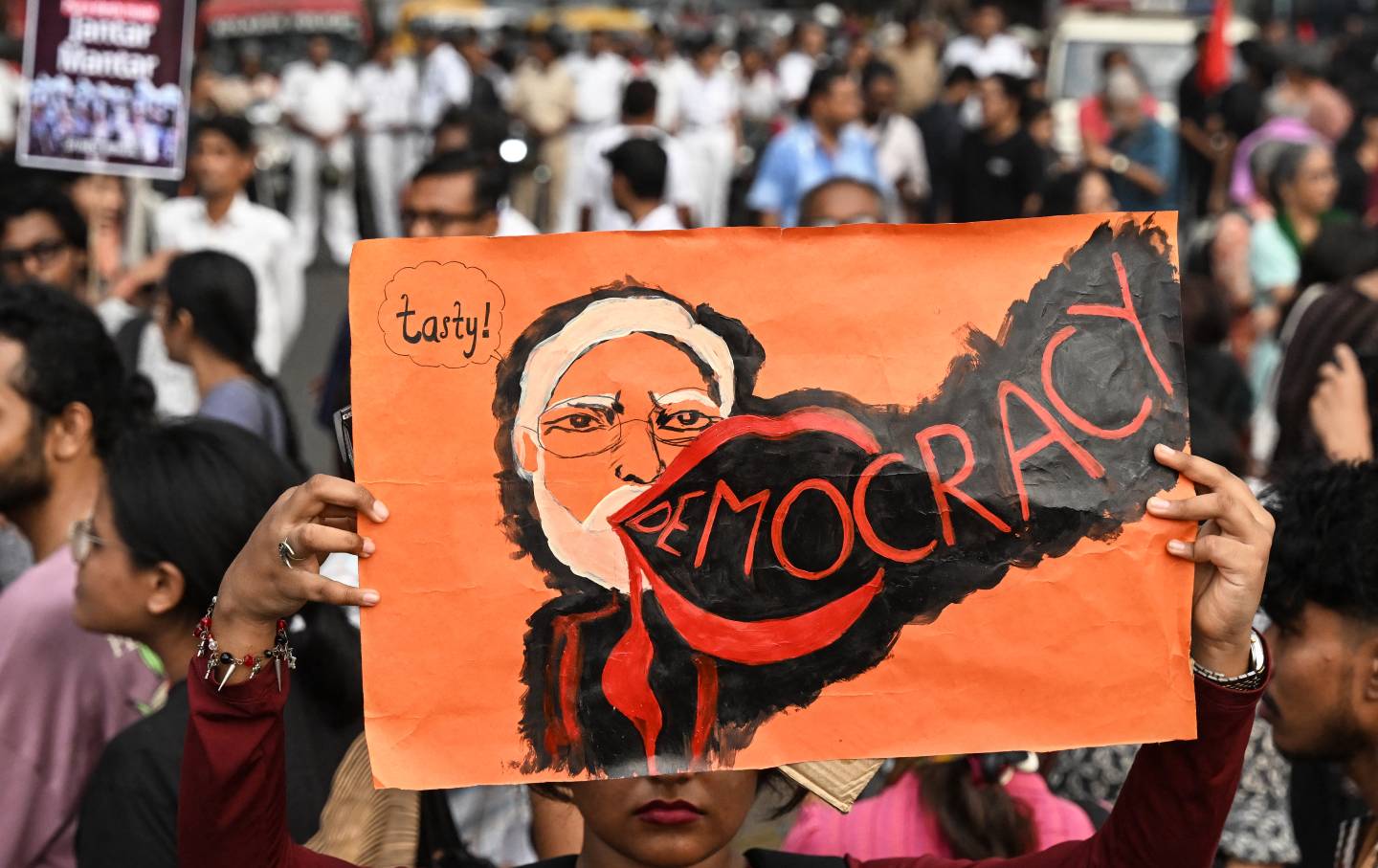
Inside India’s Gen Z Cockroach Janta Movement Inside India’s Gen Z Cockroach Janta Movement
Young Indians are challenging the purge of voter rolls by Modi’s right-wing government. Shrishti Khanna, who was detained by Delhi police while covering the protests, explains.

The Clarion Call of “NAZA” The Clarion Call of “NAZA”
Yuval Abraham and Rachel Szor’s new film not only documents the horrors of the present but give us a glimpse of a possible future too.

The Specter of Lepenism Looms Over France’s Social Crisis The Specter of Lepenism Looms Over France’s Social Crisis
Joining forces with the “yellow vests,” youth demonstrators are raising the alarm in a country falling to the far right.

