
Cutting US Aid to Israel Doesn’t Go Nearly Far Enough
Washington’s ability to pressure Israel using money has long since disappeared. Progressives need to aim much higher.
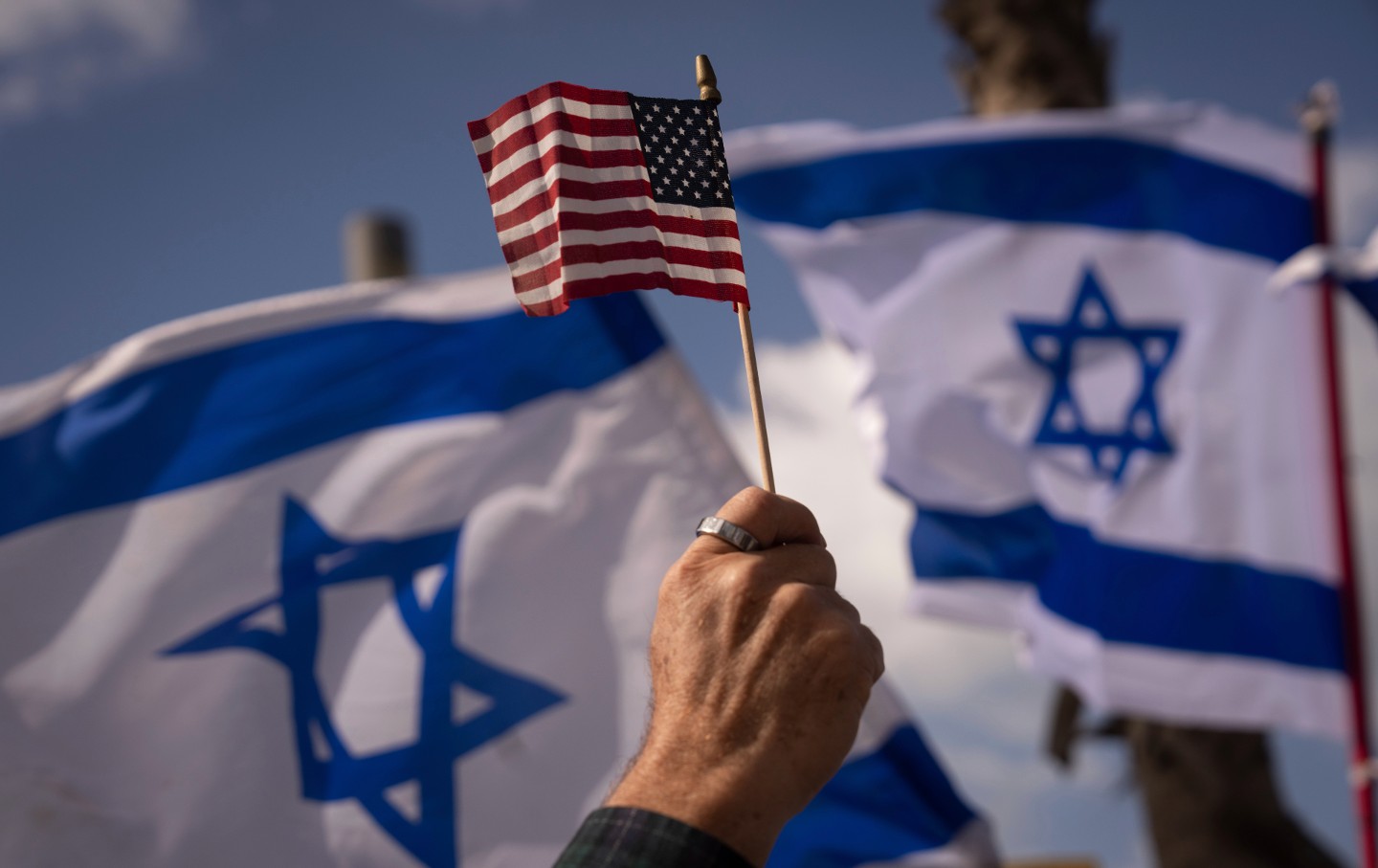
An Israeli waves a US flag during a protest against the government’s judicial overhaul in Tel Aviv on Thursday, March 30, 2023.
(Oded Balilty / AP)For decades, unconditional support of Israel represented a rare source of elite consensus in US politics. That era is coming to an end.
As the most far-right government in Israel’s history uproots its own institutions in order to further disenfranchise Palestinians and entrench Jewish supremacy, support for Palestinians in their struggle for liberation is on the rise. For the first time ever, polling shows Democrats saying they sympathize more with Palestinians (49 percent) than with Israelis (38 percent), and younger generations across the political spectrum are becoming increasingly pro-Palestinian. One area of the debate in particular is seeing an unexpected convergence of once-diametrically opposed voices: calls to condition or cut US military aid to Israel.
In July, New York Times columnists Thomas Friedman and Nicholas Kristof wrote separate pieces urging the Biden administration to conduct, as Friedman put it, a profound “reassessment” of its ties with Israel, and perhaps even consider, as Kristof wrote, the “unmentionable”: gradually “phasing out American aid for Israel.” These articles were preceded by Jacob Siegel and Liel Leibovitz’s piece in Tablet urging Congress to “End U.S. Aid to Israel,” which they contend only serves to benefit America’s military-industrial complex.
Of course, there is nothing new about these arguments, merely their source. Palestinians have spent decades calling on Washington to condition or cut aid in hopes of holding Israel accountable for occupation and apartheid. For just as long, their efforts have been met with scorn by lawmakers in D.C. and smears of anti-Semitism by Israel’s apologists. So Friedman and Kristof are, to put it mildly, very late in acknowledging that Israel’s occupation is not temporary and that Washington’s unconditional support of Israel has only fostered the impunity its leaders now feel entitled to. On the other hand, Siegel and Leibovitz are echoing conservative Israeli arguments that US military aid somehow ties Israel’s hands.
Regardless of their individual motivations, this cacophony of voices indicates a major elevation of a subject that has long been considered taboo in mainstream national discourse around Israel-Palestine. But rather than simply welcoming Friedman, Kristof, and the rest to the better side of the argument, we should use this opening to push the discourse further. Because even if the US conditioned or outright cut the funding it provides to Israel on account of its treatment of Palestinians, it would likely not be enough to deter Israel’s increasingly extremist leaders. Only by conditioning US aid alongside more assertive punitive measures such as divestment and sanctions can the US effectively pressure Israel to bring an end to occupation and apartheid.
According to the government’s own figures, the United States has provided Israel with over $260 billion in both bilateral assistance and military funding. This makes Israel the largest cumulative recipient of US foreign assistance since World War II. In 2016, the Obama administration signed a 10-year Memorandum of Understanding on military aid, committing a record-breaking $38 billion in military assistance (about $3.8 billion each year). As per the agreement, Israel must use most of the funds it receives from Washington to buy weapons from US manufacturers. As a result, Israel gets billions of dollars worth of state-of-the-art American military equipment for free, while the US military-industrial complex makes the big bucks—all paid for by us, the American people.
This raises the question: If the US were to go as far as leveraging military aid on the condition that Israel end the occupation and allow Palestinian self-determination, would Israel acquiesce?
Well, let’s look at some facts. Israel’s per capita gross domestic product is over $50,000—similar to that of Canada and Finland and higher than that of France and Japan. US aid accounts for only about 1 percent of Israel’s GDP. In addition to its developed economy, Israel fields one of the most well-trained and equipped armies in the world and boasts a rapidly expanding domestic military-industrial complex. In 2022 alone, Israeli arms sales ranging from unmanned combat drones to advanced spyware amounted to over $12.5 billion.
So the answer is: No, the withdrawal of US aid would not place any particular economic pressure on Israel. It can fund the occupation very well on its own.
The case that Israel simply no longer needs US aid in order to sustain its healthy economy or its monstrous qualitative military edge over all regional threats is clear. But even more important to consider is the reality that, at its core, Israeli apartheid is not about money. It’s about a much more inexhaustible resource: ideology. Israel’s leaders are now more determined than ever to live out their extreme expansionist settler-colonial visions no matter the cost.
In 1937, Israel’s founder and first prime minister David Ben-Gurion wrote a letter to his son in London describing how proposed plans to partition Palestine fit into the Zionist movement’s larger long-term goals. “A Jewish state on only part of the land is not the end but the beginning,” he wrote. “The rest will follow in the course of time.”
To Ben-Gurion, anything short of the whole of historic Palestine and more was only a first step toward seizing the entirety of the land Zionists believed to be biblically bequeathed to them. Ben-Gurion knew then that the absolute realization of Zionism’s settler-colonial aims would have to come gradually and by “other means.” Those “other means” made themselves evident just 10 years later, when Ben-Gurion oversaw the expulsion of hundreds of thousands of Palestinians from their homes by advancing Zionist militias.
Flash forward to the present day. Israel’s most far-right government is hell-bent on gaining full control of Zionism’s “promised land.” “One does not receive a land, one conquers it,” Itamar Ben-Gvir, leader of Israel’s extreme-right Jewish Power party and now national security minister, said in a campaign video last year. From the de jure annexation of the West Bank to entrenching Jewish supremacy to encouraging violent settler pogroms against Palestinians, Israel’s leaders are acting on their threats and making it abundantly clear that Washington’s window of opportunity to influence their decisions through conditioning aid alone closed long ago. If the only price Israel has to pay for the elimination of Palestine is a few billion dollars a year, it will consider it one of the best deals in world history.
Popular
“swipe left below to view more authors”Swipe →Unfortunately, the debate in Washington around holding Israel accountable is so thoroughly out of touch with reality, held hostage by the outsize influence of a pro-Israel lobby determined to uphold US complicity in Israel’s occupation, that lawmakers have been blind to how rapidly their tools have been rendered obsolete.
Even modest proposals to condition the portions of US aid that are directly tied to Israeli war crimes are met with concerted efforts to delegitimize not only the bills themselves but those who dare propose them. Since 2017, Minnesota Democratic Representative Betty McCollum has tried to pass several iterations of a bill that would prohibit US aid from contributing to the detention of Palestinian children and to military activities that would facilitate “further unilateral annexation” of the occupied West Bank. For daring to advocate for the rights of children and uphold a peace process that the US itself has sponsored for decades, McCollum has been repeatedly smeared with accusations of anti-Semitism from her pro-Israel colleagues and powerful lobby organizations like AIPAC. This is all despite the fact that a majority of Americans support conditioning aid to Israel and a growing cadre of progressive voices in Congress are stepping up their efforts to make a reevaluation of the “special” US-Israel relationship a reality.
Since proponents of Palestinian rights will inevitably face this kind of wrath in response to even the smallest efforts to hold Israel accountable, why not champion policies that actually stand a chance of deterring Israel’s far-right leaders? It is time to propose legislation that details plans to divest from, and sanction, the Israeli apartheid regime.
These demands for accountability are neither drastic nor novel. Those who need a reminder should look no further than the coordinated global response to apartheid in South Africa.
When the United States placed a mandatory arms embargo on South Africa’s apartheid government in 1977, it served as only a first step in the more comprehensive campaign of isolation that would follow. The subsequent mobilization against apartheid in American universities, churches, and businesses resulted in the Comprehensive Anti-Apartheid Act of 1986, which formalized sanctions and enlisted the US alongside the international community in isolating South Africa’s racist government. This collective international campaign, coupled with the internal civil disobedience campaign by Black South Africans, was a key factor in rendering apartheid unsustainable. The precedent is clear.
In 1958, Julius Nyerere, future president of newly independent Tanzania, made a straightforward appeal to the Boycott Movement in London. “We are not asking you, the British people, for anything special. We are just asking you to withdraw your support from apartheid by not buying South African goods,” he said. In 2023, advocates for Palestinian rights are making a similar plea: hold Israel to the same standards the US itself played a central role in defining and enforcing towards South Africa; end US complicity by refusing to provide Israel with the weapons it uses to kill Palestinians; and exert economic and political pressure on Israel’s far-right government until occupation and apartheid become unsustainable.
The Biden administration has made it abundantly clear that it has no intention of holding Israel accountable for anything. Washington has yet to raise a finger in response to Israel’s killing of US citizens in broad daylight, let alone object to the violence Israel inflicts on Palestinians on a daily basis. But regardless of the foreign policy blunders the current administration is determined to make, support for Palestinian rights is growing both within the halls of Congress and among the general public. Calls to end US complicity in Israel’s occupation are only getting louder. It is time that our policy demands reflect what not only is just but also represents the democratic will of an expanding majority of Americans.
That is why progressive lawmakers who are already putting their careers on the line in favor of conditioning US aid to Israel should take the conversation around Israel’s accountability to where it needs to be by making the case for divestment and sanctions. In doing so, our representatives can engage in a more honest and productive dialogue about policies that will actually work, as opposed to half-measures that no longer hold any weight.
Disobey authoritarians, support The Nation
Over the past year you’ve read Nation writers like Elie Mystal, Kaveh Akbar, John Nichols, Joan Walsh, Bryce Covert, Dave Zirin, Jeet Heer, Michael T. Klare, Katha Pollitt, Amy Littlefield, Gregg Gonsalves, and Sasha Abramsky take on the Trump family’s corruption, set the record straight about Robert F. Kennedy Jr.’s catastrophic Make America Healthy Again movement, survey the fallout and human cost of the DOGE wrecking ball, anticipate the Supreme Court’s dangerous antidemocratic rulings, and amplify successful tactics of resistance on the streets and in Congress.
We publish these stories because when members of our communities are being abducted, household debt is climbing, and AI data centers are causing water and electricity shortages, we have a duty as journalists to do all we can to inform the public.
In 2026, our aim is to do more than ever before—but we need your support to make that happen.
Through December 31, a generous donor will match all donations up to $75,000. That means that your contribution will be doubled, dollar for dollar. If we hit the full match, we’ll be starting 2026 with $150,000 to invest in the stories that impact real people’s lives—the kinds of stories that billionaire-owned, corporate-backed outlets aren’t covering.
With your support, our team will publish major stories that the president and his allies won’t want you to read. We’ll cover the emerging military-tech industrial complex and matters of war, peace, and surveillance, as well as the affordability crisis, hunger, housing, healthcare, the environment, attacks on reproductive rights, and much more. At the same time, we’ll imagine alternatives to Trumpian rule and uplift efforts to create a better world, here and now.
While your gift has twice the impact, I’m asking you to support The Nation with a donation today. You’ll empower the journalists, editors, and fact-checkers best equipped to hold this authoritarian administration to account.
I hope you won’t miss this moment—donate to The Nation today.
Onward,
Katrina vanden Heuvel
Editor and publisher, The Nation
More from The Nation
Chile at the Crossroads Chile at the Crossroads
A dramatic shift to the extreme right threatens the future—and past—for human rights and accountability.
The New Europeans, Trump-Style The New Europeans, Trump-Style
Donald Trump is sowing division in the European Union, even as he calls on it to spend more on defense.

The United States’ Hidden History of Regime Change—Revisited The United States’ Hidden History of Regime Change—Revisited
The truculent trio—Trump, Hegseth, and Rubio—do Venezuela.
Mahmood Mamdani’s Uganda Mahmood Mamdani’s Uganda
In his new book Slow Poison, the accomplished anthropologist revisits the Idi Amin and Yoweri Museveni years.

The US Is Looking More Like Putin’s Russia Every Day The US Is Looking More Like Putin’s Russia Every Day
We may already be on a superhighway to the sort of class- and race-stratified autocracy that it took Russia so many years to become after the Soviet Union collapsed.

Israel Wants to Destroy My Family's Way of Life. We'll Never Give In. Israel Wants to Destroy My Family's Way of Life. We'll Never Give In.
My family's olive trees have stood in Gaza for decades. Despite genocide, drought, pollution, toxic mines, uprooting, bulldozing, and burning, they're still here—and so are we.

