
The UK’s Far Right Is On the March—Thanks to Keir Starmer
How the Labour Party’s catastrophic prime minister paved the way for fascists to dominate British politics.
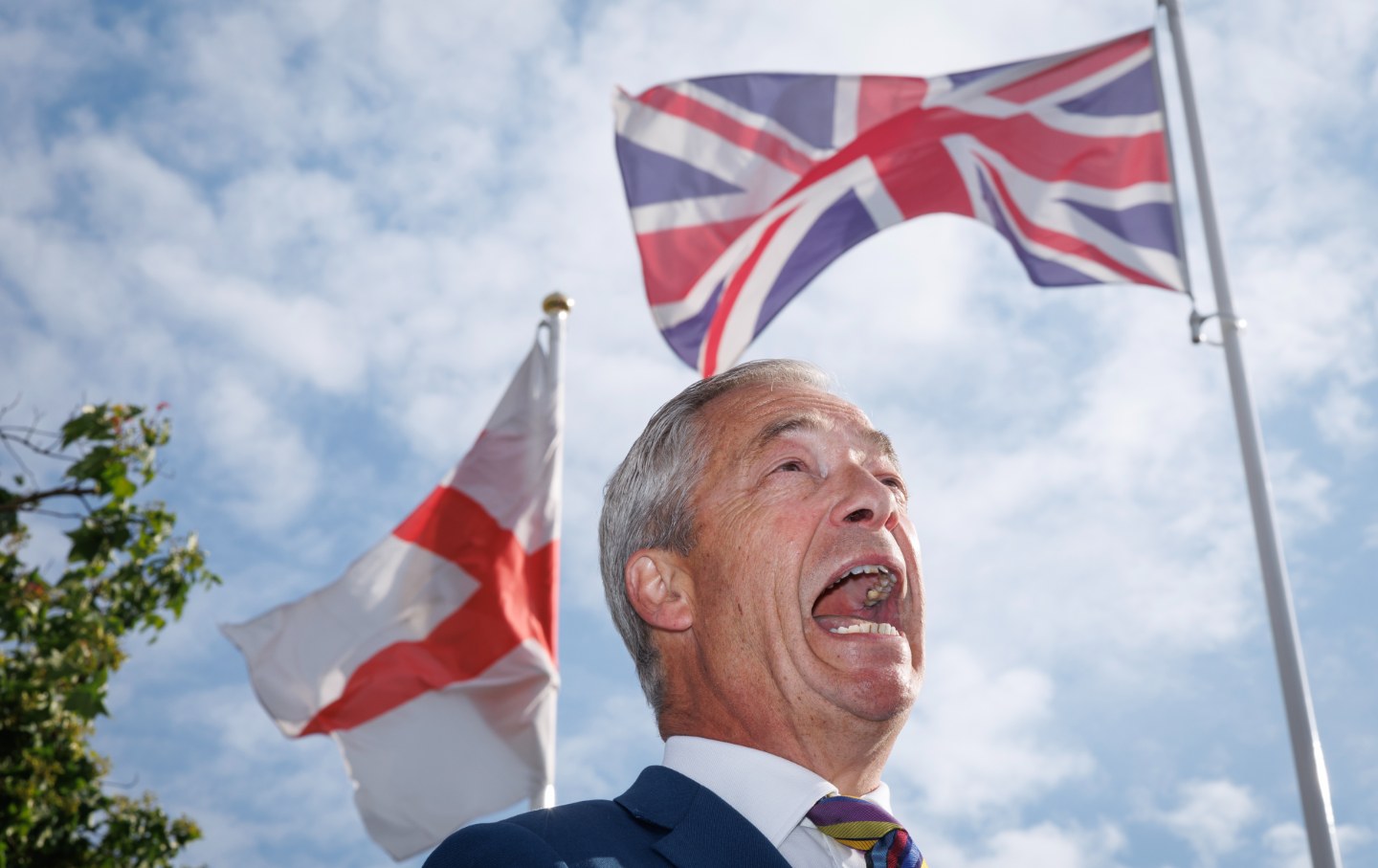
Reform UK leader Nigel Farage outside Havering Town Hall on May 8, 2026.
(Dan Kitwood / Getty Images)Two years ago, Keir Starmer’s Labour Party won a historic parliamentary majority, returning to government after 14 years of austerity, Brexit, sleaze scandals, and a revolving door of prime ministers under Conservative rule.
The scale of Labour’s victory in terms of seats won was undeniable. But shrewd analysts noted something that the size of the majority threatened to obscure: Labour’s overall vote share had actually dropped relative to past elections. More than that, Labour’s success in flipping Tory seats was not entirely its own doing. Rather, all across the country, Reform UK, a new far-right party led by Brexiteer Nigel Farage, had systematically chipped away at Conservative votes, allowing Labour to come through the middle. In the end, Reform received the third-largest share of the votes of any party in the election, even though, thanks to the distortions of the United Kingdom’s first-past-the-post system, this breakthrough netted the party only five seats in the House of Commons.
The fact that more Reform candidates hadn’t won led some to declare that its forward march had been halted; one commentator concluded that “the British can also take comfort in the fact that their far right is nowhere [near] the levers of power.” But, as has now become all too clear, the party was just getting started.
Since then, Reform has surged in popularity and leaped over both Labour and the Conservatives in the opinion polls, which it has consistently led since the beginning of 2025. And this past week, the results from crucial elections across England, Scotland, and Wales proved that Reform is no longer a specter looming over the country’s future—it is the party of Britain’s present.
Last week’s elections—in which voters chose the members of local councils in England and the national parliaments in Wales and Scotland—were widely understood to be a referendum on the two years of Starmer’s premiership, which have been an objective disaster. Accordingly, pundits predicted a catastrophic Labour collapse. They were right.
Dragged down by the visceral loathing the entire country seems to have for Starmer, Labour suffered the worst local election defeat in its history. It lost nearly 1,500 local government seats in England and control of over 37 councils. It lost in the north, the Midlands, and the south. It lost councils and borough mayoralities in London. It lost control of the Welsh parliament, the Senedd, for the first time in its 27-year history—a drubbing that also marked the first time Labour failed to win an election of any kind in Wales in over a century. To underscore the depth of the crisis, incumbent Welsh Labour First Minister Eluned Morgan became the very first leader of a national government to lose their seat while in office in British history.
The vast majority of Labour’s losses were Reform’s gains. Reform increased its presence in local government by more than 1,400 seats, about 1,000 more than the next party. It took control of 14 councils, from Sunderland in England’s north to Suffolk and Essex (which it took from the Conservatives) in its east, to even the London borough of Havering.
Where the party didn’t gain outright control of a council, Reform candidates still made substantial inroads into constituencies previously considered safe Labour territory. It is now the second-largest party in Scotland’s Parliament (tied with Labour) and in Wales’s Senedd, finishing behind the Scottish National Party and Plaid Cymru, respectively.
Reform, however, was not the only cause of Labour’s collapse. The left-wing Green Party continued its astonishing ascent less than a year into Zack Polanski’s leadership, capturing the second-highest national vote share behind Reform. With a left-populist message centered on the cost-of-living crisis, opposition to the genocide in Gaza, and anti-racism, the Greens won over 400 local seats, control of five councils throughout England, and its first ever mayoralities. The party also won its first seats in the Welsh parliament, and its sister party in Scotland made historic gains as well. In a twist on the 2024 election result, it appears that the Greens’ rising popularity across the country—not just in its assumed London base—ate into Labour’s totals and, in some cases, ultimately benefited Reform.
At the time of writing, over 60 members of Parliament have called on Starmer to resign or to set a timeline for his departure—a number that appears to grow by the minute. Several factions within the Labour Party want Andy Burnham, the current mayor of Manchester, to replace Starmer. To do that, though, Burnham needs to win a seat in the House of Commons, something which Starmer has previously blocked him from being able to do.
As a result, the parliamentary Labour Party is in a state of chaos. Nobody within Starmer’s cabinet, including those with well-documented desires to replace him, like Health Secretary Wes Streeting, seems willing to make the first move against him, and no MP representing a constituency in the northeast of England has resigned their seat—something which would trigger a by-election that could provide a path for Burnham to return to Parliament, challenge Starmer, and replace him as prime minister.
For the inept MPs trying and failing to orchestrate a coup, the hope is that Starmer will simply feel the pressure and agree to an orderly transition out of office, giving Burnham enough time to return to Parliament and take his job. Starmer, predictably, has shown no sign that he’s willing to leave, and has even suggested that he wants to be prime minister for another eight years.
So, for the moment, this painful conclusion to Starmer’s failed premiership staggers inexorably on. But the stench of impending political death is all around him. The question is not if he goes—it’s when, and more broadly, how the rest of the party understands the nature of his tremendous failure.
The answer is simple: Starmer has managed to wave Reform into Westminster through what he’s failed to do for the British people while in government. At the same time, he has actively prepared the ground for their authoritarian takeover of the state with what he has done.
Reform, for instance, has called for mass deportations, the end of Britain’s asylum system, and for the UK to leave the European Convention on Human Rights (ECHR). Rather than counter this racist attack on migrants and human rights, Starmer decided to do much of Reform’s work for it.
The week prior to the elections, nearly 150 charities, social workers, and lawyers warned that the government’s recently proposed changes to the immigration system would put the rights of hundreds of thousands of children in the UK at risk. These include plans to give immigration authorities the power to use force against children, including to handcuff and physically handle them during enforced removals. Starmer’s government has also announced that it will weaken refugee protection and has argued in favor of “reforming” the ECHR to enable its own anti-migrant schemes that blatantly violate the convention.
By doubling down on the repression of pro-Palestine protest, Starmer has dramatically changed the nature of state power and given a potential Reform government new tools for a total crackdown on civil liberties. From the banning of the activist group Palestine Action, to new powers to restrict protest, to the ongoing attempt to get rid of jury trials altogether, there are seemingly no lengths to which this government will not go to curb free speech and assembly.
Popular
“swipe left below to view more authors”Swipe →Finally, Starmer has enthusiastically sold off Britain’s data, land, and defense sector to American tech companies like Palantir, Google, and Microsoft—the same companies that have facilitated mass surveillance, genocide, and environmental degradation around the world. Just as these companies have supported Donald Trump’s fascistic agenda, there’s no doubt they would accommodate the whims of Nigel Farage.
What has Starmer achieved with these actions? Labour’s left-wing supporters, appalled by its attacks on the poor and its embrace of racism and authoritarianism, have abandoned it in droves and found a new home with the Greens. And large swaths of voters in its former heartlands have thrown up their hands in disgust at its failure to improve their lives and voted for Reform—a political journey that will be all too familiar to Americans in the age of Trump. As a result, the fascist far right is as close to power in Britain as it has been in generations.
The issue, ultimately, is not that Starmer is incapable of telling a story about his accomplishments, or that he’s failing to connect on a human level with people struggling around the country. It’s that his project, enabled at every turn by the MPs now seeking to remove him, is as unpopular as it is outright dangerous. Two years into government, the Labour Party itself is complicit in the rise of the far-right movement that has overtaken it and the left movement that will replace it. Good luck shaking off all those fleas.
Become a Sustaining Donor This September
Between the reemergence of right-wing red-baiting and Donald Trump’s use of the chilling National Security Presidential Memorandum–7 to criminalize left political organizing, we’re seeing McCarthyism reborn before our eyes.
This assault on democracy cannot be ignored or wished away. Resisting it requires bravery in the face of threats and repression, a steadfast commitment to the truth, and the unwavering belief that we can—and will—overcome this darkness.
We must have an independent media that sets the record straight, unearths corruption and abuses of power, and advances a politics of justice and dignity for all if we’re to win this fight.
That’s why I’m writing to you today. This September, The Nation needs to add 100 monthly donors to sustain our progressive journalism. Your contribution makes the next investigative report, the next truth-speaking column, and the next pathbreaking essay all possible.
I hope you’ll support our work with a recurring donation today. If you donate $10 or more a month, we’ll send you a brand new “Hands Off the Free Press!” sticker to recognise your commitment to our cause. Please, donate today.
Onward,
Katrina vanden Heuvel
Editor and Publisher, The Nation
More from The Nation
This AI Panic Is Nothing New This AI Panic Is Nothing New
In the 1940s, The Nation asked questions about the atomic bomb we’re asking of artificial intelligence today.

The Decades-Old Roots of Trump’s War on Iran The Decades-Old Roots of Trump’s War on Iran
An interview with historian Behrooz Ghamari-Tabrizi about the generations of US presidents who have tried to destroy the Iranian regime.

Emmanuel Macron’s Turbulent Exit Emmanuel Macron’s Turbulent Exit
Between a budget crisis and a cost-of-living squeeze, Macron is leaving a country feeling more insecure than ever—and ready to take to the streets.

Israel’s Election Can’t Fix What Netanyahu Broke Israel’s Election Can’t Fix What Netanyahu Broke
The fundamental problem is not the name of the prime minister, but rather the actions of the Israeli government and the urgent issues that need to be addressed.
The AfD’s Rise Isn’t Just About East Germany The AfD’s Rise Isn’t Just About East Germany
The Alternative für Deutschland has a stable national poll lead, including in the former West Germany. Its rise owes to much more than Eastern grievances.
Chinese Development Is the Betrayal Washington Cannot Forgive Chinese Development Is the Betrayal Washington Cannot Forgive
The prospects for Xi Jinping’s visit are dim because American leaders are blaming China for the failures of globalization.

