
This AI Panic Is Nothing New
In the 1940s, The Nation asked questions about the atomic bomb we’re asking of artificial intelligence today.
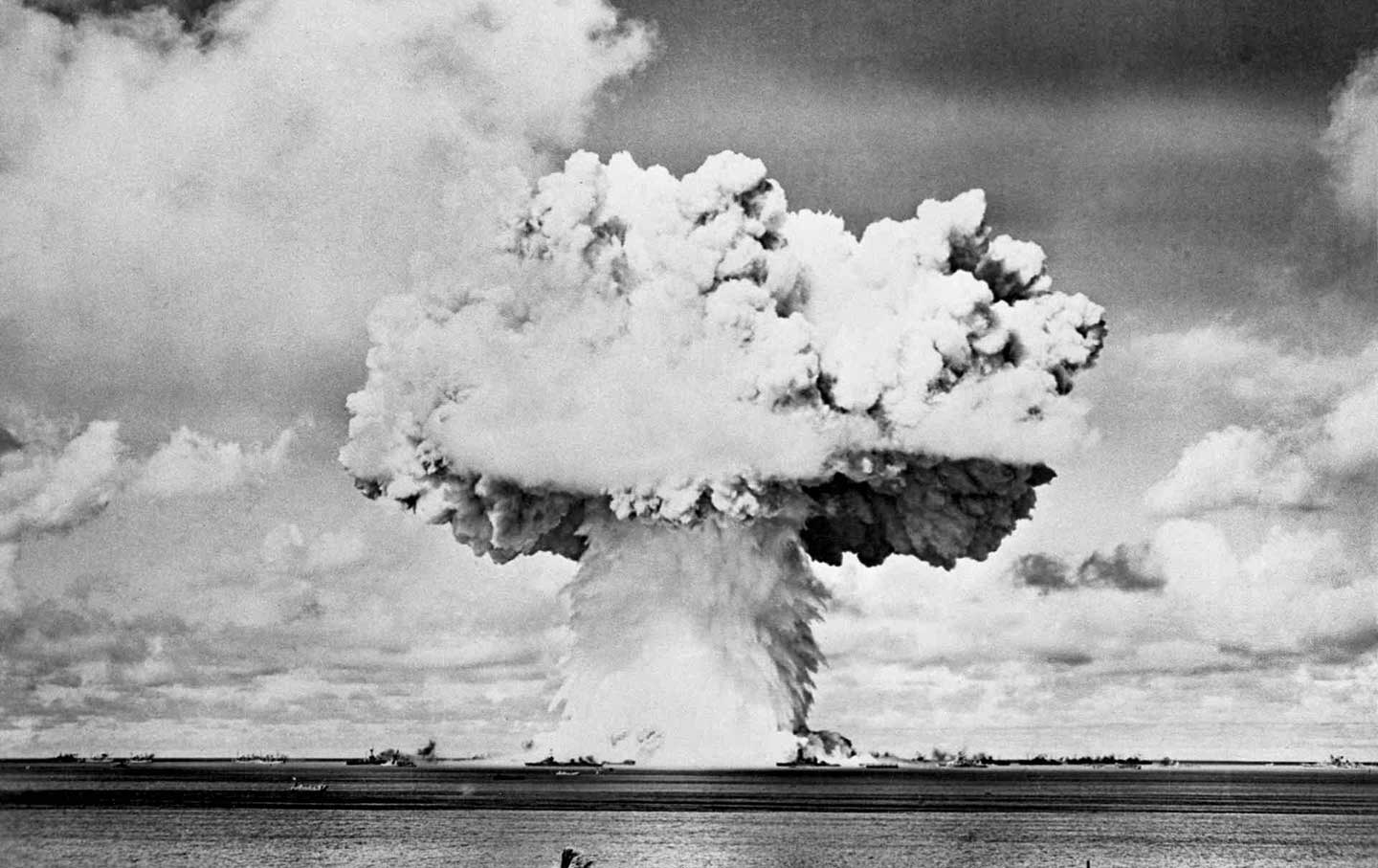
An automatic camera recorded an atomic bomb test explosion in the Marshall Islands in 1946.
(Bettmann Archive / Getty Images)Over the past few weeks, employees and executives at leading tech companies have offered stark warnings that the development of artificial intelligence is running far ahead of humanity’s ability to control it, and that the chances of an extinction-level error are alarmingly high. Whether or not this is actually true, many have drawn comparisons between the current panic and that over the atomic bomb in the 1940s, when leading scientists warned that the new weapon needed to be controlled and tightly regulated by an international alliance if humanity were to avoid destroying itself.
As the discourse has picked up on those parallels, I have often thought of a Nation editorial published just days after the first atomic bomb dropped on Hiroshima. In “One World or None,” the magazine’s then-editor, Freda Kirchwey, laid out her belief that unless a truly empowered international governing body was put in charge of the bomb, the end of humanity would be a question of when rather than if. “The atomic bomb represents a revolution in science—the greatest revolution ever accomplished,” Kirchwey wrote. “It calls for a comparable revolution in men’s thinking and in their capacity for political and social readjustment.”
In 1946, a book also titled One World or None, a collection of essays by leading scientific and cultural figures like Albert Einstein, Robert Oppenheimer, Walter Lippmann, and others, warning about the technology’s potentially devastating power, became a bestseller and was subsequently turned into a terrifying short film by the same name, which is still worth watching today.
In the 80 years since Hiroshima, with some too-readily-forgotten close calls in between, little has been done to weaken the “One World or None” argument. Today, the spiraling chaos of the global order makes it hard to say Kirchwey’s argument has been proven wrong. And, of course, should the worst occur, there likely wouldn’t be anybody around to affirm she got it right.
Struck, like many, by some of the parallels between that moment and this—scientists warning of catastrophe, officials promising prosperity, rival powers unwilling to slow down—I wanted to see what other writers in The Nation were saying at a time of widespread uncertainty about whether humanity’s capacity for cooperation could keep pace with technological innovation. As one writer in the magazine put it in 1945, “The prime question facing us today is whether or not we can save ourselves from being blown to bits.”
A few weeks after Hiroshima, the magazine ran “Everybody’s Atom,” by J.D. Bernal, an Irish chemist and physicist who had contributed important scientific knowledge for the D-Day landings in 1944. “People have been quick to see how the actuality of the atomic bomb has implicitly changed the whole existence of man in this universe,” Bernal noted. It was clear that the use of the bomb had helped bring the destructive war to a conclusion, but it was far less clear how the supposedly positive benefits of the technology would come to fruition. Popular hope for the technology remained weak, even while officials insisted it would lead to universal liberation and prosperity. The reason for that, to Bernal’s mind, was that “though the people may have little experience of the behavior of atoms, they have considerable experience of the behavior of men, corporately and individually.”
Always, in the past, scientific advances had contributed to “human destruction,” Bernal noted, a record that boded ill “for the beneficent use of these more powerful forces.”
Contrary to President Harry S. Truman’s suggestion that the US government should be the “trustees of this new force,” Bernal, a member of the Communist Party of Great Britain, argued that all humanity, not just one government or even, as Kirchwey suggested, a consortium of governments, had to be in control of the new technology. “Good will is not enough,” the scientist warned, in guiding a vast civilizational effort to harness “a concentration of energy on the order of a million times greater than any we have had before.”
By October of 1945, The Nation’s embrace of world government as a practical solution for the problem of potentially life-effacing weapons had somewhat abated. When a conference on the question, held in a small New Hampshire town, called for world government, a Nation editorial described the notion as, for the moment, unfeasible, even fantastical, not least because the dropping of the atomic bomb had exacerbated growing tensions between the West and the Soviet Union, whereas easing them would have been necessary for an international effort to harness the power of the bomb. On both sides of the divide, The Nation noted, “the immediate fears of a possible foe are politically more potent than the more distant fear of atomic destruction.”
A similar dynamic pertains to today, wherein companies and governments hurtling headlong into an AI-dominated future claim that without external regulation they cannot afford to slow down while others press ahead. The immediate fears of corporate and geopolitical foes are more potent than the comparably distant fear of AI-triggered total destruction.
In November 1945, a short essay appeared in the magazine reviewing several newly published books that touched on the development of atomic energy. Benjamin Harrow, a chemist and science writer, noted that “never before have so many of the beautiful discoveries of science been pooled to reach one overpowering climax.” The possibilities were astonishing, both for good and for ill: “[G]iven a catalytic push in one direction, it should bring happiness to mankind, but pushed in the wrong direction, it may well mean the end of this planet.”
Read now, these pieces show how quickly the argument moved from ambitious and hopeful solutions to narrow and ultimately temporary ones. As we watch the current race to build ever more capable AI models, it is worth remembering what became of the hopes of 1945. The international cooperation that Kirchwey and Bernal called for was swallowed within months by the politics of the Cold War, which would end up bringing the world to the brink of annihilation more than once. Even then, the fate of the world stayed in human hands. Someone had to give the order, and on a few important occasions, someone refused.
With AI, we are preparing to give up even that last modicum of control. Halting these development efforts now would take the kind of gargantuan global effort that Kirchwey and others called for in 1945. Alas, we have even more experience today of the “behavior of men, corporately and individually,” as the Marxist scientist J.D. Bernal put it in his post-Hiroshima Nation essay, and it’s hard to hold out much hope that this new technology will be put to benevolent purposes.
More from The Nation
The Year I Taught in a Former Coal Mining Town The Year I Taught in a Former Coal Mining Town
Teaching in the South of France, I learned that equality was just a story teachers told about themselves.

Why French Students Are Revolting Why French Students Are Revolting
France’s education system is stretched to its limits, as student anger kicks off a hot fall protest season.
Revolution or No Revolution Revolution or No Revolution
Eight years after Armenia’s “Velvet Revolution,” Nikol Pashinyan’s government has deepened the country’s neoliberal trajectory while reorienting Armenia toward the West.

The GOP Sells the Mirage of a Hormuz Victory The GOP Sells the Mirage of a Hormuz Victory
The American action in the contested strait isn’t sustainable—and won’t alter the economic and political fallout from its closure.

Japan’s Far Right Is Courting Young Voters Japan’s Far Right Is Courting Young Voters
Sanseitō has attracted young voters through a robust social-media strategy, Charlie Kirk–like public speaking events, and anti-establishment messaging.

The Decades-Old Roots of Trump’s War on Iran The Decades-Old Roots of Trump’s War on Iran
An interview with historian Behrooz Ghamari-Tabrizi about the generations of US presidents who have tried to destroy the Iranian regime.

