May Nigeria Not Happen to You
The Deadly Labyrinth of Nigerian Healthcare
My mother miraculously survived a series of health scares—but she barely survived our country’s hospitals.
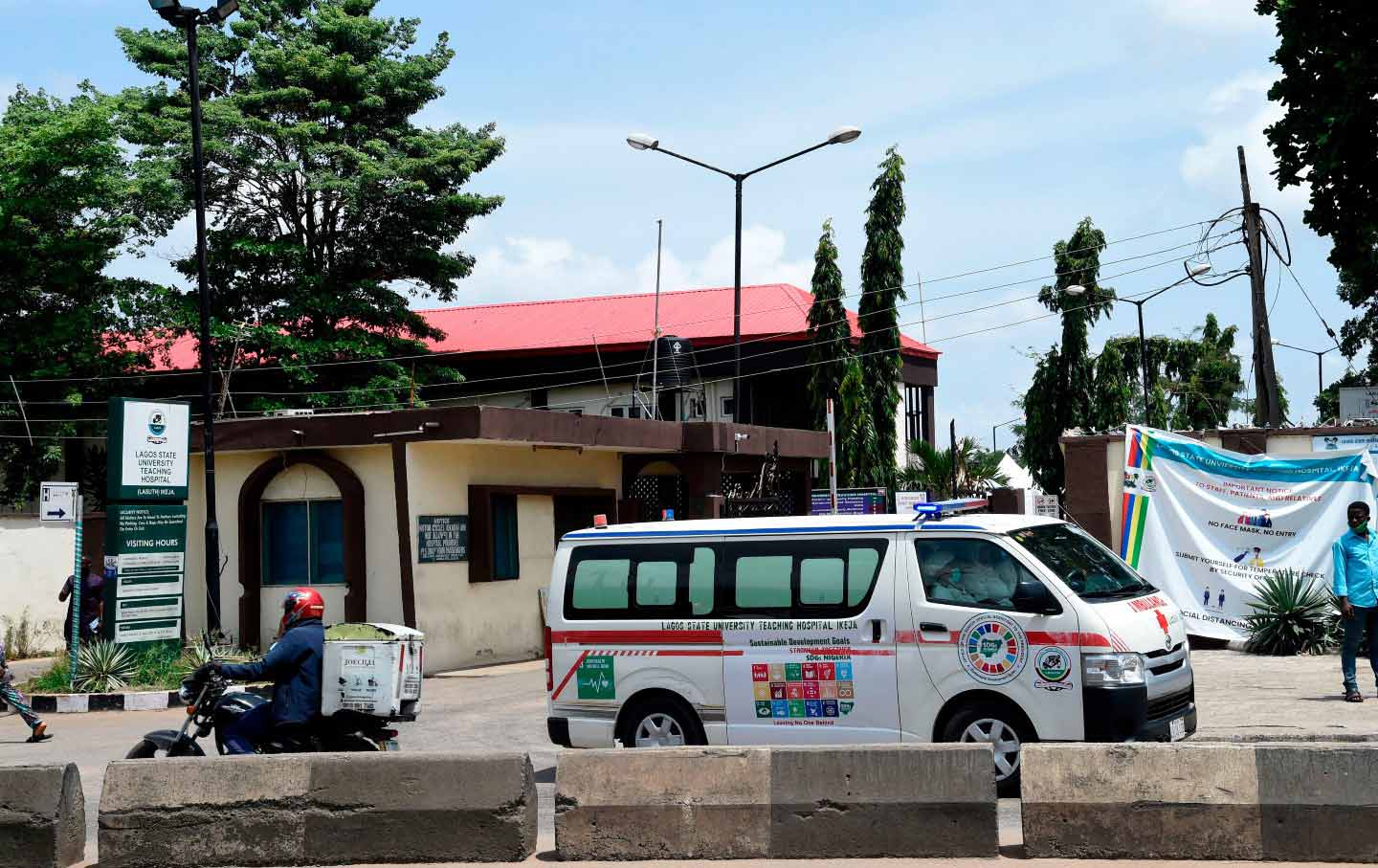
Iam packing my mother’s bags for the hospital. Neither of us know how long she’ll be away for, or precisely what the problem is, but around midnight she woke up with severe pain in her lower abdomen and a fever of 106°F, so we know we have to go. By now, I am practiced at this. Packing for the hospital has become normal and routine for us, a task akin to doing laundry or taking the dog for a walk. I put her toiletries, fresh clothes, her wallet, her Bible into her favorite bag, which is woven with brightly colored ankara fabrics. It looks more like the kind of bag you’d take to a party than to emergency surgery. When the packing is finished, the hospital informs us that there is no ambulance available tonight; they send apologies accompanied by vague excuses: no fuel in the car, no one around to drive. It’s not the first time this has happened. My uncle will have to drive us. By now, he’s practiced at that too.
We get my mother into the car safely, but as she takes her seat she turns around to look at me and sees the fear plain on my face. She tells me not to be afraid, that “what [you] fear will come upon [you].” I don’t realize this myself until much later, but she is quoting from the book of Job, the Bible’s most famous theodicy. Job, a rich man, favored by God, loses everything: his money, his family, his health, at the behest of Satan, who wants to test his faithfulness. After Job’s family dies and his wealth dries up, he curses the day of his birth, crying out that “what I feared has come upon me; what I dreaded has happened to me.” My mother quoted Job to stem my anxiety: His fear, the logic goes, is what opened the door to his ruin. In the absence of fear, the door stays shut.
But her instruction was impossible to follow. Outside, the car moves through potholed roads absent of street lights towards a hospital with no emergency staff, where a doctor’s actions further endanger my mother’s life. As my uncle pulled out of the metal gate away from our home, I watched as the night swallowed the car whole. I could not stop being afraid—because what if what you fear is not God, Satan, or some abstract terror, but your own nation’s indifference to your survival?
Nigeria has its own saying, a prayer really: “May Nigeria not happen to you.” The Nigeria in “May Nigeria not happen to you” is a metonym for a dysfunctional state, where a power cut occurs in the middle of a life-saving operation in Minna, or where a building burns in Lagos with no emergency services to evacuate its inhabitants. “I pray from the depth of my heart that Nigeria never happens to me or anyone I care about” is what journalist and activist Sommie Madegwu wrote on the night before armed robbers invaded her building in Abuja. When the men burst into her apartment, she jumped from her balcony and survived the fall. She did not survive the hospital. Staff at Maitama General Hospital reportedly insisted on seeing identification documents before providing medical attention, despite a Nigerian law requiring immediate treatment for victims of accidents or armed robbery. If Job feared that one day God would take away his riches and blessings, Nigerians have a different fear: We fear that the country we live in will be responsible for our death.
Nigeria happened to my family on November 18, 2020. My mother was in a bus with several of her friends, who were driving from Benin city to Akure on the way to a funeral. It was nighttime. They were riding along dilapidated roads with little to no visibility, when out of nowhere a truck crashed into their bus. My mother was one of two survivors. She was left with several fractures, including in both of her legs, and was bedridden for months. Over the course of two years, she would undergo multiple surgical procedures and physical therapy sessions to recover her ability to walk. After it happened, friends and family reminded me frequently of how God had saved my mother. God had saved her from becoming another statistic in Nigeria, where road accidents are the third-leading cause of death and the most common cause of disability. The WHO records 21.4 deaths per 100,000 people significantly higher than both the global and African averages. For comparison, the equivalent figures for the United States and Britain are 15 and 7 respectively. It is estimated that one in every four road accident deaths in Africa occurs in Nigeria. But Ngeria does not have an established national traffic accident database, and there is no framework for accurate reporting of road traffic incidents meaning the true scale of the problem is almost certainly undercounted. God spared my mother’s life, but Nigeria was not finished with her.
Two years later, at the end of 2023, my mother was diagnosed with kidney stones and referred to a hospital specializing in endoscopic and laparoscopic surgery. By this point, she was walking again. The procedure at hand was supposed to be simple and routine. After a surgical procedure to extract the stones was recommended, she raised a concern with the medical director: Her spine had been through too much. The trauma of the accident, fracture, and surgical procedures weighed heavily on her; she felt it in her lower back every day. Cedarcrest Hospital, her previous treatment center, had an anesthesiologist she trusted, one who knew her medical history, and she offered to pay for him herself, to arrange his release from Cedarcrest personally, and to do everything necessary to ensure he would see to her care. The medical director told her it would not be necessary. The referring doctor had already briefed him fully on her history. He would put his best doctor on the team.
But he did not. Or the best wasn’t good enough. Weeks after the surgery, my mother discovered that the hospital had not provided an anesthesiologist at all, but a nurse anesthesiologist, someone with less training—against her expressly stated wishes. By then she already knew something had gone wrong. During the administration of anesthesia she had suffered a total spinal block. She described how shortly after the needle was inserted into her spine, her breathing became labored, her skull felt as though it was held in a vice, growing tighter and tighter with each forced breath, the edges of her vision went dark and blurry, and she fought to stay alive. It is one of the most dangerous complications of an epidural. She tells me that the doctor administering the anesthesia shouted at her “don’t close your eyes, don’t close your eyes” as she struggled to remain conscious. She did her best to obey him, but the procedure nearly killed her.
The day after surgery, she was discharged. She vomited as the nursing staff wheeled her out to the car. But they sent her home anyway. At two in the morning, she spiked a fever of 100°F and had to be rushed back to the hospital, where she was treated for malaria and discharged by evening. When the fever returned, we rushed her to Cedarcrest, the hospital she had asked for from the beginning. There she was diagnosed with septicaemia and put in urgent care.
She had survived a truck crash on a dark road in Ondo state. She had survived two years of surgeries. What else was she supposed to endure? Two weeks after her kidney stone procedure, she requested the test results from the surgical specimen—she wanted to know what kind of stones they were, and how to prevent them from returning. The hospital told her the specimen had not been tested. They had removed it and discarded it, unexamined. She would never know.
My family’s experience with the healthcare system in Nigeria was a largely fortunate one. It did not end with a casket, a funeral, apologies on grief-stricken ears. But countless others are not so fortunate. It would be easy to simply move past the experience, to chalk it up to providence and ignore its implications within the issue of medical negligence and wider institutional failures in the country. But it is that very forgetting, that privatization of suffering, that a failing system depends on. We have no recourse to systems that hold doctors accountable for their mistakes, no databases that record accidents and deaths properly in order to determine trends and errors that might be used to prevent future harm, no processes instituted to ensure patient safety. No lessons learned.
Paul Farmer, the physician and global health advocate who spent his life treating the poor, wrote frequently about “stupid deaths” that referred to the premature, preventable lives lost in impoverished communities caused not by the severity of illness but by the absence of basic, affordable care. But stupid deaths are not only for the poor. Even the best facilities Nigeria often make fatal mistakes, and face no accountability for them. The fault does not rest on overworked, poorly paid, doctors alone, but on the systematic failure instituted by decades of neglect in need of urgent overhaul.
We know who to blame. Nigeria spends 5.2 percent of its national budget on health—less than a third of the 15 percent it pledged to African leaders in the Abuja Declaration of 2001, a promise made and then quietly abandoned. Per capita, that amounts to $43 a year. There are 23.3 doctors per 100,000 people in the country, despite a WHO recommendation of 100. No new hospitals have been built since 2004, despite a rapidly growing population. Out-of-pocket expenditure accounts for roughly 74.68 percent of total healthcare funding—significantly above the regional average.
Popular
“swipe left below to view more authors”Swipe →Healthcare is just one part of a failing system: the terrain most vulnerable to Nigeria’s larger governmental insufficiency. In 2023, the US provided more than $600 million in health support to Nigeria, accounting for over 21 percent of the nation’s annual health budget, primarily towards malaria prevention, HIV eradication, and vaccine distribution. That figure alone is a damning indictment of domestic neglect. More than a fifth of Nigeria’s health budget was being funded by a foreign government. Trump’s decision to cut USAID funding in early 2025, was not the advent of the crisis but its magnification and exposure. A nutrition program was terminated overnight, forcing more than 70 health facilities across three states to stop treating children with severe acute malnutrition, putting 60,000 children under 5 at immediate risk of death from preventable causes. Nigeria’s health minister said the responsibility to provide healthcare for its citizens ultimately rests on the state, as so much else in the country besides. He was right. It always did.
If the ancient Greeks were right when they said the state is a body, then we inhabit an ailing one—its organs underfunded, its limbs neglected, its vital functions outsourced to foreign donors who have now withdrawn. We pray in churches and mosques for God to heal our land to restore it to its former glory. And on our phones, we pray the more honest prayer: May Nigeria not happen to you. One is a prayer for healing. The other is a prayer for survival. What we are left with is an ill state and nowhere is that sickness more visible than in its hospitals.
The men who have presided over this failure, though, do not use those hospitals. Nigerian presidents have sought medical treatment abroad for as long as most citizens can remember—Babangida in France, Yar’Adua dying after treatment in Saudi Arabia, Obasanjo on unannounced trips, Jonathan in Germany. Buhari campaigned in 2015 on ending medical tourism, then spent 225 days abroad on medical trips. He died in a London hospital in July 2025. Before leaving office, his wife, Aisha, inaugurated a $21 billion presidential medical wing at the statehouse built—not to repair the system but to ensure that future presidents would never have to encounter it. The act itself is a blatant acknowledgment of a problem.
A significant part of this problem is the invisibility rendered by the lack of regulation in the healthcare system. The medical and dental council of Nigeria, the MDCN, also has a Disciplinary Tribunal specifically empowered to investigate professional misconduct and medical malpractice. Sanctions can range from suspension to outright deregistration, depending on the severity of the offence. The tribunal exists on paper, but not in practice. Most incidents of fatal mistakes in hospitals, or the generalized underfunding of the healthcare sector, never enter public scrutiny. Stories like my mother’s are shared privately, in WhatsApp messages between family members, during testimonies at church. It was not until January 2026, when the renowned author Chimamanda Ngozi Adichie lost her son to this system, that we began to talk more openly about medical neglect in Nigeria.
Adichie and her family were in Lagos for Christmas when her 21-month-old son Nkanu developed what they first thought was a cold, which rapidly worsened into a serious infection. He was admitted to hospital and referred to Euracare, said to be the best facility in Lagos for the procedures he needed—an MRI, a lumbar puncture, and the insertion of a central line in preparation for a flight to Johns Hopkins in Baltimore, where a medical team was waiting to receive him.During the administration of sedation, Nkanu was not properly monitored after being given Propofol, leading to a loss of responsiveness, seizures, and cardiac arrest.He did not survive. Adichie later alleged that the same anesthesiologist had been involved in two previous cases of overdosing children. The question that she, and you might be asking is: “Why did Euracare allow him to keep working?”
Nkanu’s death was not only a consequence of one doctor’s negligence. It was the consequence of a system in which such negligence is possible, unremarked, and unrecorded until it happens to someone the world is watching. Nigeria has only 600 pediatricians for over 40 million children. The United Kingdom has more than 5,000 for 20 million. The shortage of specialized pediatricians means children are routinely seen by doctors trained for adults, by staff who lack the specific expertise that paediatric care demands. My mother told me a story about a young girl with a hip problem who was not operated on by an orthoaedic pediatrician and had adult hip implants fitted, which did not work for her body and she was forced to go abroad for surgery and to intensify physiotherapy upon her return. Nkanu was being sent to Baltimore because his family knew, as so many Nigerian families know, that the system at home could not be trusted with his life. The tragedy is that he never made it out.
In a recent interview with ARISE News, a Nigerian global news channel, Dr. Elvira Asege Nkanu’s aunt delivered an impassioned plea that “Nkanu’s death should not be in vain.” But what would have to happen for that to be true? We must begin to name and speak more openly of these systematic injustices. The ambulance with no fuel. The nurse anesthesiologist deployed in place of a doctor. The specimen removed and never tested. The child sedated without monitoring. The president on a plane to London. These are not acts of God. They are acts—and failures to act—of a state that has decided, repeatedly and in full view, that its people’s lives are cheap.
Until we treat that truth not as a resignation but as an indictment—not as something to pray against but as something to dismantle—we will keep passing the phrase “May Nigeria not happen to you” between us like a warning, like the only protection we have. Like Job, what we fear will keep happening to us.
More from The Nation

In Hungary’s Steel City, Layoffs Hurt Orbán’s Appeal In Hungary’s Steel City, Layoffs Hurt Orbán’s Appeal
Why didn’t Orbán’s government, once a critic of what it called a “bad privatization,” save jobs?
The Ceasefire Just Showed the World That US Military Power Is Obsolete The Ceasefire Just Showed the World That US Military Power Is Obsolete
With the illusion shattered, now is the chance for the US to liberate itself from a broken imperial model.
How the Saudis Keep Sidestepping a Costly Role in the Iran War How the Saudis Keep Sidestepping a Costly Role in the Iran War
The brutal Gulf monarchy has been cheerleading Trump’s insane war off-stage but won’t commit to any direct role in the conflict
Pope Leo Is Speaking Truth to Donald Trump’s Power Pope Leo Is Speaking Truth to Donald Trump’s Power
The pontiff’s Easter address, like so many of his recent statements, countered Trump’s Iran bombast with a cry for peace—and sanity.
The Folly of Netanyahu’s War Against Iran The Folly of Netanyahu’s War Against Iran
A minority view from Tel Aviv.
The Iran War Is Built on Bush-Era Lies The Iran War Is Built on Bush-Era Lies
All this we heard in 2003, and all this we are hearing again now.

