
What’s Behind Saudi Arabia’s Surge in Executions?
Activists believe that authorities are abusing the justice system to silence dissent and chill speech.
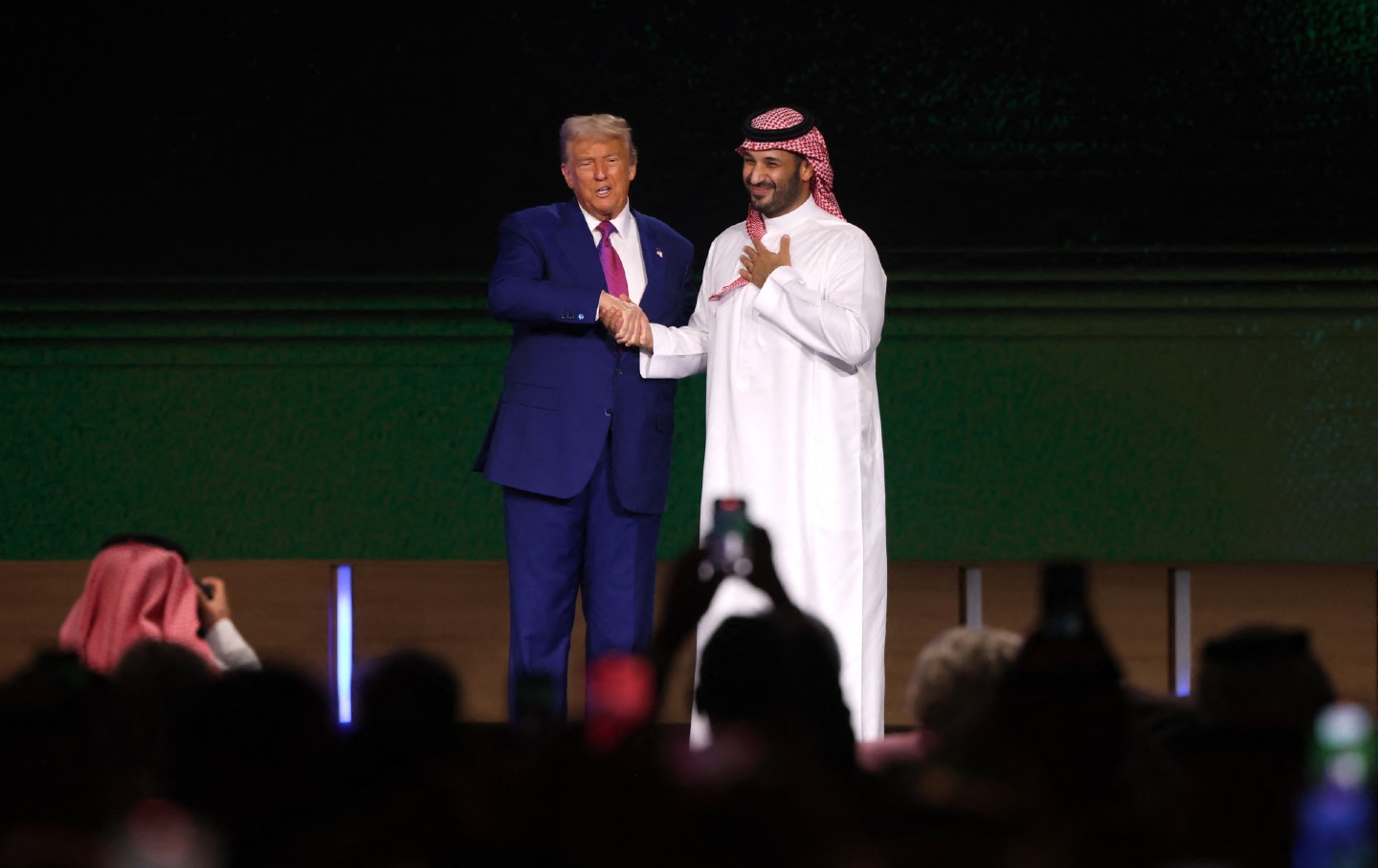
President Donald Trump greets Saudi Crown Prince Mohammed bin Salman during the Saudi-US investment forum at the King Abdul Aziz International Conference Center in Riyadh on May 13, 2025.
(Fayez Nureldine / AFP via Getty Images)
Saudi Arabia has been on a killing spree. In August, authorities beheaded Jalal Labbad, a young Shiite man who was a minor at the time of some of the charges against him. In June, the government executed Turki Al Jasser, a blogger who was critical of the government. And earlier this year, a Saudi woman named Maryam Al-Mutaib was put to death for witchcraft, sorcery, and the kidnapping of three newborns whom she later raised as her own.
Since the beginning of the year, Saudi authorities have beheaded more than 283 individuals, mainly for charges related to terrorism, treason, and drugs. Human rights experts fear that 2025 will surpass last year’s number of executions—which, at 345, made 2024 the deadliest year in Saudi Arabia in decades, with an average of one execution every 25 hours.
The surge in executions comes as a clear contradiction to Crown Prince Mohammad bin Salman’s promise, in his 2022 interview with The Atlantic, to “get rid of” the death penalty except for cases where it is mandated under Shariah law. Instead, the Crown Prince is now using Saudi Arabia’s repressive judiciary system to silence dissent and spread fear far more aggressively than even his ousted predecessor, Mohammad bin Naif. In some cases, people are being executed for no apparent reason, like Abdullah Al Shamri, a Saudi public servant.
For many Saudis, Al Shamri’s death is a bewildering and shocking spectacle, absurd even for Saudi Arabia. Al Shamri worked for decades within the official Saudi establishment: He was a diplomat at the Saudi Embassy in Turkey, then an adviser at the Saudi Ministry of Culture and Media, where he enjoyed close proximity to high-ranking members of the Saudi royal family—connections he proudly flaunted by posting pictures on X of himself with King Salman, then–governor of Riyadh, and his son Mohammad bin Salman. He regularly published in Saudi newspapers and appeared on TV shows discussing Saudi diplomacy and commenting on Turkish affairs. Most recently, he held a senior position at the Saudi Royal Court.
Sources close to Al Shamri said he never expressed critical views of the Saudi government in public or in private. A Turkish academic who has known him for over a decade said that when they last met, in Istanbul in 2018, Al Shamri talked about his new position in the media affairs department at the Saudi Royal Court. “He told me he just started working for Mohammad bin Salman,” the academic said. “He was very happy with his new post.” After the news came out in 2017 that King Salman had ousted his nephew Mohammad bin Naif as Crown Prince and replaced him with his son Mohammed bin Salman, Al Shamri showed a great deal of enthusiasm toward the young prince. “He called Mohmmad bin Salman ‘Aslan,’ which means ‘lion’ in Turkish, and said that he will make Saudi Arabia great again,” the academic said.
Al Shamri’s name was buried in a Saudi Press Agency statement in February 2024, announcing his execution, along with six other men, on accusations of terrorism and treason. The Saudi authorities frequently lump together Shias, Sunnis, and foreigners in group or mass executions, a practice that makes it hard for observers to track individual charges. Details about Al Shamri’s legal proceedings are inaccessible, but according to the official statement, he was executed only two and a half years after his arrest—an unusually short period of time for capital punishment cases in Saudi, where it can take decades before the final execution takes place.
The type of controversial legal ruling used to justify his execution—the ta’zir verdict—is another sign that the Saudi government is blatantly lying about its pledge to reform the judicial system. The ta’zir ruling is a judicial interpretation for charges that are not explicitly defined in Shariah law, covering discretionary crimes. Almost all of the ta’zir rulings are handed down by the Saudi Specialized Court (SCC), which was established in 2008 to handle indictments related to terrorism and national security.
The court has been heavily criticized by Saudi activists and international human rights organizations. During his trial at the SCC, Saudi activist Waleed Abu al-Alkhair refuted the legitimacy of the court, arguing that it was established to deal with terrorism cases, not to prosecute peaceful activists. Nevertheless, the SCC convicted Abu al-Alkhair in 2014 for publicly criticizing the country’s human rights record and sentenced him to 15 years in prison. Amnesty International accused the Saudi government of exploiting the SCC to “create a false aura of legality around its abuse of the counter-terror law to silence its critics.”
Abdullah Alaoudh, a senior director for the Countering Authoritarianism hub at Middle East Democracy Center in Washington, DC—whose father, Sheikh Salman Alaoudh, has been facing a death sentence since 2018—said that the ta’zir punishment is “frowned upon” by most Islamic jurists, since it is banned within the school of Islamic jurisprudence that Saudi Arabia officially practices under. But the court charged Al Shamri with it anyway. “From all the comprehensive rulings in Islam, [they picked] something that is frowned upon, something that is a very minority opinion,” Alaoudh said. “They abused the ruling itself, [broadening] it to include political dissidents, or just critics.”
Alaoudh said that after the murder of the journalist Jamal Khashoggi, the crown prince learned to get rid of critics by going through the judiciary, instead of through extrajudiciary means. But even with that in mind, Al Shamri’s case is unusual. “Al Shamri basically worked for Mohammad bin Salman,” Alaoudh said. “The crown prince is paranoid and insecure enough to go even after his allies.”
In 2022, a leaked draft of Saudi Arabia’s first written penal code showed that the country had codified most ta’zir crimes—but not crimes that have fixed capital punishment under Shariah law. Nevertheless, since then Saudi courts have been executing people under ta’zir rulings. In 2024, it was used for the majority of death penalty sentences and 40 percent of executions, according to an analysis by the the European Saudi Organisation for Human Rights (ESOHR) .
That’s not the only time the Saudi government has broken its promises. In a letter to Amnesty International in 2023, the Saudi Human Rights Commission, a government-run agency, wrote that “the application of the death penalty on juveniles for ta’zir crimes has been completely abolished,” referring to the Saudi juveniles law that went into effect in 2018. Still, since then, two Shia minors have received death sentences based on a ta’zir ruling.
Popular
“swipe left below to view more authors”Swipe →Most recent is the case of Jalal Labbad, who was executed in August for taking part in protests calling for an end to discrimination against the Shia minority back in 2011, when he was 15 years old. Labbad’s sentence was based on confessions extracted under torture, including electric shocks, beatings with rods and metal wires, waterboarding, and suffocation.
Though Saudi Shias make up about 12 to 15 percent of the Saudi population, 43 percent of the victims of political executions during King Salman’s reign were Shias, said Taha Al-Hajji, a Saudi capital defense lawyer and legal consultant for the ESOHR who has lived in exile in Germany since being threatened with reprisals for his work defending minors from execution.
Currently, six Saudi citizens—five of them Shias—charged for crimes they committed as minors are facing death sentences. Most urgent is the case of Abdullah Al-Derazi, a Shia citizen whose death sentence, for crimes he allegedly committed as a minor, the Saudi Supreme Court upheld under the ta’zir verdict—which has only increased his already high risk of execution at any time.
In addition to Saudi citizens, foreign nationals—who, according to the Saudi General Authority of Statistics, made up 44.4 percent of the population in 2024—are also being executed at a staggering rate for drug related offenses, despite an official moratorium on such executions that lasted 33 months. Indeed, according to an Amnesty International report published last July, “Since lifting the moratorium in November 2022 Saudi has executed more than 262 people for drug-related offences.”
“Saudi’s human rights record is not put under enough scrutiny,” said Bissan Fakih, Middle East Campaigner for Amnesty International. She added that the families of detainees from Ethiopia, Somalia, or Egypt, whose loved ones are facing death sentences, often don’t have the resources to get information about their legal status.
And experts say the scope of the issue is likely much bigger than what official records show. Al-Hajji, from ESOHR, said that while at least 60 people known to his organization are officially awaiting the death penalty, he believes the actual numbers are much higher. “The lack of transparency, and the fear from authorities’ repercussions, prevent the victims’ families from reaching out to us,” he said.
Meanwhile, as capital punishment based on ta’zir rulings looms over Shia citizens; high-ranking Sunni religious leaders and scholars; members of the Huwaitat tribe persecuted for their opposition to the forced evictions being carried out in the process of constructing the new city of NEOM; and hundreds of foreign nationals imprisoned for drug offenses; last week, Saudi Arabia hosted a two-week long comedy festival featuring primarily American stand-up comedians. Dave Chappelle, Aziz Ansari, Pete Davidosn, Kevin Hart, Louis CK, Whitney Cummings, and others were offered as much as $1.6 million for a single show.
Saudi Arabia’s entertainment industry is funded by the government and, as a part of the country’s “2030 Vision” to diversify the economy, is directly overseen by Crown Prince Mohammed bin Salman. Saudi activists believe that the the government is exploiting the world’s warranted attention on Gaza’s genocide to excecute as many activists as possible—then whitewashing any criticism through initiatives like the Riyadh Comedy Festival or the country’s controversial partnership with the New York City Metropolitan Opera.
“The world only sees us [Saudi citizens] through the lens of terrorism. We are left alone to fight a brutal dictatorship that succeeded in paying off Western governments for their silence and complicity, and western elites and celebrities for normalizing tyranny and oppression,” said a US-based Saudi activist. “Life is going to be much worse for Saudis when Mohammad bin Salman becomes the king.”
More from The Nation
The War on Terror Paved the Way for Trump's Rise—Now He's Making It His Own The War on Terror Paved the Way for Trump's Rise—Now He's Making It His Own
Only the total abolition of the DHS can restore freedom.
The Iranian Voices America Isn’t Hearing The Iranian Voices America Isn’t Hearing
We need to listen to those who oppose both the Islamic Republic’s authoritarianism and foreign military escalation.
The US Attacks Iran in a War of Aggression The US Attacks Iran in a War of Aggression
The US has waged many wars—but this is one of the most senseless we've ever seen.
Opposing Trump’s Cruel Assault on the Cuban People Opposing Trump’s Cruel Assault on the Cuban People
An interview with Representative Jim McGovern.
A New Report on Alexey Navalny’s Death A New Report on Alexey Navalny’s Death
Boris Kagarlitsky and hundreds of unknown political prisoners remain in Russia’s prisons.
Rubio, Rodeo, and Tall Tales of Empire Rubio, Rodeo, and Tall Tales of Empire
The secretary of state has provoked the ire of Britain’s first black woman lawmaker and put the spotlight once again on how the US has historically treated people of his own herit...

