
Operation Condor: A Network of Transnational Repression 50 Years Later
How Condor launched a wave of cross-border assassinations and disappearances in Latin America.
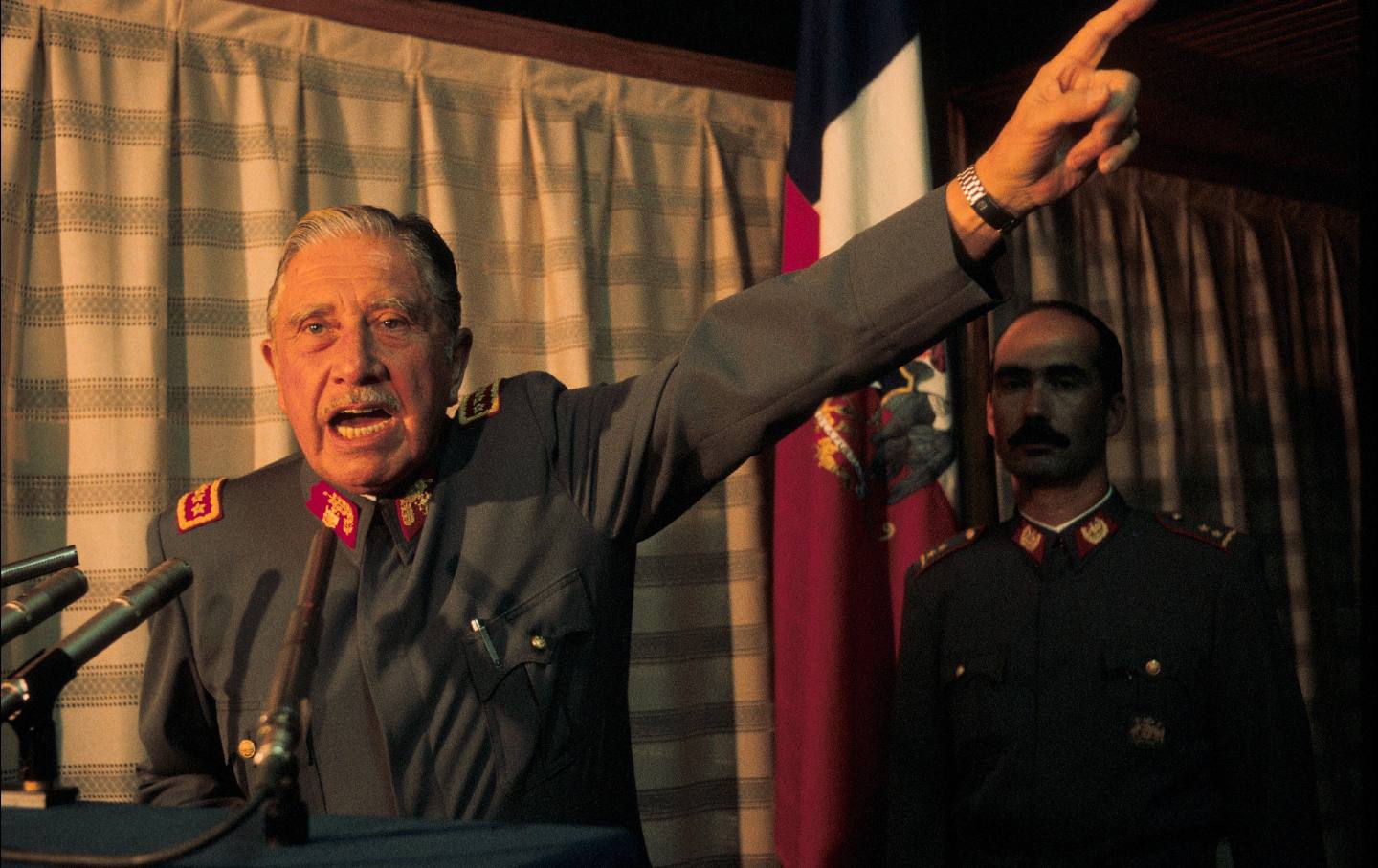
On General Augusto Pinochet’s 60th birthday, November 25, 1975, four delegations of Southern Cone secret police officers arrived in Santiago, Chile, at the invitation of the Chilean intelligence service, DINA. Their mission: “to establish something similar to INTERPOL,” according to the confidential meeting agenda, “but dedicated to Subversion.” During their clandestine three-day meeting held at Chile’s War College, the military officials from Argentina, Bolivia, Chile, Paraguay, and Uruguay agreed to form “a system of collaboration” to identify, locate, track, capture and “liquidate” leftist opponents of their regimes. As the conference concluded on November 28, a member of the Uruguayan delegation toasted the host country and proposed that the new organization be named after Chile’s majestic national bird—the Andean Condor.
There was “unanimous approval,” records a secret summary of the meeting. The transnational “sistema Condor” was born—an infamous symbol of abuses of power of the past that authoritarianism can bring in the future.
A half century ago, the inauguration of Condor launched a rampage of state-sponsored terrorism across the Western Hemisphere and beyond. “Operation Condor,” as the CIA identified it in Top Secret reports, became a multinational agency of “cross-border repression,” as investigative journalist John Dinges has written in his comprehensive history, The Condor Years, “[whose] teams went far beyond the frontiers of the member countries to launch assassination missions and other criminal operations in the United States, Mexico and Europe.”
During Condor’s active period of operation between 1976 and 1980, Dinges and other investigators documented at least 654 victims of transnational kidnappings, torture and disappearance. Most of those human rights crimes were committed in the Southern Cone region. But a sub-directorate of Condor codenamed “Teseo”—for the heroic warrior king of Greek mythology—established an international death squad unit based in Buenos Aires that launched 21 operations in Europe and elsewhere to assassinate opponents of the Southern Cone military regimes.
A Chilean Creation
The creation of Condor must be credited to the Pinochet regime—specifically to DINA chief Juan Manuel Contreras. He was, as one Condor insider told the CIA, “the man who originated the entire Condor concept and has been the catalyst for bringing it into being.” Contreras personally invited his counterparts from Argentina, Bolivia, Uruguay, and Paraguay to attend the inaugural meeting in Santiago in November 1975; Chile also hosted the second meeting convened in Santiago on May 31, 1976, when the Condor sub-directorate for international assassination, “Teseo,” was created. To select targets to “liquidate,” according to a secret CIA intelligence report, Contreras would “coordinate details and target lists with Chilean President Augusto Pinochet Ugarte.”
“Chile has many (unidentified) targets in Europe,” noted another CIA report. CIA sources also indicated that “some leaders of Amnesty International might be selected for the target list.”
Santiago, Chile, also served as the headquarters for the central data and archives office of Condor. Brazil, which joined Condor in 1976, supplied an encrypted communications network known as Condortel. (Peru and Ecuador also joined Condor in 1978.) The operational command and control division of Condor—known as “Condoreje”—would be headquartered in Buenos Aires. The special death squad “Teseo” unit, made up of specially trained operatives from Chile, Argentina, and Uruguay, also used a base in Buenos Aires.
“Each representative will put forth his choice of target in the form of a proposal,” stated the September 1976 “Teseo” accord. “The final selection of a target will be by vote and on the basis of a simple majority.” Under the section “Execution of the Target” the text of the agreement continued: “This is the responsibility of the operational team which will (A) Intercept the target, (B) carry out the operation, and (C) escape.”
For such murder missions, operational costs were estimated “at $3,500 per person for ten days, with an additional $1,000 the first time out for clothing allowance.”
The US Role
We know the banal details of these covert terrorist operations because Condor officials secretly shared them with the CIA; and over 40 years later, the CIA’s top secret intelligence cables were finally, albeit partially, declassified. The Agency appears to have learned about Condor’s existence in March of 1976; but its intelligence gathering efforts escalated following the second Condor meeting in Santiago after it learned of the “Teseo” plan.
The United States has often been accused of fostering Operation Condor, but those accusations are inaccurate. To be sure, officials such as Secretary of State Henry Kissinger had no problem with “dirty wars” against the left in Latin America. The US helped bring those repressive military regimes to power, supported secret police forces in the Southern Cone, and encouraged intelligence sharing among them. Kissinger turned a deaf ear to State Department concerns about repressive human rights violations.
But US officials did have a big problem with international assassination operations, particularly on the streets of allied nations in Europe—precisely because Washington was so closely associated with the military juntas behind Operation Condor. “Internationally, the Latin generals look like our guys,” Kissinger was advised on August 3, 1976, in a secret briefing paper on the existence of Operation Condor. “We are especially identified with Chile. It cannot do us any good.”
CIA officials agreed; they viewed these Condor assassination plots as a ticking time bomb for the Agency. At the time, the CIA was in the middle of its own massive murder scandal—generated by the publication of the special Senate Church Committee report on “Alleged Assassination Plots Involving Foreign Leaders” exposing the Agency’s own covert history of operations targeting foreign leaders such as Fidel Castro, Patrice Lumumba, and Chilean general Rene Schneider. “The plans of these countries to undertake offensive action outside of their own jurisdictions poses new problems for the Agency,” the chief of the CIA’s Latin American division, Ray Warren, warned in late July 1976. “Every precaution must be taken to ensure that the Agency is not wrongfully accused of being party to this type of activity.”
Indeed, the CIA was so concerned about what Warren called the “adverse political ramifications for the Agency should Condor engage in assassinations” that it took proactive steps to preempt Condor operations in Europe. A declassified US Senate study, based on Top Secret-Sensitive CIA reports, stated that “the CIA warned the governments of the countries in which the assassinations were likely to occur—France and Portugal—which in turn warned the possible targets.”
CIA officials also conferred with State Department officers on how to dissuade the Condor nations from their assassination operations. In mid-August, 1976, Warren informed his superiors that the CIA had agreed to “an EXDIS [Exclusive Distribution] message from the Department of State to the US Ambassadors in Buenos Aires, Santiago and Montevideo instructing them to approach the highest levels of their host governments and express the serious concern of the US Government to the alleged assassination plans envisioned within ‘Operation Condor.’” Several courageous State Department officers, among them Hewson Ryan, William Luers, and Assistant Secretary for Latin America Harry Shlaudeman, successfully lobbied Secretary of State Kissinger to approve the diplomatic démarche, but the US ambassadors in Santiago and Montevideo both opposed delivering it. On September 16, 1976, Kissinger overruled Shlaudeman’s recommendation that he order them to proceed, and “instructed that no further action be taken on this matter.” On September 20, Shlaudeman sent a memo to Luers telling him to “instruct the [US] ambassadors to take no further action noting that there have been no [intelligence] reports in some weeks indicating an intention to activate the Condor scheme.”
But the CIA had failed to detect that an assassination scheme had indeed been activated. The very next morning a car bomb exploded in the Embassy Row district of Washington, DC, killing the leading international opponent of the Pinochet regime, former Chilean ambassador Orlando Letelier, and his 25-year-old associate, Ronni Moffitt. To safeguard the secrecy of this audacious plot, General Pinochet—the CIA concluded he “personally ordered” the assassination of Letelier—and Colonel Contreras avoided the Teseo structure but utilized Condor’s collaboration. “I was informed that there was an intelligence service group that was running the ‘Condor Network,’” according to the confession of DINA assassin, Michael Townley, “and that it included Chile, Argentina, Uruguay, and Paraguay, and that the Paraguayans were going to give us official passports and obtain official visas to enter the USA.” Condor made its contribution to one of the most egregious acts of international terrorism ever committed in the capital city of the United States.
Justice and Accountability
It is a “historic irony,” as John Dinges notes, “that these international crimes of the dictatorships spawned investigations, including one resulting in Pinochet’s arrest in London, that would eventually bring hundreds of the military perpetrators to justice.”
Popular
“swipe left below to view more authors”Swipe →Indeed, the crimes of Condor came back to haunt those who committed them. The very first human rights trial in Chile after the return to civilian rule led to the conviction of Colonel Contreras and his deputy Pedro Espinoza as masterminds of the Letelier-Moffitt assassination. Pinochet himself was arrested in London pursuant to an Interpol warrant from Spain under the European Anti-Terrorism Convention.Francesca Lessa, author of The Condor Trials, has identified 50 legal proceedings that have led to prison sentences for over 100 former military officials for Condor-sponsored human rights crimes.
Those convictions, and the accumulated evidence that made them possible, stand in stark contrast to current political efforts in former Condor states to deny these atrocities ever occurred. “Negacionismo”—denialism—and even nostalgia for the era of dictatorship have contributed to an extremist political direction in former Condor states such as Chile and Argentina. And like Condor’s own murderous operations, the political winds of authoritarianism are blowing beyond the Southern Cone, through Europe and even the United States.
But 50 years after Condor’s inauguration, the factual evidence of coordinated Southern Cone human rights atrocities can never be truthfully denied, whitewashed or justified. The ongoing legal effort to hold Condor criminals accountable for their bloody abuses of power is, at its universal essence, an effort to fortify democracy over dictatorship and assure that an international commitment to “never again” prevails. There are no guarantees. As the allure of authoritarianism spreads at home and abroad, Condor’s dramatic, documented history remains a deadly reminder of what could, in fact, happen again.
Become a Sustaining Donor This September
Between the reemergence of right-wing red-baiting and Donald Trump’s use of the chilling National Security Presidential Memorandum–7 to criminalize left political organizing, we’re seeing McCarthyism reborn before our eyes.
This assault on democracy cannot be ignored or wished away. Resisting it requires bravery in the face of threats and repression, a steadfast commitment to the truth, and the unwavering belief that we can—and will—overcome this darkness.
We must have an independent media that sets the record straight, unearths corruption and abuses of power, and advances a politics of justice and dignity for all if we’re to win this fight.
That’s why I’m writing to you today. This September, The Nation needs to add 100 monthly donors to sustain our progressive journalism. Your contribution makes the next investigative report, the next truth-speaking column, and the next pathbreaking essay all possible.
I hope you’ll support our work with a recurring donation today. If you donate $10 or more a month, we’ll send you a brand new “Hands Off the Free Press!” sticker to recognise your commitment to our cause. Please, donate today.
Onward,
Katrina vanden Heuvel
Editor and Publisher, The Nation
More from The Nation
In the Age of AI, Nuclear Weapons Abolition Is a Renewed Imperative In the Age of AI, Nuclear Weapons Abolition Is a Renewed Imperative
As long as we have nuclear weapons, the job of ending humanity will continue to be as easy as the push of a button—or an AI agent hacking into a nuclear command-and-control system...

These Students Are Shaping UN Human Rights Policy These Students Are Shaping UN Human Rights Policy
Princeton undergraduates are helping the organization develop standards for post-mortem digital privacy and death in custody.
The Peril of Trump’s Final Act: Would He Use a Tactical Nuclear Weapon in Iran? The Peril of Trump’s Final Act: Would He Use a Tactical Nuclear Weapon in Iran?
Trump is trapped in a war that has already been lost, a reality that he will never allow himself to admit.
A Spreading War Rattles Global Energy Markets A Spreading War Rattles Global Energy Markets
Analysts say the consequences for energy prices and the world economy may be more serious in this later phase of a war that many had expected to be largely over by now.
The Reality Today Is That Foreign Policy Hawks Are a Minority in the Democratic Party The Reality Today Is That Foreign Policy Hawks Are a Minority in the Democratic Party
It is damn time we all started acting like it.
Trump Has Lost Interest in the Iran War, but It’s Still Quite Interested in Him Trump Has Lost Interest in the Iran War, but It’s Still Quite Interested in Him
The United States is losing the conflict, stoking chaos in the region, and inviting economic calamity—all with no end in sight.

