
“It Was Like Hell on Earth”: Scenes From a Night of Horror in Gaza
A devastating Israeli attack has left both the living and the dead unrecognizable.
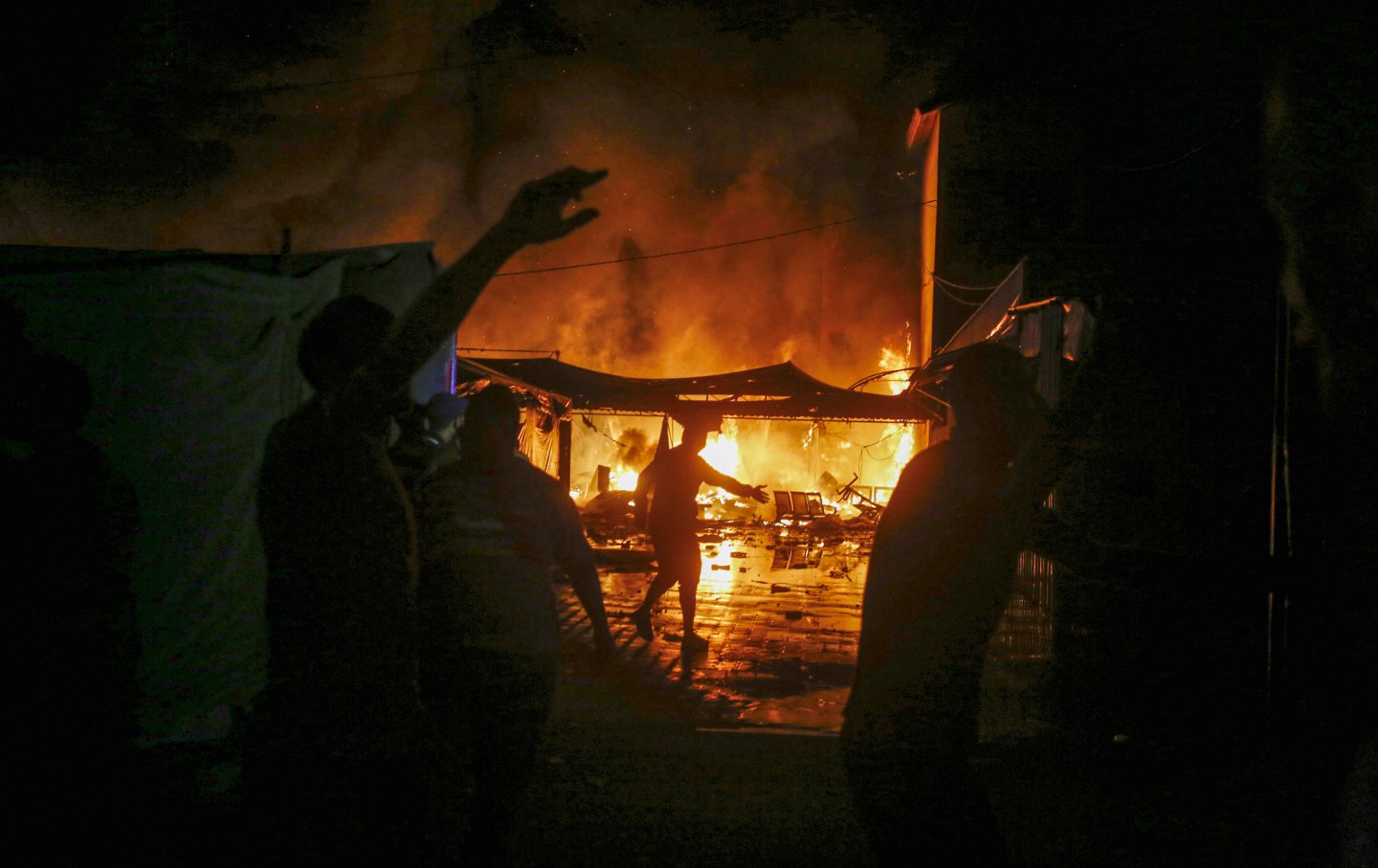
Fire breaks out on the tents of displaced Palestinians after Israeli attacks in the garden of Al-Aqsa Martyrs Hospital in Gaza City, Gaza, on October 14, 2024.
(Ashraf Amra / Anadolu via Getty Images)It was around 2 am on Monday when an Israeli air strike tore through the tents of the displaced at Al-Aqsa Hospital in Gaza—where families, patients receiving treatment, and many of my friends and colleagues were sheltering. The strike cast a horrific, searing glow of fire that soon consumed the place they thought would provide safety.
In videos from the scene, the people’s cries for help could be heard as they stumbled through the dense smoke, searching for loved ones amid plumes of smoke that curled up into the sky. The air itself seemed to scream, and the ground burned with the heat of destruction.
What brought me to tears were the wails of people burning alive before they even registered the sounds of the attack. That night has left both the living and the dead destroyed beyond recognition.
Among the chaos, nurse Amira struggled to reach the patients whose fragile bodies lay in beds just inside the tent perimeter. “I could feel the heat on my skin, smell the burning plastic,” she recalled. “People were running in all directions, and I had to shout over the noise just to be heard.”
“We were asleep, or at least trying to sleep, when the explosions started,” said Abu Khalid, a father who lived behind the hospital with his three children. His voice quivered as he described the scene: “We woke up to smoke and fire. Burning pieces were falling on the tents from every corner. The explosions—I’ve never heard or seen anything like them.”
His children clung to him as they ran, ducking between burning tents, the smell of scorched fabric and flesh overwhelming their senses. Around them, “it was like hell on earth,” he said.
Dr. Anas Wazeer, a volunteer anaesthesia specialist, was at the emergency department door when the first patients arrived. “It was a horror show,” he told me, his voice cracking.
“The burns covered 60 to 80 percent of the bodies that came in—most wouldn’t survive. The air smelled like burned flesh and melting plastic,” he said. “It was hard to breathe, hard to see through the smoke and fire. People died trapped between the flames.”
The overwhelmed medical staff struggled to prioritize care. “There were so many people with burns. Their skin was blackened and charred, their eyes open but lifeless.”
“Some were barely clinging to life as we worked to ease their suffering.” Dr. Wazeer pauses, shaking his head. “We didn’t have enough supplies, not even basic pain relief. It was as if we were asked to perform miracles with our hands tied.”
The blaze consumed over 20 tents, collapsing the frail shelters onto families who had nowhere else to go. People attached to IVs were seen burning alive, and others succumbed to smoke inhalation. Those who survived the initial explosion were left with scars that would never heal.
The attack stole more than just lives—it seared away what little hope remained in the hearts of those who had been living on the edge for a year.
Osama, a 19-year-old who had fled from Beit Lahia, had been staying in one of the tents closest to the fire when the strike hit. “The heat was unbearable,” he told me. “It felt like my skin was peeling off, and the smoke.… I watched my friend, someone I grew up with, die right in front of me. We were trying to pull people out, but he didn’t make it.”
Osama described the helplessness of that moment, the way he screamed at the sky, his voice drowned out by the roaring flames. “We had nowhere to go. There were no fire trucks, no way to put out the blaze. It just kept burning. There were bodies everywhere.” He struggled to finish his sentence, his hands trembling.
For Amira, a 38-year-old mother of four, the attack was yet another chapter in a year-long journey of displacement and terror. She and her family had fled northern Gaza last year in October, following the evacuation orders issued by the Israeli army to the residents in Gaza City and the north.
“We thought we would be safe here, that the south would shelter us,” she said. “But safety does not exist in Gaza. Not in our homes, not even in hospitals.”
Popular
“swipe left below to view more authors”Swipe →She recalled how her children cried that night, not just from fear but from a coldness that seeped into their bones as they huddled away from the fire. “We had fled our home with nothing, and now, once again, we have nothing,” Amira said. “This is not a life. It’s like the world is trying to erase us, as if we have no place anywhere.”
The assault was the third time in two weeks that the Al-Aqsa Hospital had been targeted, according to Gaza’s Media Office. The recurring strikes left an indelible message to the displaced—there was nowhere left to run.
Inside what remained of the hospital courtyard, the charred ground bore silent testimony to the devastation. The tents were now little more than blackened cloth and twisted metal.
The grief was compounded by the sheer inhumanity of peoples’ final moments. “It wasn’t just death,” Dr. Wazeer told me. “It was suffering—slow, excruciating suffering. That’s what haunts me.”
For many, the scars—both visible and invisible—may never heal. With each passing day, those dreams slip further from reach, replaced by the stark reality of their suffering—caught between endless trauma and the faint glimmer of hope for a peaceful tomorrow that doesn’t seem to be coming anytime soon.
Yet despite the devastation and heartbreak, Amira has not lost her spirit of resilience. “We are still here,” she said, “and we will keep hoping, even if it’s all we have.”
More from The Nation
Garbage In, Carnage Out Garbage In, Carnage Out
The harrowing lessons of the Pentagon’s recently dissolved partnership with Anthropic.
The Iran War Could Be Catastrophic for the US-Israel Alliance. Good. The Iran War Could Be Catastrophic for the US-Israel Alliance. Good.
As Israel’s role in pushing the war with Iran comes into ever sharper focus, it’s up to us to turn outrage into change.

An Unlawful War An Unlawful War
The precedent being set by the US in launching this war of aggression against Iran will long live in infamy.
Trump and Netanyahu Want to Turn Iran Into a Failed State Trump and Netanyahu Want to Turn Iran Into a Failed State
This war looks designed to cause maximum chaos and instability. The world will pay a high price.
The War on Terror Paved the Way for Trump’s Rise—Now He’s Making It His Own The War on Terror Paved the Way for Trump’s Rise—Now He’s Making It His Own
Only the total abolition of the DHS can restore freedom.
The Iranian Voices America Isn’t Hearing The Iranian Voices America Isn’t Hearing
We need to listen to those who oppose both the Islamic Republic’s authoritarianism and foreign military escalation.

