
Assange’s Case Shows Why Reforming the Espionage Act Is Imperative for Press Freedom
Representative Rashida Tlaib has proposed an amendment to do so.
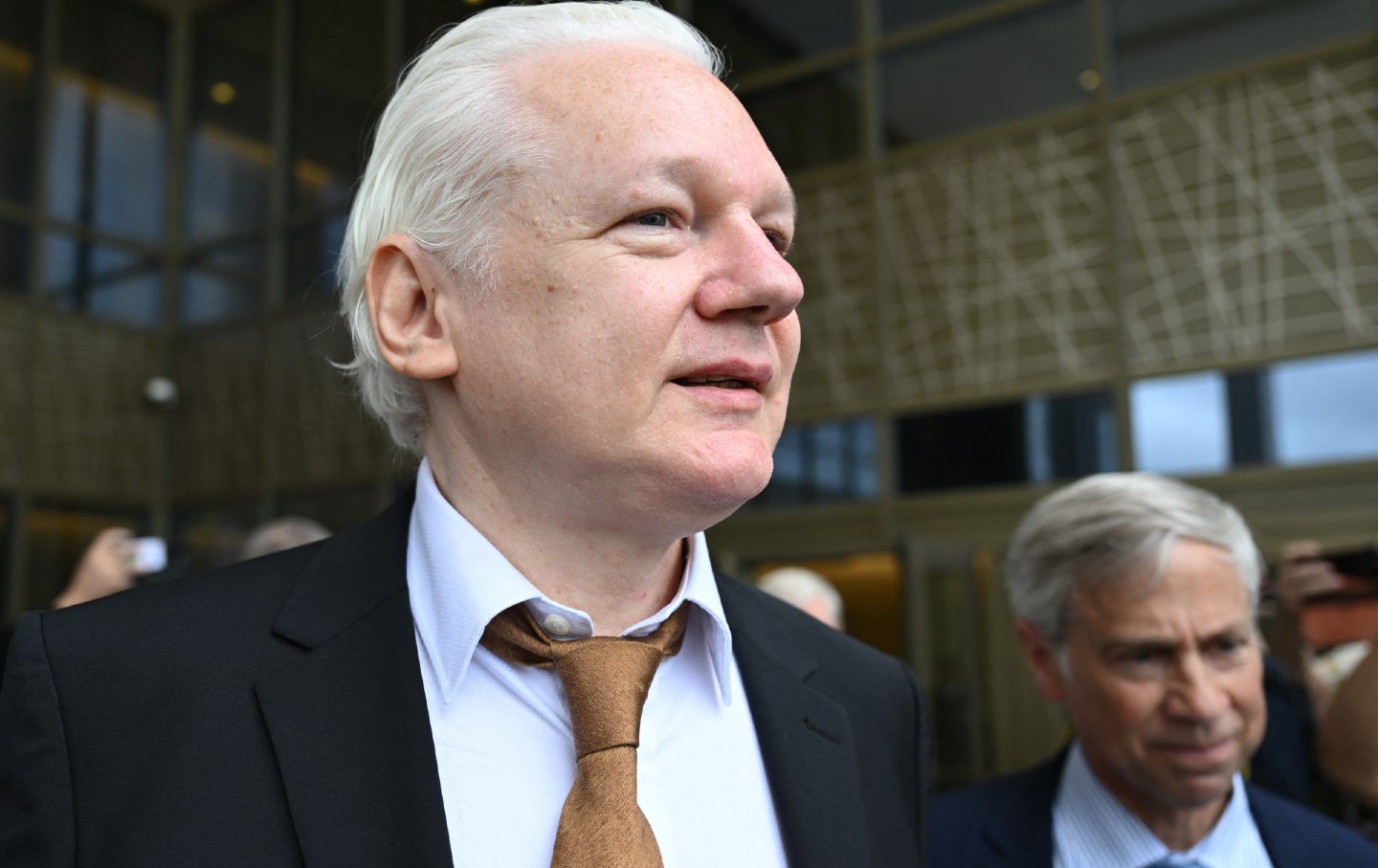
On June 25, 2024, the 14-year persecution of WikiLeaks founder Julian Assange came to an end. As part of a plea deal, the journalist pleaded guilty to violating the Espionage Act. In exchange, he received time served for the five years he spent in a British maximum-security prison while fighting his extradition. Although Assange walked out of the courthouse a free man, his freedom came after paying an extraordinary harsh price.
Officially, Assange’s crime was “conspiracy to obtain and disclose national defense information.” According to the plea deal, Assange helped to set up WikiLeaks, which announced that it would publish “classified, censored, or otherwise restricted information of political, diplomatic, or ethical significance.” Army Pfc. Chelsea Manning gave Assange national defense information knowing he would publish it. Assange accepted the information and published it.
Missing from the government’s summation of the crime was that this information contained revelations about war crimes, state criminality, and abuses of power. It also omitted that both Manning and Assange were motivated by a belief that by exposing the horrors of war, they could spark a public debate about US foreign policy.
Speaking at his sentencing hearing, Assange explained his crime to the judge by saying, “Working as a journalist I encouraged my source to provide information that was said to be classified in order to publish that information.” Assange stated that he believes these actions were protected by the First Amendment, but “the First Amendment and the Espionage Act are in contradiction with each other”
Assange is right on both counts. His actions were journalistic activities that are protected under the First Amendment. And if they are a crime under the Espionage Act, the 107-year-old law is in contradiction with the First Amendment.
Assange’s plea deal represents the Espionage Act’s latest affront to the First Amendment. As Ralph Engelman and Carey Shenkman document in their definitive history of the law, A Century of Repression: The Espionage Act and Freedom of the Press, the Espionage Act was from its inception designed to suppress political speech. Initially the law was used to prosecute anti-war speech. This outrage against free speech spawned the modern civil liberties movement. Although courts originally rubber-stamped this abuse, belatedly they adopted much of the civil libertarian’s view of the First Amendment, finally ending it.
But the Espionage Act’s century of repression was far from over. It lives on as a weapon against journalists and whistleblowers who expose national security secrets. Here the courts have been far less willing to adopt a civil libertarian approach. In the Pentagon Papers case, the Supreme Court ruled that the First Amendment imposed a high burden on when the government can prevent journalists from publishing state secrets. However, they explicitly declined to state that the First Amendment prohibited a post-publication prosecution of a journalist. Although the case was eventually dismissed due to government misconduct, Pentagon Papers whistleblower Daniel Ellsberg was prosecuted under the Espionage Act. Later courts would also find no First Amendment issue with prosecuting government employees for giving national defense information to the media. Courts’ silence on prosecuting journalists and unwillingness to protect whistleblowers set the stage for our current era of Espionage Act abuse.
Assange was indicted under §793 of the Espionage Act. This provision criminalizes obtaining, retaining, or disclosing national defense information. Although Assange is the first journalist prosecuted under §793, this provision has been used to prosecute whistleblowers. A parallel provision of the Espionage Act applies similar prohibitions to classified communications intelligence. This provision has been used to criminalize disclosures about mass surveillance and drone warfare. A separate section of the Espionage Act is used against actual spies.
The two Espionage Act sections weaponized against journalists and their sources fail to distinguish between spies and those acting in the public interest. They also apply equally to those with a duty to protect classified information and journalists or members of the public.
The Espionage Act creates endless liability. A whistleblower violates it when they give national defense information to a journalist. The journalist breaks it both when they receive the information and when they publish it. And, under the letter of the law, a member of the public who reads the journalist’s reporting and discusses it also breaks the law. While the last scenario may sound far-fetched, statements made in federal court show that federal prosecutors clearly believe that anyone who even shares a New York Times article reporting on national defense information has broken the Espionage Act.
Reforming the Espionage Act requires tackling these problems. The first step to reform is to limit many of its criminal provisions to the government insiders who have promised to protect classified information. This would bar the prosecution of journalists, publishers, or members of the public sharing a news article.
Reforms protecting journalists are not the only ones needed. Press freedom advocates have long argued that prosecuting journalists’ sources is a backdoor war on journalism. Without sources, there is no journalism. And there is a great moral imperative, as well. Government employees who alert the media to abuses of power are whistleblowers to be lauded for their courage, not spies to be prosecuted.
Currently, most sections of the Espionage Act require the defendant have “intent or reason to believe that the information is to be used to the injury of the United States, or to the advantage of any foreign nation” to be guilty. This may sound like a high burden, but prosecutors and courts have worked together to render it meaningless.
The government is not required to prove harm occurred, only that there was reason to believe it might happen. When it comes to security clearances holder, the government argues that by virtue of the information being classified, the whistleblower had reason to believe disclosure would harm the US.
Popular
“swipe left below to view more authors”Swipe →In a recent court filing, the government conceded that the vast majority of those convicted under the Espionage Act for giving information to the media did not have the intent to harm our country. Instead, they acted out of “misguided altruism.”
The Espionage Act must be amended to require the government to prove that those who disclose state secrets acted with the intent to injure the United States. If such a reform were enacted, by the government’s own admission it would have been unable to indict whistleblowers like Ellsberg, Manning, Edward Snowden, or Daniel Hale.
For three years in a row, Representative Rashida Tlaib (D-MI) has proposed an amendment to the National Defense Authorization Act reforming the Espionage Act (note: As policy director of Defending Rights & Dissent, I advised Representative Tlaib’s office on these proposals). The amendment includes both of the aforementioned reforms. It also includes two additional reforms of deep personal importance to whistleblowers. It creates a public interest defense that explicitly protects disclosure about war crimes, human rights abuses, and civil liberties violations. And it allows defendants to testify about the purpose of their disclosures.
While it amends those provisions of the Espionage Act used against journalists and whistleblowers, it leaves those provisions dealing with actual espionage untouched. Although these proposals have been blocked from reaching the floor, they constitute the best road map to reining in the act.
And as Assange’s case illustrates, the government is in desperate need of reining in. Under successive, bipartisan administrations, the Justice Department has argued that basic journalism is a crime under the Espionage Act. It has not merely done so rhetorically but pursued a criminal prosecution based on this theory. This will chill journalists the same way past prosecutions have already intimidated whistleblowers.
The First Amendment protects not only news gathering but also citizens’ right to receive information and ideas. The use of the Espionage Act against journalists and whistleblowers attacks both our free press and our right to know. For too long, the Espionage Act has been allowed to cast a shadow over the First Amendment. And as the Assange case illustrates, reforming this draconic relic of repression is imperative for preserving press freedom.
More from The Nation
Progressives Are Backing Puerto Rican Independence. It’s About Time. Progressives Are Backing Puerto Rican Independence. It’s About Time.
More and more leftists are concluding that statehood for the island is not enough.
The Saudi Phase of the Iran War Signals More Chaos to Come The Saudi Phase of the Iran War Signals More Chaos to Come
The conflict that Donald Trump has repeatedly proclaimed an unequivocal American victory keeps spiraling out of control.

Andy Burnham’s Speech to the Labour Party Conference Could Be the Start of a Positive Social-Democratic Politics Andy Burnham’s Speech to the Labour Party Conference Could Be the Start of a Positive Social-Democratic Politics
But the autumn budget to be released at the end of October will offer needed details.

Why Navi Pillay’s Receiving the Nobel Peace Prize Is So Important Why Navi Pillay’s Receiving the Nobel Peace Prize Is So Important
She believes that human rights and international law are universal principles that must be enforced regardless of violator’s ideology, ethnicity, or geostrategic alignment.


Writing About War as Bombs Fall Writing About War as Bombs Fall
While the Israeli government launched a well-orchestrated offensive of disinformation and hyperbole that would make the illegal permissible in the war on Gaza.

