
Emmanuel Macron Is on His Last Legs
The French took to the streets en masse last week, days after the collapse of the latest Macron-aligned government. But the divided left-wing opposition is struggling to capitalize.
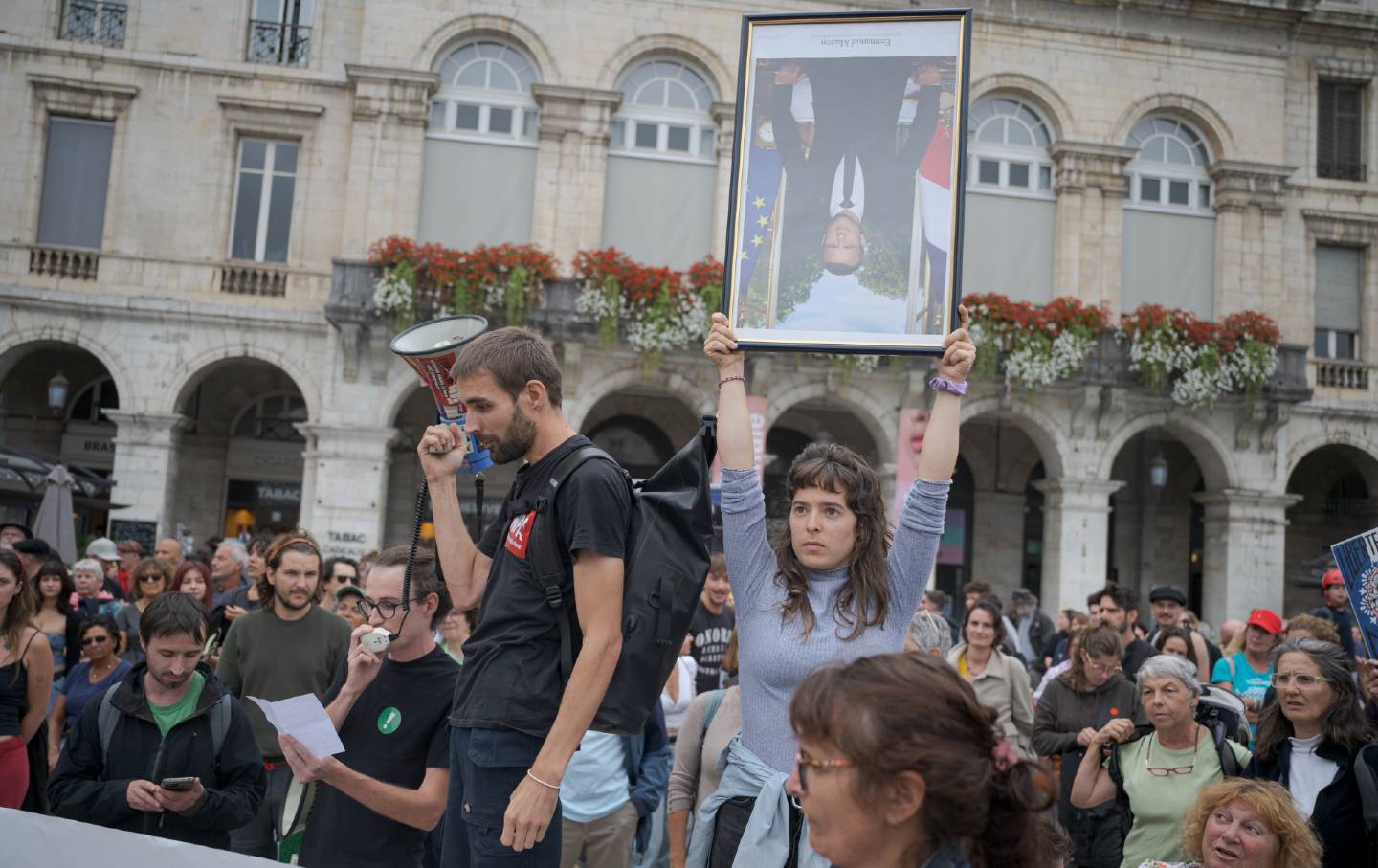
“Did you see what happened in Nepal?” Mehdi asked his friends gathered early this Wednesday morning alongside hundreds of other demonstrators outside an east Paris hospital where healthcare workers are on strike. He was referring to the protesters who set fire to the Nepalese parliament and forced the resignation of the country’s prime minister.
The analogy was lost on nobody. The French, too, are exhausted by a political system stretched to its limits. And they have long since had enough with the inflexibility of President Emmanuel Macron, who faces a growing authority crisis.
Those frustrations erupted on September 10, when a wave of demonstrations unfurled across France. At shopping malls and roundabouts, outside high schools and alongside highway toll booths, hundreds of thousands of protesters took to the streets in rejection of Macron, more than a year after the president’s camp was dealt a severe blow in the summer 2024 snap legislative elections.
The protesters had at least some reason to celebrate, however.
On September 8, the minority government headed by centrist Prime Minister François Bayrou lost a critical confidence vote in the National Assembly, ousting him from the premiership and burying his unpopular 2026 austerity plan. The vote again confirmed the weak hold of Macron’s centrist and conservative allies in the lower house of France’s parliament, where they control just over a third of seats.
For September 10 demonstrators, Bayrou’s defeat in the National Assembly was above all a setback for Macron, who greenlighted his premier’s failed attempt to force parliament into accepting a 2026 budget with some €44 billion of spending cuts and savings. Gaining traction this summer on social media, the September 10 movement crystalized the broad rejection of the centrist bloc’s austerity plan. Opinion studies show that roughly half of the country supports the protest movement, which came to be dominated by the left.
If many want to see this week’s upsurge as a revival of the 2018 and 2019 Yellow Vests revolt, the critical question will be if the movement is able to sustain itself in the weeks ahead. “We don’t want to lose all our energy on this first day of action,” said Jalel, a striking doctor at Wednesday morning’s picket line outside the Tenon Hospital in Paris. “Our goal is to construct a multifaceted and durable opposition.”
Yet that hope will have to square with the fact that the “block everything” movement—for now a one-off day of protest—is leaderless and without formal organization, propelled instead by ephemeral action groups. There were only a few localized work stoppages on Wednesday, but France’s national unions have called for strikes and demonstrations on September 18, when many hope that the groundswell will be able to pick up more momentum.
It might help that protesters can now point to a new enemy. On September 9, the night before Wednesday’s demonstrations, Macron moved to replace Bayrou with Sebastien Lecornu, a longtime ally who has most recently served as defense minister. Macron’s new PM pick has been denounced as a “provocation” by protesters and opposition politicians alike, as the president doubles down on deploying his inner circle.
Jalel, the striking hospital worker, denounced Lecornu as a choice for “continuity” by Macron.
“[Macron] has fallen back on his best friend to be prime minister,” he went on. “Once again, we have proof that it couldn’t matter any less what we’ve voted for.” In September 2024, Macron spurned the left-wing New Popular Front alliance by assembling a minority governing coalition of conservatives and centrists.
Yet it’s anything but clear if Lecornu will be able to succeed where Bayrou failed. The new prime minister alluded to the need for a “change of method” during the transfer of power on Wednesday—which occurred as various crowds of demonstrators elsewhere in the capital contended with tear-gas grenades and police charges. France’s interior ministry deployed some 80,000 police across the country and claimed the arrest of 540 protesters.
“There’ll need to be some serious ruptures,” Lecornu seemed to concede as he took power, referring to a shift not just in “form” but in “content” as well.
That’s shorthand for the new premier’s main challenge: putting together a 2026 budget that might pass in the divided National Assembly. If he fails and becomes the third Macron-selected PM forced from office since the snap elections, the president will find himself backed even further against the wall. Macron is already allaying calls for a dissolution of parliament that might prove devastating for his political bloc, as he hits record lows in popularity. One recent study has the president at 17 percent in approval ratings. There are even growing calls that Macron resign.
Lecornu’s focus in the upcoming wrangling is expected to be the center-left Socialists (Parti Socialiste, PS), who at most would agree on a tacit non-censure pact to allow the minority government to pass a budget. In exchange for a smaller package of spending cuts, the Socialists are demanding increased taxation on the ultra-wealthy and revisions to Macron’s despised 2023 increase in the pension age.
Yet those fault lines are identical to the ones that separated the Socialists from Bayrou, whose successor will only be able to go so far in an attempt to curry favor with the center left. The president and his allies are rigidly committed to protecting the pro-business tax cuts enacted since Macron first won the presidency in 2017—cuts which themselves are in part responsible for France’s deepening fiscal crisis. Anything that Lecornu gives to the Socialists will strain ties with the right wing of his coalition, namely the conservative Republicans who held the premiership under the brief tenure of Michel Barnier last autumn. On Friday, Fitch Ratings downgraded French debt to A+, which will likely only galvanize deficit hawks.
Popular
“swipe left below to view more authors”Swipe →If a rapprochement with the Socialists fails, the last alternative is the far right. For Macron, one advantage of tapping Lecornu is that he has a proven relationship with Marine Le Pen, with whom he has served as interlocutor in the past. The National Rally’s price tag in exchange for any support will be steep, as the party throws its weight behind the demand for a new dissolution of parliament and fresh elections.
“The president has only a few cartridges left, holed up in his bunker with a small bunch of loyalists,” Le Pen wrote on X in response Lecornu’s nomination. “After the inevitable future parliamentary elections, the prime minister will be Jordan Bardella.” Her party’s official president, the 30-year-old Bardella was its presumptive PM candidate in the summer 2024 elections. Polls suggest that the far-right force would emerge in first place in a new vote.
How far the center-left and far-right oppositions go in working with Lecornu in part depends on the temperature of public opinion—and the pressure felt on the streets in the weeks ahead.
“It’s been a long time since I’ve given up trying to make sense of what Macron’s next moves are going to be,” said Hadrien, a teacher who attended an organizing meeting on September 9 outside a Paris metro stop. “What I do know is that we brought down his budget and that he’ll have to square with us.”
If he’s forced to dissolve parliament, Macron may find some consolation in the divided state of the left-wing opposition. The growing power vacuum has only aggravated the tensions between the Socialists and the far-left France Unbowed (La France Insoumise, LFI), led by Jean-Luc Mélenchon—the two key pillars of the 2024 New Popular Front alliance.
LFI has denounced the PS’s new overture to the center as a betrayal. Yet its insistence that Macron resign, provoking new presidential elections, is in part an attempt to shore up the Mélenchonist force’s position as the dominant party on the left. Both LFI and the PS have ruled out a full reboot of the 2024 alliance, as unionist voices struggle to rise above the acrimony between the center left and far left.
That’s all the more dangerous, because new elections are perhaps the only way out of the stalemate.
More from The Nation
Garbage In, Carnage Out Garbage In, Carnage Out
The harrowing lessons of the Pentagon’s recently dissolved partnership with Anthropic.
The Iran War Could Be Catastrophic for the US-Israel Alliance. Good. The Iran War Could Be Catastrophic for the US-Israel Alliance. Good.
As Israel’s role in pushing the war with Iran comes into ever sharper focus, it’s up to us to turn outrage into change.
An Unlawful War An Unlawful War
The precedent being set by the US in launching this war of aggression against Iran will long live in infamy.
Trump and Netanyahu Want to Turn Iran Into a Failed State Trump and Netanyahu Want to Turn Iran Into a Failed State
This war looks designed to cause maximum chaos and instability. The world will pay a high price.

The War on Terror Paved the Way for Trump’s Rise—Now He’s Making It His Own The War on Terror Paved the Way for Trump’s Rise—Now He’s Making It His Own
Only the total abolition of the DHS can restore freedom.
The Iranian Voices America Isn’t Hearing The Iranian Voices America Isn’t Hearing
We need to listen to those who oppose both the Islamic Republic’s authoritarianism and foreign military escalation.

