Can the UAW Finally Organize the South?
Postwar failure to organize the South entrenched racism and corporate greed. Now there’s a chance to course-correct.
It was the week before school started, and my mother and I had pulled into the parking lot at Korvette’s—a discount department store in Northeast Philadelphia—ready to load up on pencils, pens, composition notebooks, and other supplies, when she stopped dead and said we were going elsewhere. Noticing my confusion, she said simply, “We don’t cross picket lines.” And so began my political education.
Many years later, at Nation associate editor Andrew Kopkind’s kitchen table in Vermont (where much of my higher political study took place), I met Jack O’Dell, a once-blacklisted ex-communist who had provided the fundraising muscle for Martin Luther King Jr.’s campaigns and was a key adviser to Jesse Jackson’s presidential campaign at the time. It was O’Dell who tipped me to the importance of Operation Dixie, the Congress of Industrial Organizations’ campaign to unionize Southern workers, launched in 1946. The effort was brought down by the same postwar Red Scare that ushered in the Taft-Hartley Act (forcing many unions to purge their most effective organizers) and decades of bloated military budgets (championed by defense intellectuals, corporate profiteers, and cold-warrior union leaders alike).
But in describing Operation Dixie as “a promise abandoned,” O’Dell—who’d been a National Maritime Union organizer during the campaign—offered more than just a history lesson. He wanted people to understand that failing to organize the South had left racism and reaction unchallenged, setting back the civil rights movement by a decade and handing corporations an effective Southern strategy for resisting labor’s demands.
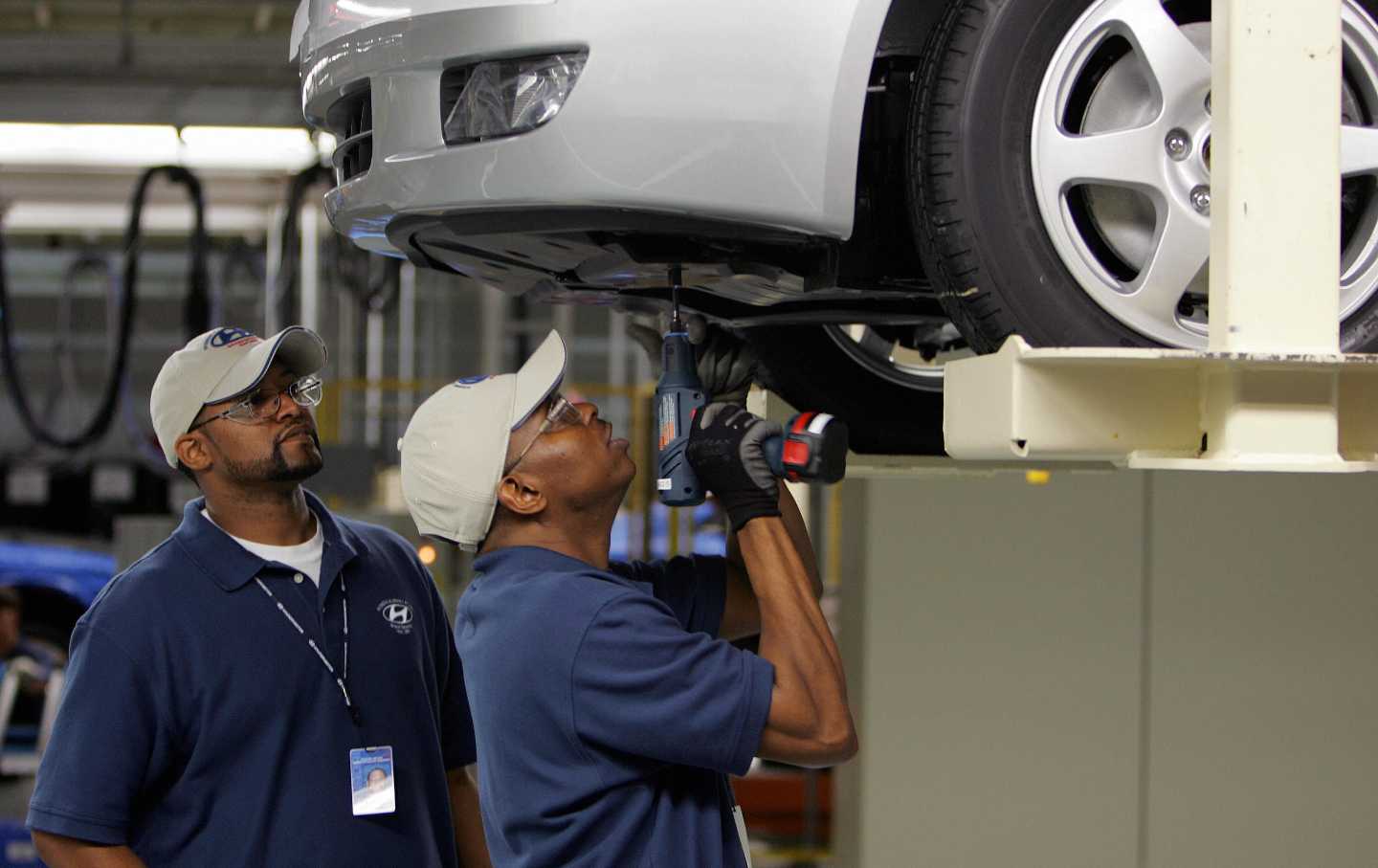
Which is why I was so excited to see the United Auto Workers president Shawn Fain commit to organizing in the South—a promise whose first fruits may well come later this month, when over 4,000 workers at Volkswagen’s plant in Chattanooga, Tennessee, will vote for the third time in 10 years on whether to join the UAW. Previous votes have been thwarted by a combination of ineffective organizing and political threats by the state’s ruling Republicans—who have not restrained their opposition. But should the UAW succeed in Chattanooga and go on to win at Mercedes in Vance, Alabama; Hyundai in Montgomery; and Toyota in Troy, Missouri—not to mention Tesla—the effect may well be more long-lasting than anything else that happens in 2024.
Imagine a South where a unionized manufacturing workforce holds politicians to account, and where the bounds of the politically possible have more in common with a progressive powerhouse like Michigan—a state whose Democratic leadership has passed major legislation on abortion access, LGBTQ+ rights, public education, and voting rights and rolled back a decade-old right-to-work law—than a plantation economy like Mississippi. Imagine—if you can—empowered workers like the members of the Machinists Union at Boeing, who recently demanded a seat on the company board. Imagine—if you dare—a Democratic Party liberated from its addiction to dark money and the corporate donors who provide it.
Thanks to the UAW campaign, workers at Tesla have already received a raise. But as Bryce Covert reports in our cover story, money may not be enough to buy love from Elon Musk’s much-abused workforce. Other instances of the power of solidarity in this issue can be found in Michelle Alexander’s prophetic riff on King’s 1967 anti–Vietnam War speech; in my own interview with Gillian Slovo, whose play Grenfell: In the Words of Survivors opens this month in New York; and in Arturo Cano’s fascinating profile of Claudia Sheinbaum, who will almost certainly become Mexico’s first woman (and Jewish) president.
Not to mention Chris Lehmann’s terrifying account of the rise of Trump-inflected Christian messianism; David Klion’s clinical dissection of the disaster that is Joe Biden’s foreign policy (also covered in Gaby del Valle’s review of Jonathan Blitzer’s history of the border crisis); Alana Pockros on Lauren Oyler and the rise of “Internet criticism”; Rachel Hunter Himes on Harlem modernism; Bijan Stephen on the return of the rapper Kid Cudi; and Daniel Bessner bidding farewell to Curb Your Enthusiasm. Plus our brilliant columnists, stunning illustrations—and a new column, “Rethinking Rural.” It must be springtime at last!
D.D. Guttenplan
Editor