
The Supreme Court’s New Ethics Code Won’t Stop the Corruption
For all the hype, the high court’s flashy new ethics rules are little more than a PR stunt designed to take the heat off scandal-plagued justices.
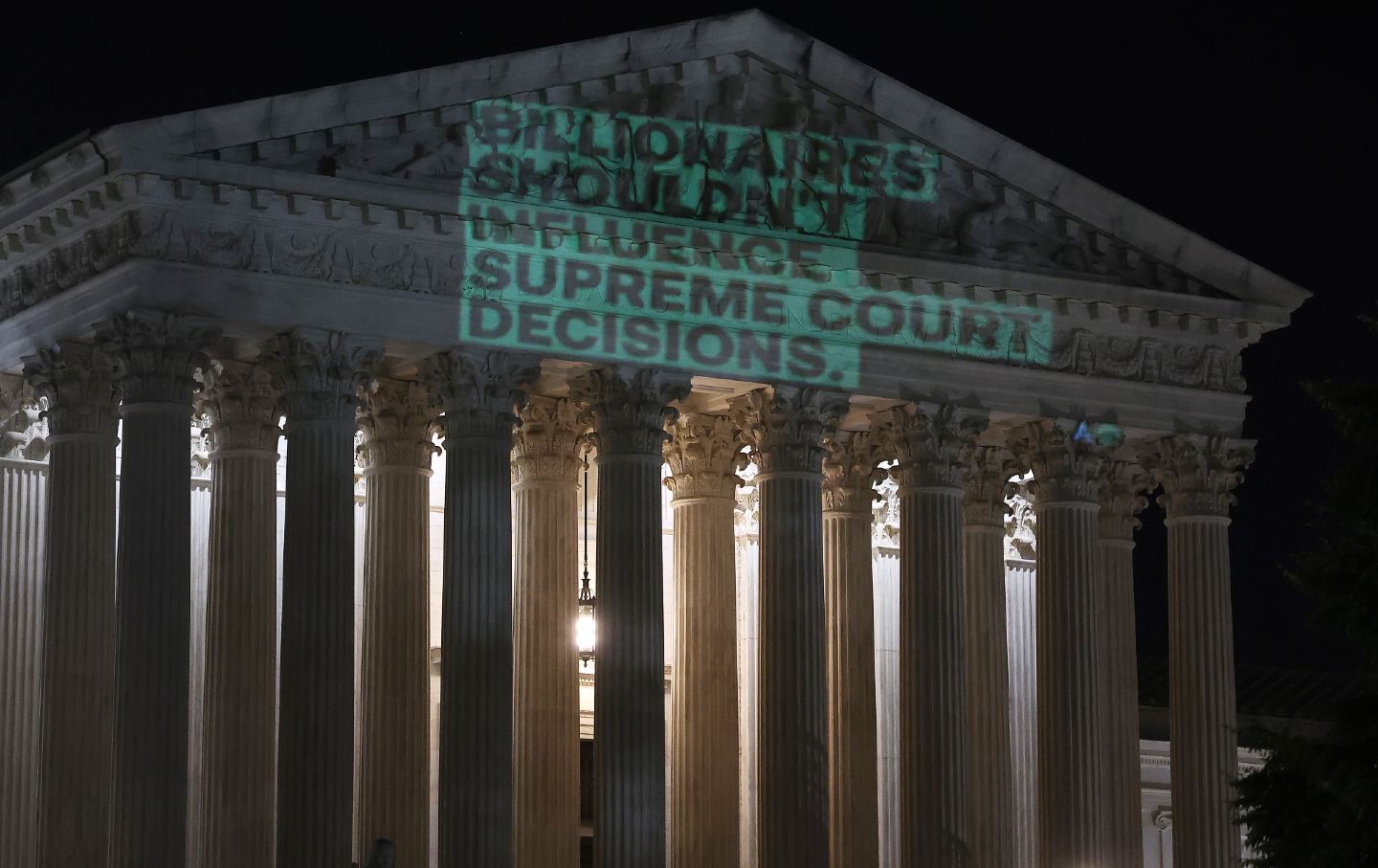
Government watchdog Accountable.US shines a light on the facade of the Supreme Court Building as part of a campaign calling attention to corruption on the court.
(Paul Morigi / Getty Images for Accountable.US)In surprising news, the Supreme Court announced Monday that for the first time in history, all nine justices have adopted an ethics code. But there’s no reason to celebrate just yet or herald the end of public corruption on the Supreme Court. Their self-adopted ethics rules have holes big enough to sail a super yacht through.
The first and most obvious problem with the court’s self-imposed ethics code is that there is no enforcement mechanism. It’s still up to the individual justices to decide if they have violated their own ethics rules. There’s no third-party adjudication of an ethics violation; there isn’t even meaningful peer review among the other justices of a potential violation. Put simply, it’s up to Clarence Thomas to decide whether Clarence Thomas violated Clarence Thomas’s rules.
To quote Captain Barbosa from Pirates of the Caribbean, the code is more what you’d call guidelines than actual rules. Which means, effectively, that there has been no change. In fact, in a terse, one-paragraph cover letter accompanying the supposed ethics code, the Supreme Court says as much. The justices wrote:
For the most part these rules and principles are not new: The Court has long had the equivalent of common law ethics rules.… The absence of a Code, however, has led in recent years to the misunderstanding that the Justices of this Court, unlike all other jurists in this country, regard themselves as unrestricted by any ethics rules. To dispel this misunderstanding, we are issuing this Code, which largely represents a codification of principles that we have long regarded as governing our conduct.
A misunderstanding? The justices want people to believe that we were simply confused, like wee babes in the woods, about the existence of ethical strictures that they hold themselves accountable to even as they take free stuff from interested parties. The justices are essentially saying that they’ve adopted this code so that people like me cannot say, “The Supreme Court is the only court in the country that operates without ethics rules.” Beyond that, it’s business as usual for them as they go about their graft and corruption.
Of course, what I’ve actually been saying is that the Supreme Court is the only court to operate without “statutory” ethics rules and commensurate statutory penalties for violating those rules. The “adoption” of these rules changes nothing on that front: The justices are still the ones policing themselves and expecting everybody else to believe they are beyond reproach.
It might be possible to overlook that key failure of enforcement if the court’s self-imposed code of ethics were targeted at the spate of corruption recently revealed by publications like ProPublica. Unfortunately, there is nothing in this 15-page document that would make it unethical for, say, a justice to accept a private luxury vacation from a friend, or for a justice to get a free RV from a friend, or for a justice to have a really good friend buy their mother’s house.
There’s no clearer indication that these rules are useless than the fact that they end up codifying Thomas’s outrageous behavior as ethically within bounds. According to the rules, not a single thing Thomas has done is a problem. Putting out a code of conduct that doesn’t restrain Thomas is like erecting a dam that doesn’t restrain water. It’s just a gigantic waste of everyone’s time.
Moreover, Thomas isn’t even the biggest elephant-in-the-room that this code ignores. One of the consistent ethical failures of the current Supreme Court is not the fishing trips or free vacations the justices regularly get from wealthy donors but the fact that conservative justices are basically on call with the Federalist Society, a conservative political organization dedicated to making the law safe for conservative white men and nobody else.
Just last week, some of the justices appeared at the Federalist Society’s annual gala, and Justice Amy Coney Barrett was a featured speaker. But according to this alleged code of conduct, that is all OK. The code says that a justice should not speak at an event sponsored by a “political party” or “campaign for political office.” But when it comes to fundraising for a group that claims to be dedicated to law instead of politics, here’s what the court wrote: “A Justice may attend a ‘fundraising event’ of law related or other nonprofit organizations, but a Justice should not knowingly be a speaker, a guest of honor, or featured on the program of such event. In general, an event is a ‘fundraising event’ if proceeds from the event exceed its costs or if donations are solicited in connection with the event.”
You see what they did there? The court redefined “fundraising event” as only those events where people are literally passing the hat around, as if somebody would ask the justices to make a solicitation speech at a telethon. The court’s definition of a fundraiser seems to designed to exempt the annual Federalist Society gala, which the organization claims is not a fundraiser but merely a “dinner” attached to its “National Lawyers Convention”:—this year’s black-tie affair was called the “2023 Antonin Scalia Memorial Dinner”—and it just so happens that people are charged money to attend. The FedSoc doesn’t release information about how much it makes or loses from that dinner, so I guess the justices can never “knowingly” be aware if they’re attending a fundraiser or not.
And wait, there’s more: The justices can also straight-up fundraise for their pet causes and legal friends, if they really want to. The code says: “A Justice may assist nonprofit law-related, civic, charitable, educational, religious, or social organizations in planning fundraising activities and may be listed as an officer, director, or trustee. Use of a Justice’s name, position in the organization, and judicial designation on an organization’s letter head, including when used for fundraising or soliciting members, is permissible if comparable information and designations are listed for others.”
Sure, just go ahead and put the justices on the actual letterhead of the social or religious organization when scrounging for dollars. What could possibly be the problem with that?
Popular
“swipe left below to view more authors”Swipe →This thing couldn’t be more self-serving if it were written by the justices’ financial advisers. Which forces the question: Why is it here? What possible use is an “ethics code” that leaves so many opportunities for ethics violations?
My guess is that this thing exists for an audience of one: Senate Judiciary Chairman Dick Durbin. Durbin has been conducting hearings on judicial ethics—hearings that the justices have refused to show up for and offer testimony at, despite polite requests from the chairman. I imagine that the justices think this will take some of the heat off them, or at the very least give ranking Republican Lindsey Graham something different to scream-cry about as he claims that investigations into judicial behavior are politically motivated. There will undoubtedly be Republican politicians, and moderate Democrats, who claim that the justices have now done enough and should be trusted to self-police the rules they made up for themselves.
Nobody should fall for it. The Supreme Court is corrupt precisely because it acknowledges no outside institution to police its corruption. A code that has no enforcement mechanism, no imposed penalties, and merely rubber-stamps the justices’ own behavior is not an ethics code.
The code of conduct should be treated like a press release from the Supreme Court. Its message is: We are better than you; leave us alone. Nobody should accept it. The first step in restraining the behavior of Supreme Court justices is for somebody other than the justices to try restraining them.
More from The Nation

Cornell Students Challenge University Power at a “Students vs. Billionaires” Town Hall Cornell Students Challenge University Power at a “Students vs. Billionaires” Town Hall
Representative Alexandria Ocasio-Cortez spoke to Ithaca students about tuition hikes, sexual violence, free speech, and university governance.

Trump Has Made it Legal to Destroy Endangered Species’ Habitats Trump Has Made it Legal to Destroy Endangered Species’ Habitats
By redefining the meaning of “harm” in the Endangered Species Act, the administration is giving big corporations a gift they have long demanded.

Journalist Meaghan Beatley on Latin America’s Feminist Resistance Journalist Meaghan Beatley on Latin America’s Feminist Resistance
A conversation with the author of Sex and Dissent about what American feminists can learn from the Green Wave movement.

As Cornell’s Rape Case Draws National Attention, Students Want Accountability As Cornell’s Rape Case Draws National Attention, Students Want Accountability
A new lawsuit alleging that a former student was drugged and gang-raped by Chi Phi fraternity members is sparking outrage in the Cornell community.

Irish Goalkeeper Gavin Bazunu’s Refusal to Play Against Israel Puts Him on the Right Side of History Irish Goalkeeper Gavin Bazunu’s Refusal to Play Against Israel Puts Him on the Right Side of History
Bazunu’s decision raises the perennial question: Why is a country that is currently committing a genocide allowed to compete in the first place?

