The End of Russell Brand’s Rape Schtick
The British celebrity kept reinventing his image to try to cloak his predations.
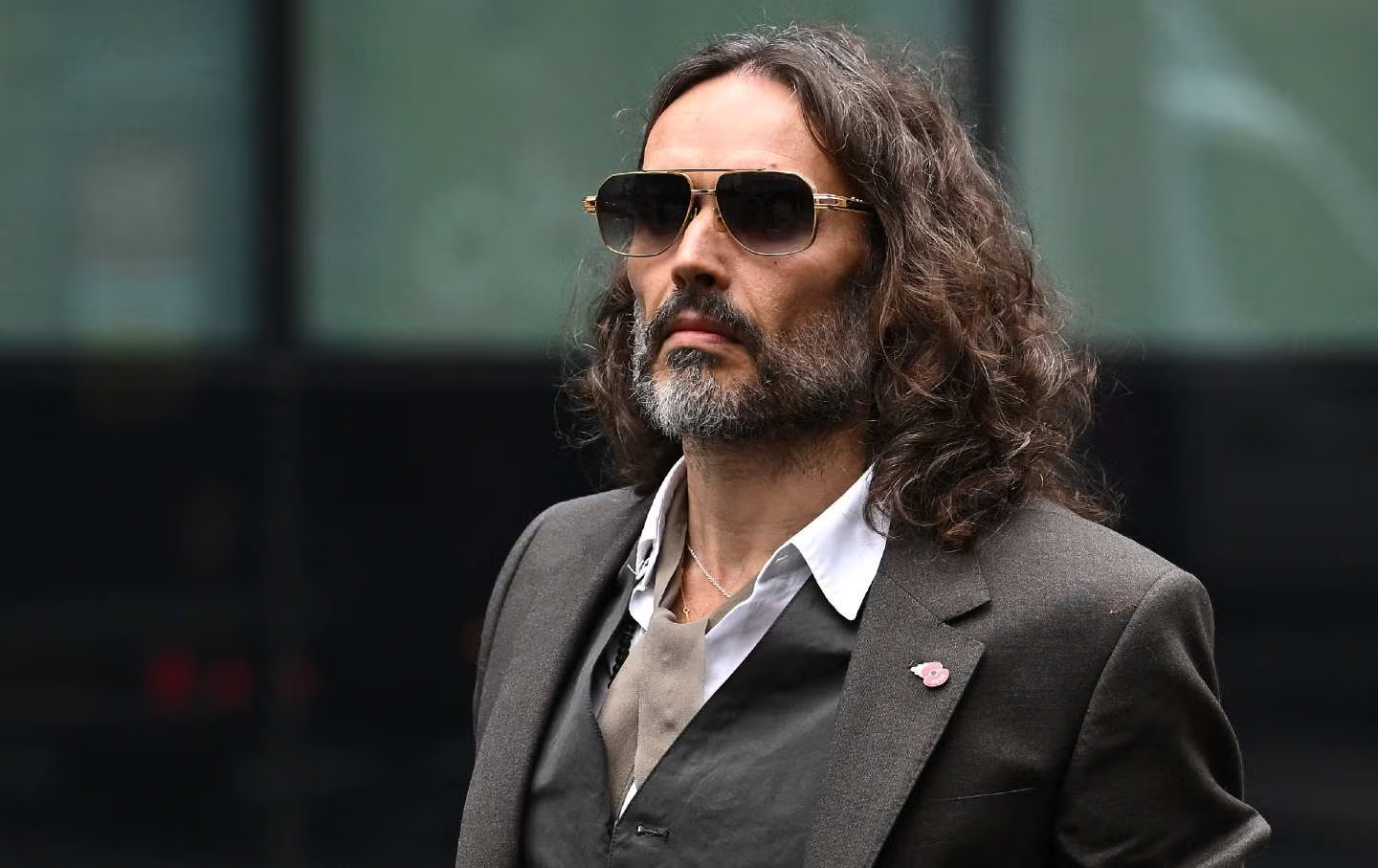
Russell Brand outside Southwark Crown Court in London for his trial on charges of rape, sexual assault, and attempted indecent assault
(Leon Neal/Getty Images)
Foreign rapists are not, apparently, all created equal. Years of fear-mongering about notional predators penetrating the US border don’t seem to count when the culprits are rich and famous and British. This week, born-again YouTube grifter and alleged comedian Russell Brand received a 10-year sentence in England for rape and sexual assault. Today, apex manosphere grifter Andrew Tate and his unimportant brother will appear in a Florida court pending extradition to the U.K. on rape and human-trafficking charges. These are men who got away with staggering feats of sexual violence not only in plain sight but also on large public platforms—getting away with it, in fact, was the gimmick. Performative misogyny wasn’t incidental to their appeal. It was their schtick from the start.
Everyone knew about Russell Brand. Not just everyone at the BBC in 2009 or everyone on liberal Twitter in 2012, but everyone who, at any point in the past several decades, watched him leering and groping and degrading women live on air. “Did Russell Brand go too far this time?” has been an open tab in British public discourse for my entire adult life. He swaggered around the BBC in a skinny scarf cackling about his conquests like some sort of sex pirate—an erotic swashbuckler who would never be square enough to ask before grabbing or take no for an answer. Everyone loves pirates; yes, they’re violent criminals, but that’s fine because they’re on the right side—namely the side where, to quote the leader of the nominally free world, “when you’re a star, they let you do it.”
How much violence and corruption should powerful men be allowed to perpetrate? How many rules do they get to break? How long do we let them laugh at the concept of individual and democratic consent? The moral questions shape our politics on a fundamental level. The #MeToo movement still casts a deep shadow over culture, and the misogyny of the modern right is not your mother’s misogyny. It’s new, reactive and openly vengeful—after all, if women were allowed to take the rule of law into their own hands by asking men to stop raping them, men should get to overthrow the democratic consensus and wreck the global economy just to show us they still can.
That wounded, weaponized patriarchy is still in power—for now. Millennial and Gen Z men are in the unlucky position of having to foot the bill for a thousand years of male privilege that they never got to enjoy because they happened to hit adulthood just when the music stopped and the reckoning began. These men have proven easy marks for self-serving Gordon Gekkos of the attention economy like Brand and the Tates and the president of the United States.
But something has changed. We’re now in the backlash to the backlash to the backlash. It’s been a good few weeks of consequences for men who model that vengeful, nihilist masculinity, where power is its own reward and the rules only apply to losers. Russell Brand was one of the very first. In the early aughts men wanted to be him, women wanted to fix him, non-binary people wanted to know how he got his hair like that. All the while, he lapped up the attention, indulging his particular fetish for sexually degrading women live on air where they had to keep smiling. His personal aura has shifted through the whole spectrum of charismatic criminality from Jack Sparrow to, lately, David Koresh. He’s always been the patron saint of getting away with it—a wrong’un so devoid of integrity that he could and did relentlessly alter his personality so as to attach his coercive control circus to any movement that could offer him a moral alibi and an army of adoring fans. When it was cool to be anti-capitalist, he was suddenly a revolutionary figurehead, until those of us who actually went to the meetings started pointing out that he never did.
Brand first attempted to retcon his cheeky-neighborhood-crotch-grabber persona in the 2010s by identifying as a sex addict—as a sinner in need of saving, a sick boy in need of healing, rather than an adult man in charge of his own behavior. I remember him claiming to have been cured, as so many coercive men do, by “the love of a good woman”—as opposed, presumably, to the bad women who let him degrade them. The good woman in question, Jemima Khan, has spoken today about the abuse she suffered at his hands, and his ex-wife Katy Perry has only commented that Brand belongs in jail.
And yet Brand is clearly convinced that he is the victim here—a martyr to vile mind-virus #MeToo purity politics, which are of course very different from the down-home purity politics he’s pushing these days. His latest incarnation is as a born-again YouTube guru, complete with salt-and-pepper ponytail and linen shirt, taking the knee for God on stage for cash and applause at Turning Point USA. The alt-right is certainly a more welcoming place for professional sex pests. Among the lost boys of the manosphere Brand, like the Tates, groomed an army of angry minions ready to rush to his aid as a brave free speech defender. Now that consequences have come calling, inevitably, wokes like me are being told that this is all our fault. We are the ones who somehow made him do it, along with every other outrage that dark-triad Svengalis perpetrate against public decency.
I will not waste energy arguing with this, having finally learned that when someone wants to fight a version of you they made up, it’s best to leave the room and let them get on with it.
More interesting is the insistence we are now seeing in the online blood-gutters where chemtrail-huffing tech moguls and their flying monkeys now control the discourse that this conviction represents a miscarriage of justice—mob rule that degrades the rule of law. In the maelstrom of #MeToo, this is what women were accused of doing when they denied wrongdoers their day in court, but now that those days are here, the same procedural outrage persists. The absolute importance of the rule of law, of course, is conveniently forgotten when it’s your own side that runs militantly afoul of it. The alleged journalist Michael Tracey has made it his business to reveal the identities of Brand’s accusers, just as he tried to expose Jane Doe in the ongoing frat house rape cases at Cornell University. Feminist scholar Catherine MackInnon wrote that the crime of rape is defined not by women’s experience of violation but by the level of violence men consider acceptable. Here the question isn’t whether sexual violence happened, but whether we consider it a crime.
At his trial, Brand didn’t dispute the events—but he still seems to believe he did nothing wrong, and millions of people agree with him. The fact is that a great many ordinary people seem to think that violence is the price women should expect to pay for casual sex, and that women who claim otherwise are the real villains. Brand and his online corps of enablers seem to think that if a young girl goes to a celebrity’s dressing room, he gets to do whatever he wants to her; that his reputation will always be more important than her dignity and safety. They seem to think that sex is disputed territory in a war between men and women—a violent, dirty thing men do to women who are foolish enough to let them.
Brand, the Tates and their ilk groomed millions of supporters for cash and cover stories. Their fans know who they are defending, just as the millions of Americans knew what they were choosing, in 2016 and 2024, when they showed the world that they would rather elect a rapist than a woman. But persecution fantasies are part of the playbook of modern fascism. Brand has every incentive to position himself as a martyr, a figure unfairly punished for doing what every man would obviously do if he only had the balls.
This is, of course, nonsense. Most men and boys are not abusers-in-waiting, and most have far more in common with the victims of Brand and Trump and the Tates and every other professional wrong’un. But that’s the whole point of this weaponized, wounded patriarchy. It’s integral to the recruiting strategy of modern fascism to persuade millions of men that they are no more than temporarily embarrassed sex criminals, who owe their allegiance to the venal and shameless.
More from The Nation
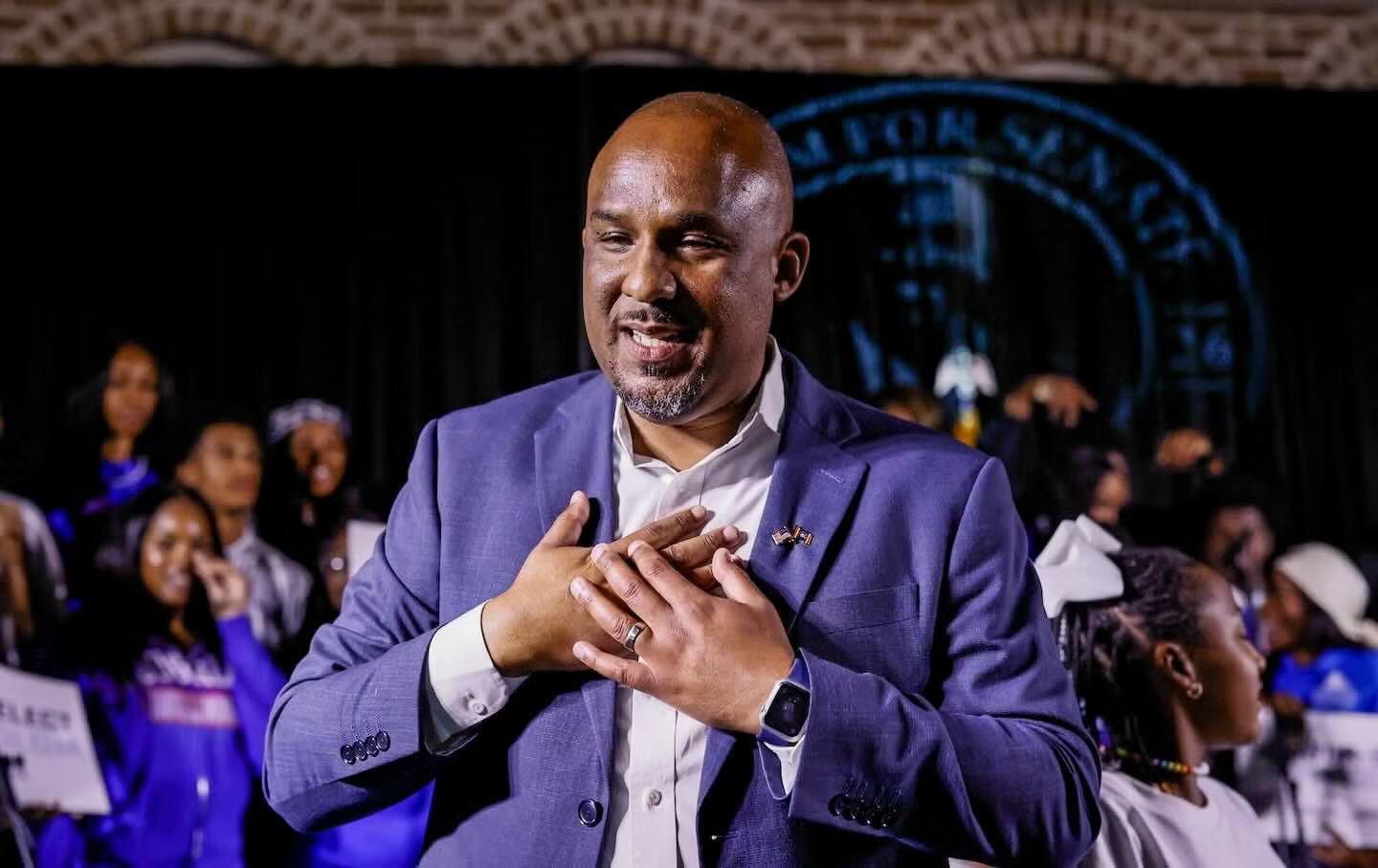
Scott Colom’s Historic Victory Scott Colom’s Historic Victory
The Mississippi Democrat’s win is more than a joyous occasion—it’s redemption.
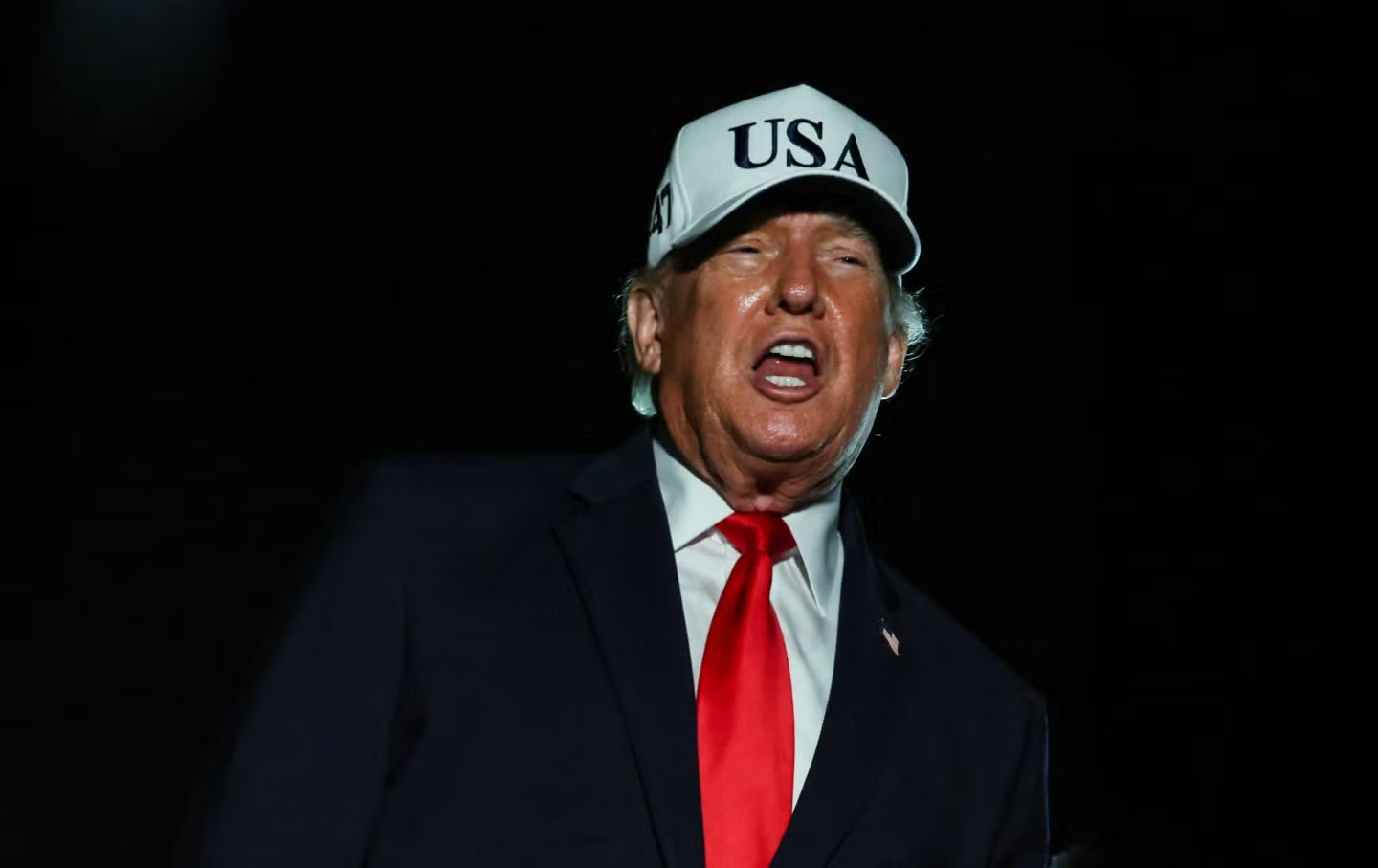
Never Let Trump’s Elite Enablers Forget What They’ve Done Never Let Trump’s Elite Enablers Forget What They’ve Done
Universities, scientists, law firms, and many other powerful institutions are about to start pretending they never rolled over for the president. But we know better.

We Have Invited Insane Surveillance Into Our Homes We Have Invited Insane Surveillance Into Our Homes
Aggregated property listings are being weaponized by insidious intelligence outfits. We have ourselves to blame.
How Mona Chalabi Explains Income Inequality How Mona Chalabi Explains Income Inequality
An interview with the data journalist about how she uses numbers and design to illustrate how class weighs on the lives of Americans.

Letters From the December 2026 Issue Letters From the December 2026 Issue
True progress… A willful blilndness… Correction…
Documenting Women Out of Their Cells Documenting Women Out of Their Cells
Over a 10-year period, a photographer captured the lives of women in and out of prison.

