
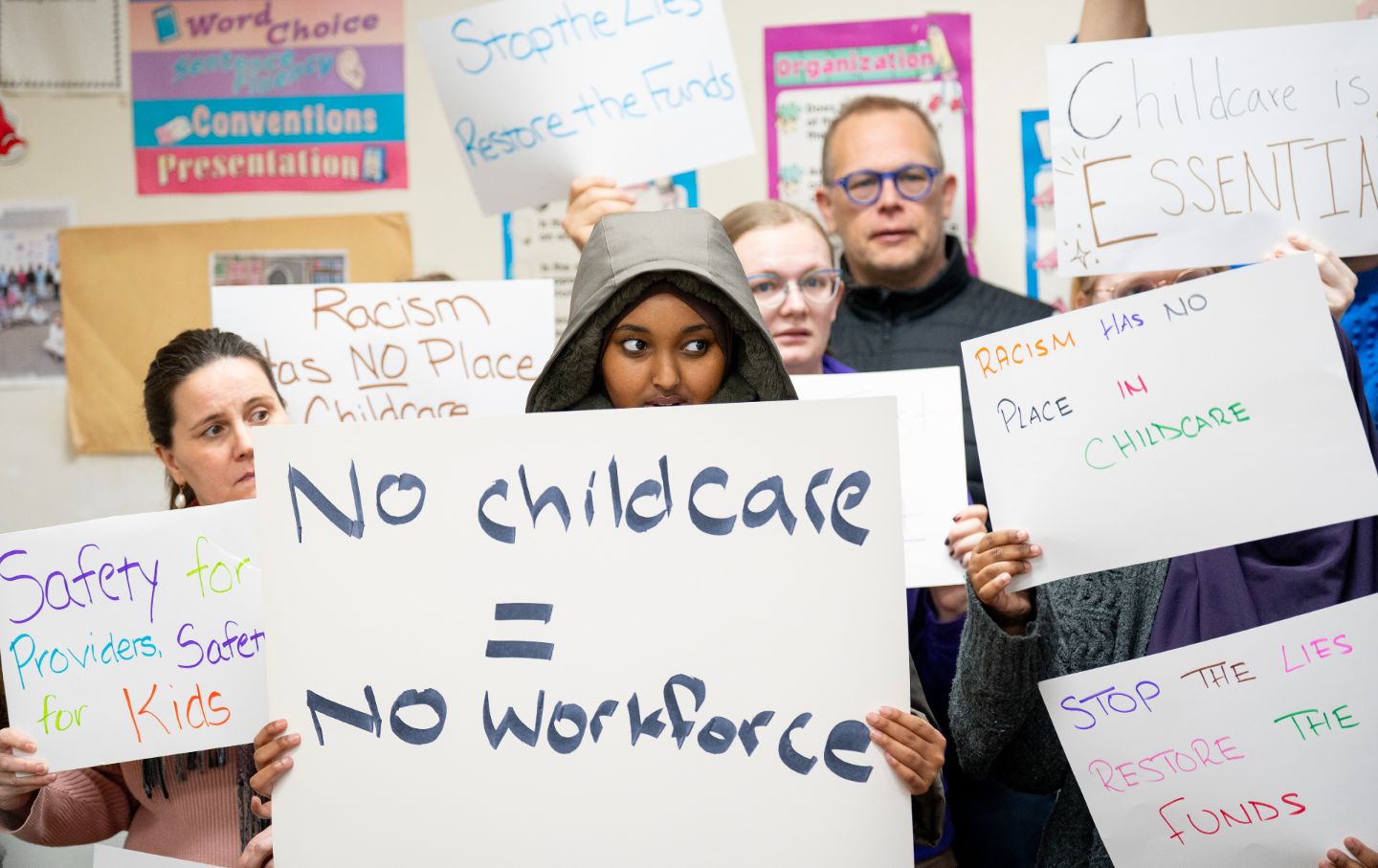
Parents, teachers, childcare workers and community members hold up handmade signs defending local childcare programs during a press conference at a daycare center Minneapolis, Minn.
(Alex Kormann / The Minnesota Star Tribune via Getty Images)
The allegations surfaced over a decade ago: A handful of childcare centers in Minnesota had defrauded the state and federal government by billing for children who weren’t actually being cared for. Then, during the pandemic, some groups again took advantage of laxer rules for emergency funding meant to cushion Americans from an immediate crisis by again siphoning funds without delivering services.
Investigations have long been underway and arrests have been made. At least a dozen people and centers in Minnesota have been charged with fraud. But that’s no matter to the Trump administration. After a right-wing influencer showed up unannounced at childcare centers run by the members of the Somali community in Minnesota and claimed to have uncovered fraud when the programs wouldn’t let him in, the administration has resurfaced these allegations to launch a crusade against what it’s characterizing as rampant fraud in federal childcare funding and other programs.
If the Trump administration were first and foremost concerned with fraud in social services spending, it wouldn’t start with childcare, and it wouldn’t start with Minnesota. It would start with the Temporary Assistance for Needy Families program, which, when it replaced the previous federal welfare program in the 1990s, was turned into essentially a slush fund for states. And it would start not in a blue state but in deep red Mississippi.
Between 2016 and 2020, Mississippi organizations that received TANF funding to conduct things like workforce development and teen pregnancy prevention misspent or stole at least $77 million. Brett Favre, former NFL quarterback, and former Governor Phil Bryant orchestrated the schemes, which included $5 million to build a volleyball stadium at the University of Southern Mississippi. Although some of those involved in the scheme have pleaded guilty and await sentencing, Bryant hasn’t faced any charges. Favre faces a civil lawsuit.
Five years later, the state still doesn’t have enough staff in the program to improve the way it operates, according to the agency itself. Less than a decade ago, the state approved less than 2 percent of the poor people who applied for TANF for funds; even now, less than 10 percent of the poor Mississippians who apply make it through the application process. Perhaps unsurprisingly, a tiny fraction—just 5 percent—of the state’s TANF money actually goes toward cash payments for needy families. The rest of the money can be used for a huge universe of activities, and that’s perfectly legal. When fraudsters siphon off even more, as happened just years ago, there’s even less left for poor families.
In this, Mississippi is not exactly unique. Before 1996, the program TANF replaced—Aid to Families with Dependent Children—was focused mostly on giving poor families cash to support their basic needs. Then, in 1996, President Bill Clinton led the fight for “welfare reform,” which made cash assistance much harder to get and allowed states to use the leftover money for all sorts of other purposes. In 1996, for every 100 poor families who applied, 68 got assistance; in 2023 just 21 did. Fourteen states, including Mississippi, now spend less than 10 percent of their federal TANF funds on direct assistance to poor families. All told, less than a quarter of TANF money goes toward basic assistance, down 71 percent since the 1990s. Most of the money goes elsewhere. It can be spent on things the state would otherwise fund itself, essentially filling holes in budgets, like child welfare and preschool. Several states spend money that’s supposed to help poor families get jobs instead on college scholarship programs that can go to families making six figures. The “other” category sucks up nearly 14 percent of funding and can go toward things like pregnancy prevention and marriage classes for poor people.
These numbers are troubling enough, but there’s even more we don’t know about where and how TANF money gets spent. That’s because there are few reporting requirements. States don’t have to track the outcomes of where they spend money and only have to send the federal government minimal information about what they did with their funds. It’s easy to see how a multimillion-dollar scheme like the one in Mississippi might unfold.
None of this seems to much bother the Trump administration. Last March, the Department of Health and Human Services asked Mississippi to repay nearly $101 million it said was misused under former Governor Bryant. But then in April it turned around and rescinded the penalty, saying it would issue a new one “at the appropriate time.”
Instead, Trump and his administration have used the overhyped, decades-old allegations in Minnesota to attack social programs of all kinds all across the country, particularly in blue states.
The program taking the heaviest barrage is the Child Care and Development Fund, the main source of federal funding for childcare subsidies. The error rate for CCDF, which includes potential fraud as well as instances where programs were actually underpaid, is less than 4 percent and has been falling over the last five years. Between 2013 and 2020, only seven states had improper payment rates above 10 percent.
No matter. The administration said it was freezing all CCDF funding to Minnesota, California, Colorado, Illinois, and New York, as well as all TANF and Social Security Block Grant funding, claiming it is “concerned by the potential for extensive and systemic fraud.” After the states filed suit, a judge granted a temporary restraining order blocking the freeze.
HHS has also instituted a new “defend the spend” system all states must comply with before they can get the CCDF money Congress appropriated for them; although details are still scarce, the administration has said it will require receipts and photographs before the money will flow. If states can’t appease the administration and get the funding, childcare providers risk going unpaid for money they need to meet payroll and make rent. Some could back out of the subsidy program or even be shuttered completely. At least one center in Missouri already has been.
Popular
“swipe left below to view more authors”Swipe →The administration has also moved to rescind rules that stabilized funding for providers who accept childcare subsidies. Under President Biden, HHS changed the rules and urged states to pay providers based on enrollment instead of attendance so they would still get paid even if a kid called out sick or skipped a day. It also encouraged states to pay providers upfront instead of after childcare services had already been delivered. But claiming that the new rules “increased the risk of waste, fraud and abuse,” HHS is rescinding them and using the trumped-up scandal Minnesota as justification.
The Trump administration has targeted Minnesota with other punitive federal funding cuts, too. The Department of Agriculture announced that it was blocking all funding to Minnesota, including for food stamps and school lunches, until the state provides unspecified “payment justifications.” The Small Business Administration cut off all Minnesota borrowers and blocked the state’s annual funding.
The administration has made it clear that Minnesota is merely the testing ground for a weapon it wants to wield against any state in its crosshairs. Kelly Loeffler, SBA administrator, said that Minnesota is “just the start.” In his announcement about the new “defend the spend” step in CCDF, HHS Deputy Secretary Jim O’Neill said that fraud “appears to be rampant in Minnesota and across the country.”
Fraud does happen in social service programs; there will always be people and organizations looking for ways to make off with stolen money. But when Republicans rant and rave against widespread waste and fraud, they are rarely calling for more administrative funding to better police these programs or more employees to review payments. It’s almost always a fig leaf for simply draining money from the programs that go to helping poor people.
“Governor Walz’s administration is taking away money from working families and giving it to fake daycare scams,” O’Neill claimed, evidence-free, on the social media website X. “Every dollar stolen is a dollar stolen from children and families who need the services the most,” Assistant Secretary for the Administration for Children and Families Alex Adams chimed in. They’re counting on the public’s buying the idea that the reason they can’t seem to scrape by is not because we don’t tax the rich heavily enough and so end up with a skimpy social safety net but because some fraudster has stolen from them.
More from The Nation

The Disturbing History of ICE’s “Death Cards” The Disturbing History of ICE’s “Death Cards”
The Vietnam-era practice is yet another example of ICE agents thrilling to the brutality they have been encouraged to cultivate.

The Red State–Blue State Healthcare Divide Is Dangerous for Everyone The Red State–Blue State Healthcare Divide Is Dangerous for Everyone
Whether or not you have access to independent, scientifically sound public health guidance may depend on how your state voted for governor.
The American Universities Programming Israel’s Killer Drones The American Universities Programming Israel’s Killer Drones
Industry partnerships in higher education are pushing STEM graduates into the business of weapons manufacturing and genocide profiteering.

In the Trump Era, Celebrating Black History Month Feels Radical Again In the Trump Era, Celebrating Black History Month Feels Radical Again
After putting on their very best performances of solidarity every Black History Month, this year corporate marketers have seemed at a loss for words.
ICE’s Detention of Pregnant People Continues a Disgraceful American Tradition ICE’s Detention of Pregnant People Continues a Disgraceful American Tradition
We are seeing yet another example of state-sanctioned violence against the reproductive futures of those deemed outside the national body.

The Price of Being Black and Proud in European Soccer The Price of Being Black and Proud in European Soccer
The Brazilian star Vinicius Jr. has repeatedly been a victim of racist abuse from soccer fans. Now, it seems such vitriol can even come from players without much consequence.

