
Diminished Lives: an Assault on the Humanities
More and more students are being indoctrinated into a cult of cold “efficiency,” where the training of workers for corporate employment are held to be the ultimate priorities.
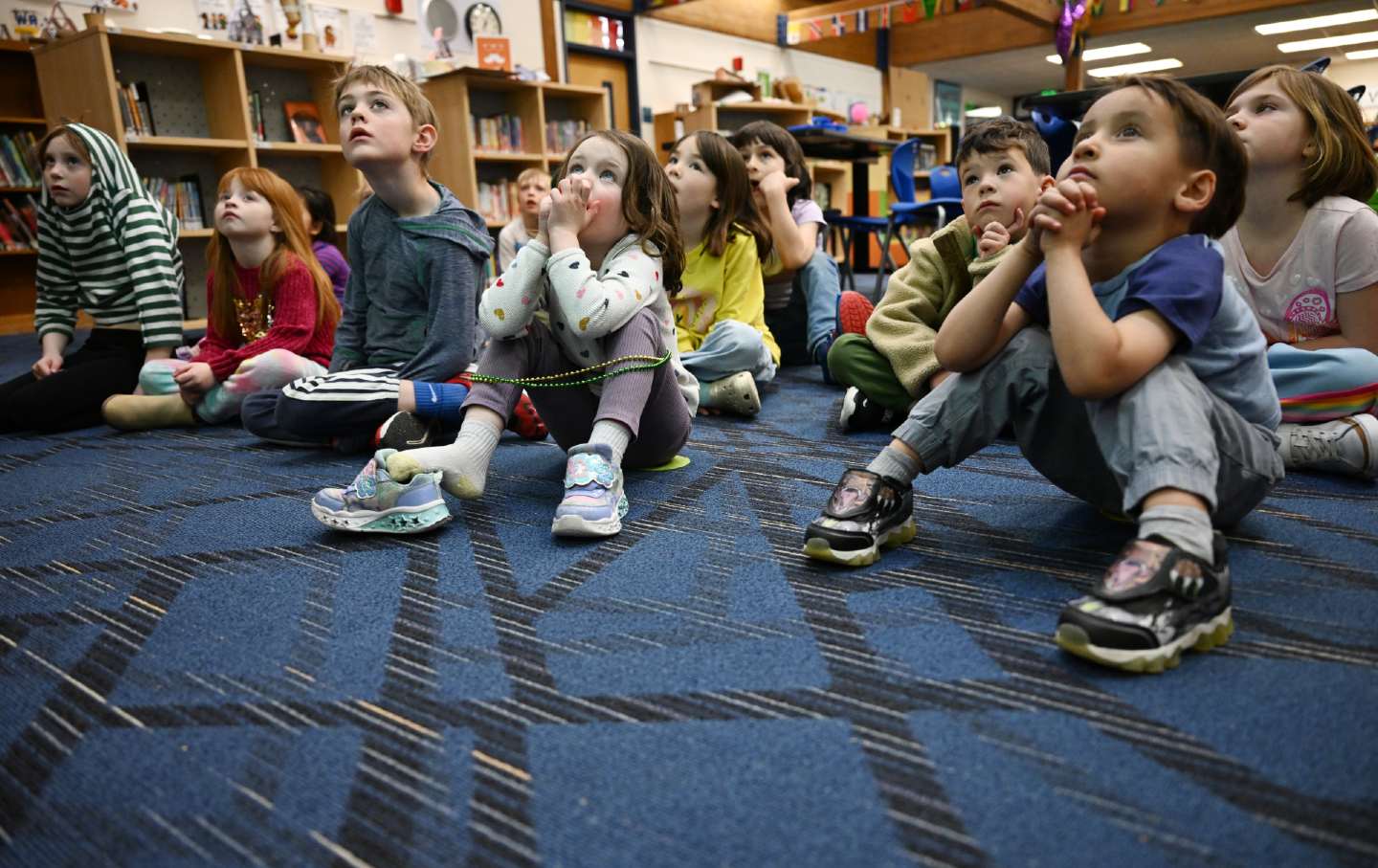
Kindergarten students at Coal Creek Elementary in Louisville, Colorado, on March 11, 2026.
(RJ Sangosti / MediaNews Group / The Denver Post via Getty Images)Anyone who spends much time visiting with children in the public elementary schools is likely to notice that the time traditionally given to the study of the arts and letters has undergone a notable reduction. “Severe budget cuts to [the] humanities and other non-STEM fields,” according to Robin D.G. Kelley, a professor of American history at UCLA, have accompanied the growing assault on critical inquiry.
This trend, which I began to notice in the years that followed the passage of the testing law No Child Left Behind, is part of a larger pattern of retreat from the humanities in general, which tends to be given less and less attention, as it seems, because the benefits or “outcomes” of a child’s engagement with a literary work that he or she enjoys do not easily lend themselves to rigorous and scientific measurement. “I want to change the face of reading instruction from an art to a science,” said a high-ranking official at the US Department of Education in 2002. If she had simply meant that reading instruction ought to be grounded in reputable research with a scientific basis, her statement would have seemed like common sense to me. Regrettably, in too many schools, the scientific theme soon grew into a storm of arctic air that blew away any serious concern for the artistry of language in the books and stories that children were increasingly denied the time to read.
“So maybe we aren’t teaching an entire novel,” a curriculum administrator in a New York district noted in an interview with The New York Times in 2015, “but we’re ensuring that we’re teaching the concepts that the novel would have gotten across.”
It’s a funny statement. I don’t think too many people read a novel in order to dig out “a concept” or a bunch of concepts hidden in its pages. I think most people read a novel to enjoy the story and get caught up in the lives of the people it portrays and the ways their personalities and character develop as the narrative evolves. This is obviously impossible if all the students get to read are a couple of paragraphs or pages.
A case in point: One of the bright young teachers whom I came to know when she was a graduate student here in Cambridge went on a few years later to become a teacher in a fifth-grade classroom in a poorly funded district in Virginia. There was no library at the school and, in the classrooms, literary books had largely been abandoned and replaced by tiny bits of writing that were known as practice texts.
The teacher, who had studied education after she had done her undergraduate degree at the University of Virginia, had done her practice teaching in a fairly affluent district in a suburb close to Cambridge where testing pressures had been less severe and where she’d had a chance to introduce her students to books she’d known and loved since she was a child. So the idea of using what she called “hokey little bits and pieces” of test-aligned materials as the mainstay of instruction struck her, as she put it, as “pretty damn amazing.”
She later sent me a package that included several of the passages her students had to read in a six-week period prior to the final round of standardized exams—during which, she told me, they read no books at all.
One of the longer pieces that she sent was a passage of nonfiction about a creature of the sea I had never heard of, which was called the blobfish. It started out by saying that the blobfish has “a human-looking face” and, in the next sentence, is “a human-looking fish” and, in the paragraph that followed, is “nearly human-looking.” While it “may not be one of the most attractive of sea creatures,” the passage continues, “it is certainly one of the most interesting.” Its shapelessness “allows the blobfish to float easily” in “the ocean depths where it makes its home.” The blobfish “spends all its time floating” and, two sentences later, the blobfish (plural) “spend most of their time floating…. They are made for floating.”
The blobfish “may not be the most attractive fish,” the children are told a second time in the final paragraph, after which a multiple-choice question asks the students to identify the structure that was used to organize the passage. The teacher said one of her students stuck her fingers in her throat to indicate how interesting she found this.
It’s not surprising that so many teachers with her good education and buoyant personality—and feisty resistance to the loss of her autonomy—are unwilling to remain for long in schools in which “hokey little bits” of mediocre writing and the pressure to conform to standardized banalities are snuffing out any pleasure to be taken in the arts and letters.
The banning of books on social justice issues and works that address the nation’s racial history is another reason teachers who have come to education with a sense of social conscience are fleeing from the classrooms. About 12 years ago, one of my friends in Arizona told me about teachers in the Tucson district who had developed a Mexican American studies program that also included the writings of James Baldwin and dissident historians, such as Howard Zinn.
But legislative leaders were not pleased. The legislature passed a law to eliminate the program, and Republican Governor Jan Brewer signed the law in 2012. Among the titles taken from the shelves were works by Cesar Chavez, Isabel Allende, Sandra Cisneros, Laura Esquivel, and Thoreau (“Civil Disobedience”)—and, bewilderingly enough, Shakespeare’s play The Tempest.
In more recent years, right-wing parent groups have been attempting to exclude from their children’s schools hundreds of other books that foster critical thinking or address the conflicts that divide us, based on gender, class, and race.
Popular
“swipe left below to view more authors”Swipe →All in all, between the assault from groups like these and the broader curricular constraint on reading almost any book of literary worth from the beginning to the ending, teachers I know are speaking of a bleak and bare scenario.
I go into an elementary classroom and, being old-fashioned as I am, I look to see if Harriet the Spy is sitting there invitingly on the top shelf of a bookcase. Depending on the grade and ages of the students, I also look for Owl Moon, Peeny Butter Fudge, Born on the Water, Bridge to Terabithia, Grandma’s Purse, The Wind in the Willows, Number the Stars, A Wrinkle in Time, Alice’s adventures when she fell into the rabbit hole—and, naturally, Eeyore, Pooh, and Piglet as they were depicted not by Disney but by E.H. Shepard.
Most of these books and dozens of other old or modern treasures are usually listed by the state or district as recommended titles for kids of different ages, and they’re usually there, somewhere in the classroom, packed in shelves or boxes. Too often, however, the books remain there in the shelves and boxes for too many days and hours while children fill in bubbles on their practice texts. Healthy and well-educated teachers tell me that they hate this. They did not come into teaching in order to become the dutiful technicians of mechanistic learning. They want to seed the future of their students with a lifelong love of reading.
It’s harder to do this in the kinds of schools where the obsessive measurement of outcomes and a cult of cold “efficiency” in the training of workers for corporate employment are held to be the ultimate priorities. What can’t be measured won’t be taught. What won’t be “useful”—fascination, and delight, and wonderment—are no longer wanted. This way lie diminished lives for millions of our children and a continued flight of teachers from their schools.
Become a Sustaining Donor This September
Between the reemergence of right-wing red-baiting and Donald Trump’s use of the chilling National Security Presidential Memorandum–7 to criminalize left political organizing, we’re seeing McCarthyism reborn before our eyes.
This assault on democracy cannot be ignored or wished away. Resisting it requires bravery in the face of threats and repression, a steadfast commitment to the truth, and the unwavering belief that we can—and will—overcome this darkness.
We must have an independent media that sets the record straight, unearths corruption and abuses of power, and advances a politics of justice and dignity for all if we’re to win this fight.
That’s why I’m writing to you today. This September, The Nation needs to add 100 monthly donors to sustain our progressive journalism. Your contribution makes the next investigative report, the next truth-speaking column, and the next pathbreaking essay all possible.
I hope you’ll support our work with a recurring donation today. If you donate $10 or more a month, we’ll send you a brand new “Hands Off the Free Press!” sticker to recognise your commitment to our cause. Please, donate today.
Onward,
Katrina vanden Heuvel
Editor and Publisher, The Nation
More from The Nation
The Promises and Compromises of the University of California The Promises and Compromises of the University of California
I grew up in a neighborhood manufactured by the University of California, Irvine. It felt like a utopia for academics—until the university forsook its mission of serving the publi...

Is Platonic Co-Parenting the Future of the Family? Is Platonic Co-Parenting the Future of the Family?
Disillusioned with the nuclear family and apprehensive of tethering their reproductive futures to the bleak hellscape of modern love, young people are seeking a different way.
How Trump’s Crackdown on Speech Has Damaged the Student Press How Trump’s Crackdown on Speech Has Damaged the Student Press
I serve as editor in chief and president of The Stanford Daily. Our newsroom has keenly felt the effects of Trump’s campus crackdown, which is why we sued the federal government.

Treat Spotify Like a Public Utility Treat Spotify Like a Public Utility
Music streaming platforms have way too much control over musicians and music lovers. It’s time to rein them in.

What’s the Matter With Effective Altruism? What’s the Matter With Effective Altruism?
President Trump has decried the techbro creed for indulging in AI doomerism, but its excesses are far worse than that.

