Is a Trump Endorsement Becoming a Liability?
The president’s backing failed to secure a primary win in Minnesota for Mike Lindell. And he’s not the only one.
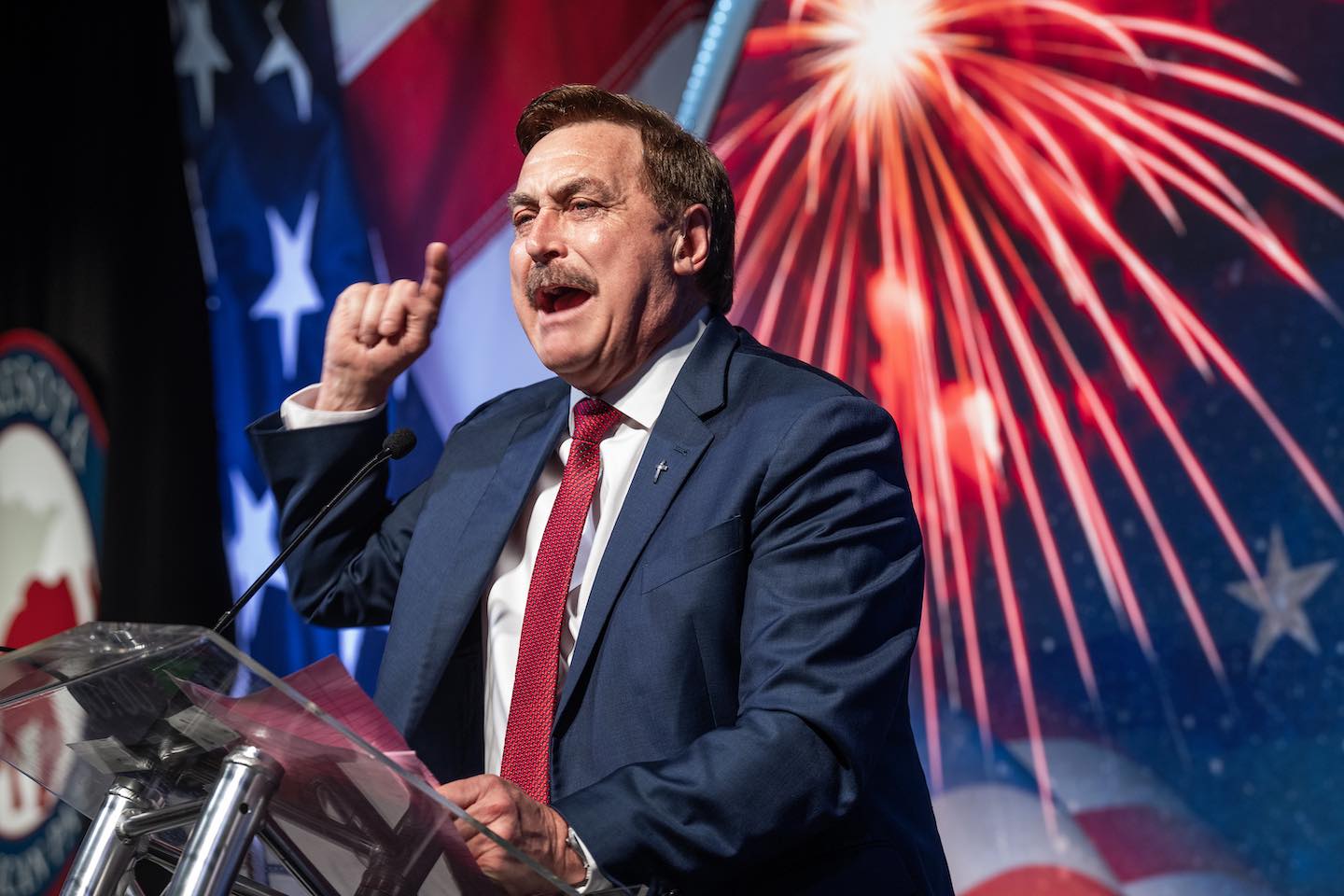
Gubernatorial candidate Mike Lindell makes his case for the GOP nomination in Duluth, Minnesota, in May 2026.
(Richard Tsong-Taatarii / The Minnesota Star Tribune via Getty Images)In the wake of this week’s primary votes in Wisconsin, Minnesota, and South Carolina, our punditry complex remains fixated on the left insurgency in the Democratic Party. But we should find some time, amid all these speculative forecasts, to linger over one of the most satisfying outcomes of this primary season: the decisive defeat of MyPillow impresario Mike Lindell as he mounted an ultra-MAGA bid for Minnesota’s GOP gubernatorial nomination.
Lindell is best known for his zealous public support of Donald Trump’s unhinged conspiracy theories about his 2020 electoral defeat—an effort that devoured millions of Lindell’s own fortune and resulted in a handful of delusional pseudo-documentaries peddling lies about election fraud, while earning him still more disavowals and deplatformings from media networks that agreed to air his calumnies in exchange for cash. Lindell has also faced a welter of court cases based on his election lies. In June, he settled a lawsuit brought by the voting machine company formerly known as Dominion, which settled an earlier $787 million claim against Fox News on the same grounds. A separate action, brought by a Dominion executive in Colorado, resulted in a $2.3 million judgment against Lindell, together with $4.4 million in punitive fees his lawyers are still fighting, amid a steady stream of sanctions for false citations and other errors. And the voting machine firm Smartmatic won a separate suit against Lindell, though he continues to refuse to pay the damages he owes.
This long trail of fabulism and conspiracy-mongering is a credential in a MAGA movement now rife with election deniers, and Lindell minted an enthusiastic Trump endorsement out of it, which pretty much furnished his entire campaign platform. But Lindell’s reliance on the president’s kingmaking prowess came decisively to naught: He was soundly thrashed by Minnesota House Speaker Lisa DeMuth on Tuesday, losing by 11 points and more than 45,000 votes; to absolutely no one’s surprise, he is refusing to concede and floating a fresh round of fabricated claims about rampant election fraud.
It’s far too soon to hail Lindell’s defeat as a sign that the Republican Party might be, at long last, stirring out of its authoritarian fantasias and engaging with some semblance of reality once more. But Lindell’s face-plant, after his leading in the polls during the campaign’s homestretch, marks the most prominent loss by a Trump-anointed hopeful in this primary cycle. Trump endorsements still command widespread devotion from the GOP base, as incumbent casualties on the right such as John Cornyn, Thom Tillis, Thomas Massie, and John Cassidy can readily attest. Yet Lindell’s defeat comes after a number of other setbacks for handpicked Trump endorsees in the primaries. Just last week, Tennessee Representative Andy Ogles—a stout homophobe and anti-Islamic racist hailed by Trump as a “conservative warrior”—lost a race in his redrawn district to former state agricultural commissioner Charlie Hatcher. In Michigan’s eighth district, meanwhile, Trump-endorsed candidate Amir Hassan lost badly to Thomas J. Smith—an especially embarrassing outcome for Hassan and Trump since Smith had suspended his campaign the month before.
Several of Trump’s biggest endorsement flops centered, as Lindell’s did, on a governor’s race. In Iowa, MAGA standard-bearer Randy Feenstra lost to Zack Laun, an insurgent candidate aligned with the MAHA movement. In Georgia—a critical swing state—Trump’s pet candidate, Lieutenant Governor Burt Jones, lost to Rick Jackson, a billionaire healthcare executive running as an “outsider.” And in South Carolina—traditionally deep-red Trump country—Pamela Evette, another lieutenant governor endorsed by Trump, fell to state Attorney General Alan Wilson. (Though Trump, who can’t bear to lose, issued a hurried dual endorsement of both candidates when he saw that an Evette win was looking like a long shot.) These miscues in governors’ races are revealing, since they’re statewide tests of voter sentiment that, unlike Senate contests, aren’t heavily reliant on the national party’s resources and organizing infrastructure.
Lindell’s poor showing in Minnesota was also telling because the state has become a flash point in the protests against the Trump administration’s fascist mass deportation campaign—an initiative that’s losing public support on a massive scale. Right-wing leaders in Minnesota have sought to distract from this liability with demagogic and racist attacks on the state’s Somali community, which they allege has engaged in rampant government-funded fraud, but that’s chiefly served to further diminish the party’s support among non-white voters.
It’s true that, in addition to facing these MAGA headwinds, Lindell also contended with some structural challenges. He wasn’t the beneficiary of the state GOP’s endorsement—though the candidate who did nail it down, former healthcare executive Kendall Qualls, finished a distant third in the primary balloting. In an election cycle more friendly to Trump—who now has an approval rating below the depths he reached in the wake of the January 6 coup attempt—Lindell might well have claimed that the state GOP leaders were RINO’s, stiffing a heroic truth-teller to continue feathering their own nests. Instead, the state party’s failure to play much of a significant role in the race’s outcome seems to be an ominous reflection of the broader cluelessness of the national party in the face of a Trump-free future. It’s unclear how much Lindell wound up spending on his campaign, given his plutocratic portfolio and the absence of any serious regulation of dark-money spending, but it doesn’t appear to be much—not a surprising development, since he’s still drowning in legal fees and stepped away from his MyPillow post to run for governor.
But all these factors aside, the resounding defeat of Trump’s best-known ally in election denial and MAGA grievance politics is a boon for sanity and truthfulness. There may well be another boomlet in self-funded bogus documentaries about Lindell’s loss, but it seems like a growing contingent of the public is happy to tell the tireless self-dramatizing crank to stuff a pillow in it.
Become a Sustaining Donor This September
Between the reemergence of right-wing red-baiting and Donald Trump’s use of the chilling National Security Presidential Memorandum–7 to criminalize left political organizing, we’re seeing McCarthyism reborn before our eyes.
This assault on democracy cannot be ignored or wished away. Resisting it requires bravery in the face of threats and repression, a steadfast commitment to the truth, and the unwavering belief that we can—and will—overcome this darkness.
We must have an independent media that sets the record straight, unearths corruption and abuses of power, and advances a politics of justice and dignity for all if we’re to win this fight.
That’s why I’m writing to you today. This September, The Nation needs to add 100 monthly donors to sustain our progressive journalism. Your contribution makes the next investigative report, the next truth-speaking column, and the next pathbreaking essay all possible.
I hope you’ll support our work with a recurring donation today. If you donate $10 or more a month, we’ll send you a brand new “Hands Off the Free Press!” sticker to recognise your commitment to our cause. Please, donate today.
Onward,
Katrina vanden Heuvel
Editor and Publisher, The Nation