Recently, a friend who is house-hunting lamented that houses don’t look like houses anymore. Rather, they look like hotel lobbies or Airbnbs, or the “after” result of one of those renovation TV shows that take a house full of people’s stuff and turn it into a hotel lobby or an Airbnb. This spring, in a superb essay, “Merchandizing the Void,” that appeared in the online feminist journal Dilettante Army, Kelly Pendergrast expounded on the strange, hyper-organized, almost retail-like environment of the contemporary pantry (think Khloé Kardashian’s). Noting the proliferation of Excel-grid-like shelving systems displaying accumulated wares in the aspirational kitchens of today, she describes a turn toward the “logistical imaginary” in the home: Luxury pantries, not incidentally, resemble distribution centers.
Pendergrast argues that because delivery has almost completely supplanted in-store retail experiences, the job of imbuing products with wonder now falls to us—hence these seemingly commercial displays in home kitchens. We’re the merchandisers now. This itself is an extension of an earlier generation of home-design trends, especially during the high McMansion era, which brought hitherto non-domestic social environments indoors: bars, theaters, gyms. Those kinds of customizations are less and less common, because they tended to be highly tailored to the tastes of the owner, often being themed (Tuscan, Art Deco, baseball, rainforest). But whether they are tasteful or garish, homes with these kinds of personalizations are not as salable as “neutrally” decorated houses, which match the genericism of a merchandised world.
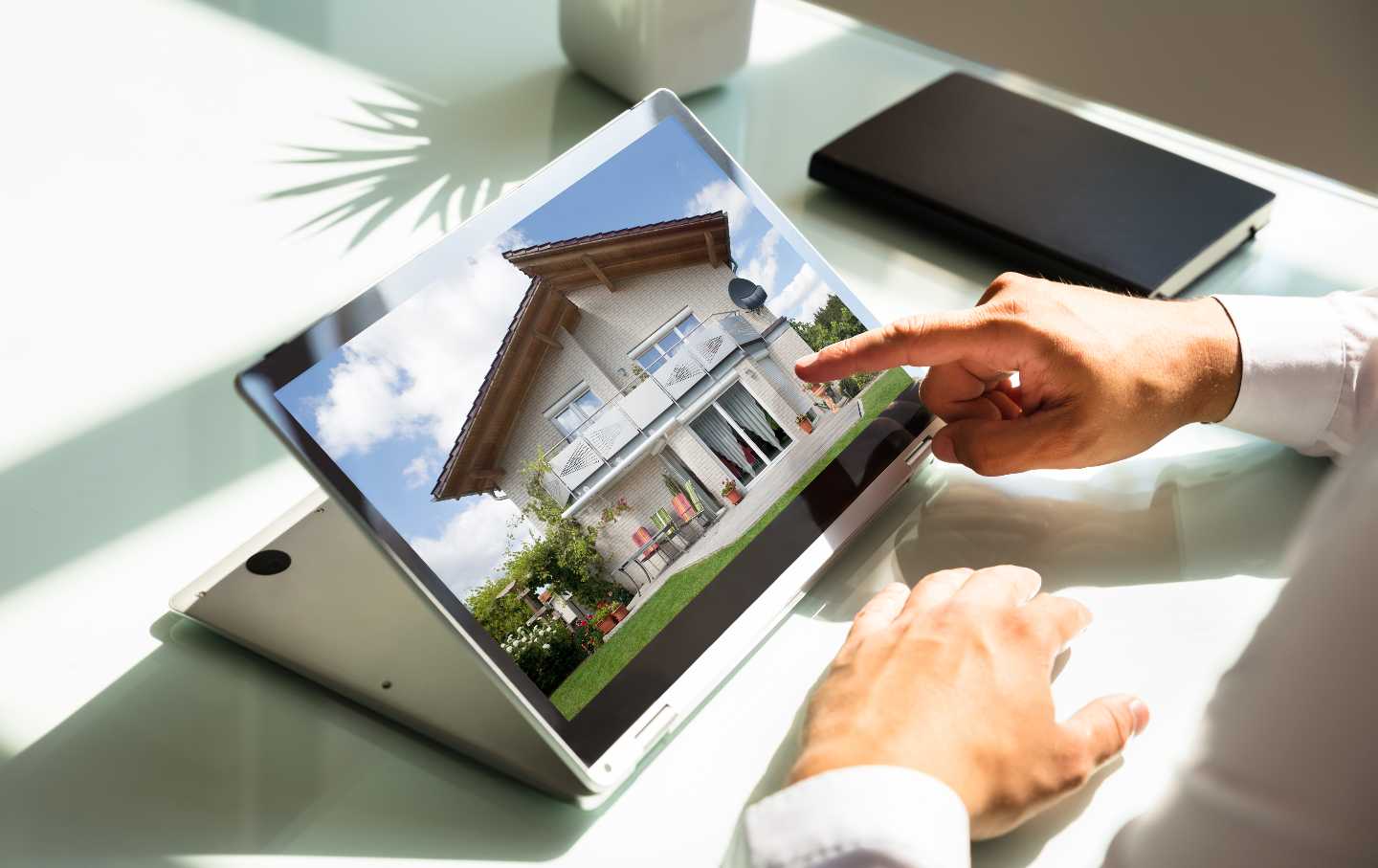
This is part of why houses increasingly look like hotels. Another important, rarely discussed factor is that most of the home-related media we now consume does not come to us via magazines or cable television or even social media; it comes to us through real estate listings. Real estate listings as a specialized form of media is a relatively new phenomenon. Our ability to surf them recreationally is a post–Web 2.0 invention. Before aggregators like Zillow appeared in the late 2000s, real estate websites were more localized and usually difficult to navigate. They existed not to be browsed by curious strangers but simply to sell property. In some cases, listings were text-only; to see the inside, you had to schedule a tour. This tended to prevent interiors from becoming homogenized. In the pre-Zillow era, home staging—the practice of preparing a place to either photograph it or sell it—involved filling empty rooms with rented furniture to make it look lived in.
Now people increasingly use these websites for both escapism and inspiration for their own homes, though no concrete data exists on whether this is reflected in remodeling practices—partly because researchers don’t consider listings sites to be home-improvement media. However, the same decorating trends can also be found on home-improvement television, which used to be more diverse in its aesthetic approaches. Current HGTV shows are overwhelmingly premised on flipping or selling houses, which seriously constrains the range of decorating languages they present. We seem unable to move beyond the various minimalisms of the 2010s, whether farmhouse modern or greige-and-marble blahness, because of a self-perpetuating cycle in which selling is prioritized over living—and because real estate listings are now the primary medium for viewing, interpreting, and valuing houses.
After all, what do hotels (and Airbnbs) and real estate listings have in common? They are staged. A hotel is not a home but merely pretends to be one for a short, comfortable time. Staging has merged in a very strange way with the practice of decorating itself. It is through this lens of real estate listings as media and staging as decorative practice that we can understand the present state of vernacular interior design—as well as emerging practices like the self-merchandising that Pendergrast describes. If we inhabit a house designed primarily to be sold, the logic of commodification touches everything in sight. A room with objects placed normally—say, a broom resting against a kitchen wall—seems “cluttered” once you’ve internalized the tenets of staging for a mass audience. If our pantries and kitchen now follow the logic of merchandising, the rest of the home now follows the logic of staging.
In the same way that images of emaciated fashion models distort our perceptions of our own bodies, staging distorts our idea of what home is and what a good house looks like. Also like fashion media, which rarely features bodies that are close to statistical norms, real estate listings and home-improvement shows pathologize what is, in reality, perfectly fine. As I’ve written before, because of financial incentives, non-renovated houses are rarer and rarer in listings. But beyond that, we don’t often see the interiors of real houses and the messy truth of how most of us live except when we visit other people. We see the interiors of celebrities’ homes, photographed for magazines or Instagram. We scroll through Zillow out of boredom, but also out of a natural and wonderful curiosity about what other people’s homes look like, and are often disappointed to see what seems like the same hotel-lobby interior over and over again.
Ironically, one is more likely to find content set in an ordinary person’s house or apartment on newer social media like TikTok, which are often blamed for algorithm-driven homogeneity and various social ills, than on their still-image predecessors like Instagram and Pinterest. And numerous TikTok users are busy archiving and explaining rapidly disappearing phenomena that many members of Gen Z grew up with, like the Tuscan kitchen of the McMansion era. What these users label “aesthetic,” “-core,” or nostalgia content is in reality a form of ad hoc historic preservation and documentation. These interiors are interesting because they are different. As is often the case, the youth offer us hope.
We should always remember that the purpose of a home is for living and that decoration, for many, is a form of self-expression. Media literacy, which has improved with regard to beauty and fashion content, lags when it comes to architecture and interior design. Changing that begins with realizing that most homes don’t actually look like hotel lobbies or real estate listings. They, rather joyfully, look like homes—dust bunnies and all.
Support independent journalism that does not fall in line
Even before February 28, the reasons for Donald Trump’s imploding approval rating were abundantly clear: untrammeled corruption and personal enrichment to the tune of billions of dollars during an affordability crisis, a foreign policy guided only by his own derelict sense of morality, and the deployment of a murderous campaign of occupation, detention, and deportation on American streets.
Now an undeclared, unauthorized, unpopular, and unconstitutional war of aggression against Iran has spread like wildfire through the region and into Europe. A new “forever war”—with an ever-increasing likelihood of American troops on the ground—may very well be upon us.
As we’ve seen over and over, this administration uses lies, misdirection, and attempts to flood the zone to justify its abuses of power at home and abroad. Just as Trump, Marco Rubio, and Pete Hegseth offer erratic and contradictory rationales for the attacks on Iran, the administration is also spreading the lie that the upcoming midterm elections are under threat from noncitizens on voter rolls. When these lies go unchecked, they become the basis for further authoritarian encroachment and war.
In these dark times, independent journalism is uniquely able to uncover the falsehoods that threaten our republic—and civilians around the world—and shine a bright light on the truth.
The Nation’s experienced team of writers, editors, and fact-checkers understands the scale of what we’re up against and the urgency with which we have to act. That’s why we’re publishing critical reporting and analysis of the war on Iran, ICE violence at home, new forms of voter suppression emerging in the courts, and much more.
But this journalism is possible only with your support.
This March, The Nation needs to raise $50,000 to ensure that we have the resources for reporting and analysis that sets the record straight and empowers people of conscience to organize. Will you donate today?