
Israel Is Using Its Genocidal Gaza Playbook on Iran
Just as in Palestine, the Israeli government is framing its latest conflict as a holy war of extermination.
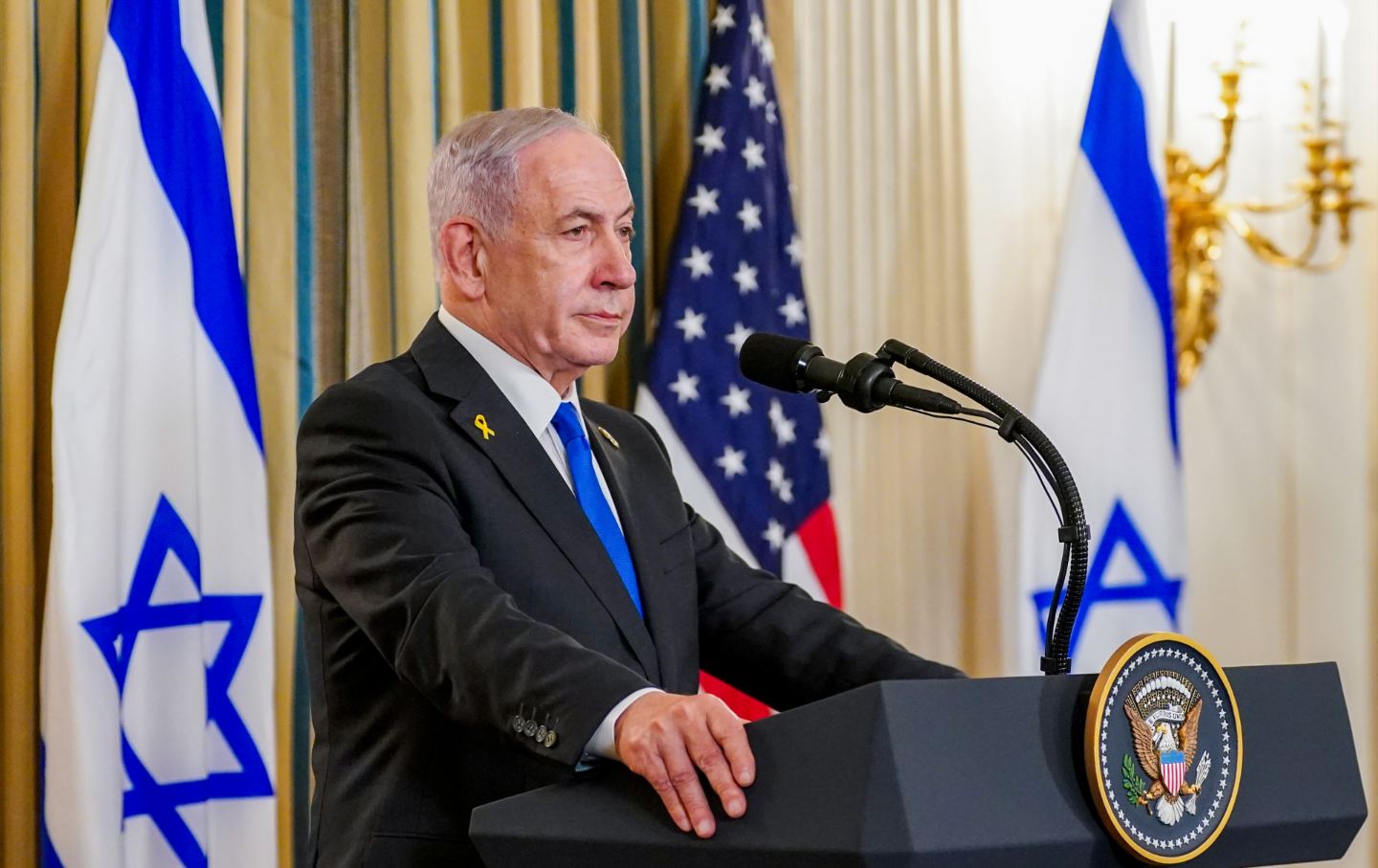
Benjamin Netanyahu in the State Dining Room of the White House, on September 29, 2025.
(Will Oliver / EPA / Bloomberg via Getty Images)On March 2, Israeli Prime Minister Benjamin Netanyahu spoke from the site of an Iranian ballistic missile strike in the city of Beit Shemesh, 19 miles west of Jerusalem. Beit Shemesh had come under fire from Iran’s allies before, with the Houthi movement targeting a military base near the city in November 2024 with a hypersonic missile. The Iranian strike, which came days after the US and Israel launched an unprovoked war on Iran, hit Beit Shemesh directly, killing nine Israelis and injuring 27 more. When Netanyahu spoke to the media from the site of the devastation, he remained defiant and told gathered reporters, “But we are acting here together with the US, in the name and for the sake of all humanity. In this week’s Torah portion, we read ‘Remember what Amalek did to you.’ We remember and we act.”
Amalek, in the Torah, is described as one of the nations that fought against the Israelites. In the Bible, the prophet Samuel tells the Israelite King Saul that God wants him to “go and destroy Amalek. Destroy all they have, and do not let them live. Kill both man and woman, child and baby.”
Israel has long sought to deemphasize the invocations of Amalek in its Western-facing communications, not just because there may be unfamiliarity with the religious reference but because Israel routinely compares modern-day Palestine to Amalek as part of its justification for the Gaza genocide. “Wipe out the memory of Amalek” has become an oft-used phrase at the highest levels of Israel’s government, a dog whistle well understood to call for the extermination of the Palestinians.
Now, by linking Iran and Amalek, Israel’s government seems to be bringing that same genocidal logic to its latest conflict—only one of a number of different religious frameworks Netanyahu’s government is working within as it wages war alongside the United States.
Reports conflict about how far in advance the beginning of the war was planned, but reporting from Drop Site News indicates that the start date, on the eve of Purim, was apparently decided weeks in advance. While it is perhaps unlikely that the IDF, however committed to genocide against the Palestinians, would organize its campaigns around the onset of certain holidays, the Israeli government has seized on the religious significance of starting this conflict as Purim begins.
Supreme Leader Ali Khamenei, who was killed in a US-Israeli strike last weekend, had long been referred to by Israeli commentators as a Haman of modern times, referencing the scheming Persian vizier in the book of Esther that sought to exterminate the Jews of the Persian Empire. In the biblical story, Haman is executed by the king when his plot is revealed, and his children are killed in battle against the Jewish people defending themselves from extermination. Khamanei’s assassination, which occurred alongside the killings of his wife, daughter, and 14-month-old grandchild, has been spoken about in this register, with both pro-Netanyahu and anti-Netanyahu politicians alike boasting that the modern Haman had been eliminated. Itamar Ben-Gvir, Israel’s national security minister, declared that there had been a “great miracle…like on Purim” and that “they will all end like Haman.”
Ben-Gvir, a far-right extremist and an instrumental member of Netanyahu’s cabinet, has also used Amalek comparisons when discussing the Iran war. While some Israeli commentators who invoke Amalek’s name in describing Iran make the differentiation between the Iranian government and an allegedly Israel-friendly people waiting to take power, Ben-Gvir has made no such distinction, posting on X at the beginning of the war, “Blot out the memory of Amalek from under heaven; you shall not forget!”
Ben-Gvir has, unsurprisingly, also invoked the name of Amalek in reference to Palestinians both before and after the war against Gaza began. Ben-Gvir went so far as to post a placard from his political party, Jewish Power, including with Khamenei’s photo one of former Iranian president Mahmoud Ahmadinejad, captioned with a verse from the Book of Esther: “That the Jews had rule over those who hated them”—and a giant noose. Reports of Ahmadinejad’s assassination at the hands of Israel have apparently been greatly exaggerated, but the potential news of the killing of someone who had not been president for over 13 years was to be supported by Ben-Gvir regardless.
While Israel does not desire to depopulate and settle Iranian territory in the way that it does Palestinian or Lebanese land, the policy of collective punishment of the entire population has been much the same, both now and during the so-called 12-day war in June of last year. For whatever Netanyahu has said about encouraging a mass rebellion by the Iranian people, his defense minister, Israel Katz, declared in 2025 that the “residents of Tehran will pay the price, and soon.” As massive bombardments rained down on the capital last June, Katz, who is still in charge of executing carpet bombings of Tehran in this war, bragged bluntly: “Tehran is burning.” That ethos remains in the current war, as was proven when a US-Israeli strike targeted an elementary school in the town of Minab. At least 168 people, many of them young girls, were killed in scenes hauntingly reminiscent of the massacres of children and the destruction of educational institutions in Gaza.
Israeli politicians have not been the only ones engaging in religious symbolism and eschatology. The US military under Defense Secretary Pete Hegseth, who sports several tattoos with Crusader symbols and mottos, has evidently revealed itself as rife with commanders who believe the war with Iran to be the final one before Armageddon. The president of the Military Religious Freedom Foundation said on Tuesday that it has received reports from 30 different installations about commanders invoking the idea of this war being “God’s plan,” that the Book of Revelation foretold these events, and that Jesus would be returning soon. One commander apparently told troops that Trump had been “anointed by Jesus to light the signal fire in Iran to cause Armageddon and mark his return to Earth.” Whether Christ’s return is imminent in the same way that the Iranian attack was imminent remains to be seen.
Hegseth has levied accusations against the Islamic Republic that it is “hell-bent on prophetic Islamist delusions,” and Secretary of State Marco Rubio has said that the country needed to be attacked now because “that entire regime is led by radical clerics who make decisions on the basis of their view of theology, which is an apocalyptic one.” Meanwhile, the executors of this war phrase the conflict in apocalyptic terms of their own, saying that they are fulfilling the promises of their own holy books, and that their justice is in fact God’s.
Both the US and Israel have long asserted the right to commit imperial violence with impunity, while expecting other countries to pay a high price if they do the same. Now that double standard is being applied to the idea of holy war itself. Theocracy, it would seem, is wrong only when some people do it. To play on an old trope: “The apocalyptic prophecies are coming from inside the house.”
More from The Nation

Israel’s Extremist Election Israel’s Extremist Election
The run-up to the vote on Tuesday is exposing the façade of Israeli democracy—and the fealty of the country's so-called opposition when it comes to matters of Jewish supremacy.

“NAZA” and Israel’s History of Automated Warfare “NAZA” and Israel’s History of Automated Warfare
As violent technologies like spyware, predictive targeting algorithms, and 2,000-pound warheads become ordinary instruments of military rule, once-abhorred practices become routin...

Brazil’s Workers’ Party Is Not Stopping Brazil’s Workers’ Party Is Not Stopping
With just a few days remaining before the runoff election, supporters of Lula’s party are doing everything possible to rally support behind the president.


Brazil’s Decision Brazil’s Decision
The moral compass and basic humanity of political leaders really does matter.

Albanian Student Strikes Spur a Political Crisis Albanian Student Strikes Spur a Political Crisis
A new round of protests against the ruling party’s corruption has Prime Minister Edi Rama giving cops bonuses to crack down on dissent.

