Renaming Columbus Day Was Never the End Goal
Don’t let fights over names distract you from the real fights over Indigenous land, sovereignty, and rights.
Every year, my tribe—the Aquinnah Wampanoag—celebrates Cranberry Day on the second Tuesday in October. It’s one of our most important gatherings, when the tribe comes together to pick wild cranberries in the bogs by the beach. Starting early in the morning, we spread out across the squelchy bogs, steadily filling buckets and baskets with the firm, red berries. I grew up away from our homelands on Martha’s Vineyard, but my family always made a trip back to the island for Cranberry Day.
The holiday fell the day after Columbus Day, meaning we could have a four-day weekend to spend on the island, but the juxtaposition of those two days always seemed ironic to me. When many states and cities began to observe Indigenous Peoples’ Day instead of Columbus Day, not much changed for us. We still spend the day after like countless generations of Wampanoags before us have—picking cranberries and catching up around a fire. There is nothing that can replace those hours reconnecting with one another, the land, and our traditions.
But as the popularity of Indigenous Peoples’ Day has waxed and waned, and with the Trump administration’s assaults on “DEI” practices like renaming holidays and places, it’s worth thinking about what the value of a day called Indigenous Peoples’ Day really is.
Joe Biden was the first president to observe Indigenous Peoples’ Day, although he did not make it a federal holiday. This year, Trump signed a proclamation for Columbus Day, calling Christopher Columbus the “original American hero.” The proclamation also says, “Columbus has been a prime target of a vicious and merciless campaign to erase our history, slander our heroes, and attack our heritage.” This spring, Trump had said that he would bring Columbus Day “back from the ashes.” In a similar vein, US Secretary of Defense Pete Hegseth said that he would preserve medals given to perpetrators of the massacre at Wounded Knee.
These actions might seem insignificant compared to the deployment of ICE and the National Guard in cities across the country, but it’s clear that they are important to the administration. On his first day in office, Trump signed an executive order changing the name of Mount Denali back to Mount McKinley, reversing a change Indigenous people had won under President Barack Obama. These actions do matter, because they are part of a larger campaign of white nationalism and colonial erasure that perpetuates the myth that Indigenous people are all gone and American settlers were noble heroes.
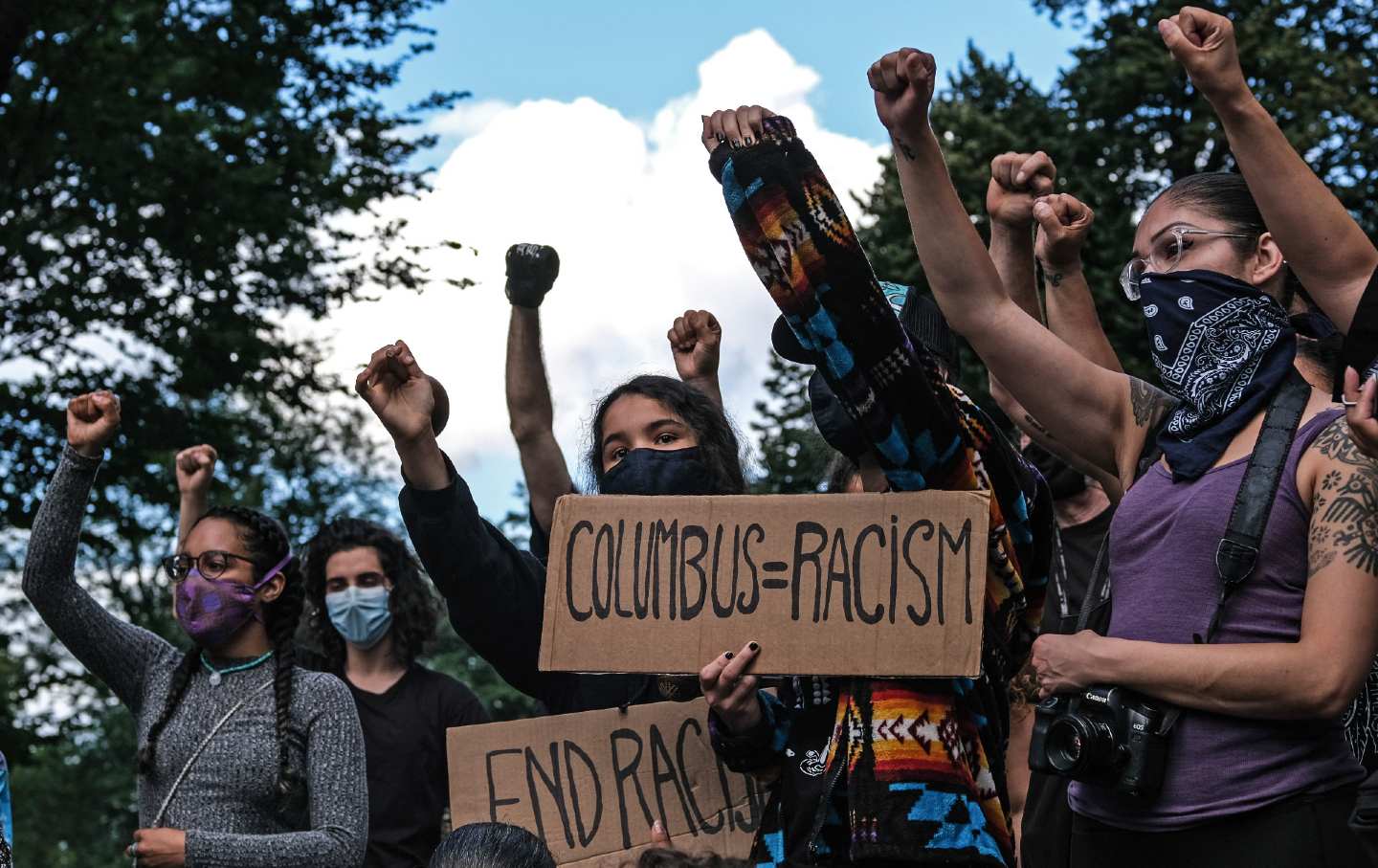
But I think we have lost sight of why those name changes were important in the first place. Columbus Day is a celebration of a brutal, genocidal history that the country continues to whitewash. One of the first observances of Indigenous Peoples’ Day in the United States was in Berkeley, California, in 1992 as a protest against the 500th anniversary celebration of Columbus’s infamous voyage. The organizers of that protest knew that we have to acknowledge and understand Columbus’s real legacy not as an unfortunate historical chapter but as part of colonialism’s ongoing project. And amid all the back and forth over names, that project has continued. Across the country, under Democratic and Republican leadership, Indigenous land and rights have been constantly under attack.
More on “Columbus Day”
As property taxes and the cost of living on Martha’s Vineyard continue to skyrocket, for example, most of our tribe no longer lives on our homelands. Meanwhile, the tribe’s efforts to establish economic opportunity and to make decisions about our homelands have been opposed by many of the same people championing Indigenous Peoples’ Day.
Name changes were real wins for Indigenous communities, but for non-Indigenous people, I think it became too easy to see them as mission accomplished. Changing the name was supposed to be the beginning of a conversation about colonialism and genocide, not the goal itself. If progress can be erased by a decree or a new sign, then the limits of that progress become obvious.
By focusing on the names of holidays and places, rather than the reasons why those names matter, we let the conversation drift away from the more important question: What would it look like to win real change? Taking on this moment requires honesty about what we have achieved and how much left we have to go.
When I talk to people from other tribes across the country, the challenges they talk about are not about names. Those challenges—from preserving Indigenous languages to the US government violating treaty rights—are the direct result of the broader mission of colonialism that Columbus was a part of. That is the work that interested allies can and should learn more about and help with. Changing names can be a stepping stone on the way to building that solidarity, but it cannot be the last step.
When my grandfather was a kid, the cranberry harvest was a longer affair, with the community staying down by the bogs for days. Back then, Martha’s Vineyard was a relatively unknown island, not the exclusive vacation destination it is now seen as. The tribe also did not have federal recognition as a sovereign nation, a status that the tribe fought for years to get, finally achieving it a few years before I was born. Those are the bigger fights—fights over land, sovereignty, and rights—that we can lose sight of when we focus only on names.
I recently published a book that explores, among other things, the complexity of Indigenous identity. At book events, one of the most common questions I am asked by non-Indigenous people is about terminology. People want to know, more than anything, what the right thing to say is—Indian, Native American, or Indigenous. Words matter, of course, but it bothers me that their most urgent concern seems to be using the term that won’t get them in trouble. There are many ways to support Indigenous communities, but they all require actually engaging with and listening to them. The problem with these conversations about language is that they can become sideshows, apart from the deeper political questions. And that’s how most Americans have thought about Indigenous people—as sideshows to the real political struggles.
For many Americans, fall is the only time of year when they think about Indigenous people. Between Indigenous Peoples’ Day, Native American Heritage Month, and Thanksgiving, we are more present this time of year in the American consciousness than any other. People often ask me if my family celebrates Thanksgiving and say they feel conflicted about celebrating the holiday. To be honest, I don’t care, and I find those conversations exhausting. I enjoy having a day off on Thanksgiving and sharing a meal with my family. No one needs my permission to do the same. It doesn’t matter to me how you spend a Thursday in November or the second Monday in October. It matters how you spend the rest of the year.