
Care Workers Are Saying No to 24-Hour Workdays
Fed up with the inhumane practice, they took their message to City Hall on May Day. Will Zohran Mamdani listen?
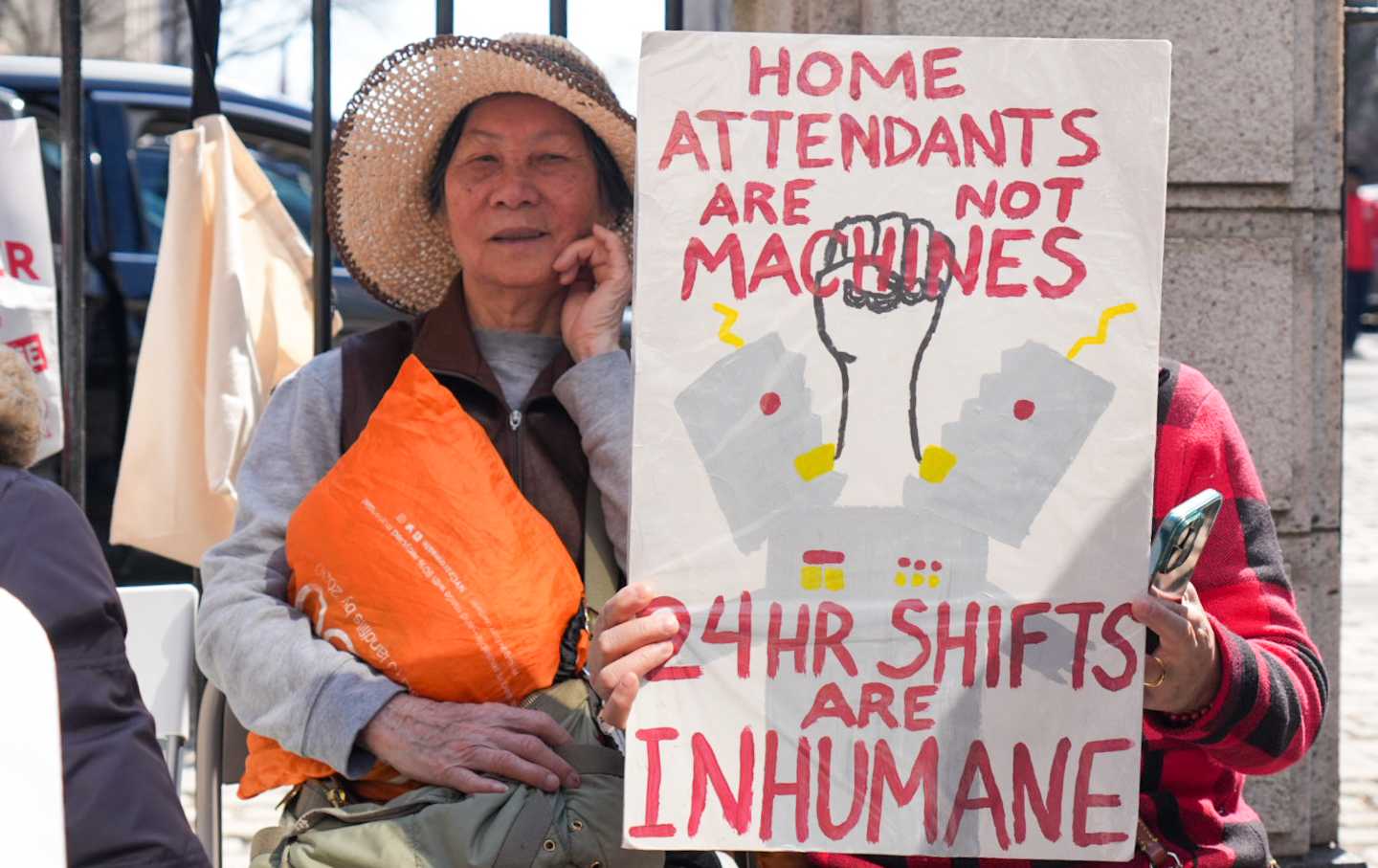
Home care workers hold a sit-in outside City Hall.
(Xavier Diaz / AP)Earlier this month, the world celebrated International Workers’ Day, a solemn occasion that isn’t recognized in America to the same degree as in other toiling nations. That oversight is particularly conspicuous because the day originated on American soil: On May 1, 1886, hundreds of thousands of American workers walked off the job in protest of an eight-hour workday. In Chicago, these eight-hour workday protests culminated in the Haymarket Affair, when police sought to break up a rally near Haymarket Square, and a bomb was detonated in the process. The trial and martyrdom of the eight anarchists who were indicted, charged, and executed led to the formation of a day to recognize the labor struggle.
The more things change, the more they stay the same. One hundred and forty-four years later, on a brisk, sunny May Day afternoon in New York City, home care workers demonstrated outside City Hall, still campaigning for a fair workday. After all this time, a 24-hour workday still exists in this country in the 21st century—even in a deep-blue union town like New York City, which recently elected a self-proclaimed socialist mayor.
The coalition was calling on City Hall to formally abolish 24-hour workdays in favor of a 12-hour limit. The speakers—among them workers, organizers, and elected officials—testified against the practice, along with addressing a litany of other pressing issues facing the Chinatown and Lower Manhattan area, such as healthcare access, housing costs, and the construction of a massive jail-complex in Chinatown. Despite differences in tone and allegiance to the mayor, the speeches coalesced around one central theme: The socialist mayor is colluding with Governor Kathy Hochul against a constituency of mostly women workers of color from South America and China—or at least failing to act on their behalf.
“We’ve had enough of Mamdani’s hypocrisy,” said Cai Qiong Liu, a home care worker who worked 24-hour days for nine years. “Hiding behind a ‘socialist’ banner, while forcing women of color to work 24-hour workdays.”
The crowd was intergenerational, with as many elderly protesters as there were youth of all races and genders, and they belonged to a range of political organizations. In the end, organizers counted some 500 people—an impressive feat in itself, considering that May Day isn’t a federal holiday, for reasons obvious to any student of American history.
The years-long struggle to abolish the 24-hour workday has been led mostly by groups such as the Chinese Staff and Workers’ Association; unfortunately, it hasn’t been received with universal goodwill and, in some quarters, has produced fault lines that undermine common sense. The 24-hour shift is an unusual exemption carved out in New York state law. Workers are paid a minimum wage of $19.10 and allotted three hours for meal breaks and five hours for sleep. Worse still, workers are paid for only 13 of the 24 hours. Some workers have reported wage theft; Cai Qiong Liu told Documented that she is owed over $100,000 in back wages. With approximately 130,000 home care workers in the city and the care economy being among the fastest-growing sectors of New York’s economy, the scale of exploitation is breathtaking.
In all my conversations with the assembled care workers, none seemed to have consistently received the five hours of uninterrupted rest the law hinted at. With patients waking up and requiring care at all hours of the night, home care workers found their own sleep disrupted. The accelerant to their own overwork inevitably led to injuries or an early forced retirement. Each of them also spoke to how isolation progressively wore them down.
Yunfang Zhang has been a home care worker for 12 years. Over most of her career, she worked the 24-hour work shift for four days straight, at the cost of both her health and her time with her family. She got involved in the movement when, in 2022, she received a call from a friend who told her about the number of workers who were “rising up” against the practice.
“Our workdays are very inhuman,” she said, “It’s slowly killing us, because the whole 24-hour workday, we work day and night. During the day, I have to do housework, do the laundry, cook, and take care of everything for the patients. At night, we have to help the patient turn over their body every two hours, which caused huge damage to my health.” At the end of the interview, she showed me an image of her hand from 2022, which was twice its size and had a bluish-purple tint.
Despite a large Democratic majority and a strong union presence in both the city and state, the plight of home care workers was largely ignored during the freewheeling Eric Adams era, as former speaker Adrienne Adams refused to bring an earlier version of the No More Act 24 to a vote in 2022. In mid-March, several home care workers launched a hunger strike outside City Hall to demand that the No More 24 Act finally be put to a vote. On the second day, council speaker Menin directly addressed the starving workers, promising not only a vote but also that no changes would be made to the act’s current language.
In its current formulation, No More 24 would eliminate 24-hour shifts, replace them with 12-hour shifts, and impose a maximum limit of 56 hours per week. Additionally, the bill would empower the Department of Consumer and Worker Protection—one of Mamdani’s key enforcement mechanisms—to investigate violators and punish them accordingly. Fortunately for workers, the new version of the No More Act 24—currently under the title of Intro. 303—has a host of backers in City Hall. Among the sponsors of the act are city progressives like Chi Ossé, who was recently arrested during an eviction defense against deed theft in Bed-Stuy, public advocate Jumanne Williams, and the bill’s author, Christopher Marte, who was a keynote speaker at the rally.
“Today we gather here to remind everyone that history will not be rewritten by those evil players who say ‘New York City is a workers’ town, NYC is a labor town’ but do not stand with these workers,” Marte said to the cheering crowd. “Call my council member colleagues and tell them to look these workers in the eye, and to pass the No More 24 Act.”
Popular
“swipe left below to view more authors”Swipe →When I spoke to Marte after the rally, he laid blame not only on home care agencies but also on the “system and mindset of complacency” that includes insurance companies, nonprofits, and elected officials, alluding to Hannah Arendt’s concept of “the banality of evil.” The issue is personal, as Marte’s mother also worked 24-hour days as a home health aide in the Bronx, going days in a row without seeing her family.
Some don’t see the issue the same way. Advocates for the elderly, people with disabilities, and even some labor unions have voiced concerns over issues such as President Trump’s cuts to Medicare funding. The union that represents home care workers, 1199SEIU—which fought against an earlier version of No More 24—estimates that an additional $460 million in funding would be required for the change, which would require a state- rather than city-level law. However, organizers and workers feel that these concerns, while legitimate, are being shifted onto workers rather than employers.
The 24-hour shift is emblematic of the other crises these workers face: the rising cost of living, immigration status, limited healthcare access, and the threat of developments in Chinatown such as a casino and a jailscraper. “If our health isn’t protected and our money isn’t being given to us, then we’re easier to displace,” said Casey Robinson, an organizer with Youth Against Sweatshops. “It’s harder to build power as working people together.”
If Speaker Menin doesn’t put the No More 24 Act to a vote by May 14, organizers and workers have promised to return to City Hall on the 15th. Although the bill is expected to pass, amid divides over public safety, immigration, Palestine, and now the home care struggle, a left opposition to the mayor may soon gain momentum.
More from The Nation

Trump Has Made it Legal to Destroy Endangered Species’ Habitats Trump Has Made it Legal to Destroy Endangered Species’ Habitats
By redefining the meaning of “harm” in the Endangered Species Act, the administration is giving big corporations a gift they have long demanded.
Journalist Meaghan Beatley on Latin America’s Feminist Resistance Journalist Meaghan Beatley on Latin America’s Feminist Resistance
A conversation with the author of Sex and Dissent about what American feminists can learn from the Green Wave movement.
As Cornell’s Rape Case Draws National Attention, Students Want Accountability As Cornell’s Rape Case Draws National Attention, Students Want Accountability
A new lawsuit alleging that a former student was drugged and gang-raped by Chi Phi fraternity members is sparking outrage in the Cornell community.

Irish Goalkeeper Gavin Bazunu’s Refusal to Play Against Israel Puts Him on the Right Side of History Irish Goalkeeper Gavin Bazunu’s Refusal to Play Against Israel Puts Him on the Right Side of History
Bazunu’s decision raises the perennial question: Why is a country that is currently committing a genocide allowed to compete in the first place?
The Promises and Compromises of the University of California The Promises and Compromises of the University of California
I grew up in a neighborhood manufactured by the University of California, Irvine. It felt like a utopia for academics—until the university forsook its mission of serving the publi...

