
The Troubled History of DIY Trans Healthcare
Trans people have been going underground to access care for generations. But that doesn’t mean DIY networks are a large-scale strategic answer to transphobia.
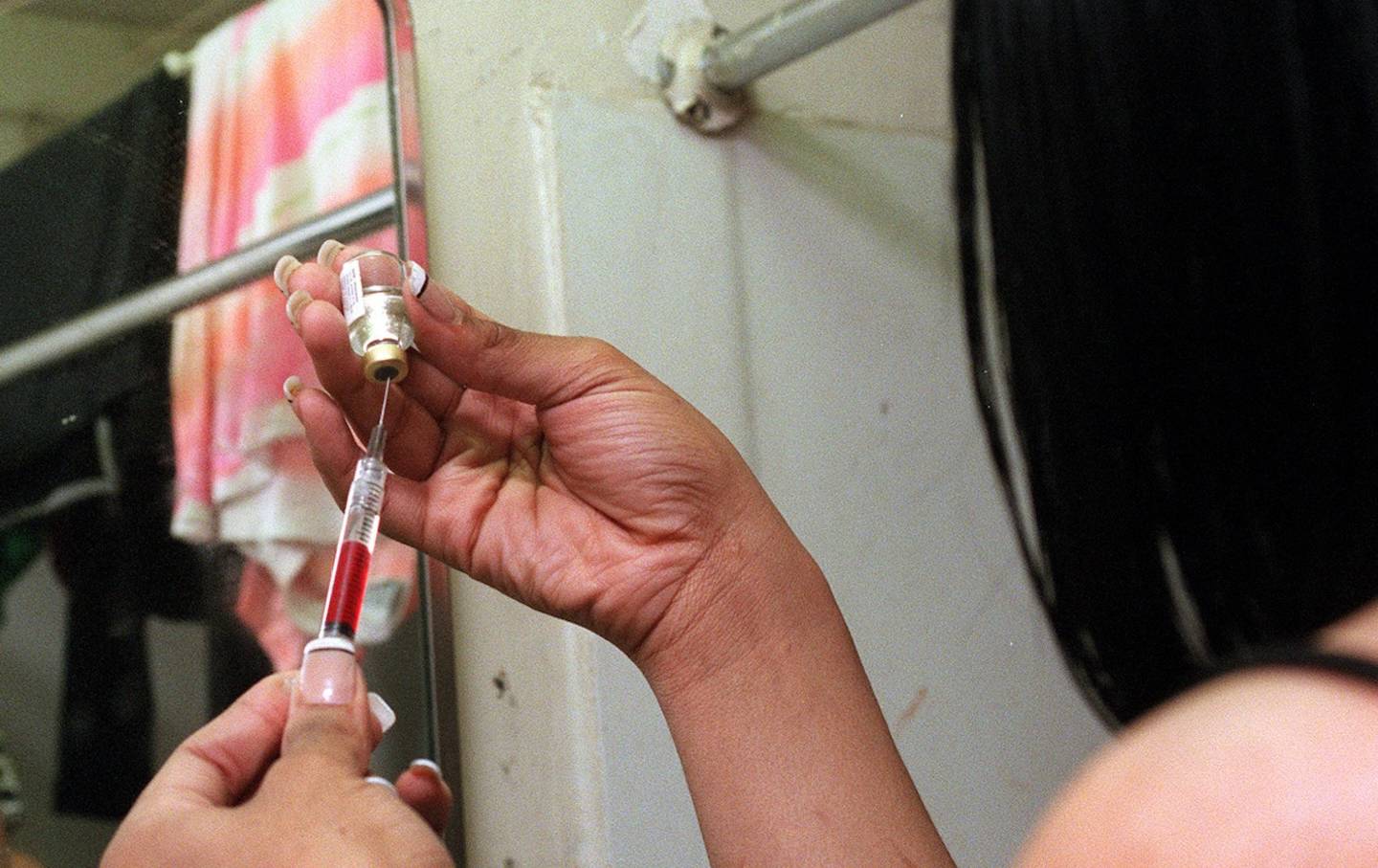
A trans woman prepares a hormone shot obtained on the black market, in New York City on December 1, 1999.
(Lynsey Addario / Getty Images Reportage)Donald Trump’s return to the White House in 2025 made many trans Americans worry about whether their access to healthcare would be taken from them. Nearly 18 months later, as Trump continues to dismantle rights for minorities of all kinds and for trans people in particular, that fear is worse than ever.
The Trump administration has already moved to ban trans care for minors nationwide—a position backed in principle by the Supreme Court—and has attempted to remove trans care from federal health plans. Furthermore, 11 states have passed laws banning Medicaid from covering trans-related care for adults as well as children—a serious attack on a group of people who are disproportionately likely to live in poverty. Many people suspect that it’s only a matter of time before the federal government tries to outlaw hormone replacement therapy altogether. A few experts are even worried America is in the early stages of an attempt “to destroy a gender group.”
Against this backdrop, some trans people have been forced to find hormones outside official channels, turning to online forums for help securing estrogen or testosterone. Recent reports detail trans people ordering drugs from countries like Taiwan and China.
Hormones, for what it’s worth, are relatively easy to produce. They’re readily available across the medical market. Most people who take estrogen or testosterone are not trans, and such hormones are not inherently dangerous. The onslaught of anti-trans legislation is designed to demonize the small fraction of people who do medically transition.
It’s not the first time trans people have been forced to seek healthcare underground, smuggling hormones across state lines or locating sympathetic doctors in the face of a repressive government. In fact, the history of do-it-yourself hormone replacement therapy stretches back decades. That history can be traced through zines, documentaries, and contemporary interviews with trans women. Legendary trans activist Miss Major once said she bought estrogen from a fortune-teller in Chicago, who furtively handed over pills from behind her crystal ball.
In the mid-20th century, many poor trans people shared material resources, including hormones, with one another on the streets, while more upwardly mobile white trans people dismissed DIY hormones as unnecessarily dangerous in newsletters like Tranvestia and Moonshadow. But only a select few were able to transition through mainstream healthcare institutions. Doctors often set draconian standards for those they were willing to treat—often only helping wealthy white trans people who professed heterosexual inclinations.
That didn’t stop people from wanting to transition—and, after World War II veteran Christine Jorgensen rose to fame in 1952 as an early transgender celebrity, the demand for surgery continued to increase. In 1966, John Hopkins Hospital opened a gender clinic, one of the first of its kind, but it only treated 24 candidates out of nearly 2,000 applicants during its first few years.
Faced with such stingy proscribers, many trans people circumvented bureaucracy through dubious sources. In the 1960s, trans starlet Candy Darling bought her estrogen from a less-than-reputable doctor, something many believe contributed to her early demise. Around the same era, Agnes, the subject of Dr. Harold Garfinkel’s foundational sociological text, Studies in Ethnomethodology, convinced her physician that she was intersex and talked him into giving her a vaginoplasty. (Some doctors like John “Butcher” Brown preyed upon trans women as an easy mark, performing “crude” and harmful operations; Brown even killed a patient in 1998.)
In the 1970s, the controversial entrepreneur Geraldine Elizabeth Carmichael tricked a veterinarian into prescribing her estrogen for a pet that she then used herself. Others went to Tijuana to buy estrogen off the shelves, returning to the United States with suitcases full of hormones to distribute. Venus Xtravaganza, a ballroom ingénue and the breakout star of the 1990 documentary Paris Is Burning, bought her hormones from a sketchy doctor who waited around ballrooms for potential buyers of pills and silicone injections.
Some trans women, like Aleshia Brevard, even learned how to perform orchiectomies by pestering their doctors with endless questions, only to then perform the operations themselves. Michael Dillon, the first known trans man to undergo a phalloplasty, also became the first known trans surgeon when he gave Roberta Cowell an orchiectomy around 1950. Rumors of self-castration dogged the 1970s, causing Edythe Ferguson and other “respectable” trans women to decry such “self-mutilation.”
But to many, doctors were merely an obstacle to transition rather than a resource, and DIY care offered an alternative to the prurient gaze of cis doctors. In his essay “Mutilating Gender,” Dean Spade sums up the reason many seek care outside the hallowed walls of hospitals: “No one trusts doctors as the place to work things out.”
Statistics about current DIY HRT use are sparse; few want to admit to engaging in what is technically an illegal form of healthcare. But a 2015 study of 433 trans people by the Trans PULSE Project found that a tenth were using hormones obtained through friends or the Internet. Self-administering hormones does seem, however, to be a more common practice among trans women since estrogen is not a controlled substance like testosterone. But as the Trump administration makes it more and more difficult to transition legally, DIY hormone use may become more widespread.
Trans historian and scholar Jules Gill-Peterson is skeptical about DIY’s ability to solve the contemporary political attack on the right to change sex. The author of Histories of the Transgender Child and A Short History of Trans Misogyny has written extensively on the history of DIY trans healthcare. Her 2022 article in The Baffler, “Doctors Who?” outlines how many found care outside the doctor’s office. At first, Gill-Peterson considered DIY an antidote to wishy-washy liberal arguments in favor of trans rights. It seemed like a framework that allowed for trans people to solve their own problems.
But as she did more research on the topic, she was surprised to discover that most people who transitioned still saw doctors. There were, for example, no DIY vaginoplasties. Sure, some women could get silicone injections to aid in breast augmentations, but no one was obtaining all their care exclusively from the underground. Most people I spoke to didn’t seem to think DIY hormones were that widespread. Trans mutual aid networks did not have the resources or institutional power to supply major surgeries. To describe the material aspects of such a life, Gill-Peterson utilizes the term transsexuality, a word she says more accurately describes the cobbling together of care undertaken by trans women to change their sex.
Her research led Gill-Peterson to conclude that DIY was not a large-scale strategic answer to transphobia. “I understand why DIY feels like a kind of fallback position or [gets] described as mutual aid, but I think one of the things I want to say is that this is often not the case,” Gill-Peterson says. “DIY is a form of hard-earned resilience that people have been forced into.” It was not a large-scale strategic answer to transphobia. Even a group like the Transgender Action Organization, which hoped to establish a trans clinic staged by trans women, didn’t quite get there. Instead, the group, led by Angela Lynn Douglas, seems an admirable but flawed example of how DIY efforts can easily fall apart without institutional support.
Gill-Peterson worries that terms like “gender-affirming care” obscure the fact that for many people, getting surgery is life-saving and treats debilitating dysphoria. The romance of DIY, she feels, can’t quite live up to such a challenge. “Changing sex is a calling,” Gill-Peterson says. In the past, trans women had to devote their entire lives to transitioning. Sometimes it took years to discover how to start the process. “You would go to the library and read every book, every magazine you could find. You would go to every bar and interrogate every working girl. You would do whatever it took.” Now the Internet has revolutionized trans medicine. It’s far easier to find and connect with sympathetic doctors, clinics, and hormones. But under the current administration, trans rights are continuing to deteriorate. Gill-Peterson believes the adminstration’s goal is to dissuade more people from coming out. “Fear is very successful in stopping people from transitioning,” she says.
DIY may play a role in the future of trans care in America, but securing surgery is another matter altogether. Perhaps doctors willing to bend the rules will once again arise. “I think the tradition of transsexuality is something you commit your life to,” Gill-Peterson adds. “If you’re willing to build your whole life around it, if it’s what you have to do in order to be alive, then you can do it. I think hormones will remain the easiest part of transition.” While DIY hasn’t figured out solutions to all of these problems, there is at least one example of a successful trans-run clinic.
For years, the myth of the “balls barn” haunted online trans discourse. Some wondered about the supposed existence of a hub for orchiectomies in Olympia, Washington, run by two trans women from 2004 to 2006. It was mentioned briefly in a 2010 essay by Sybil Lamb, but wasn’t confirmed until a few years ago when its founder, Eilís Ní Fhlannagáin, went public. “Never ask permission,” she told The Independent in a 2022 interview outlining how she ran the clinic with a woman she calls Willow.
Popular
“swipe left below to view more authors”Swipe →When the operation first opened in Washington, it was Ní Fhlannagáin’s job to keep her patients calm during the procedure as Willow operated. “I know so many dad jokes because that was verbal anesthesia,” she tells me over the phone. The idea was to provide care by trans women for trans women. It was also a way to make money, something Ní Fhlannagáin believes is important to clarify. The group didn’t treat everyone who reached out online through their website, but it did end up performing orchiectomies on nearly 20 patients.
The center was entirely legal, even passing an inspection by Washington State health officials. The clinic carefully screened potential patients and turned them away if their documents didn’t match. Letters from doctors were required to undergo an orchiectomy, as the two women were careful to do everything above board. Ní Fhlannagáin states that their operation had a zero percent infection rate.
The women took inspiration from the Jane Collective, an underground abortion service that ran from 1969 to 1973 in Chicago. Their punk, DIY ethos inspired her own. She Ní Fhlannagáin wanted trans women to feel safe receiving care from trans women. They provided their services on a sliding scale, never charging more than $500—far less than any official doctor offering an orchiectomy. The money was mostly used to cover the cost of medical supplies, Annie’s Mac & Cheese, and cigarettes. Ní Fhlannagáin also offered electrolysis on the side. Sometimes, after surgery, she and Willow would teach their patients how to fire an AR-15. One of the women they treated and shot guns with was Bryn Kelly, a beloved cult writer who passed away in 2016. “She was my baby girl,” Ní Fhlannagáin says. “I had her Godfather DVD for years because she was playing it while I did electrolysis on her. That and Fleetwood Mac. I can’t hear Fleetwood Mac without thinking about Bryn.”
The operation didn’t come without a cost. “Trans healthcare is a drag,” Ní Fhlannagáin told the Independent. Eventually, running the clinic took its toll. Such massive undertakings by individuals are hardly a substitute for institutional support—the kind that Trump is now aiming to strip away for those under 21. Eleven years ago, a few years after the clinic closed, Ní Fhlannagáin ended up moving to Ireland. She started working in tech and writing her memoir, and even toured with trans writers like Casey Plett, Imogen Binnie, and Cat Fitzpatrick. She felt safer in Ireland, where the queer community more readily integrated trans people. “If I was in the United States again,” she says, “I’d be doing everything I could to get out.”
Ní Fhlannagáin feels that DIY is only one part of the equation. Still, she sees the appeal. “I’m taking control of my fucking body,” Ní Fhlannagáin says. “DIY is probably that one step that trans people can do to gain back some agency.”
The threat to bodily autonomy isn’t new. From Magnus Hirschfeld’s gender clinic in Weimar Germany to the Compton Riots in San Francisco, the right to change sex has faced intense backlash. The troubled history of DIY trans healthcare shows that doctors and politicians often decided who was and wasn’t worthy of care. In response, trans people found their own way. Sometimes this involved obtaining hormones from friends or trips across the border. Sometimes it meant dealing with less-than-reputable doctors. Shrouded in secrecy and myth, past precedent illuminates how trans Americans may once again turn to using their wits and excavating the underground to survive. If only such measures weren’t necessary.
More from The Nation

Trump Has Made it Legal to Destroy Endangered Species’ Habitats Trump Has Made it Legal to Destroy Endangered Species’ Habitats
By redefining the meaning of “harm” in the Endangered Species Act, the administration is giving big corporations a gift they have long demanded.
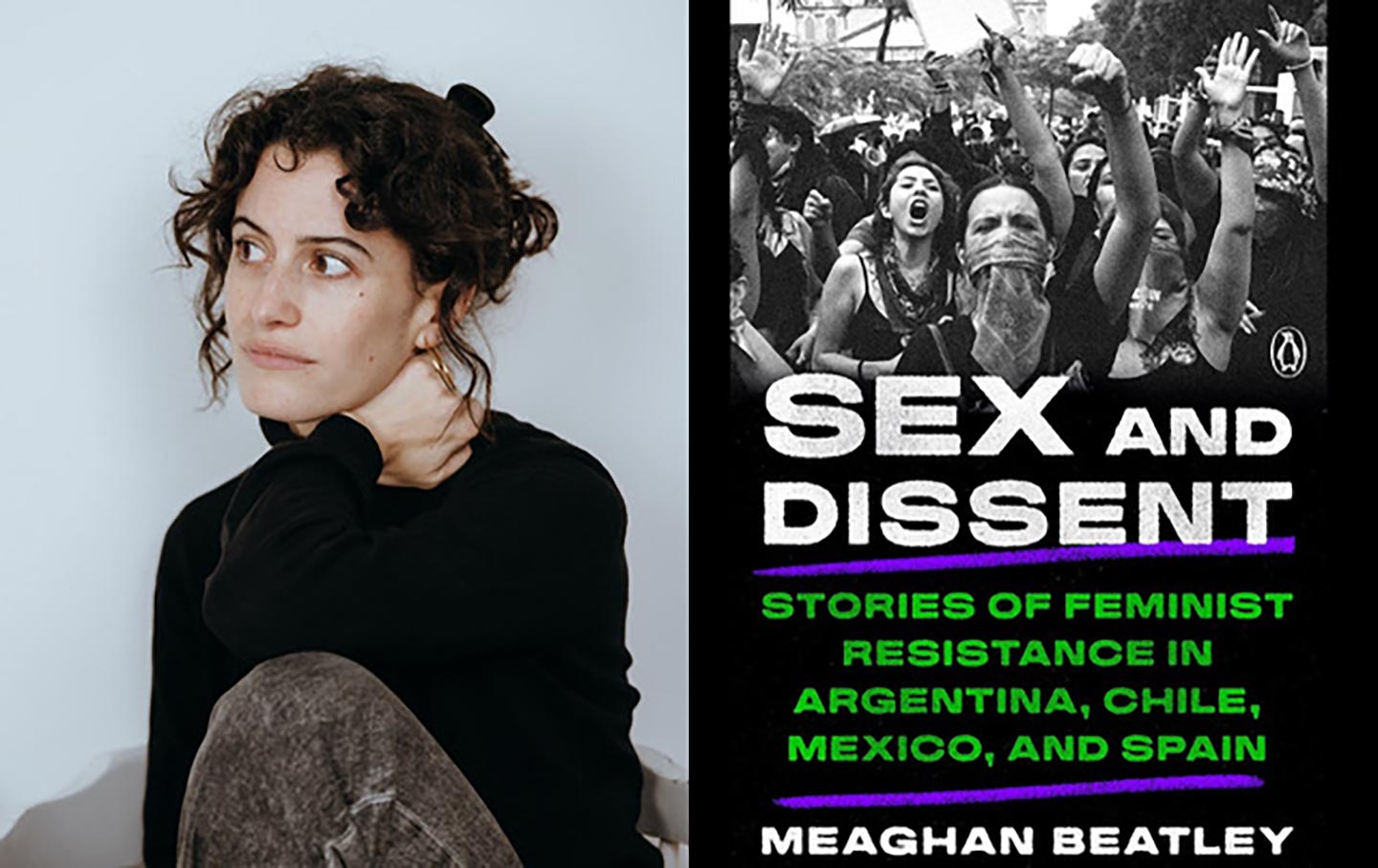
Journalist Meaghan Beatley on Latin America’s Feminist Resistance Journalist Meaghan Beatley on Latin America’s Feminist Resistance
A conversation with the author of Sex and Dissent about what American feminists can learn from the Green Wave movement.
As Cornell’s Rape Case Draws National Attention, Students Want Accountability As Cornell’s Rape Case Draws National Attention, Students Want Accountability
A new lawsuit alleging that a former student was drugged and gang-raped by Chi Phi fraternity members is sparking outrage in the Cornell community.

Irish Goalkeeper Gavin Bazunu’s Refusal to Play Against Israel Puts Him on the Right Side of History Irish Goalkeeper Gavin Bazunu’s Refusal to Play Against Israel Puts Him on the Right Side of History
Bazunu’s decision raises the perennial question: Why is a country that is currently committing a genocide allowed to compete in the first place?
The Promises and Compromises of the University of California The Promises and Compromises of the University of California
I grew up in a neighborhood manufactured by the University of California, Irvine. It felt like a utopia for academics—until the university forsook its mission of serving the publi...

