Why Pope Leo Gets Under Trump’s Skin
The Catholic Church’s power is on the wane—but it now has a pope who is to the left of many US institutions and enrages the president by expressing his convictions.
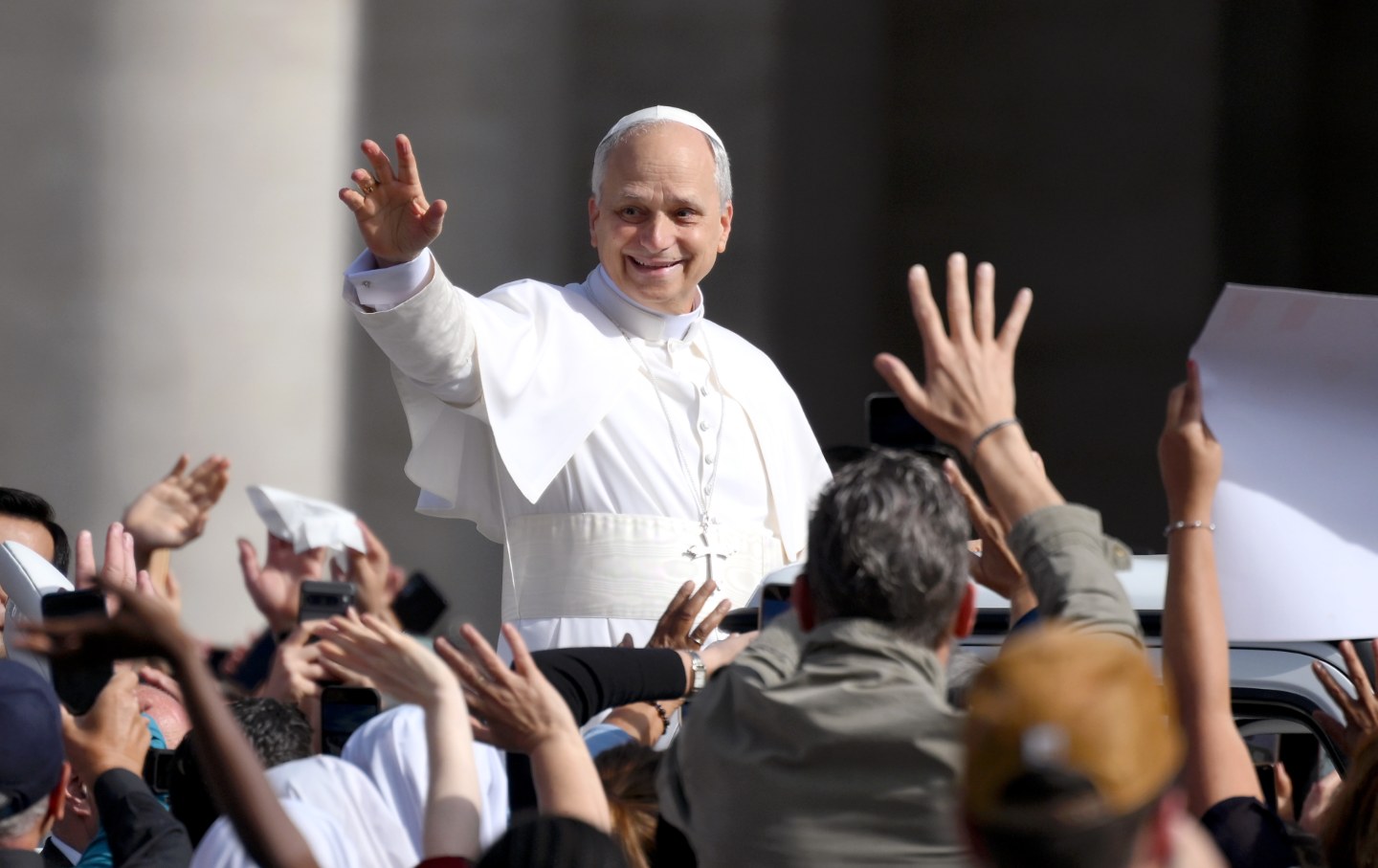
As is the case with so many of its forays, it’s hard to figure out the endgame of the Trump administration’s belligerent clash with the Vatican. There was more than a touch of mockery to The New York Times’ April headline “Vance Says the Pope Should Be More Careful When Talking About Theology.” The vice president converted to Catholicism (loudly) seven years ago and has not taken kindly to Pope Leo XIV’s exhortations to avoid bloodshed (or shelter the immigrant, or abide by any number of the core tenets of Catholic social teaching). The contretemps, while alternately entertaining, infuriating, and baffling, does not tell us much we didn’t already know about the current White House. But what does it tell us about the current Catholic Church? What, if anything, do the agnostic, the irreligious, or the non-Catholic religious need to know about it?
The irenic tenure of the late Pope Francis, who welcomed trans Catholics and denounced unrestrained capitalism, piqued a lot of secular interest. And secular, religious, and lapsed observers alike have been trying to read the tea leaves of this new papacy ever since the election of the first American pope last spring. His public statements have been quickly seized upon and claimed (or denounced) by various political factions; there’s an online cottage industry dedicated to interpreting them. Leo’s choices do invite these reactions. It’s hard to imagine that his decision to include Isaiah 1:15 (“Even though you make many prayers, I will not listen: Your hands are full of blood”) in his Palm Sunday homily in St. Peter’s Square was unrelated to Defense Secretary Pete Hegseth’s worship service several days earlier, in which he prayed for “overwhelming violence of action against those who deserve no mercy.”
Nation readers are likely encouraged by the pontiff’s stance on the United States’ illegal and confounding war against Iran. They are probably less happy about his insistence that while the church should de-emphasize traditional Catholic stances on sexuality in favor of the pursuit of social justice, the Holy See still officially doesn’t endorse the formal blessing of same-sex couples. (I share their disappointment.) But secular observers often fail to reckon with the Catholic Church’s sheer age and size: More than 2,000 years old and sprawling across the globe, it is ill-equipped to seamlessly and promptly reconcile with concerns, however real and urgent, that have emerged in more recent decades. There’s something to the writer Madoc Cairns’s quip that “Catholicism is nine times older than the left-right paradigm.”
But here we are in 2026, when that paradigm (arguably) still holds. The apex of the church’s temporal power is centuries in the rearview mirror, and we’re living in, if you like, a disenchanted world. And yet we find ourselves with a pope to the left of any number of mainstream American institutions and a president enraged by his own inability to dampen the pontiff’s convictions.
The artifacts of the Trump administration’s side of the feud—however unprecedentedly hostile—are likely to remain either inscrutable or too daft to warrant parsing. The president keeps mentioning the fracas at inopportune moments, such as at his own public-relations stunt to highlight his tax bill’s “no tax on tips” provision. But how much “there” is there to Trump’s AI-generated image of himself in papal regalia, or the quickly deleted image of himself as a robed, Jesus-like figure healing a sick man? These are desperate bids for attention from a bellicose lame duck. The richer texts come from Leo, whose provocations remind us that religious and secular concerns can converge beautifully on the matter of human dignity in a world riven with inequality and violence. During a recent visit to Cameroon, the pope didn’t need to name names when he said, “They turn a blind eye to the fact that billions of dollars are spent on killing and devastation, yet the resources needed for healing, education, and restoration are nowhere to be found.”
It is less surprising that Leo has refused to back down in the face of Trump’s and his cronies’ attacks than that he has refused to cater to the revanchist elements that haunt his own church, particularly in the United States. For sizable factions of both the laity and the clergy (which are dramatically overrepresented online), the appeal of the church is its ostensible preservation of some pristine, remnant traditionalism. When perpetuating conservative sexual politics takes precedence over everything else, the Gospel is bound to fall by the wayside. This kind of selective thinking has plagued US Catholicism for far too long: Catholic voters are won over by pro-life politicians with policies that harm workers and the poor, while bishops play politics even at the risk of undermining the care of the most vulnerable. (If you have time on your hands, Google “Americanism heresy.”)
The pope’s promotion of peace and communal care is not a concession to some woke infiltration but the most organic possible outgrowth of the stated principles of the church he leads. His words at his first Christmas Eve mass at St. Peter’s Basilica were unequivocal: “On earth, there is no room for God if there is no room for the human person. To refuse one is to refuse the other.”
Become a Sustaining Donor This September
Between the reemergence of right-wing red-baiting and Donald Trump’s use of the chilling National Security Presidential Memorandum–7 to criminalize left political organizing, we’re seeing McCarthyism reborn before our eyes.
This assault on democracy cannot be ignored or wished away. Resisting it requires bravery in the face of threats and repression, a steadfast commitment to the truth, and the unwavering belief that we can—and will—overcome this darkness.
We must have an independent media that sets the record straight, unearths corruption and abuses of power, and advances a politics of justice and dignity for all if we’re to win this fight.
That’s why I’m writing to you today. This September, The Nation needs to add 100 monthly donors to sustain our progressive journalism. Your contribution makes the next investigative report, the next truth-speaking column, and the next pathbreaking essay all possible.
I hope you’ll support our work with a recurring donation today. If you donate $10 or more a month, we’ll send you a brand new “Hands Off the Free Press!” sticker to recognise your commitment to our cause. Please, donate today.
Onward,
Katrina vanden Heuvel
Editor and Publisher, The Nation