
Banquo’s Ghost
The contradictions of the American Revolution.
The Contradictions of 1776
From the outset the United States was founded to protect both freedom and slavery.
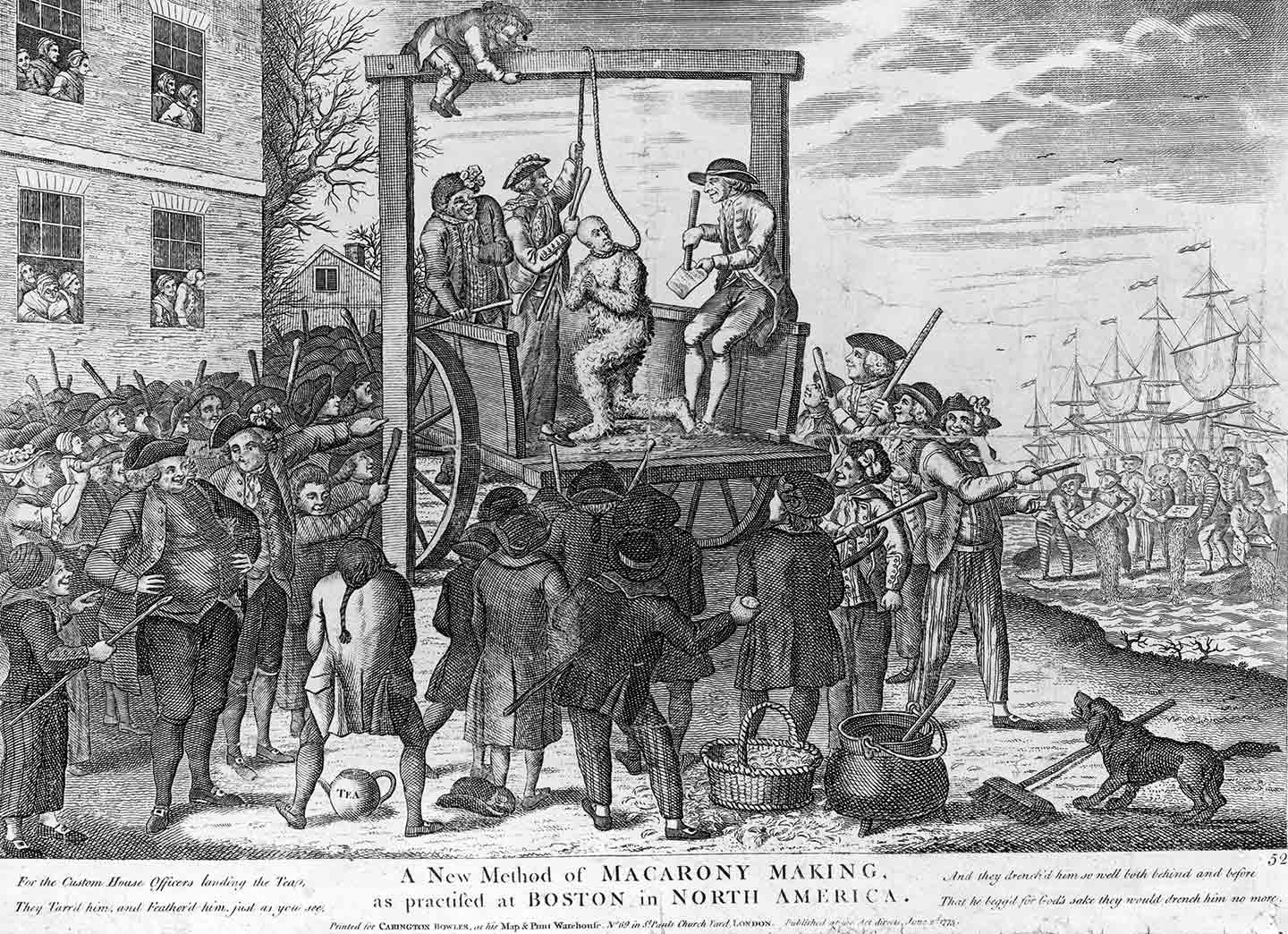
Joseph J. Ellis is one of the most celebrated historians in the nation. A winner of the Pulitzer Prize and once the holder of an endowed chair at Mount Holyoke, he was hailed by The Washington Post as the “most widely read scholar of the Revolutionary period and…probably the most influential as well.” His best-selling books on Thomas Jefferson, John Adams, and other founders have sold hundreds of thousands of copies and have been instrumental in forging a remarkable consensus, from left to right, that sees July 4, 1776, as a sacred date and a great leap forward for all of humanity.
Books in review
The Great Contradiction: The Tragic Side of the American Founding
Buy this bookBut in his latest book, The Great Contradiction: The Tragic Side of the American Founding, Ellis reconsiders the essence of his oeuvre and this consensus, which is akin to the pope reconsidering Catholicism. Focusing “on two unquestionably horrific tragedies the founders oversaw”—the “failure to end slavery, and the failure to avoid Indian removal”—Ellis seeks to understand how and why they happened. “Next to the failure to end slavery,” he writes, the “inability to reach a just accommodation with the Native Americans was the greatest failure of the revolutionary generation.” Charting not only the history of the republic’s founders but also the history that preceded and followed them, he outlines what he terms the “Great Silence”: “For more than four centuries, the most important voices of Western civilization remained mute as a highly organized program of unspeakable barbarity with genocidal implications flourished throughout Europe. Plato, Socrates, Aristotle, Aquinas, Erasmus, Locke, and all the Catholic popes regarded slavery and the slave trade as acceptable features of European society.”
Why has Ellis chosen at this late date to break from the pack of rationalizers and justifiers? The antics of the 47th US president and his avid followers have clearly left him shaken, but more than that: They point to a pattern, “an inherently paradoxical pattern,” that “racism surges only after some semblance of racial equality becomes foreseeable,” which Ellis now believes runs throughout this nation’s history. It began, he notes, “during the American founding,” and “we are currently living through its most recent manifestation in the movement to ‘Make America Great Again.’”
Ellis does not expand on this explosive point, but he concedes that the late Edmund Morgan, one of his mentors, got it right, particularly in his trailblazing American Slavery, American Freedom, which argues that these polar opposites were there from the outset. Much like Macbeth and Banquo’s ghost, Ellis concedes, the nation cannot evade the tragedy preordained at its founding.
To begin his story, Ellis starts with the horrors of the Atlantic slave trade, which accelerated as the settlers landed on these shores and was “growing exponentially” in the prelude to 1776. He observes cogently that “creating a [multiracial] society” was not as pressing a concern in the imperial capitals as it was here. Abolition would have created such a nation, and this was inconceivable for most of the founders, he suggests. Likewise, he presents the expropriation of the Indigenous as being virtually inevitable, given the pressure from below of land-hungry settlers.
Throughout his account, Ellis continually reminds us that without a compromise favoring the enslavers, the republic would not have materialized—to which I say: So what? This could have meant another Canada, a pleasing alternative to the war-driven status quo. He also explores the central paradox found in the fact that the republic depended on the labor of enslaved workers, one that Morgan had put at the center of his own work—namely that, as Ellis writes, “the presence of an enslaved black population actually enhanced the commitment to freedom by the white population of Virginia…. Less prominent Virginians were spared the task of performing manual labor, since enslaved blacks filled that role, thereby allowing all white Virginians to unite racially instead of being divided into upper and lower classes, as was the case in England and throughout Europe.”
A corrupt bargain indeed: a republic born out of enslaving many so that some could profit and be free. Naturally, such a society would engender enormous instability. Enslavers, and those who admired them, Ellis writes, “were sitting atop an active volcano on the verge of eruption…especially in the Tidewater [Virginia] counties, where Blacks outnumbered Whites three to one.”
Virginia was the California of the founding, the largest and most prosperous settlement, and it produced a disproportionate number of presidents in the antebellum era. Yet as a place where enslaved Africans tended to reside, it was simultaneously “the soft underbelly of the American resistance” to London’s rule. Being the richest and, at the same time, the most insecure of the 13 states fomented unsteadiness that ultimately culminated in civil war.
This was especially the case, Ellis writes, when Virginia’s last colonial governor, Lord Dunmore, created the “Ethiopian Regiment, numerous and armed,” which began “marching toward isolated plantations with revenge in their hearts. Any Virginia planter who harbored doubts about the wisdom of war with Great Britain quickly discovered a powerful reason to abandon those doubts.”
Simultaneously, the British Empire was becoming ever more dependent on Black labor. As Ellis writes, “the Caribbean, most especially Jamaica…provided more revenue to the empire than all the American colonies put together.” Seeking to keep a lid on Ireland, and increasingly on India as well, the British felt compelled to enlist more Black troops, which was not endearing to the settlers.
In sum, the republic was triggered into being in no small measure to quash Black resistance. As Ellis avers, “the surprising size and scale of Dunmore’s movement terrified the planter class…. The most self-evident truth of all was white supremacy.” Or to put it another way, class collaboration has been the “most self-evident truth,” still the unmentionable today in divining the country’s elections. And the unpaid sector of the working class—the enslaved, and then their descendants—have had difficulty in “integrating” into this framework, not least because it was sparked into being precisely to repress them.
“Any frontal assault on slavery,” Ellis writes, “put at risk the political unity necessary to win the war [and] to assure southern support for a nation-sized republic…. Consider the alternative scenario provided by the French and Russian revolutions, where justice imposed led to justice destroyed.” But didn’t 1776 merely delay the reckoning that arrived in 1861, which led not only to hundreds of thousands of lives destroyed in a bloody civil war but to countless Indigenous lives destroyed thereafter?
Although Ellis devotes much more time to enslavement than to Indigenous dispossession, some of this book’s most valuable insights emerge when he discusses the latter.
“Indian removal,” Ellis writes, “was the inevitable consequence of unbridled democracy in action.” While many in this nation might prefer to think otherwise, the foundations of popular government rested on the unraveling of Indigenous self-rule. The republic rests on the brutal fact that “ordinary American citizens seeking a better life and a parcel of land” colonized a continent with people already living on it. If US radicals and liberals had done a better job over the centuries in explaining this aspect of the nation’s history, perhaps Ellis would have been able to spend less time focused on it and to instead explore some of its subtleties—such as how settler colonialism in North America was not just an elite project, but one that involved “class collaboration”—unity across class lines by the interlopers—as well as a construction of whiteness that included even many born outside of Europe, particularly if they were Christian.
But to his credit, Ellis is determined to fill in many of the elisions in North American history that exist today. For example, he points out that George Washington was “in current currency…a multimillionaire” as well as a substantial landowner. A goodly number of the sainted founders were similarly endowed, thanks to Indigenous dispossession.
Ellis is also dismissive of the increasingly popular “antislavery interpretation of the Constitution as Abraham Lincoln viewed it. Lincoln, of course, had some powerful political reasons to downplay the proslavery side,” he observes in one of his endnotes, “which, as I see it, was shaped by powerful political reasons to defer the slavery question until the infant American republic had outgrown its infancy.” Instead, he focuses on the Constitution’s “fugitive slave clause,” which “explicitly endorsed slavery” and “required all the states to publicly acknowledge the abiding existence of slavery.”
Unlike today’s judicial “originalists,” who purport to ascertain the original understanding of the Constitution, and the overly confident historians who perform a similar role, Ellis stresses our inadequate surviving record of the Constitution’s creation. “We know very little about the covert deliberations,” he observes, “the arguments, concessions and compromises that generated and shaped those words.”
I confess to being torn while reading Ellis’s account. On the one hand, when a scholar of his eminence begins to raise searching questions about such a foundational matter, one is tempted to stand and cheer. On the other hand, I wish Ellis had gone further in this slim volume, particularly since the heroic Nikole Hannah-Jones, in her estimable 1619 Project, had already played a vanguard role in opening up these vistas by suggesting that a revolt led by enslavers may have had something to do with preserving slavery.
Popular
“swipe left below to view more authors”Swipe →One such area where I wish Ellis had gone further is in resurrecting the other side of his tale: those Black writers, past and present, who sought to raise searching questions about the republic’s roots. It’s a subject recently explored in Black Writers of the Founding Era, a volume edited by James G. Basker; and it’s also at the center of the film Belle, directed by the British Ghanaian auteur Amma Asante and starring the British South African actor Gugu Mbatha-Raw, which tells the backstory of the landmark “Somerset’s Case” of 1772, which blocked the forcible removal from England of an enslaved African to return him to bondage in Virginia. The role of Black critics of slavery is also portrayed in the Canadian–South African–BET coproduced docudrama The Book of Negroes, which features a classic scene in which the heroine confronts none other than George Washington himself as he is basking in victory in Manhattan.
In general, a deeper appreciation of Black studies and the scholarship it has produced would have aided The Great Contradiction immeasurably. More scrutiny of this now-besieged field would have helped Ellis and his readers understand why Black people “fled to [Benedict] Arnold’s army by the thousands,” or why—by his counting—“twice as many” of this beleaguered minority served under the British Union Jack than with George Washington’s forces. This tendency contributed to a significant reversal by Washington, who at first had “issued an order ‘to reject all slaves and to reject Negroes altogether’” and then concurred that the independence forces should accept them.
In The Great Contradiction, Ellis seems to be pessimistic about what the future holds as well. “In or about 2045, when demographers predict that the white population of the United States will become a statistical minority,” we will see yet another backlash, he writes, this time more pernicious.
Given the alarm bells sounded by the otherwise sober Ellis, one wonders if it might be time for liberals to revise many of their presuppositions—not only those that relate to the myths of the country’s founding, but also those that concern US power. For example, what Ellis condemns as “white supremacy”—and what I elaborate as “class collaboration”—requires analysts to view “Trumpism” not as aberrational but as endemic. If we are not surprised by the rightward profile of settlers in the West Bank or their comrades in today’s South Africa, then why should we be surprised by the performance of their historical counterparts, and their descendants, in this republic?
To his credit, by having the courage and wisdom to rethink his life’s work, Ellis has provided a grand service for us all.
More from The Nation
What Trump and Tucker Carlson Have in Common What Trump and Tucker Carlson Have in Common
Carlson has broken with Trump largely over the war in Iran. But on Ukraine and immigration, the two speak very much the same language.
The Jewish Case Against AI The Jewish Case Against AI
Haredi rabbis and the secular left agree: This technology is a threat to the entire social fabric.
The Fight for Educational Equality Is Also a Fight for a Just Supreme Court The Fight for Educational Equality Is Also a Fight for a Just Supreme Court
The court has severely weakened our ability to make an education system that fulfills the promise of Brown.
The Fall of “Scientific American” The Fall of “Scientific American”
When the beloved science publication got too political, its corporate owners stepped in. Now its future is uncertain.

The Bookstore Revolution in Taiwan’s Conservative Heartlands The Bookstore Revolution in Taiwan’s Conservative Heartlands
After Taiwan legalized same-sex marriage, gender-themed bookstores are working to build the social acceptance that the law alone couldn’t deliver.
Jalen Hurts Deserved Better. We All Do. Jalen Hurts Deserved Better. We All Do.
In a country that treats workers as expendable parts, Hurts’s playing through a blood clot is just the highest-profile example of the price workers pay in an oligarchy.

