
The Supreme Court Could Make Encampment Sweeps Even More Dangerous
Unhoused people face significant health risks from encampment sweeps. Grants Pass v. Johnson threatens to make them much more common.
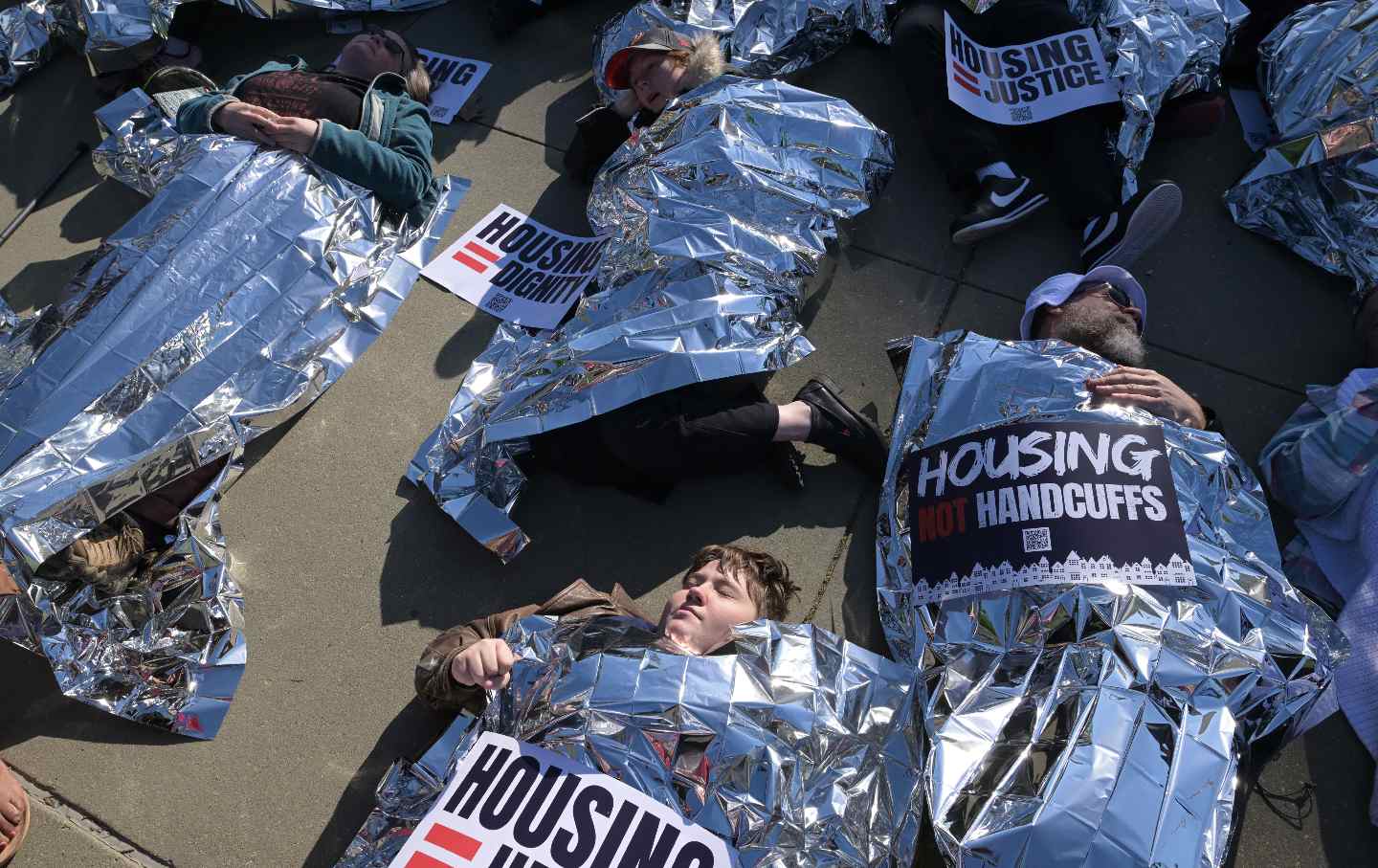
People gather to protest outside the US Supreme Court Building as the court prepares to hear Grants Pass v. Johnson.
(Matt McClain / Getty)Late last March, Christina Del Santo pitched a tent on a marshy plot of land by Connecticut’s Quinnipiac River. She calls the encampment—where she lives with two other people—one of the most comfortable situations she’s found. After becoming unhoused four years ago during the pandemic, she stayed in a shelter, but quickly moved out after being physically assaulted. Last fall, she lived in a tent until the parking authority evicted her. In the winter, she slept in a camper, but it was eventually towed, and she didn’t have the money to reclaim it.
Del Santo, who grew up in the Amity neighborhood of New Haven, moved frequently throughout her childhood to escape the abuse of her biological father. Housing insecurity has been one of the only stable fixtures of her life. “It’s oddly normal for me,” she says. “It sucks, but I’ve always been able to couch surf, or find something.”
Last spring, while visiting the McDonald’s she frequents to charge her phone, Del Santo met two people who invited her to join their encampment along the the I-91 highway. She quickly said yes.
The two other residents are good people, she says; they have a mutual understanding and get along. “I guess I’d describe it like a family,” says Del Santo, immediately adding: “But that sounds so corny.”
Yet the threat of eviction looms large. Del Santo and her neighbors are careful: no lights, no fires, no garbage pileups. She says they do their best to keep the area inconspicuous and clean. She wishes they could hang a string of solar lights around the encampment, but worries that it would draw unwanted attention.
Nationally, homelessness is on the rise. In 2023, the Department of Housing and Urban Development recorded the highest number of people experiencing homelessness in the United States since data collection began in 2007. And for the first time on record, more people experiencing homelessness are unsheltered—living in cars, on the streets, or in encampments—than living in shelters.
With limited access to medical care and greater exposure to the elements, unsheltered people face significant health risks; they are also more likely to be punished by law enforcement. And as homelessness rises across the country, those who are unsheltered and unhoused—like Del Santo—have become central in the fight over the criminalization of homelessness.
This month, the Supreme Court will rule on Grants Pass v. Johnson, deciding if the government can fine, ticket, or jail a person with no other options for sleeping on public property. On the municipal level, cities across the nation grapple with how aggressively to remove encampments and punish people for sleeping outside. In New Haven, where Del Santo lives, Mayor Justin Elicker controversially bulldozed the city’s largest encampment, known as Tent City, in 2023. In New York City, encampment enforcement reached a high of 500 sweeps a month last fall.
To unhoused activists, this fight over the rights of unsheltered people hinges on one crucial question—is criminalizing homelessness cruel and unusual?
As the question is battled out in courts and legislatures across the country, people like Del Santo are caught in an exhausting cycle: sweep, move, repeat.
Phil Costello carefully steps over a four-foot length of fishing wire, pulled taut between two trees and nearly invisible in the long grass. It’s a tripwire, protecting an encampment hidden in a grassy area off a section of I-95 running by New Haven.
Costello—or Dr. Phil, as his patients know him—visits this encampment weekly. Costello works at Cornell Scott-Hill Health Center, a Federally Qualified Health Center whose Street Medicine Team provides medical services, including wound care, abscess drainage, and prescription updates, to unhoused people in the New Haven area. Every week, Costello and his team travel across the city—from the New Haven Green to the side of highways.
Costello has worked as a street medicine provider for 11 years. Body language, he says, is crucial to his job. He greets his patients with a handshake or a hug; if they are sitting on a bench, he’ll sit on the ground. “We’re kind of like a rural practice in a big city,” Costello says. “We create relationships, we’re there every week, and we gain trust.”
Shelters aren’t a viable option for many of Costello’s patients. Some people have partners or pets they don’t want to be separated from; some experience intense withdrawal symptoms and cannot comply with no-use policies; some have trauma and psychological disorders that make congregate living impossible; some experience homophobic and transphobic discrimination in the shelter setting. Sometimes, like two winters ago, there are simply no available beds in city shelters, and waiting lists stretch dozens of people long.
Popular
“swipe left below to view more authors”Swipe →For Del Santo, encampment living affords “autonomy.” “You can’t have that in shelters,” she says. But one worry looms constantly in the back of her mind—the threat of the sweep. Soon, the Supreme Court will rule on a case that threatens to make such sweeps more common and draconian.
Grants Pass v. Johnson challenges a previous decision from the US Court of Appeals for the Ninth Circuit, Martin v. Boise, which found that the city of Boise, Idaho, could not criminalize homeless encampments if there were not available shelter beds for people who were evicted. Such criminalization, the court found, was in violation of the Eighth Amendment—cruel and unusual punishment.
In 2013, the City Council of Grants Pass, Oregon, met to devise a plan to address “vagrancy problems.” The city began to levy $295 fines and criminal trespassing charges against people sleeping outdoors. The goal, in the words of the City Council president, was “to make it uncomfortable enough for them in our city so that they will want to move on down the road.”
The city of Grants Pass has no emergency warming shelters, and, besides a domestic violence shelter and tiny nonprofit-run home village, no adult homeless shelters. The group of unhoused people who sued the city argued that the fines don’t punish them for a specific crime but rather a state of being—homelessness.
During oral arguments, the court appeared to largely split along party lines, with the Republican appointees mostly indicating agreement with the city of Grants Pass. The question of how expansive the ruling could be remains open—though experts warn that the case could have far-reaching consequences.
“There are at least 200,000 people who have no choice but to sleep outside every night,” says Scout Katovich, a staff attorney at the National ACLU Center for Justice and Equality. “What the Supreme Court would be doing and ruling for Grants Pass is essentially allowing cities to make all of those people criminals.”
This legal distinction between punishing action versus punishing status echoes the debates over how the city of New Haven, and other municipalities, should treat people living on public land. The city argues that it punishes illegal actions—such as trash buildup, health violations, and disruptive activities. But unhoused activists argue the city is punishing people for a state of being—for living in extreme poverty.
Many city governments highlight health concerns like excess debris to justify encampment sweeps. “Typically, we will remove encampments if we have a concern about safety-related issues,” says Mayor Elicker. “And we’ll respond to potential complaints if there’s an adjacent property owner or people that are using the public space.”
A different health concern, however, is overlooked in debates over encampments: the health consequences sweeps have on the people evicted. To Costello, the cost is simple. By clearing camps, the city puts his patients at higher risk of death and injury.
All three people in Del Santo’s encampment require daily medication; one neighbor uses a pacemaker. Del Santo relies on medicine and psychiatry programs to receive her meds. Street psychiatrists visit Del Santo each Thursday; in addition to medicine, the medical teams also bring her supplies like fresh socks and tooth brushes. A stable encampment is key to this routine. “If they can’t find us, we don’t get medicated,” Del Santo explains.
“When somebody gets cleared, we lose contact with them—and a lot of times, because they associate us with the city, people stop talking to us,” Costello says. People may lose their belongings or IDs in the sweep, and with that access to critical services. Costello finds that patients forcibly moved from encampments often relocate to more precarious areas: underneath bridges, next to train tracks, in flood-risk areas.
Emma Lo, an assistant professor of psychiatry at Yale and a psychiatrist with Connecticut Mental Health Center’s Street Psychiatry Team, often struggles to locate patients after their encampments are swept. When a patient is evicted from an encampment and loses contact with Lo’s medical team, they can become hospitalized for health complications that could have been treated with continued care.
Confirming Costello and Lo’s experiences, a 2022 study found that encampment abatements, or sweeps, harmed the health of unhoused people by disconnecting people from health resources, driving them to more hazardous locations, increasing interactions with law enforcement, and generating distrust of other forms of state support.
“We’re seeing some conditions decompensating, in the context of these encampment clearings, and we’re also seeing a disconnection from care,” Lo says. She works directly with Del Santo, providing her medication and psychiatric treatment at her encampment.
“Breaking up the routine is devastating,” says Del Santo. “For a lot of people like me, it’s too much. It’s overwhelming.”
Of course, Del Santo is worried about the city sweeping her new encampment, but she doesn’t have time to think about evictions all day. “I’ve got too much to worry about. I’ll wait it out, and when they do it, we’ll just find another place to go.”
Support independent journalism that does not fall in line
Even before February 28, the reasons for Donald Trump’s imploding approval rating were abundantly clear: untrammeled corruption and personal enrichment to the tune of billions of dollars during an affordability crisis, a foreign policy guided only by his own derelict sense of morality, and the deployment of a murderous campaign of occupation, detention, and deportation on American streets.
Now an undeclared, unauthorized, unpopular, and unconstitutional war of aggression against Iran has spread like wildfire through the region and into Europe. A new “forever war”—with an ever-increasing likelihood of American troops on the ground—may very well be upon us.
As we’ve seen over and over, this administration uses lies, misdirection, and attempts to flood the zone to justify its abuses of power at home and abroad. Just as Trump, Marco Rubio, and Pete Hegseth offer erratic and contradictory rationales for the attacks on Iran, the administration is also spreading the lie that the upcoming midterm elections are under threat from noncitizens on voter rolls. When these lies go unchecked, they become the basis for further authoritarian encroachment and war.
In these dark times, independent journalism is uniquely able to uncover the falsehoods that threaten our republic—and civilians around the world—and shine a bright light on the truth.
The Nation’s experienced team of writers, editors, and fact-checkers understands the scale of what we’re up against and the urgency with which we have to act. That’s why we’re publishing critical reporting and analysis of the war on Iran, ICE violence at home, new forms of voter suppression emerging in the courts, and much more.
But this journalism is possible only with your support.
This March, The Nation needs to raise $50,000 to ensure that we have the resources for reporting and analysis that sets the record straight and empowers people of conscience to organize. Will you donate today?
More from The Nation
In Memoriam: the Rev. Jesse Jackson (1941–2026) In Memoriam: the Rev. Jesse Jackson (1941–2026)
The civil-rights activist and founder of the Rainbow PUSH Coalition changed what’s possible in politics.

The Real Reason Americans Love Guns The Real Reason Americans Love Guns
With a weak social safety net, a gun offers a false sense of personal power and security.

The Endless Hypocrisy of Bari Weiss The Endless Hypocrisy of Bari Weiss
She claims to be a free speech champion. But as her actions at CBS News keep showing, she seems to think free speech should run only in a rightward direction.
What Will Be Left After the University of Texas Destroys Itself? What Will Be Left After the University of Texas Destroys Itself?
UT-Austin has collapsed its race, ethnic, and gender studies into a single program while a new policy asks faculty to avoid “controversial” topics. But the attacks won’t end there...

The Corporate Media Is Head Over Heels for the Iran War The Corporate Media Is Head Over Heels for the Iran War
Donald Trump’s attack may be surreal, unjustified, and illegal. But that’s not stopping the press from turning the propaganda dial way up.
The Disturbing History of ICE’s “Death Cards” The Disturbing History of ICE’s “Death Cards”
The Vietnam-era practice is yet another example of ICE agents thrilling to the brutality they have been encouraged to cultivate.

