
Why Gen Z Is Turning to Christian Influencers
Bryce Crawford, a tattooed Evangelical influencer, built a devoted young following out of algorithms, TikTok despair, and generational loneliness.
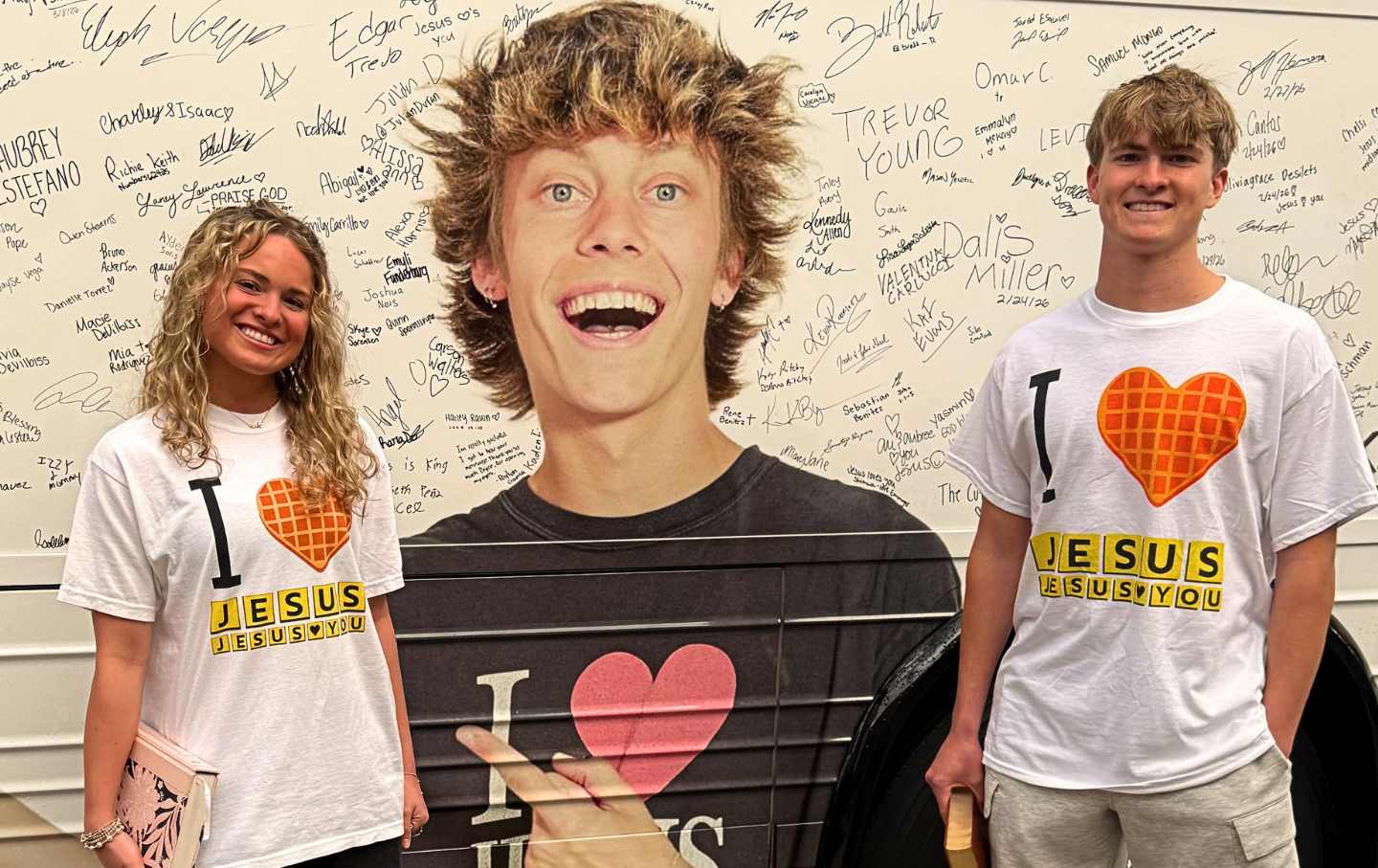
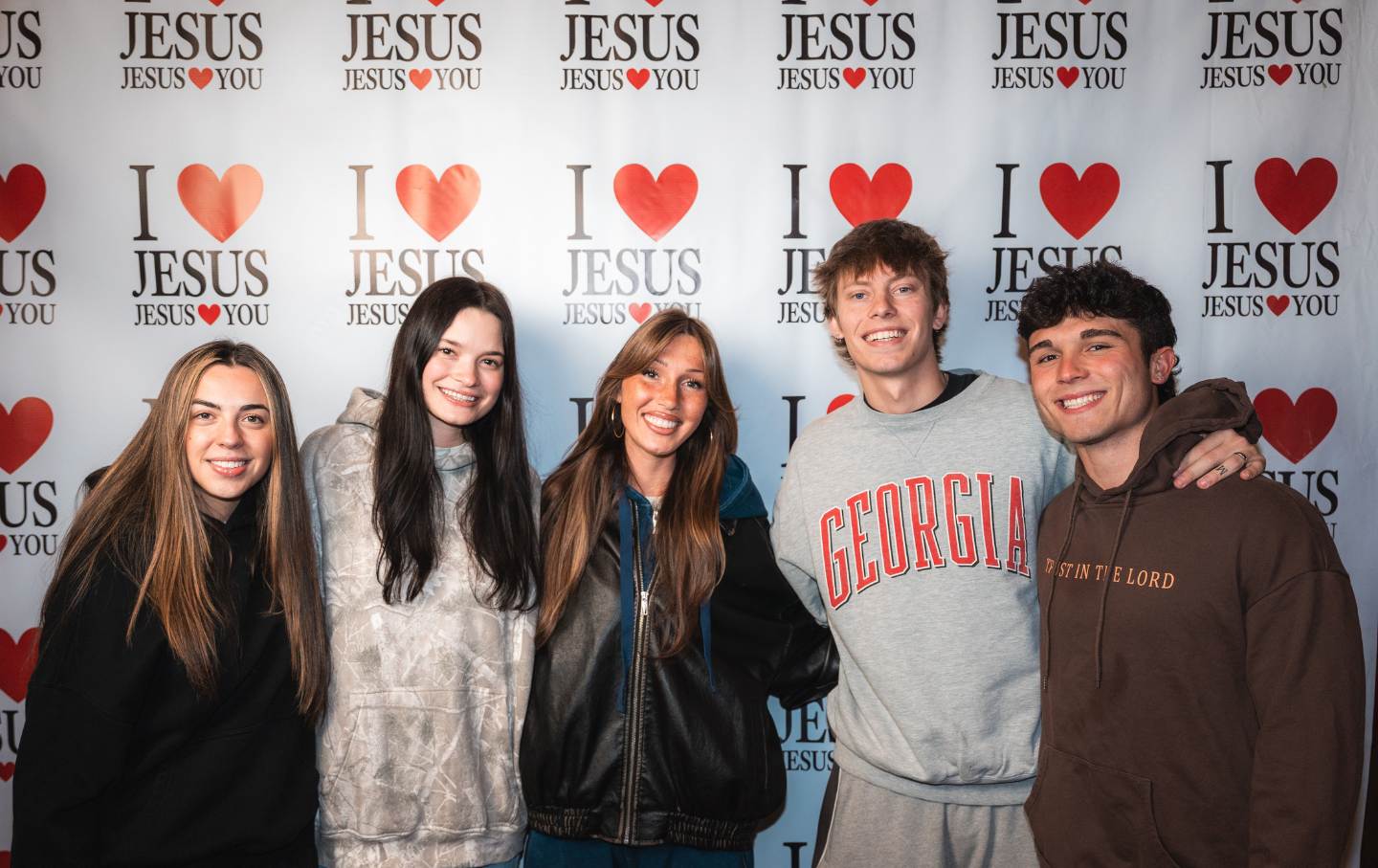
In March, Bryce Crawford, an evangelical Christian influencer, came to the heart of Times Square to spread the gospel. The show, which took place in The Town Hall, was part of his “I Love Jesus Tour.” Crawford had packed the 1,500-seat venue with Gen Z fans who were hungry to hear him preach.
The “I Love Jesus Tour” was part pop gospel concert (with worship music from Liberty Collective, a band hailing from the ultraconservative Liberty University), part evangelical church service led by Crawford, and part fan meetup, all bundled in the aesthetics and entrepreneurial spirit of influencer marketing.
When I first arrived at The Town Hall, I was met by a long line of people snaking up the spiral staircase toward the balconies. I thought the crowd was bottlenecking for their seats before realizing that they were waiting to buy something at the merchandise table. I passed somewhere between 50 and 100 fans, many of whom were already wearing Bryce’s merch and had come back for more. The merch style is tailor-made for Gen Z—it’s kitschy, referential, tongue-in-cheek, with the wholesomeness of nondenominational Christianity. “I Love Jesus” in the style of a Waffle House logo. The D.A.R.E.-like messaging of “Crack This! Not Drugs!” with an illustration of a Bible. Just before the event officially started, someone started a cheer, shouting “Je-sus! Je-sus! Je-sus!” like Beatlemaniacs calling Paul out for an encore.
The question of whether a Gen Z–led return to Christianity is taking place in the United States has been hotly contested. This “revival” has been flaunted as a cultural victory for the religious right and debunked as a propaganda myth by the secular left. There is a discrepancy between the statistics and a diffuse, vibes-based sentiment that young people are, indeed, demonstrating an increased interest in the Christian faith. I began to wonder if statistics measuring religious participation, like church attendance, could be used as a litmus test for the Gen Z revival. It seemed to me that the popularity of faith-based content creators revealed something that traditional metrics were missing. If Crawford could get thousands of twentysomethings across the US out of their houses and off of their phones to hear the gospel in person, surely something was going on.
Crawford is an evangelist, a podcaster, an influencer with an audience of over 3 million, most of them Gen Z. He has a goofy, distinctly TikTok Hype House look to him: silver hoop earrings, tattooed thighs, baggy camouflage pants. Picture Joel Osteen with boy-band looks and a ring flash. Allie Beth Powell, 19, a college student who attended the “I Love Jesus Tour” in Atlanta, told me Crawford came out onstage wearing red Lightning McQueen–themed Crocs, which she said made him more “relatable” to her and her peers. Crawford is also the founder of an energy drink brand called “Praise Energy,” which comes in flavors like “Rainbow Candy” and has a friendly, children’s cereal-style mascot named “Zion the Lion.” While he has managed to make himself immediately legible as cool and Gen Z–friendly, his content is gravely serious. A life lived in sin, Crawford often reminds his audience, is a life bound for Hell.
Gianna Calabrese, 24, received tickets to Bryce’s tour stop in Pittsburgh as a gift from her friend and posted a TikTok of herself crying tears of joy. Another fan, Heather Farley, 24, who is also a faith-based content creator, drove four hours from her home in North Carolina to Georgia and back to see Bryce’s live show. A huge part of Bryce’s appeal is that he possesses the coolness and relatability of any other influencer, but with the authority and knowledge of a bona fide preacher. “He’s young, he’s attractive, he has a sense of humor, while being so knowledgeable on the word [scripture],” Farley said. “That’s what captured me. I was searching for something I didn’t know existed, and he introduced me to that. He’s been a beacon of light in this dark world.”
It can be hard to distinguish Crawford from your garden-variety Los Angeles influencer. He has built a successful enterprise from the same bricks: monetization of online engagement, flashy merchandise, energy drinks, and ticketed live engagements across the United States. Like critics of televangelists, one could leverage the accusation that the influencer lifestyle—fame-seeking, entrepreneurial, and often ostentatiously wealthy—is at odds with the Christian values of modesty and charity.
Crawford got a bit of heat on a Christian subreddit after his wife posted a photo from the couple’s honeymoon in what appeared to be first-class plane seats. The post prompted bigger questions about Bryce’s Patreon subscriptions, where fans pay between $5 and $100 a month to support his ministry. It would be easy to declare Crawford and his enormous fan base as nothing more than the inevitable manifestation of the televangelist adapted for 2026, if not for how seriously his fans take him, his ministry, and, in turn, their own faith.
“It seems like the only thing that we can’t escape in this lifetime is suffering,” Crawford said in a projected video onstage at the tour in New York. “Will the pain ever stop?”
That’s a prescient question to ask a group of people who, statistically speaking, appear to be in a great deal of pain. The Gen Z mental health crisis has been an ongoing point of discussion, and for good reason: in 2023, the CDC reported that 40 percent of American high school students experienced “persistent feelings of sadness or hopelessness” in the past year. Mental health issues are also a cornerstone of Bryce’s story. He says that on Christmas Day 2020, he was battling depression, anxiety, and an “addiction to explicit videos” so severe that he made a plan to take his own life, a plan that was intercepted while he dined late one night at a Waffle House in Georgia. He credits what he calls “a supernatural encounter with Jesus” at the restaurant for influencing him to keep living and devote his life to Christ.
I spoke to several fans of Bryce across the country, ranging in age from 19 to 24, and their generational suffering came up repeatedly. Many of them had traditional religious upbringings, less fervent and animated than the kind of Christianity Bryce preaches. A few of them lost interest in religion in their teenage years and returned to God during times of personal hardship, feeling their faith bolstered and comforted as Bryce runs through their algorithms. They see their age group as addled with mental health issues and overwhelmed by political and economic uncertainty. They consider their faith as a remedy, and Bryce as a healer.
“I think the way that Bryce talks about Jesus in the Bible is very relatable because he relates to the things our generation might be struggling with,” Calabrese said.
Another fan, Holden Juliano, who struggled with severe anxiety in high school, credits Bryce and his faith in God for helping him manage his symptoms. “Anxiety is washed away when you put your faith in Christ,” he said. “As far as strengthening my faith, Bryce planted a seed in my head and my heart so I could fully understand that.”
When I asked Farley if she thought the Gen Z Christian revival was a real phenomenon, the answer was an unequivocal yes. She highlighted economic precarity and despair among her generation as a possible reason why. “Let’s say I get a nine-to-five job, but then I can’t afford gas. I can’t afford food. I’m not fulfilled in what I’m doing, and I can’t afford to buy a house. So what is the point? I think Gen Z is realizing that everything kind of leads to a dead end. Finding Jesus is a renewed fulfillment, because happiness fades, but joy is everlasting.”
Popular
“swipe left below to view more authors”Swipe →The people I spoke to were mostly gun-shy on the issue of politics, but there was widespread agreement that Bryce is an apolitical figure. I agree that he’s hard to pin down: Crawford avoids sharing his personal politics. However, he has appeared on Fox and Friends, hosted Tucker Carlson on his podcast—which devolved into Carlson spewing a conspiracy theory that online pornography exists to turn American men into “eunuchs”—and spoke onstage at Turning Point USA’s “AmericaFest” following the killing of Charlie Kirk. He may not overtly claim the political right as his tribe, but they seem to have claimed him as part of theirs. He feels right-wing-coded, but this is not of much concern to the fans I spoke to. Instead, they seem to appreciate Bryce’s nonpartisanship and see him as an even-keeled, empathetic voice. This, of course, erodes the argument that increased Gen Z religious participation is rooted in fascism more than it is earnest belief.
People are right to question whether the Gen Z religious revival is as great a trend as it’s purported to be. However, naysayers on the left would be wise to consider whether traditional methods of measuring religious participation in America, like church attendance, membership, or even self-identification, can still be relied upon in an era when faith is something increasingly abstract and online. The practice of contemporary Christianity in America is as tied to performance and personality as it is to doctrine, meaning, and institutions. Those personalities, like Bryce Crawford, are a convincing presence in the lives of millions of young people, many of whom are desperately seeking meaning and fulfillment. That’s something to be seriously reckoned with.
Become a Sustaining Donor This September
Between the reemergence of right-wing red-baiting and Donald Trump’s use of the chilling National Security Presidential Memorandum–7 to criminalize left political organizing, we’re seeing McCarthyism reborn before our eyes.
This assault on democracy cannot be ignored or wished away. Resisting it requires bravery in the face of threats and repression, a steadfast commitment to the truth, and the unwavering belief that we can—and will—overcome this darkness.
We must have an independent media that sets the record straight, unearths corruption and abuses of power, and advances a politics of justice and dignity for all if we’re to win this fight.
That’s why I’m writing to you today. This September, The Nation needs to add 100 monthly donors to sustain our progressive journalism. Your contribution makes the next investigative report, the next truth-speaking column, and the next pathbreaking essay all possible.
I hope you’ll support our work with a recurring donation today. If you donate $10 or more a month, we’ll send you a brand new “Hands Off the Free Press!” sticker to recognise your commitment to our cause. Please, donate today.
Onward,
Katrina vanden Heuvel
Editor and Publisher, The Nation
More from The Nation
Irish Goalkeeper Gavin Bazunu’s Refusal to Play Against Israel Puts Him on the Right Side of History Irish Goalkeeper Gavin Bazunu’s Refusal to Play Against Israel Puts Him on the Right Side of History
Bazunu’s decision raises the perennial question: Why is a country that is currently committing a genocide allowed to compete in the first place?

The Promises and Compromises of the University of California The Promises and Compromises of the University of California
I grew up in a neighborhood manufactured by the University of California, Irvine. It felt like a utopia for academics—until the university forsook its mission of serving the publi...

Is Platonic Co-Parenting the Future of the Family? Is Platonic Co-Parenting the Future of the Family?
Disillusioned with the nuclear family and apprehensive of tethering their reproductive futures to the bleak hellscape of modern love, young people are seeking a different way.

How Trump’s Crackdown on Speech Has Damaged the Student Press How Trump’s Crackdown on Speech Has Damaged the Student Press
I serve as editor in chief and president of The Stanford Daily. Our newsroom has keenly felt the effects of Trump’s campus crackdown, which is why we sued the federal government.
Treat Spotify Like a Public Utility Treat Spotify Like a Public Utility
Music streaming platforms have way too much control over musicians and music lovers. It’s time to rein them in.

