
The Multipronged Red-State Attack on Voting Rights
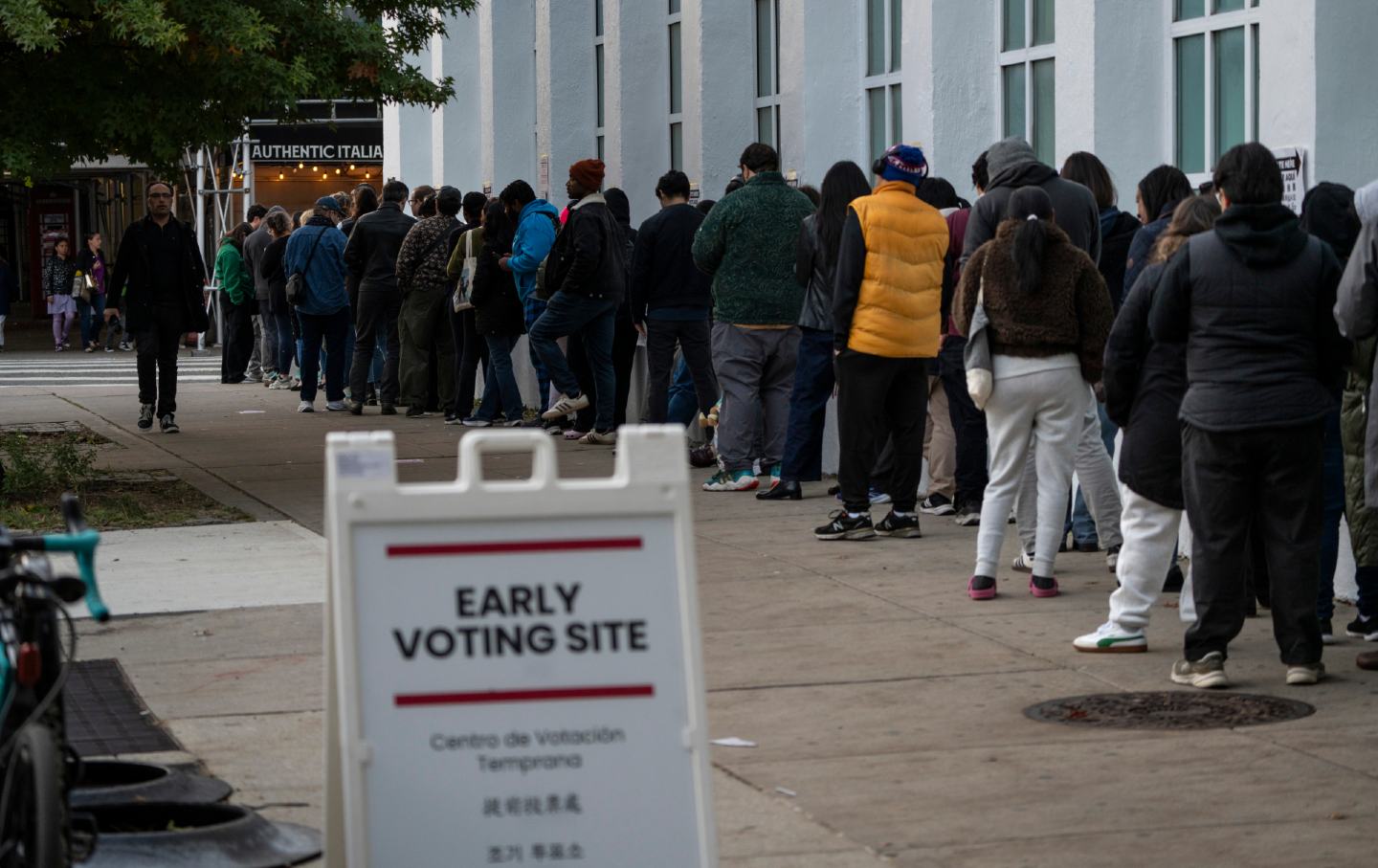
Red states aren’t just gerrymandering away voting rights—they’re working overtime to suppress the vote in as many ways as possible.
Editor’s note: This piece was written before the Louisiana v Callais decision removed the necessity to pretend that the Voting Rights Act mattered at all.
In his quest to hold on to power, Donald Trump has been working hard to force through policies to suppress the vote and rig elections. His principal vehicle has been the Safeguard American Voter Eligibility (SAVE) Act, which requires proof of citizenship to vote. Another Trump-inspired proposal, the Make Elections Great Again, or MEGA, Act (so named because these people are in a cult), would ban universal voting by mail. Trump has also turned to his favorite tool, the executive order, to direct the Department of Homeland Security, among other agencies, to compile a list of US citizens that the states can use to establish voter eligibility. The order also curtails the use of mail-in voting.
So far, Trump is closer to taking over Greenland than he is to taking over the federal elections system. His executive order is legally inert; it basically says that citizens, and only citizens, are allowed to vote—which is already a well-established legal principle—and then offers mere suggestions for how states can enforce that principle. The SAVE Act has passed the House of Representatives but is dead in the Senate, where Democrats have filibustered it. The MEGA Act hasn’t even passed the Republican-controlled House yet. Trump can huff and puff as much as he wants, but he cannot, by executive fiat, blow down the entire structure of federal elections.
The states may be a different matter. They can try to pass parts of the SAVE Act, the MEGA Act, and other Trump policies, rigging our elections state by state—which is precisely what some have been doing.
Voting Rights Lab, a national nonprofit, has been doggedly keeping track of all these state-level attempts to suppress voting. As of late April, five states (Florida, Mississippi, South Dakota, Utah, and Kentucky) have passed laws requiring proof of citizenship to register to vote, and six have taken Trump’s executive order to heart, adopting the DHS “citizenship list” to reorganize their voter rolls. In all, 17 states have considered—or are still considering—proposals to require proof of citizenship, while 26 states have considered—or are still considering—adopting the “citizenship list.”
So far, no state has prohibited universal mail-in voting, though proposals to do so exist in three states. No state has adopted the Trump policy of requiring a witness or a notary public to attest to a mail-in ballot, but 17 states have weighed such proposals (of these, 10 are still considering them). And no state has dropped early voting (Alabama, Mississippi, and New Hampshire never had it to begin with), but three, including the battleground state of Pennsylvania, are considering it.
There are two ways to interpret these Trump-fueled state-level attacks on voting rights, and both are valid. The scary interpretation is: There is a lot of interest, especially in MAGA-controlled states, in making voting as restrictive as the president wants it to be. Anti-democracy activists are working overtime to try to hijack the levers of state government to make it harder for people to vote.
The hopeful interpretation is: The anti-democracy advocates are losing. Trump’s anti-voting agenda is losing. Even in the MAGA states, where would-be Trumps sit in the governors’ mansions and occupy the legislatures, the adoption of his policies has not been robust.
That’s not exactly surprising. States, even red ones, are generally proud of their elections. That’s the funny thing about the right’s election-fraud allegations: The people who push them always argue that the fraud is happening somewhere else. For Texas, the main problem is never Texas—the real fraud is happening in New York City or Chicago or any place where nonwhite people are allowed to vote. That makes it difficult for Trump or Stephen Miller to say to a state, especially one where Republicans already win easily, “You are terrible at running elections—let me and Markwayne Mullin fix it for you.” Most states are telling the Trump administration to take their antidemocratic ideas to some other state where they perceive the real problem to exist.
Florida is one of the exceptions. It passed a law requiring proof of citizenship for voter registration—but even here, I’m not sure Florida’s law (which doesn’t take effect until 2027) will hold up in court. That’s because, ironically, there’s a federal law that potentially preempts Florida’s attempt to add voter-registration requirements: the National Voter Registration Act (NVRA) of 1993, more commonly known as the Motor Voter Law. This law, signed by Bill Clinton, requires states to accept a universal voter-registration form, which is most often filled out at the DMV when people apply for or renew their driver’s license.
In 2013, the Supreme Court ruled that the NVRA preempted states from adding restrictive requirements for voter registration. The case, Arizona v. Inter Tribal Council of Arizona, involved a 2004 state law that required (wait for it) proof of citizenship to register to vote. The law made it much harder for Native Americans living in Arizona to get on the voter rolls. The court ruled that states must accept the federal registration form as sufficient.
That ruling was 7–2, with Clarence Thomas and Samuel Alito dissenting (because of course). Chief Justice John Roberts was in the majority striking down Arizona’s citizenship requirement, and the opinion was written by none other than Antonin Scalia. This means that if Governor Ron DeSantis wants to change Florida’s law, Trump likely has to amend or repeal the NVRA first. And any changes to the federal legislation will almost certainly be filibustered by Democrats.
Popular
“swipe left below to view more authors”Swipe →The upshot? While voting rights are indeed under attack, the antidemocratic forces can be defeated—even in the deep-red states that voted for Trump.
I have long complained about federalism when it comes to voting rights. The fact that we have 50 different election systems instead of a single centralized one makes expanding voting rights extremely difficult and allows the former Confederacy and its fans to suppress the vote. But I must admit, in the face of Trump’s attacks on voting rights, federalism is working as intended. The dictator in chief cannot wave his hand and force 50 different states to run elections the way he wants them to. The Constitution won’t let him.
Become a Sustaining Donor This September
Between the reemergence of right-wing red-baiting and Donald Trump’s use of the chilling National Security Presidential Memorandum–7 to criminalize left political organizing, we’re seeing McCarthyism reborn before our eyes.
This assault on democracy cannot be ignored or wished away. Resisting it requires bravery in the face of threats and repression, a steadfast commitment to the truth, and the unwavering belief that we can—and will—overcome this darkness.
We must have an independent media that sets the record straight, unearths corruption and abuses of power, and advances a politics of justice and dignity for all if we’re to win this fight.
That’s why I’m writing to you today. This September, The Nation needs to add 100 monthly donors to sustain our progressive journalism. Your contribution makes the next investigative report, the next truth-speaking column, and the next pathbreaking essay all possible.
I hope you’ll support our work with a recurring donation today. If you donate $10 or more a month, we’ll send you a brand new “Hands Off the Free Press!” sticker to recognise your commitment to our cause. Please, donate today.
Onward,
Katrina vanden Heuvel
Editor and Publisher, The Nation
More from The Nation

Irish Goalkeeper Gavin Bazunu’s Refusal to Play Against Israel Puts Him on the Right Side of History Irish Goalkeeper Gavin Bazunu’s Refusal to Play Against Israel Puts Him on the Right Side of History
Bazunu’s decision raises the perennial question: Why is a country that is currently committing a genocide allowed to compete in the first place?

The Promises and Compromises of the University of California The Promises and Compromises of the University of California
I grew up in a neighborhood manufactured by the University of California, Irvine. It felt like a utopia for academics—until the university forsook its mission of serving the publi...

Is Platonic Co-Parenting the Future of the Family? Is Platonic Co-Parenting the Future of the Family?
Disillusioned with the nuclear family and apprehensive of tethering their reproductive futures to the bleak hellscape of modern love, young people are seeking a different way.

How Trump’s Crackdown on Speech Has Damaged the Student Press How Trump’s Crackdown on Speech Has Damaged the Student Press
I serve as editor in chief and president of The Stanford Daily. Our newsroom has keenly felt the effects of Trump’s campus crackdown, which is why we sued the federal government.

Treat Spotify Like a Public Utility Treat Spotify Like a Public Utility
Music streaming platforms have way too much control over musicians and music lovers. It’s time to rein them in.

