Coaching Great Dawn Staley Defends Trans Athletes
The courageous comments of the South Carolina Gamecocks’ coach upset all the right people.
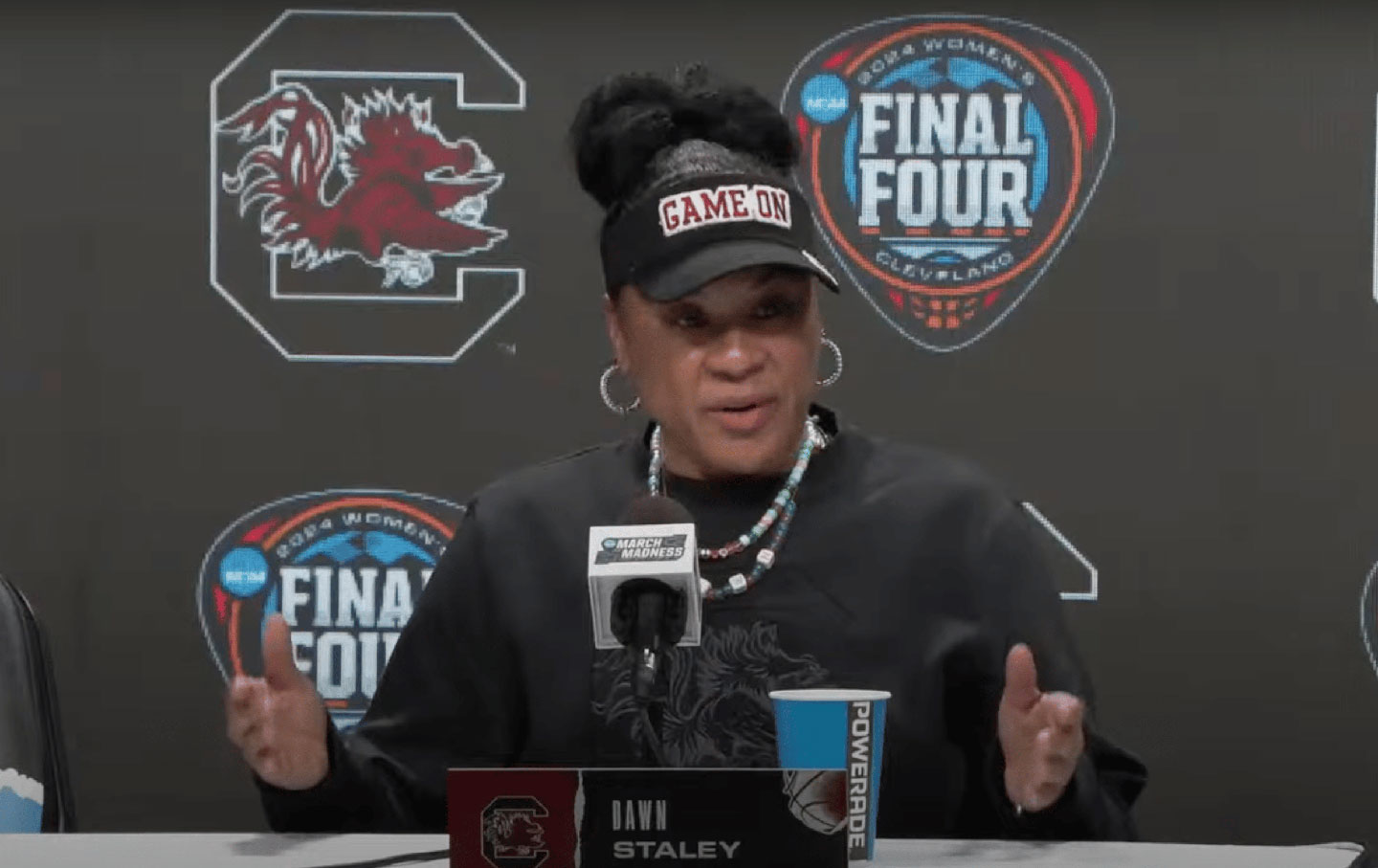
Dawn Staley, 53, is already regarded as one of the greatest coaches in the history of college basketball. That’s what happens when you lead your school to three national championships—two in the last three years—and this year’s iteration of the South Carolina Gamecocks went undefeated along the way. Unless some NBA front office is smart enough to break both a sexist tradition and the bank to hire her (if that’s even an ambition for Staley), her ascension to the Mount Rushmore of college coaches seems predestined. She built the South Carolina program from scratch over 16 seasons and turned it into a gritty powerhouse that reflects her own South Carolina–born Philadelphia-made Hall of Fame playing style. As a player, Staley walked and talked tough. As a coach, she walks with strength and talks with a no-bullshit clarity that commands attention.
Staley’s stature has never been greater, which makes her recent words in defense of trans athletes so important. When a somehow-credentialed right-wing troll in the press room asked her the day before Sunday’s championship game against Iowa whether “biological males” should be able to play women’s sports, she did not equivocate. An at first surprised Staley said, “Damn, you got deep on me, didn’t you?” Then, after a pause, she said, “I’m of the opinion of, if you’re a woman, you should play. If you consider yourself a woman and you want to play sports or vice versa, you should be able to play. That’s my opinion. You want me to go deeper?”
When pressed again by the same person about whether transgender women should be allowed on the playing field, Staley was emphatic while also acknowledging the backlash she would receive.
“Yes, yes,” Staley said. “So now the barnstormer people are going to flood my timeline and be a distraction to me on one of the biggest days of our game, and I’m OK with that. I really am.”
(That last part: acknowledging the backlash as well as potential for distraction and saying “and I’m OK with that. I really am” is more than smooth. It’s modeling a response to these kinds of questions.)
Staley’s comments upset all the right people, especially the professional hacks who—driven by hatred, profit, publicity addiction, or some rancid stew of the three—rushed to the nearest right-wing cable TV cameras to denounce Staley’s principles of inclusion. It’s been high comedy to see the leading intellectual lights of the fascist right sputter that Staley is a “traitor,” “sellout,” and disgrace to women’s hoops—when it’s a sport none of these people seem to have ever watched or supported. Their efforts to paint Staley as the Antichrist were also muted by the reality that, as anyone who actually follows the sport knows, Staley praises Jesus whenever the mood strikes her. I think there’s way too much religion in sports, but Staley can say whatever the heck she wants. Also to see these keyboard character assassins face-plant so spectacularly in trying to paint Staley as some kind of radical has been almost as amusing as the women’s tournament was thrilling.
The eruption in fan interest in college women’s hoops is the backdrop for all of this, and it amplifies Staley’s response. The 2024 tournament could someday be remembered as a dramatic pivot in the mass appeal of women’s sports. The athletic-industrial complex finally woke up to the fact that there exists not only Iowa’s Caitlin Clark and her incredible shooting range but also an entire generation of incredibly skilled and improbably charismatic players. The finale garnered almost 19 million viewers, with a peak of 24 million: a far higher number than the World Series, the NBA Finals, more than a few NFL games, and, by a wide margin, the men’s final.
As wondrous as Clark has been, there is something appropriate about seeing Staley and the Gamecocks at the top of the mountain. To see Staley receive so much appreciation while scurrilous bottom-feeders shoot rubber arrows in her direction says something about the power of women’s sports. It also speaks to Staley’s political courage: a courage that understands that the coordinated attack on trans kids—and the eliminationist perspective of the far right—must always be challenged.