Bridging the Red-Blue Divide, One Concrete Deed at a Time
The evidence is in: working together to solve local problems reduces polarization.
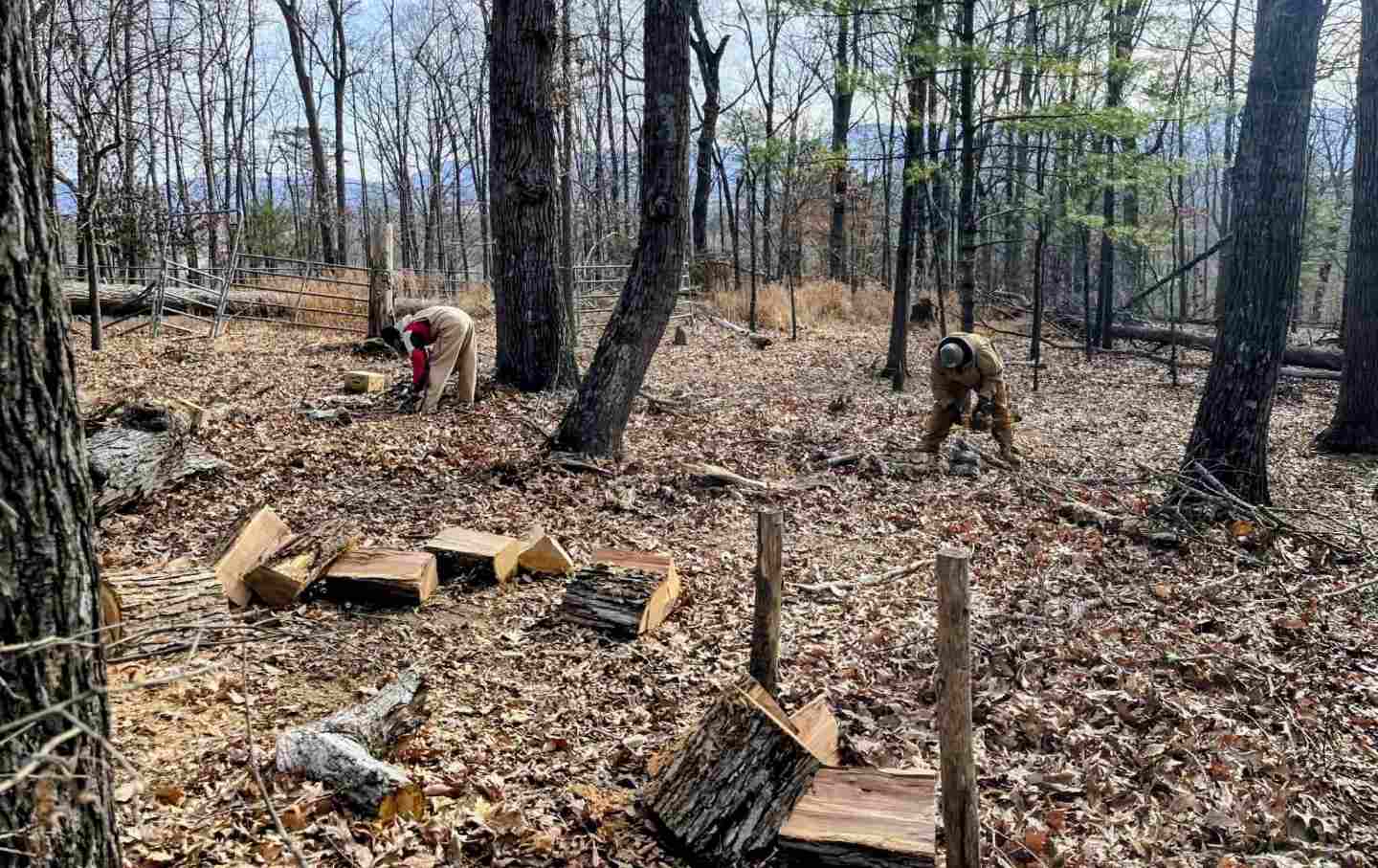
Community Works volunteers chopping firewood to deliver to local residents in Luray, Virginia, in January.
(Community Works / Facebook)
Luray is a small town in Page County, in the Shenandoah Valley of Virginia. Its town council has for years been overwhelmingly Republican, with no elected Democrats. In this respect, it’s a microcosm of Page County overall. Not surprisingly, members of the county Democratic Committee had some negative experiences over the years with town officials, reinforcing local Democrats’ sense of being in a small and unpopular minority.
About two years ago, it was with some trepidation that Skip Halpern and Sara Finn first approached the council on behalf of the Page County chapter of Community Works, a recently launched strategy designed to get neighbors working together across the divide. Their request that the council support water testing by the Friends of the Shenandoah River was unanimously approved. This marked the beginning of an ongoing collaboration between the Democratic-supported Community Works and a wide range of mostly conservative churches, civic and community groups, and governmental bodies around the county. Like other Community Works chapters in Virginia and elsewhere, the Page County chapter undertakes a wide array of community service activities about three times each month. Whether they’re testing water, picking up trash, installing fire alarms in trailer homes or distributing food to homebound residents, Community Works’ activities are done with no politicking or proselytizing (disclosure: I’m the executive director of Community Works’ parent organization).
Community Works’ experience with the Luray Town Council is not unique. In fact, the anecdotal evidence that Community Works builds trust and reduces partisan polarization has been growing steadily since the initiative was launched in rural Virginia in the summer of 2023, followed by Georgia one year later.
Community Works was designed as a pilot project to test whether sustained, concrete, nonpolitical action at the local level would gradually rebuild trust in rural and red communities, and some rural, more conservative people would moderate their views of liberals and Democrats. It’s not altogether surprising that local Democrats, Republicans, and independents put aside differences long enough to get stuff done. But it was an open question as to whether this would lead to a more definitive changing of hearts and minds.
The evidence is now in, and it’s compelling. Community Works curbs partisan polarization. Significantly.
With the help of political scientists, Nick Jacobs of Colby College and Kal Munis, then at Utah Valley University, the Community Works team designed a survey to assess feelings about and views of Democrats and Republicans among rural residents. The surveys were administered in Community Works counties before the program launched, and in other deeply red counties nearby.
The survey was readministered after two years of Community Works activities in Virginia and just after just one year in Georgia. According to Jacobs, “Across six counties within two states and across multiple outcome measures, Community Works consistently reduces the intensity of partisan polarization. [Emphasis mine.] The study period (2023–2025) coincided with a difficult national political environment for Democrats, particularly in rural communities where attitudes toward the Democratic Party deteriorated sharply in both Virginia and Georgia. Against this backdrop, Community Works counties stand out: rather than following the broader pattern of ‘cooling’ attitudes toward Democrats and ‘warming’ toward Republicans, partisan attitudes in these counties shifted far less dramatically.”
Jacobs says the pattern of results is neither accidental nor trivial. “The consistency of the results across multiple domains increases confidence that the observed moderation in partisan animosity is meaningfully related to Community Works,” which “appears to anchor political judgement more firmly in local experience and less in national partisan narratives.” Put more simply, how Democrats were relative to Republicans improved in counties with active Community Works chapters, including an increased association of Democrats with such things as opportunity and responsiveness.
Diffusing partisan polarization and improving the Democratic brand have not been the only positive outcomes of this local action. According to Meredith Dean, Community Works’ national director, the shift in views has been a two-way street. “We started Community Works in hopes of changing the views of rural communities towards Democrats, but what’s been most inspiring is the way it has changed the views of Democrats towards their rural communities.” This is particularly important, since, as Dean points out, “Many rural Democrats are urban and suburban transplants who bring both conscious and unconscious stereotypes into their new surroundings.” Altering some of the negative views that many on the left hold of rural people can be challenging, but according to Dean, “the greatest myth-buster is to spend a day with someone distributing baby supplies or cleaning up a roadside or public park.”
Most of the nearly 500 Community Works projects undertaken to date have been in the six pilot counties in Virginia and Georgia. Beginning in 2025, however, the initiative has expanded to 14 counties across seven states, including Alabama, Maryland, Kansas, Washington, and Wisconsin. County chapters have a good deal of flexibility in what they do, who they partner with locally, and when and how they make clear their association with the local Democratic Committee (which is a part of every chapter). While all chapters are in rural counties thus far, the demographics of those counties vary, just as they do in rural America more broadly. The counties in Virginia and Maryland, for instance, are predominantly white, while those in Georgia and Alabama are much more racially diverse. But the process plays out similarly regardless: People who’ve grown weary of politics-as-usual get reenergized through Community Works; civic engagement and more positive outlooks grow; trust and neighborliness begin to reemerge; partisan animus declines.
The idea of making public service a part of what Democratic committees do is certainly gaining popularity. But is it scalable? The Community Works model involves a good deal of training, ongoing peer support, and $10,000, at most, per county per year in funds to support the local work. If the Democratic Committees in a thousand rural counties adopted this model, it would cost about $10 million each year. That’s the equivalent of less than one-fourth of 1 percent of the funds Democrats spent on TV ads in the 2024 election cycle alone. Now that we know that this approach reduces polarization and rebuilds trust, that seems like a bargain the Democratic Party can’t afford to ignore.
Support independent journalism that does not fall in line
Even before February 28, the reasons for Donald Trump’s imploding approval rating were abundantly clear: untrammeled corruption and personal enrichment to the tune of billions of dollars during an affordability crisis, a foreign policy guided only by his own derelict sense of morality, and the deployment of a murderous campaign of occupation, detention, and deportation on American streets.
Now an undeclared, unauthorized, unpopular, and unconstitutional war of aggression against Iran has spread like wildfire through the region and into Europe. A new “forever war”—with an ever-increasing likelihood of American troops on the ground—may very well be upon us.
As we’ve seen over and over, this administration uses lies, misdirection, and attempts to flood the zone to justify its abuses of power at home and abroad. Just as Trump, Marco Rubio, and Pete Hegseth offer erratic and contradictory rationales for the attacks on Iran, the administration is also spreading the lie that the upcoming midterm elections are under threat from noncitizens on voter rolls. When these lies go unchecked, they become the basis for further authoritarian encroachment and war.
In these dark times, independent journalism is uniquely able to uncover the falsehoods that threaten our republic—and civilians around the world—and shine a bright light on the truth.
The Nation’s experienced team of writers, editors, and fact-checkers understands the scale of what we’re up against and the urgency with which we have to act. That’s why we’re publishing critical reporting and analysis of the war on Iran, ICE violence at home, new forms of voter suppression emerging in the courts, and much more.
But this journalism is possible only with your support.
This March, The Nation needs to raise $50,000 to ensure that we have the resources for reporting and analysis that sets the record straight and empowers people of conscience to organize. Will you donate today?