Gisèle Pelicot Shows Us Why “Shame Must Change Sides”
Fifty-one ordinary men raped an unconscious woman. Her case reveals the limits of anti-carceral feminism.
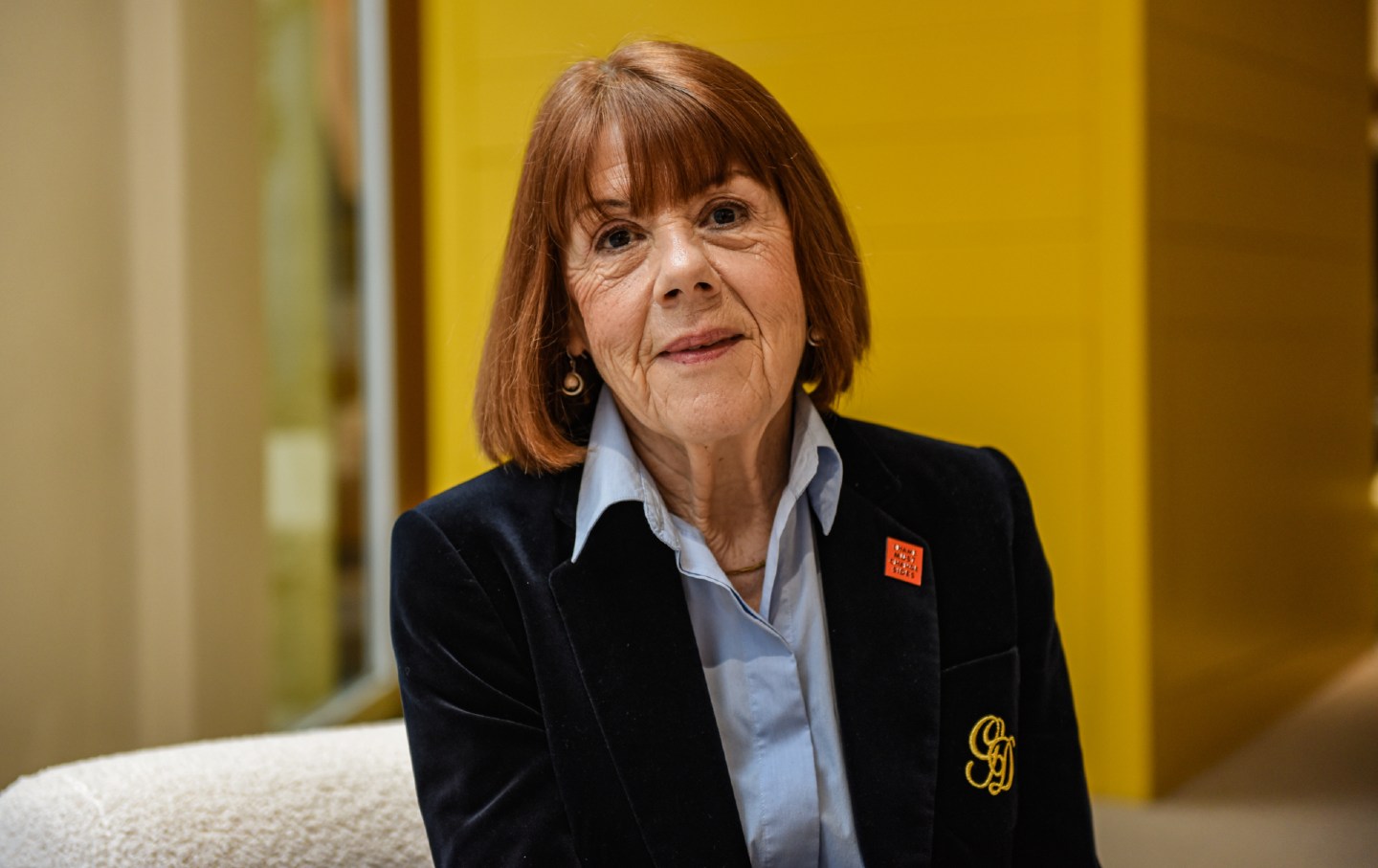
Gisele Pelicot has published the book A Hymn to Life in which she recounts her memories of discovering one morning in November 2020 that her husband had been secretly drugging her and inviting strangers to her home to rape her.
(Alberto Paredes / Europa Press via Getty Images)Gisèle Pelicot thought she had a good marriage. Sure, it had its ups and downs—there were money troubles, and both she and her husband had affairs—but the way she saw it, she had had 50 years of quiet contentment. She had a good job, a devoted husband, two sons and a daughter, plenty of grandchildren, and a retirement home in the town of Mazan in Provence with a swimming pool and plenty of countryside outside the front door.
As the whole world now knows, and as her recently published memoir A Hymn to Life describes in painful detail, the reality was rather different. From 2011 to 2020 her husband, Dominque Pelicot, was drugging her and using a chatroom called “à son insu” (“without her knowledge”) to invite local men to rape her while she was unconscious. He might never have been found out had he not been caught taking pictures up women’s skirts in a supermarket. The police took his computer, and in a folder neatly labeled “abuse,” there were hundreds of videos of local men assaulting his wife’s orifices, often with his help.
What happened next astonished the world. Gisèle Pelicot revealed her identity and chose an open trial so that the world could see what had happened to her and by whom. Only Dominique acknowledged that he was a rapist; the other 50 men on trial treated the proceedings as a joke and insisted they had done nothing wrong: It was just kinky sex; she was only pretending to be asleep; and anyway the husband gave permission, so how could it be rape? Sadly, some of the wives and girlfriends of the accused blamed themselves: They didn’t satisfy their husbands, so what do you expect? Sadder still, some 20 men in the videos could not be identified and are free to rape again.
I think of Gisèle when anti-carceral feminists argue against prosecuting those accused of sex crimes. I suppose they would mourn the conviction of her rapists: Dominique got 20 years and the others sentences ranging from three to 15 years. (The prosecution had asked for 10 to 18.) After all, with a few exceptions, these were normal middle-class and working-class men, aged 26 to 74. There was a truck driver, an IT worker, a journalist, a banker, a mechanic, and a baker. One was even her next-door neighbor. They weren’t all ideal citizens: One was an HIV-positive retiree who refused to wear a condom. Another was a worker in a garden store who, perhaps taking a leaf from Dominique, drugged and raped his own wife for five years. A third missed the birth of his daughter to rape Gisèle. Still, presumably they had much to contribute to their communities and families when they weren’t busy raping. One even used to greet Gisèle politely at the bakery.
As Anna Krauthamer wrote in a recent Nation piece, “Why I Didn’t Report My Rape,” about her all-night sexual assault by six men in a Las Vegas hotel:
The simple answer to the question of why I never reported the rape is that I believe in the abolition of police and prisons. The less simple, less articulate answer is that to pursue prosecuting and potentially incarcerating other people is inconceivable to me, even when they have hurt me more than I could have ever believed possible.
Imagine if Gisèle Pelicot had done the same: There would be 51 men free to rape again, and, since in this alternate anti-carceral history Gisèle would have chosen to do nothing, why not? Krauthamer writes, “I don’t want to ruin the lives of my rapists, and I don’t know if they have children.” So what if they do? Some of Gisèle’s rapists had kids—Dominique himself has three. But what kind of a father is a gang rapist?
Four years after her rape, Krauthamer remains tormented by it. I doubt that her rapists feel the same. Why should victims absorb their own suffering rather than have the rapists suffer for what they have done? And why is rape the crime that anti-carceral feminists so often focus on? Supposedly it’s because rape is so uniquely horrible, but I think it’s the opposite: They actually don’t think rape is so bad, so women should forgive and move on. Forgiving men, after all, is women’s job.
I also think of Pelicot whenever I hear progressives and leftists talk about “the Epstein class.” Yes, Epstein’s crimes were enabled by our grotesque inequalities of wealth and power and the impunity they so often convey. He was an evil grand wizard of sex crimes, flying all over the world in his magic plane, hobnobbing with royalty and billionaires and politicians and famous academics, ferrying “girls” to his mansions and private island for orgies, pulling strings and bestowing largesse on his friends to keep them close. His wealth made it possible for him to move in a world of the rich and powerful, who excused and protected each other. All that’s a given.
But class is only part of the story. Dominique Pelicot was an electrician, and not a particularly successful one. The men who answered his invitation were ordinary too. And clearly they were not the only men who had an interest in this kind of sex—there were enough of such men to have a chatroom devoted to it. Indeed, we really have no idea how common this type of rape is. (Miriam Toews brilliant novel Women Talking is based on a real case of mass drugged rape in a remote Mennonite farming colony.) Indeed, since the trial, other cases of “chemical submission”—now a crime in France, thanks to Gisèle Pelicot—have come to light. For example, some 200 women have accused a top-level French government bureaucrat of drugging their coffee with powerful diuretics during job interviews and forcing them on long walks, watching as they became more and more desperate to pee and sometimes even did so in public, right in front of him. Would those women have come forward without Gisèle Pelicot’s example?
In every social class, men tend to have power over the women in that social class and the ones below. It’s not universal—some men are more interested in sexual coercion than others, some women are more vulnerable than others. But men who commit sex crimes mostly get away with it, and society mostly shames the woman. Often the woman blames herself. That is the brilliance of Gisèle Pelicot’s demand that “Shame must change sides.”
But for that to happen, the men’s identities must be public, and a social message must be sent that sexual crimes are crimes. Not mistakes, not misunderstandings, not caused by drinking or drugs or not getting enough sex at home, and not being “led on” by a girlfriend or persuading yourself that the victim “really wanted it.” Dominique is now under investigation for a rape and a murder back in the 1990s. It’s terrifying to think of such a seemingly normal man with such an evil and secret life. Gisèle, however, has found peace and a new love. Her rapists were ordinary men, and she is an ordinary woman. But she, not they, has changed the world for the better. Long may she enjoy her happiness. No one deserves it more.
Become a Sustaining Donor This September
Between the reemergence of right-wing red-baiting and Donald Trump’s use of the chilling National Security Presidential Memorandum–7 to criminalize left political organizing, we’re seeing McCarthyism reborn before our eyes.
This assault on democracy cannot be ignored or wished away. Resisting it requires bravery in the face of threats and repression, a steadfast commitment to the truth, and the unwavering belief that we can—and will—overcome this darkness.
We must have an independent media that sets the record straight, unearths corruption and abuses of power, and advances a politics of justice and dignity for all if we’re to win this fight.
That’s why I’m writing to you today. This September, The Nation needs to add 100 monthly donors to sustain our progressive journalism. Your contribution makes the next investigative report, the next truth-speaking column, and the next pathbreaking essay all possible.
I hope you’ll support our work with a recurring donation today. If you donate $10 or more a month, we’ll send you a brand new “Hands Off the Free Press!” sticker to recognise your commitment to our cause. Please, donate today.
Onward,
Katrina vanden Heuvel
Editor and Publisher, The Nation