
Is Your Diet a Little Bit Fascist?
The right is summoning its armies via their stomachs. When we dismiss food politics, we risk missing what’s being stirred when a group coheres itself around the table.
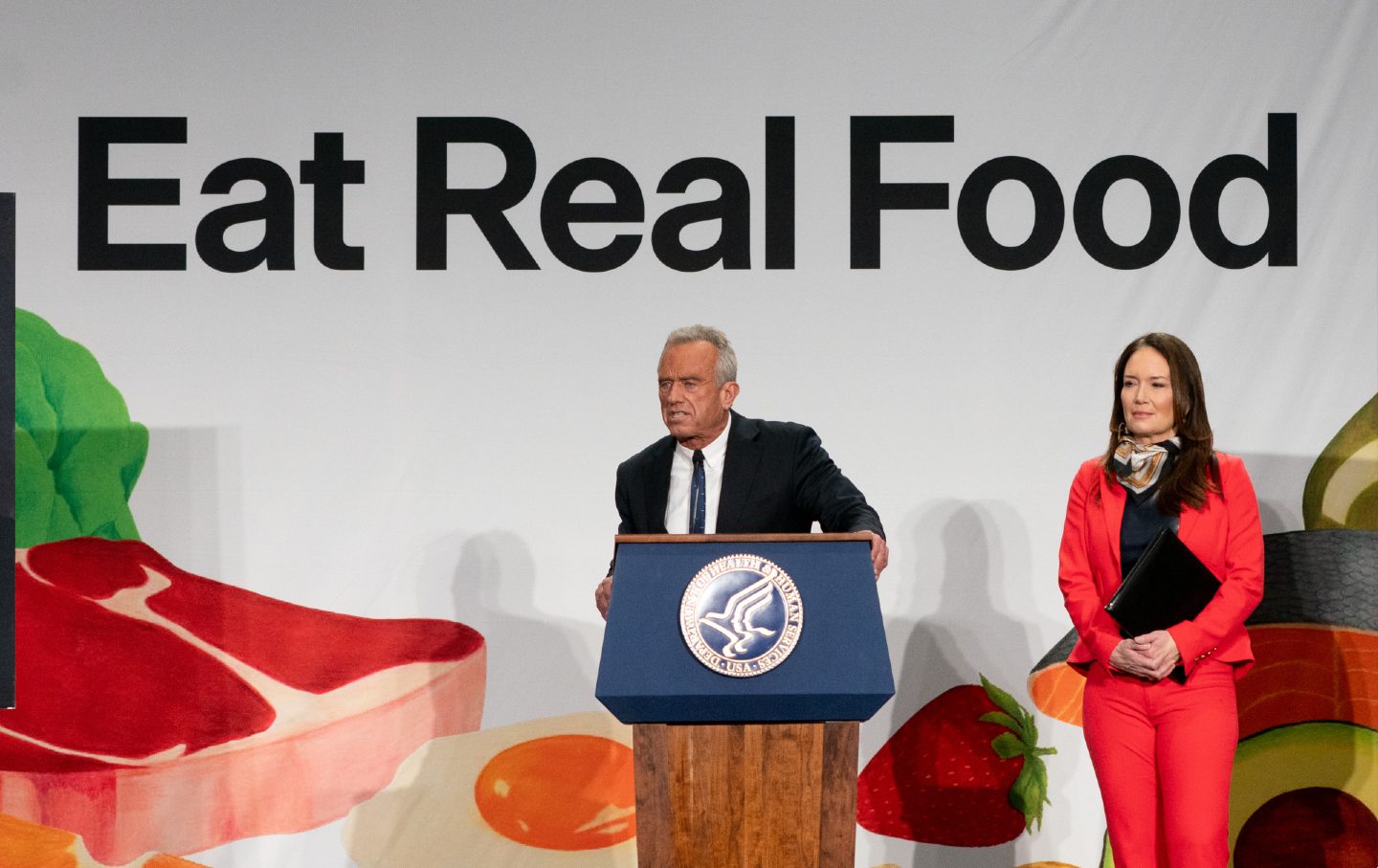
Robert F. Kennedy Jr., US secretary of Health and Human Services, left, and Brooke Rollins, US agriculture secretary, stand during an in Washington, DC, on February 11, 2026.
(Stefani Reynolds / Bloomberg via Getty Images(You may have heard that organic vegetables are right-wing now. That raw milk is the gateway to MAGA. That supplements are for fascists.
You may be unsure just how this happened. It seems like only yesterday that vegetables were for hippies; that eco-communists—not MAHA momfluencers—were spreading the good word of pesticide-free potatoes. That baking bread was ideologically neutral. Now we speak of pipelines that run from granola-filled stomachs to white-supremacist hearts: the “crunchy-to-alt-right pipeline,” the “wellness-to-fascism pipeline,” the “woo to Q pipeline.”
There is very little time, it seems, to understand the plumbing, so quickly are recruits getting sucked down the drain. It might seem wise to beware unpasteurized milk, then, not just because of E. coli, but in case it turns you ideologically toxic. Or, at the very least, leaves you ideologically tainted, part of a club you have been at pains to avoid. Perhaps you fear what Foucault called “the fascism in us all…that causes us to…desire the very thing that dominates and exploits us.” And what if that thing is raw milk?
The mapping of foods to fascist perspectives makes a certain kind of sense. In the frenzy for rawness—raw milk, raw eggs, raw meat—we can identify a posture of bodily invincibility, a stylized aspiration to a jacked-up, mythically self-immunizing super-race. Raw Farm Founder and CEO Mark McAfee frames his love of raw milk as a matter of superior strength. “Fearing viruses is ridiculous,” the whole-food advocate claims. (We can assume he feels the same about bacteria.)
In the aversion to any kind of process, whether malignant (chemical poisoning) or benign (pasteurization, fluoridation), we might sense a bid for the deregulation of our machineries of nourishment, rather than their holding-to-account. In the general fetishization of “nature,” we witness a blood-and-soil gesture at racial and national purity, as well as a nostalgia for a simpler, more neatly gender-hierarchical past. Hence the “Raw Egg Nationalist,” the “Liver King,” every tradwife her own personal cheesemonger.
Then there is also simple pragmatism: Fascism is vague, demanding proxies—dietary preferences, say—to help us see it clearly. Rather than carrying any simple definition, the word “fascism” denotes a cluster of overlapping tendencies and ideas, often non-coincident, and operative by stealth: nationalism, racism, sexism, a militaristic vibe, a penchant for authority, aversion to reason or reasonable debate. Perhaps it is no wonder so many rely on loud and visible cues, writ large across T-shirts and hats: “Got Raw Milk?” (sold by MAGA youth-voter organization Turning Point USA), “Make Frying Oil Tallow Again” (official MAHA campaign merch). The leftist’s sense of the enemy becomes a matter of headgear.
It makes sense until it doesn’t. Until the right people eat the wrong things. Or until the people with whom you might broadly disagree, but certainly don’t deserve the label fascist do. When it isn’t just RFK Jr. and his followers with a thing for unpasteurized milk but liberal writer Michael Pollan and scattergun business opportunist Gwyneth Paltrow. Or until, with the right’s colonization of health, there is nothing really left for the left to eat. When it isn’t just beef-tallow lip gloss and candy-cane bone-broth protein that starts to look a little bit fascist, but your bohemian auntie’s tote bag of organic carrots. When leftist women start ironically, coyly referring to any use of their own oven as “tradwifing.” What to do when every whistle sounds like a dog whistle—and all the foods are whistling?
One response is to insist that the herrings are red; the food was never the point. When something tries to define itself through an appeal to consumer choice, that thing isn’t politics but posture. The MAHA appeal to “health” is self-evidently hollow, and so too was the Obama-era anti-obesity campaign—a relatively superficial gesture. At stake in the nation’s health is not just the market availability of fruits, grains, and veggies, but the kind of just economy in which workers could reasonably buy them and find the time to cook them. Consumers’ allegiance to buying organic, or to avoiding UPFs (ultra-processed foods), does very little to eliminate poison from the crops.
And yet food and eating has never been just “consumption.” Deciding how and what to feed ourselves and others has always been more than mere shopping. At this time, the right appears to be summoning its armies via their stomachs. It may be true, as the left often argues, that food justice is a matter of fighting bigger fights than the war over what to eat: against worker and animal exploitation, the dispossession of growers, imperialist conflict, profiteering from the sale of malnourishing foods. But even so, though what we eat may not constitute our politics, something is being stirred when a group coheres itself around the table.
Today’s “fascist” foods might be similar to those that have previously stirred environmentalist feelings, but if it isn’t the foods themselves that are at work, then what is? What is the difference, for example, between a vegetarian Nazi and a plant-based liberal? A vegetarian Communard of 1871 and a vegan fascist today? If not the diet in question, perhaps the way of eating—the spirit in which a movement feeds itself.
Hitler himself, a self-declared vegetarian, sometimes ate liver, ham, and game. When the Nazis got into drugs and Hitler’s doctors would ply him with injections, he had no problem with a derivative of bull’s testicles in the formula. Less important than what he consumed was the fantasy he nourished, the ideology of purity and divine superiority. An ethos grounded, perhaps, in national self-reliance in the wake of World War I. After the five-year British blockade of German ports from 1914, German leaders in the ’20s and ’30s encouraged reliance on German-grown foods. Imported meat and grain-fed beef were out, rye and potatoes in. Italian fascist “autarchy” sustained a similar logic, making a “pauper’s diet” a matter of national pride. From the material humiliation of not enough food, there arose an ethnically coded spirit of vegetarian virtue. To eat in this way was not just to eat a largely vegetable diet but to invest your vegetable diet with a defensive, defiant, belief in the supremacy of your homeland.
When the Nazis came to power, armed with a vision of Aryan families thriving on fertile German land, they trialed experiments in organic farming at Dachau concentration camp. Were the organic herbs themselves at Dachau Nazi? No. What was Nazi was forcing Jewish labor to tend and package the herbs, and the idea that their distribution to Aryan buyers would enact a kind of herbal purification, that it would feed and reinforce their already God-given class superiority.
When liberal vegetarians today invoke the “virtue” in their choices, the sentiment is certainly less sinister than this. When, for instance, the eco-conscious speak of “doing their bit” for the planet, they may indeed believe that this is true—that their decision not to eat meat is slowing ecological collapse. But the refusal to participate in meat does nothing about the centrality of cheap animal life to a for-profit food system. Nor is refusing meat on these terms a mere consumer choice. By practicing self-satisfaction in this way, the liberal effectively feeds their own and others’ belief in the power of consumer choice. This is not just consumption but the consumerist ideology itself, chewed on, ingested, regurgitated.
Others are vegan “for the animals.” Some are simply squeamish. For many it goes no further than a consumer choice. But history shows that major class struggle—of waging “the bigger fight”—has galvanized many a fighter through the cultivation of taste, a linkage of the pleasure in vegetarian meals with the pleasure of solidarity in struggle. While the health-obsessed fascist might invoke the strengthening power of plant-based protein, former Paris Communard Elisée Reclus wrote in 1901 that for vegetarians of his ilk, “the question is not whether the biceps and triceps are more solid than those of the flesh eaters,” but rather “the recognition of the bond of affection and goodwill that links man to the so-called lower animals.” The idea was to preserve the horse and the cow, the rabbit and the cat “either as respected fellow-workers, or simply as companions in the joy of life.”
We saw a similar dynamic at play in the vegetarianism of the early women’s movement. “It is a strange fact,” wrote the English activist Maud Joachim in her 1908 memoir My Life in Holloway Gaol, “that the ranks of militant suffragettes are mostly recruited from mild vegetarians.” And yet, if we pay attention to the radicalizing force of the attitude with which a person eats, the fact no longer seems so very strange. Where some might eat a carrot and imagine they are simply improving their health, others might eat a vegetarian diet and hear, in the words of suffragette leader Charlotte Despard, “the awakened instinct which feels the call of the sub-human.” In other words, she feels the call and responds with political action.
Popular
“swipe left below to view more authors”Swipe →Modern-day fascists are not just “colonizing” health foods, they are using ways of eating them to foment ideological violence. When we dismiss this mobilization of food and how it is eaten as a mere appropriation of this innocent thing called diet, we misunderstand not just the power of food but the nature of the fascism at hand. What we also risk forgetting is the potential in culinary culture as grist for the left. Food justice organization Food Not Bombs, for example, distributes vegan food as a way of inspiring the public not to change their own diets but to participate in the anti-capitalist transformation of the food system. The group’s horizon is one of ending poverty, homelessness, war, and climate devastation, processes that thrive on the cheapening of life, both animal and human. “Food is a right, not a privilege,” insists the group, which has over 1,000 estimated chapters active in over 60 countries. “Solidarity not charity.”
Vegetarian Nazism, plant-based influencing, eco-socialist veganism, alt-right “crunch.” None is a mode of production, but each of these modes of eating shapes how those who adhere to it relate to the mode of production. The same can be said of “health food” trends that fixate their targets on personal bodily purity rather than ecosystemic health. The way we eat can inform whether we care about the world or only our own, perfected, climbing of its ranks. To eat and to feed are, at bottom, modes of absorption and expression—modes of being. They can train, inspire, or trample.
Is your diet a little bit fascist? No depth of knowledge of modern food trends can hope to give us the answers. Instead, it might be more helpful to ask: What is it you’re trying to feed?
Become a Sustaining Donor This September
Between the reemergence of right-wing red-baiting and Donald Trump’s use of the chilling National Security Presidential Memorandum–7 to criminalize left political organizing, we’re seeing McCarthyism reborn before our eyes.
This assault on democracy cannot be ignored or wished away. Resisting it requires bravery in the face of threats and repression, a steadfast commitment to the truth, and the unwavering belief that we can—and will—overcome this darkness.
We must have an independent media that sets the record straight, unearths corruption and abuses of power, and advances a politics of justice and dignity for all if we’re to win this fight.
That’s why I’m writing to you today. This September, The Nation needs to add 100 monthly donors to sustain our progressive journalism. Your contribution makes the next investigative report, the next truth-speaking column, and the next pathbreaking essay all possible.
I hope you’ll support our work with a recurring donation today. If you donate $10 or more a month, we’ll send you a brand new “Hands Off the Free Press!” sticker to recognise your commitment to our cause. Please, donate today.
Onward,
Katrina vanden Heuvel
Editor and Publisher, The Nation
More from The Nation
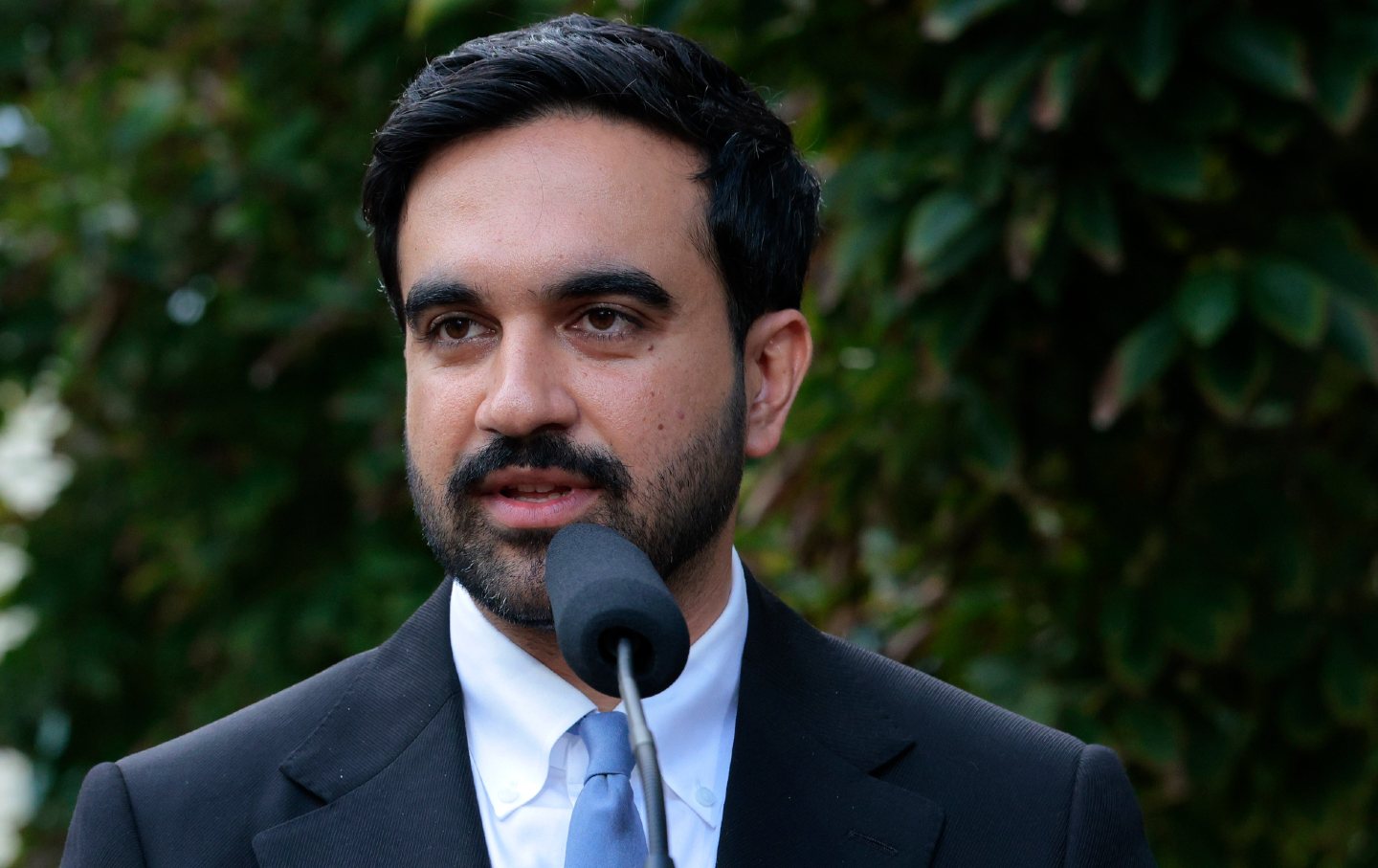
Zohran Mamdani Hosts the World Zohran Mamdani Hosts the World
In a meeting with mayors from around the globe, Mamdani argued that the left must fix everyday problems—or the right will find someone to scapegoat for them.
Is There Any Good News Left? Is There Any Good News Left?
Despite what our algorithms suggest, there’s still news worth celebrating.
CEOs Are Losing Control of AI CEOs Are Losing Control of AI
With no slowdown from Trump’s administration.
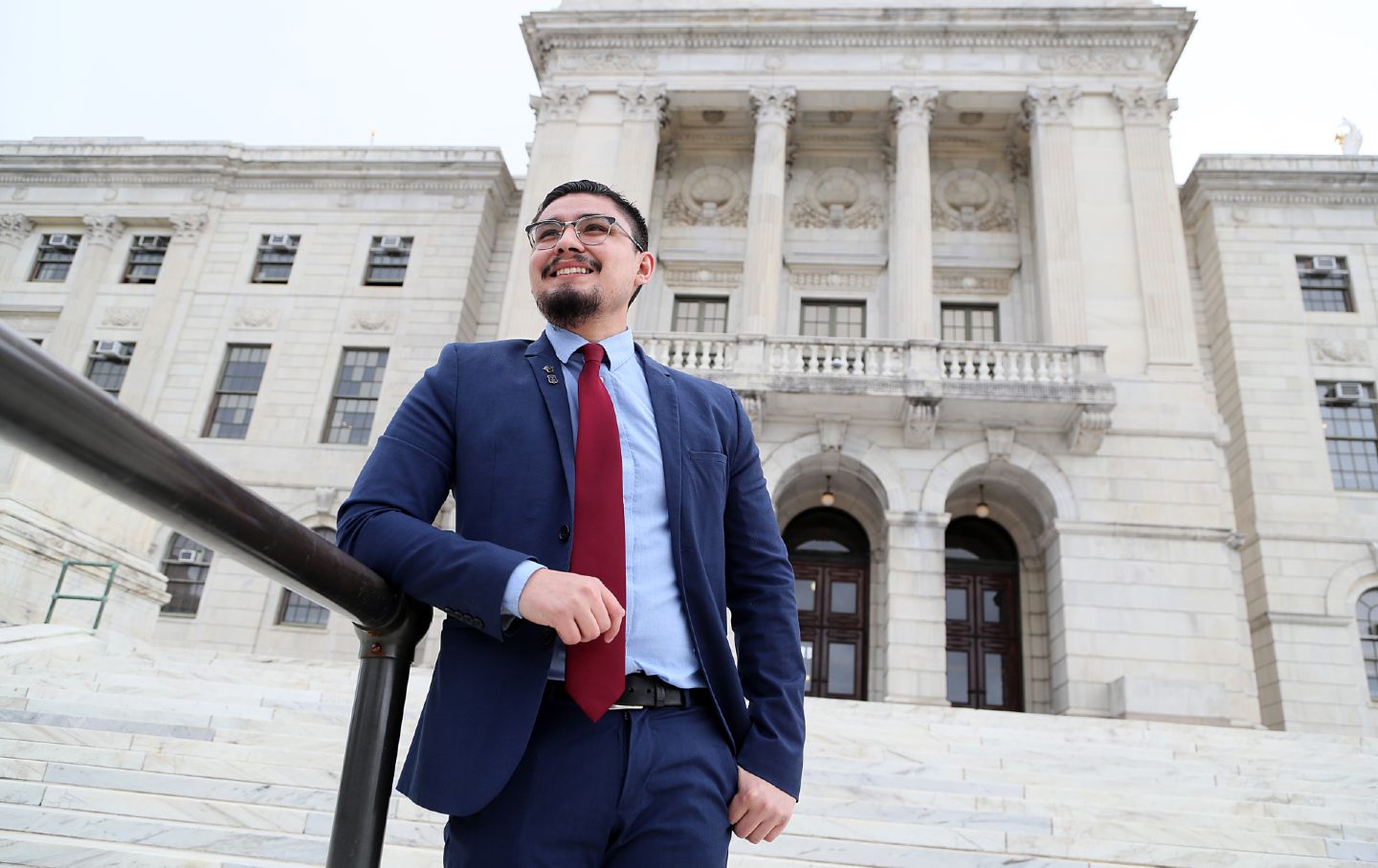
Gina Hinojosa: “We Flip Texas, and It’s Over” Gina Hinojosa: “We Flip Texas, and It’s Over”
Talking to Texas gubernatorial candidate Gina Hinojosa about what redistricting could mean and how a new generation of Democrats is speaking more directly to voters.

Trump Wants to Keep Journalists Out of the White House. He Should Get His Wish. Trump Wants to Keep Journalists Out of the White House. He Should Get His Wish.
The president has banned MS NOW, CNN, and Politico from attending press briefings. The rest of the media should respond with a boycott.

