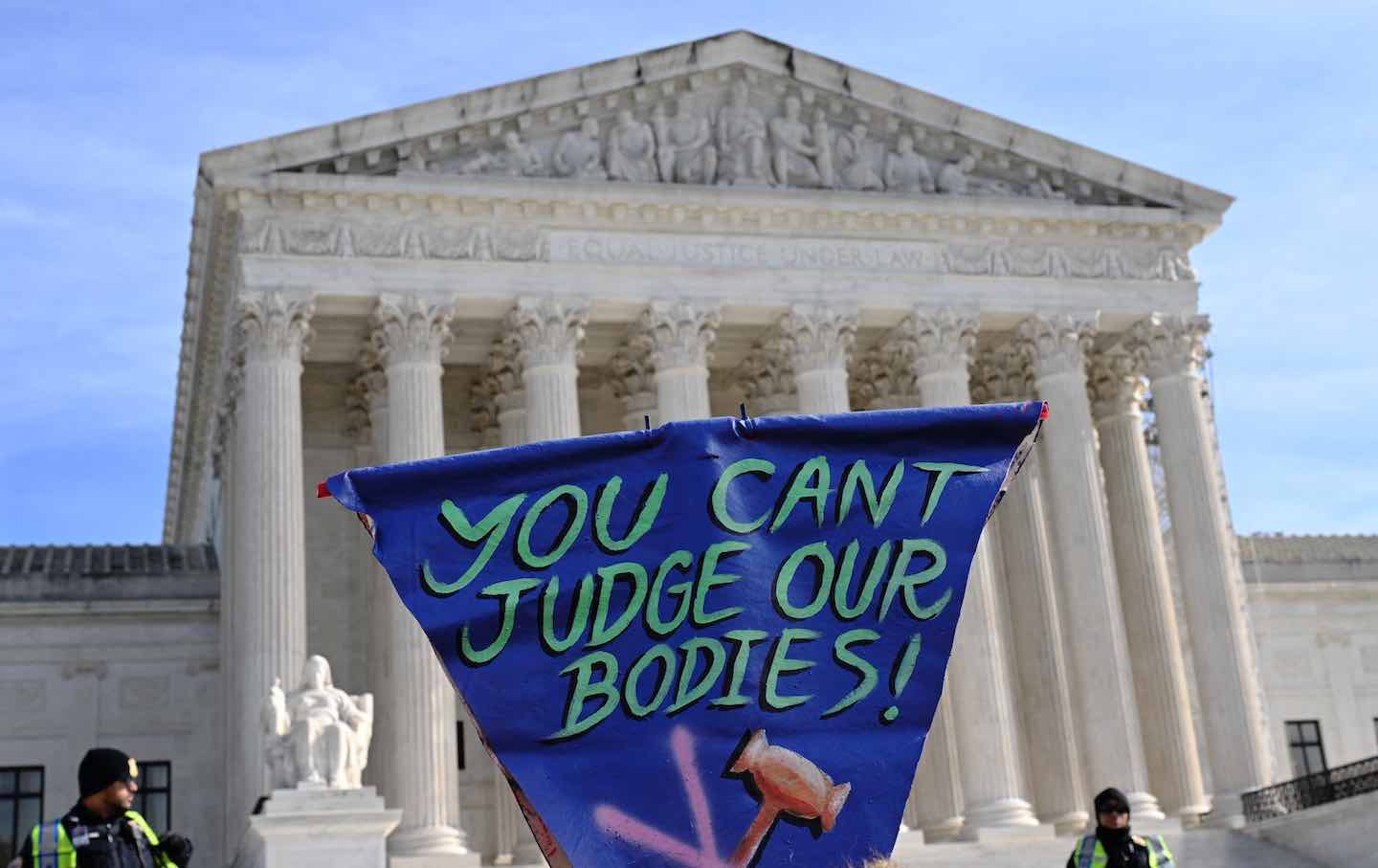
People hold signs outside the US Supreme Court Building on December 4, 2024, in Washington, DC, during oral arguments on whether states can ban certain medical treatments for young people.
(Roberto Schmidt / AFP)
The Supreme Court heard oral arguments in United States v. Skrmetti on December 4. At issue in the case is Tennessee’s complete ban on any therapies that would allow a young person to exercise their bodily autonomy and agency by transitioning away from the sex they were assigned at birth to the one aligned with their gender identity. Given the questions that this case raises for civil rights more broadly, it is understandable that much of the commentary on last week’s oral arguments focused on questions of sex and gender-identity discrimination in equal protection law. However, we must stay focused on the medical risks and harms that will be generated by upholding the Tennessee ban and reject the claim that conservative lawmakers seek to or will eliminate risk by outlawing best practices in health care.
Legally, the practice of medicine is managed at the state level under the 10th Amendment of the Constitution, which provides states the authority to regulate on questions of health, safety, and general welfare. That power has enabled state and local governments to require vaccinations against deadly diseases and to proscribe coercive and scientifically discredited change- therapy efforts for LGBTQ+ patients, more commonly known as “conversion therapy.”
The oral arguments last week revealed how Tennessee is using the pretext of medical regulatory authority as a way to justify its ban, along with restrictions on gender-affirming care in 25 other states. Such state laws have been passed and defended over the protests of parents and physicians who have advocated for the preservation of gender-affirming care given the positive health outcomes associated with these medical interventions.
Related article
We have seen this before: Anti-abortion state lawmakers have long been limiting abortion access based on the notion that they are protecting pregnant people and their fetuses, when in fact they put both at risk.
While state regulation of medical practice is legal, sex discrimination can be found unconstitutional under the equal protection doctrine of the United States Constitution, a principle that both the Biden administration and the American Civil Liberties Union have accused Tennessee of violating with its recent ban. Skrmetti puts gender-affirming care bans at a crossroads: Are they a legitimate regulation of medicine and thereby constitutional, or are they an act of blatant sex-discrimination, making them unconstitutional?
The argument that the Tennessee law is sex discrimination is an easy one to make. The law itself is concerned with the regulation and management of sex and clearly discriminates against individuals seeking some therapies while not discriminating against others based explicitly on whether the care is to address issues with the child’s or adolescent’s gender dysphoria. That means that the law allows children experiencing precocious puberty symptoms to access puberty suppressing medications while disallowing children whose gender dysphoria requires the exact same drug regimen.
To illustrate the unconstitutionality of the law, Justice Sonia Sotomayor described a 9-year-old child assigned male who starts to grow body hair prematurely who can be prescribed hormone suppressors and a similarly aged assigned-female child developing unwanted breasts who requires the same intervention. In the justice’s words, the fact that the former is acceptable and the latter is unlawful means that Tennessee’s ban is based on the kind of “sex-based difference” that the Constitution is supposed to prohibit.
Justice Elena Kagan agreed, reasoning that the state had targeted healthcare that is “utterly and entirely about sex.”
To find the Tennessee law constitutional, conservative justices would have to concede that the gender-affirming care bans actually do regulate medicine as opposed to simply defaulting to the idea that gender-affirming care is an ideological, “woke” affront to traditional gender norms. The oral arguments revealed how the conservative justices and Tennessee framed gender-affirming care as an unusually fraught medical practice, one that poses significant danger to those within the state, in order to subject youth and their providers to regulation.
To make the case that they are regulating medicine, the lawyer for Tennessee invoked the idea of risk, making the case that lawmakers are protecting “minors from risky, unproven medical interventions.” Beyond the fact that the American Medical Association and the American Academy of Pediatrics have described such care as “medically necessary,” this argument ignores the risks associated with an inability to access those treatments.
Conservative Justices Samuel Alito and Brett Kavanaugh bolstered the state’s case, citing European health bureaucracies, which have recently restricted puberty suppressing medications to research settings. It’s important to note, however, that they have not banned them outright.
The risk of regret also played a prominent role during oral arguments, as Kavanaugh picked up on the state’s portrayal of detransition as a common occurrence despite its rarity and the fact that many detransitioners cite stigma and discrimination as reasons for discontinuing care. Furthermore, as Sotomayor noted, “Every medical treatment has a risk, even taking aspirin,” and healthcare professionals are always balancing risks and benefits in the treatment of any one patient, allowing for a patient-centered approach that is impossible in the context of a blanket ban. And as Biden administration Solicitor General Elizabeth Prelogar made clear in her oral arguments, enabling a patient-centered approach guards against the many harms associated with an inability to access gender-affirming care, which range from suicide and suicidal ideation to drug use.
It’s also worth noting that conservatives have a long track record of selective risk-taking. From using ivermectin to treat Covid-19 to refusing to wear masks, many of the same voices warning against gender-affirming care today argued for risk-taking in medicine not long ago. Unlike gender-affirming care, which has demonstrated benefits, ivermectin showed no benefits to Covid-19 patients and masks have been proven to lower the risk of contracting or spreading the virus.
Alas, the conservative leaning justices spent the oral argument period questioning warnings about the most dire risks that gender dysphoric patients face and framing gender-affirming care as the more risky way forward. So risky that the care can be banned by states. This set of moves is also familiar: The court’s 2022 Dobbs decision overturned constitutional abortion rights, leaving abortion regulation to the states. The abortion bans that quickly followed have ignored the needs of pregnant people and the harsh health consequences that would follow, ranging from loss of limbs and organs to death.
Popular
“swipe left below to view more authors”Swipe →In finding the Tennessee ban constitutional, the Supreme Court could be forcing young people and their parents into a new risk environment—they may soon be left alone to address issues from suicide and suicidal ideation to depression with no help from the healthcare system, despite physicians’ capacity to intervene. Treating the Tennessee law as a legitimate regulation of medicine twists the language of medical risk to portray the state as minimizing harms when it is, in fact, producing them.
Support independent journalism that does not fall in line
Even before February 28, the reasons for Donald Trump’s imploding approval rating were abundantly clear: untrammeled corruption and personal enrichment to the tune of billions of dollars during an affordability crisis, a foreign policy guided only by his own derelict sense of morality, and the deployment of a murderous campaign of occupation, detention, and deportation on American streets.
Now an undeclared, unauthorized, unpopular, and unconstitutional war of aggression against Iran has spread like wildfire through the region and into Europe. A new “forever war”—with an ever-increasing likelihood of American troops on the ground—may very well be upon us.
As we’ve seen over and over, this administration uses lies, misdirection, and attempts to flood the zone to justify its abuses of power at home and abroad. Just as Trump, Marco Rubio, and Pete Hegseth offer erratic and contradictory rationales for the attacks on Iran, the administration is also spreading the lie that the upcoming midterm elections are under threat from noncitizens on voter rolls. When these lies go unchecked, they become the basis for further authoritarian encroachment and war.
In these dark times, independent journalism is uniquely able to uncover the falsehoods that threaten our republic—and civilians around the world—and shine a bright light on the truth.
The Nation’s experienced team of writers, editors, and fact-checkers understands the scale of what we’re up against and the urgency with which we have to act. That’s why we’re publishing critical reporting and analysis of the war on Iran, ICE violence at home, new forms of voter suppression emerging in the courts, and much more.
But this journalism is possible only with your support.
This March, The Nation needs to raise $50,000 to ensure that we have the resources for reporting and analysis that sets the record straight and empowers people of conscience to organize. Will you donate today?