
Senate Democrats Are Attacking Tulsi Gabbard for the Wrong Reasons
Preferring to defend spy agencies and line up behind the hawkish consensus, the bipartisan elite ignores the director of national intelligence nominee’s rampant Islamophobia.
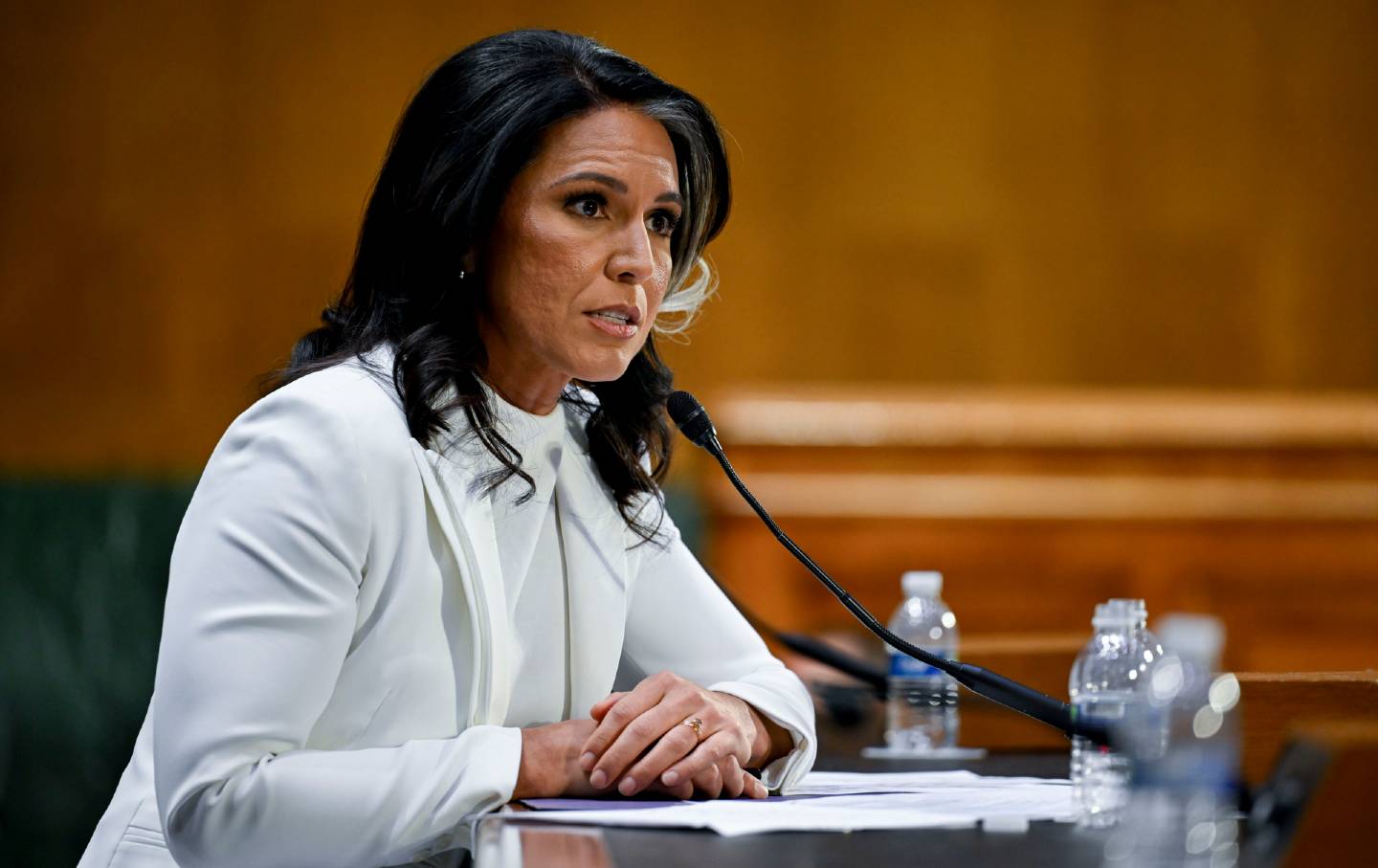
Donald Trump’s slate of presidential nominees has been top-heavy with figures described as “controversial” and “polarizing”—but who might more accurately be describe as oddballs and misfits: Matt Gaetz, Pete Hegseth, Robert F. Kennedy Jr., Kash Patel, and Tulsi Gabbard. This group stands variously accused of alleged statutory rape (Gaetz), rape (Hegseth), antivax politics and sexual assault (Kennedy), and authoritarian aspirations (Patel). Gaetz has been the only one of these contentious nominees forced to withdraw—so far. Hegseth won a narrow confirmation. But even among this list of oddballs with repellent personal histories and authoritarian goals, Tulsi Gabbard—Trump’s nominee to be director of national intelligence (DNI)—stands out, since what makes her strange are her wild ideological shifts.
Former Hawaii governor Neil Abercrombie, a disillusioned former supporter, describes Gabbard as a “shapeshifter.” Abercrombie, a Democrat, was quoted in a New York Times profile that documented Gabbard’s wild dance across the political spectrum. She was born into the Science of Identity sect, described by the New York Times as “a secretive offshoot of the Hare Krishna movement vehemently opposed to same-sex relationships and abortion, and deeply suspicious of Islam.” Although she now says she is not associated with the Science of Identity Foundation and simply identifies as Hindu, the movement has been instrumental in supporting her throughout her career. Notably, when she was first elected to the Hawaii statehouse in 2002, she shared the Science of Identity’s opposition to abortion and marriage equality. Later on, when running for Congress as a Democrat, she disavowed those positions, although she has held steadfast in her Islamophobia, one of the few consistent commitments in her volatile political career.
In 2003, she was caught up in nationalist enthusiasm for George W. Bush’s war on terror and joined the military. But witnessing the carnage in Iraq, she turned against what she calls “regime change wars.” Elected to Congress in 2010, she had a biographical profile—military veteran, a woman, a racial minority, and skewing mildly conservative on social issues—that made her attractive to the party’s establishment. She was groomed to be a rising star but burned her bridges with the establishment by supporting Bernie Sanders for president in 2016. When Trump won in 2016, she was actively courted by MAGA leaders like Steve Bannon, who rightly saw her discontent with mainstream Democrats as a sign that she could be a potential recruit. In 2016, she met with the victorious candidate at Trump Towers when he was president elect.
Gabbard’s mix of foreign policy preferences—a deep aversion to regime change wars and democracy building efforts, unwavering support for Israel, a desire to deepen America’s ties to the Hindu nationalism in India—aligned her with Trump and Bannon’s America First foreign policy.
Like the MAGA movement, Gabbard is xenophobic but also wary of military interventions involving boots on the ground. This heterodox foreign policy mix also led her question America’s support of Ukraine—both before and after Russia’s invasion—and to praise Edward Snowden, who leaked a treasure trove of National Security Agency secrets in 2013, as a whistleblower who deserves a pardon. These latter two positions are the main source of national security elite aversion to Gabbard. As the Times notes, “Her nomination has alarmed national security officials of both parties, and Mr. Trump has privately told allies that hers is the cabinet confirmation he is most worried about.”
Given Gabbard’s checkered political career, there’s reason for people across the political spectrum, ranging from traditional conservative Republicans to liberals to leftists to oppose her nomination. Her one base of support might be MAGA ideologues who care about foreign policy—notably former Fox News host Tucker Carlson. But it’s unclear whether this faction has enough sway over Republicans in the Senate to successfully defend her from attacks by the foreign policy elite.
In the nomination hearings held on Thursday, Senate Democrats made a move—politically shrewd but dismaying in policy terms—to play up Gabbard’s foreign policy heterodoxy, especially her former defense of Snowden, which she only partly recanted. In terms of the dynamics of the Senate, this move makes sense. Republicans hold a majority of 53 Senate seats. To defeat a Trump nominee, Democrats need to flip four Republicans, otherwise the GOP will have 50 votes plus Vice President JD Vance as a tie breaker.
The mathematical logic means that to defeat Gabbard, Democrats needed to make a pitch that appeals to Republicans. But beyond the math, there is the broader political fact that in response to Trumpism, establishment Democrats prefer to build a centrist coalition by shoring up the national security consensus. Democratic Party leaders are deeply wedded to a policy of ancien régime restoration—which means that when they challenge Trumpism on foreign policy it is for his heterodoxy that offends the national security establishment (notably wanting a rapprochement with Russia and questioning the honesty and competence of intelligence agencies).
In the past, Gabbard has praised Snowden as a “brave” whistleblower who deserved clemency. She has now backtracked on this by saying that he “broke the law” and that she would not as head of the DNI support clemency. Both Republicans and Democrats hit her hard on this issue, with Colorado Democrat Michael Bennet thundering, “This is when you need to answer the questions of people whose votes you’re asking for to be confirmed as the chief intelligence officer of this nation. Is Edward Snowden a traitor to the United States of America? This is not a hard question to answer when the stakes are this high.”
Gabbard still refused to describe Snowden as a traitor—which Democrats seized on as a means to discredit her. On X, formerly Twitter, Bennet posted, “Four times Tulsi Gabbard was asked if Edward Snowden is a traitor for releasing U.S. secrets & four times she declined to answer Democrats or Republicans. Anyone who refuses to label a traitor to the U.S. as a traitor is completely unqualified to lead our intelligence community.”
What Bennet refused to even consider was the possibility that, far from being a traitor, Snowden was a patriotic whistleblower who did the public a great service by revealing real government abuses—some of which were subsequently redressed by Congress.
Bennet and other Democrats on the committee were playing their old game of running to the right of Republicans on foreign policy. While this might be seen as smart politics in centrist circles—and could well sink Gabbard’s nomination—it’s questionable whether the public as a whole shares this implicit enthusiasm for the national security establishment and intelligence agencies. Trump twice won the presidency by being the voice of anti-system rage, with both the national security consensus and the intelligence services among his prime targets. Conversely, Democrats have twice lost to Trump by criticizing him as a disruptive force on foreign policy, while embracing such stalwarts of militarism as Henry Kissinger (extolled by Hillary Clinton in 2016) and Dick Cheney (celebrated by Kamala Harris in 2024). This strategy of being the hawkish pro-system party has torn the Democratic Party apart and alienated key parts of the party’s base.
Popular
“swipe left below to view more authors”Swipe →What’s appalling about the whole spectacle is that there are many legitimate reasons for challenging Gabbard’s nomination—but scant interest in the Senate in raising these questions. As journalist Mehdi Hassan noted, “Sad that Democrats—instead of hitting Gabbard for her Islamophobia and support for genocide in Gaza and support for Assad and her alleged membership of a weird cult—are obsessing over the one thing she’s right about: Edward Snowden.”
If Gabbard is defeated, there will be little reason for regret. She deserves to go down, but is being targeted for the wrong reasons. The true tragedy is that the Democratic Party elite remains committed to keeping foreign debate as narrow as possible, eagerly enlisting as the bodyguards to an increasingly out of touch and discredited national security establishment.
Become a Sustaining Donor This September
Between the reemergence of right-wing red-baiting and Donald Trump’s use of the chilling National Security Presidential Memorandum–7 to criminalize left political organizing, we’re seeing McCarthyism reborn before our eyes.
This assault on democracy cannot be ignored or wished away. Resisting it requires bravery in the face of threats and repression, a steadfast commitment to the truth, and the unwavering belief that we can—and will—overcome this darkness.
We must have an independent media that sets the record straight, unearths corruption and abuses of power, and advances a politics of justice and dignity for all if we’re to win this fight.
That’s why I’m writing to you today. This September, The Nation needs to add 100 monthly donors to sustain our progressive journalism. Your contribution makes the next investigative report, the next truth-speaking column, and the next pathbreaking essay all possible.
I hope you’ll support our work with a recurring donation today. If you donate $10 or more a month, we’ll send you a brand new “Hands Off the Free Press!” sticker to recognise your commitment to our cause. Please, donate today.
Onward,
Katrina vanden Heuvel
Editor and Publisher, The Nation
More from
Jeet Heer 

Even Republicans Are Figuring Out That Pete Hegseth Is a Disaster Even Republicans Are Figuring Out That Pete Hegseth Is a Disaster
Hegseth was always a horrible choice for defense secretary. At long last, some in the GOP are admitting it.
Why Aren’t We Talking About the Warmongering Lies of Mike Rogers? Why Aren’t We Talking About the Warmongering Lies of Mike Rogers?
The media’s relentless focus on Hasan Piker allows the dishonest GOP hawk (and actual Michigan Senate candidate) to evade scrutiny.

MAGA Is Exploiting the Lindsay Clancy Case to Try to End Voting for Women MAGA Is Exploiting the Lindsay Clancy Case to Try to End Voting for Women
As Trump subverts elections, his most ardent fans want to overturn the 19th Amendment.

Accountability for the Gaza Genocide Can’t Focus on Netanyahu Alone Accountability for the Gaza Genocide Can’t Focus on Netanyahu Alone
Getting rid of one bad leader won’t bring justice.

In Trump’s Mafia, Even Goons Can Do Billion-Dollar Shakedowns In Trump’s Mafia, Even Goons Can Do Billion-Dollar Shakedowns
Corey Lewandowski is a disposable underling, but he’s protected enough to scorn the law.

Maria Bartiromo Was Fired for the Wrong Reason Maria Bartiromo Was Fired for the Wrong Reason
For Fox News, blind servility to Trump is fine until it hits the bottom line.

