
Why Jeff Bezos Loves Trump’s Big, Ugly Bill
The legislation contains massive giveaways to the oligarch class.
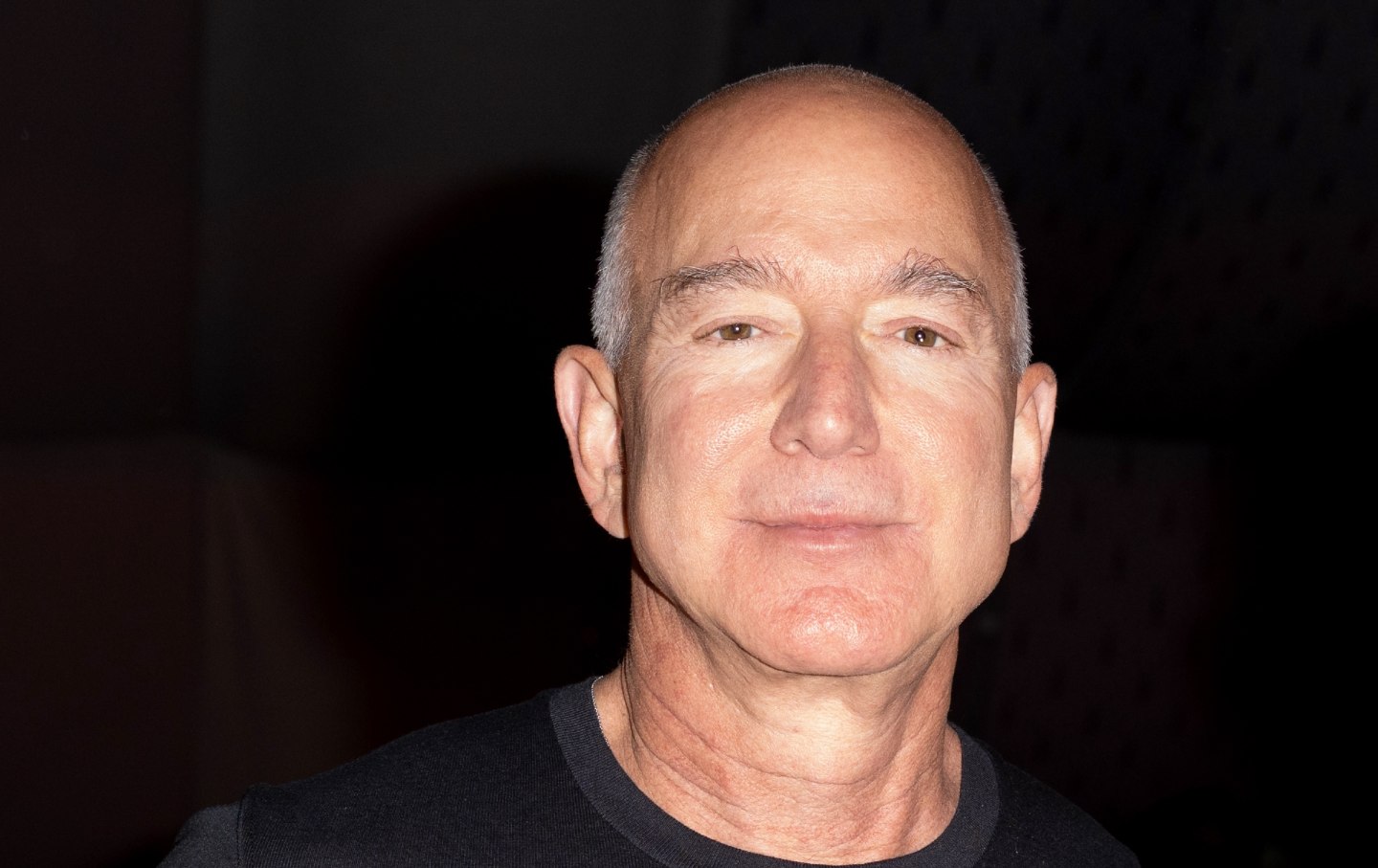
Jeff Bezos attends the Global Champions Arabians Tour Miami Beach on April 17, 2025, in Miami Beach, Florida.
(Alexander Tamargo / Getty Images for Global Champions Arabians Tour Miami Beach)By a one-vote margin, the House has just passed a bill brimming with tax giveaways for large corporations and billionaires. One major corporation—Amazon—provides a telling example of the high costs of these giveaways for working people and our democracy.
President Trump had made some noises about increasing the top marginal income tax rate, but House leaders opted instead to keep that rate at 37 percent—down from 39.6 percent before the last big tax cuts for the wealthy in 2017.
According to a report our organizations recently released with the Athena Coalition, Amazon CEO Andrew Jassy has enjoyed about $1 million a year in tax windfalls from that rate cut.
Amazon founder Jeff Bezos, on the other hand, doesn’t have much of a stake in the income tax rate because he, like most other ultra-wealthy Americans, gets nearly all his money from investment profits. And that money is taxed at about half the rate as income from work. The House bill preserves this perversity, meaning that millions of middle-class Americans will continue to pay a higher tax rate than many billionaires.
Just how much has Bezos gained from this double standard? We looked into the $37 billion worth of Amazon stock he’s sold since 2018. If we taxed income from wealth at the same rate as income from work, the world’s second-richest man would’ve owed Uncle Sam $6.2 billion more on his capital gains from those sales alone.
Amazon also stands to gain from House leaders’ plan to keep the corporate tax rate at just 21 percent—a drastic reduction over the pre-2018 rate of 35 percent. And they have no intention of closing the loopholes that Amazon and many large corporations have exploited to pay far less. In the first four years of the 2017 law, the e-commerce giant paid just a 5 percent average effective tax rate.
What have Amazon and Bezos been doing with all these tax windfalls? Not making serious investments in their workforce, that’s for sure. Since 2018, the company’s median worker pay has increased just 3.3 percent, to $37,181. Instead, Amazon and Bezos have been spending money on union busting and hiring an army of lobbyists to block pro-union reforms.
Perhaps it should come as no surprise that a corporation opposed to workplace democracy has now thrown its economic clout behind a political regime that threatens our national democracy as well. In January, Amazon donated $1 million for Trump’s inauguration, earning Bezos a spot in the billionaires’ row behind the president. The company has also reportedly paid $40 million for a documentary featuring Melania Trump—most of which goes directly to the Trump family.
Amazon has also been investing heavily in technologies the Trump regime is now using in its crackdown on immigrants and federal workers. Amazon’s cloud services, for instance, undergird tech platforms used by ICE, the agency that is escalating attacks on immigrants, international students, farmworker labor leaders, and people they accuse of being gang members because they don’t like their tattoos.
Nor has Amazon spared any expense in developing high-tech surveillance technologies to track warehouse workers’ every move. Through DOGE, the Trump regime is now drawing on these techniques to surveil federal workers.
Of course, Amazon is just one example of how corporations and billionaires are benefiting from our rigged tax system while selling out our freedoms. Elon Musk, who paid zero taxes in at least one year since becoming a billionaire, has been leading the charge to gut vital programs that protect workers, consumers, and communities. Mark Zuckerberg, whose Meta corporation has reaped billions from the 2017 corporate tax breaks, has discontinued fact-checking of hate-fueled disinformation on Facebook and Instagram and terminated diversity programs.
Across the country, people have had enough of billionaire bullies. Amid Tesla Takedown protests, the company’s stock has plummeted. Millions of people have taken to the streets during Hands Off, Fighting Oligarchy, and May Day rallies. And when people learn the details of the House budget proposal, the outcry will only get louder.
Popular
“swipe left below to view more authors”Swipe →Now that the House has narrowly passed its version of the budget reconciliation bill, the fight moves to the Senate. We need to amplify demands for a tax code that supports economic prosperity for all of us—not just the billionaires and massive corporations.
Amazon is a perfect case study of how a rigged tax system further expands the excessive power of corporations and the wealthy over our lives and our democracy. Unrigging that system is a crucial step in the fight against fascism.
Your support makes stories like this possible
From illegal war on Iran to an inhumane fuel blockade of Cuba, from AI weapons to crypto corruption, this is a time of staggering chaos, cruelty, and violence.
Unlike other publications that parrot the views of authoritarians, billionaires, and corporations, The Nation publishes stories that hold the powerful to account and center the communities too often denied a voice in the national media—stories like the one you’ve just read.
Each day, our journalism cuts through lies and distortions, contextualizes the developments reshaping politics around the globe, and advances progressive ideas that oxygenate our movements and instigate change in the halls of power.
This independent journalism is only possible with the support of our readers. If you want to see more urgent coverage like this, please donate to The Nation today.
More from The Nation

Karen Tei Yamashita on Why We Shouldn't Take Fiction Lightly Karen Tei Yamashita on Why We Shouldn't Take Fiction Lightly
A conversation with the author about her new book’s regretful relevance amidst escalatingly violent ICE detainments.
Everything Is a Scam Everything Is a Scam
Our economy allows poor and working people to be shafted every day—does anyone care?
The Billionaires’ Bathos Club The Billionaires’ Bathos Club
American plutocrats can’t stop whining about how extremely modest tax increases are killing their initiative.

Americans Are Being Bled Dry by Hidden Taxes Americans Are Being Bled Dry by Hidden Taxes
Three private taxes are pushing electricity costs far above what ordinary people can afford.
The Great AI Grift The Great AI Grift
Tech leaders want you to believe that AI is the key to a new golden age. The reality looks more like a bold, government-backed heist.
How Trump’s Economy Is Crushing Everyday Americans How Trump’s Economy Is Crushing Everyday Americans
As costs surge and safety nets shrink, millions of Americans are struggling to afford the basics.

