What We Get Wrong About Patriarchy
A conversation with philosopher Robin Dembroff about their new book, Real Men on Top, identity categories, and the possibility of undoing patriarchy.
It is a truth recently acknowledged that men are not doing well. Look at different metrics, and a pattern quickly becomes evident: Boys and men are falling behind girls and women. Lower college enrollment levels, higher suicide rates, stagnant wages: The problem is pervasive, and op-eds, essays, and podcasts on the “masculinity crisis” abound.
Missing from many of these think-pieces, however, is a more rigorous and systemic account of gender dynamics. How can it be true that men are falling behind when we live under a patriarchal society that—traditionally understood—harms women and benefits men? Or, asked in the opposite direction: How can we say that we live in a patriarchal society when men are clearly not OK?
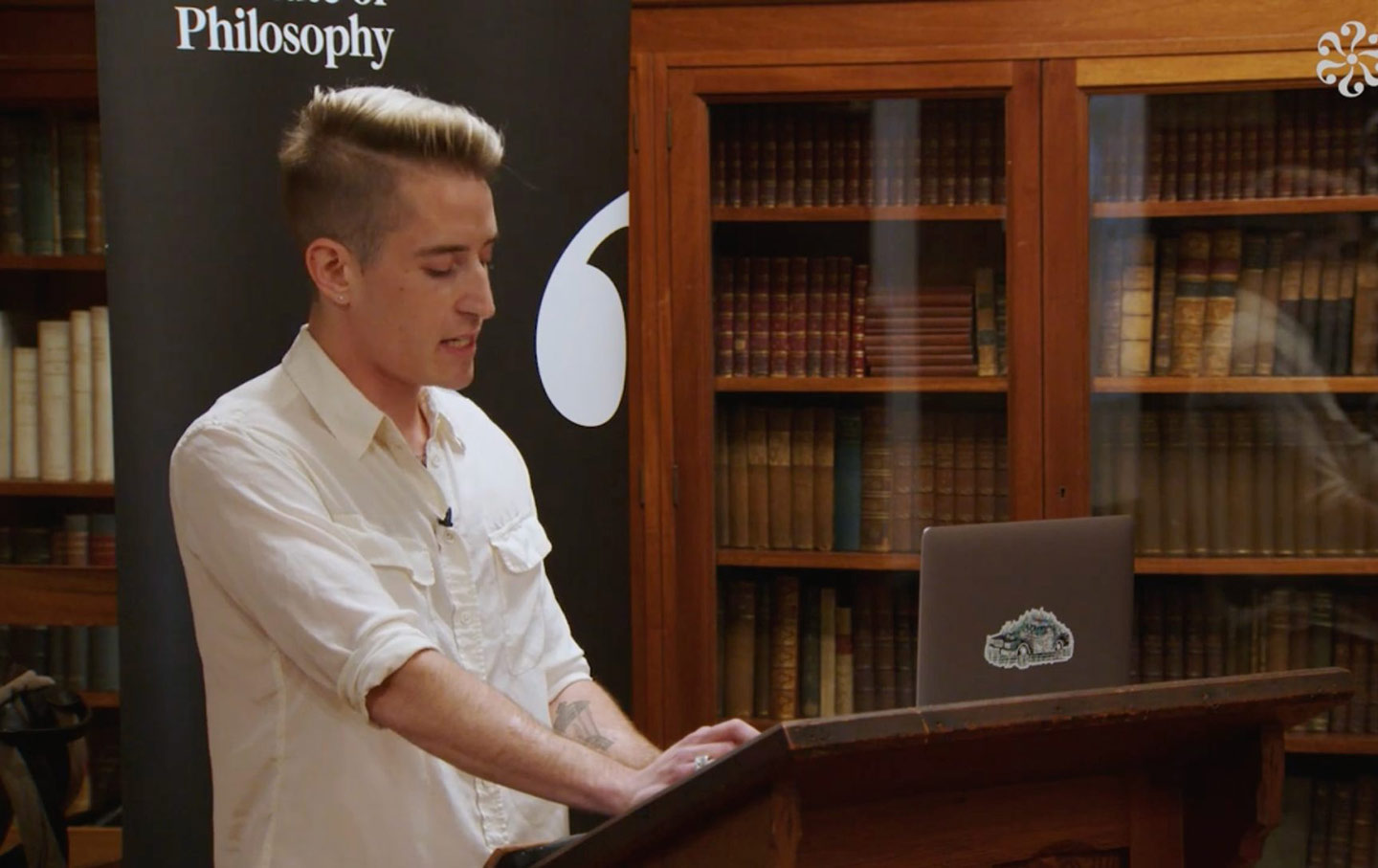
“Many men experience violence, marginalization, and exploitation not despite patriarchy, but because of it,” wrote philosopher Robin Dembroff in a 2020 tweet that was met with wide controversy. Six years later comes Real Men on Top: How Patriarchy Shapes Our Reality, a fresh work of philosophy in which Dembroff defends and expands that thesis.
Written in the first person and drawing from Dembroff’s personal experiences, Real Men on Top marks a shift away from the detached, impersonal style that characterizes most contemporary academic philosophy, opening formal possibilities for future philosophers to follow. Dembroff reimagines conceptions of patriarchy first inherited from second-wave feminists, many of whom understood patriarchy as the social domination of women by men. Unlike these theorists, though, Dembroff rethinks patriarchy as a system based on a mythology that legitimizes “economic exploitation, political injustice, and social cruelty,” all while harming women, children, animals, and the majority of men.
The Nation spoke with Dembroff to discuss Real Men on Top, how patriarchy harms men, and possible avenues for undoing patriarchy. This interview has been edited for length and clarity.
—Andrés Muedano
Andrés Muedano: Your book opens with a reference to David Foster Wallace’s 2005 commencement speech at Kenyon College, in which he shares the story of two young fish who encounter an older, wiser fish. “How’s the water?” the latter asks them, to which one of the two young fish responds: “What the hell is water?” Gender, you argue, is like the water in Wallace’s parable: an often-unquestioned assumption that “disappears into the background fabric of daily life, successfully camouflaged as an eternal and universal given.” You describe the goal of Real Men as an attempt to “articulate the shape of this water.” What do you mean by this?
Robin Dembroff: What we’re doing when we do theory is build concepts that give us an explanatory framework for understanding certain patterns of activity—or, in this case, inequality. When I think about what it means for me to “articulate the shape of this water,” I think of giving people a concept of gender—of patriarchy—that is a very significant revision of the concept they’ve been given before. I hope that as soon as people have this revised concept, they can rise to a level of conscious awareness they didn’t previously have.
An example of this from the history of feminist thought would be when consciousness-raising groups came up with concepts like sexual harassment, for example. It wasn’t like women were not experiencing sexual harassment before, but the experiences weren’t understood as such. And so, what I’m hoping to do is give people a concept that allows them to see their daily lives in a new way that is not only helpful to them personally, but also creates a greater sense of solidarity between them. I’m particularly hoping that men and women start to see each other not as members of “the other side.”
AM: Tell me more about this revised concept of patriarchy. How does it differ from the mainstream conception of patriarchy?
RD: It’s fundamental to my book that we start with the idea of people as living bodies that then get interpreted through inherited concepts and identities. So “Man,” for instance, is an identity conferred on certain people, and with that identity come a lot of expectations and prescriptions about how those people ought to be.
Feminist theory previously understood the identity of “Man” in opposition to the identity of “Woman.” Notions of biological sex and of the difference between male and female were the singular dimension on which gender and gender oppression were subsequently analyzed.
My view says: “No, that’s one dimension of ‘Man,’ but ‘Man’ is really a tripartite identity constituted by the identities of ‘Male,’ ‘Adult,’ and ‘Human.’” When we focus on “Man” as a mythological character instead of a supposedly biological definition, we open the door to seeing how this identity gets weaponized against people. It moves us away from the realm of biological groups to the realm of how this mythology—the moral grammar of patriarchy—plays out at a political and economic level. To elevate “Man,” you have to devalue “Animal,” “Child,” and “Woman.”
Practically speaking, this means that being compared to a woman, a child, or an animal—being feminized, infantilized, or dehumanized—is equivalent to being degraded. Look at the rhetoric that Donald Trump uses for undocumented immigrants. He uses the imagery of animals to devalue people and elevate himself as “Man.” That’s not separate from patriarchy, in my view.
AM: You argue in Real Men that we need a concept of patriarchy for a “coherent feminist politics.” Can you explain this? What makes the concept of patriarchy so necessary?
RD: I understand feminism as the struggle against systemic gender injustice, and I think that the notion of systemic gender injustice is incoherent if you don’t have a concept of gender. If we’re going to think of gender injustice as systemic, we need to have an account of the mechanism that is creating these routine harms.
The promise of the term “patriarchy”—following its rebranding by the radical feminist movement—was to do the work of naming this very mechanism: the mechanism that creates systemic harm against women. I want to say that patriarchy does that, and that it also creates systemic harms against children, animals, and the vast majority of men. (And if you want to include psychological harms, all men).
AM: How does patriarchy harm men?
RD: In my picture, we must translate this question to “How does the tripartite and supremacist mythology of ‘Man’ harm men?” And there are two dimensions to the answer that I talk about in my book: one psychological, emotional, and interpersonal; the other systemic and economic.
The first has been talked about more in our culture. People talk about isolation and loneliness, about depression, about the rates of male suicide. Patriarchy requires the isolation of men, because the identity “Man” demands that you see yourself as superior to women, children, and animals, and in constant competition for manly status with other men. That’s going to create a lot of loneliness and detachment, especially when you combine that with the fact that the expression of emotions and emotional intimacy are considered feminine. You’ve immediately taken the building blocks of meaningful relationships—the ability to build communities—so now men feel like they can’t access those relationships and communities without undermining their social status. That’s a recipe for disaster, and I think we’re seeing it play out right now on a grand scale.
But the second dimension—the one I really wanted to drive home in my book—has not been discussed. We’re told that men get an economic benefit from gender, and I think that story is totally wrong. It is a rhetoric that’s used to legitimize economic exploitation and extreme violence, including state violence, by some men against others, and it totally relies on the mythology of “Man.” Think of the use of propaganda in the United States: the use of propaganda to convince poor white men to vote for rich white men on the promise that they’re going to help them out economically by cutting Black men and brown men out of the economic system. This idea of white brotherhood traces back to the Civil War, when notions of Confederate manhood were used by wealthy white men in the South to get poor white men to die for them. It is based on the idea that we are true Americans. That we are the real men.
And so, when we look at men as individuals, we miss these broader economic patterns. We fail to appreciate how the rhetorics of feminization, dehumanization, and infantilization are used by the wealthiest men to cause severe and systemic harm to men who have far less power and wealth than they do.
AM: How might we develop a better vocabulary to name and identify these harms?
RD: I think we need men’s consciousness raising in a very serious way.
The feminist consciousness-raising groups of the mid–20th century got women together to talk about the experiences they were having as women. This allowed them to identify patterns, and it gave them words to name those patterns. Something similar is needed for men, both for the reasons of individuals coming to a higher consciousness of their experience, and for the purpose of coming up with useful concepts to name patterns of treatment.
What is very dangerous is when men get together and have these conversations within a men-versus-women framing of gender, because then it introduces the idea of reverse sexism: the idea that the bad things happening to men are somewhat benefiting women.
AM: It’s interesting because the so-called manosphere we see today has its ideological origins in the men’s liberation movement of the 1970s, when men were frustrated with traditional gender roles. Their frustration could’ve motivated the kind of consciousness raising you’re pointing to, but instead it quickly turned—
RD: Into a right-wing movement, right? There was an oversight at the heart of that movement, and we’re actually seeing the same oversight at the heart of our current men’s health movement. They’ll talk about men falling behind women in higher education, for instance, but they won’t subject the identity of “Man” to interrogation. They continue to rely on ideas like “good man” or “real man” to frame their political agenda, which is, of course, the same framing that’s being used by the right wing.
If you keep doing that, then you’re still relying on an identity that’s been set up so that it has its content—its meaning—defined in opposition and superiority over that of “Woman.” If you don’t critically interrogate the identity of “Man,” then we’re just going to keep repeating that same cycle.
AM: Many anglophone philosophy departments have been slow to integrate insights from feminist theory and queer scholarship. Historically, at least, the philosophy of gender has not been taken very seriously. Is that changing? Do you see your book as representative of a broader trend in philosophy?
RD: Philosophy is becoming much more open, ecumenical, and fluid in terms of what kinds of questions can be asked and what kinds of sources and literatures can be used to try to answer those questions. There are a lot of factors that play into that, but certainly one of them has to do with the fact that the field has become less homogenous. My book is part of that tradition; it contributes to philosophy becoming a place where questions of gender can be asked more broadly and more seriously. But I also think that’s happened in philosophy already. There are other frontiers—related to disability and environmental ethics, for example—where we have yet to do the work of allowing more space to ask those questions. Where I think my book is really pushing the boundaries has more to do with genre than the topic itself.
AM: What do you mean by genre?
RD: There is an inherited assumption within philosophy—analytic philosophy, but maybe more broadly, too—that philosophical writing must be dry and with no meaningful first-person perspective. It must be written as if there’s one universal truth you’re tapping into with your genius, written to be read by other philosophers and only other philosophers.
In my book, when I talk about the existential hooks of gender and patriarchy that exist in our sense of self, I am not trying to give a reductive analysis of what a sense of self is in some cognitive or psychological way. I’m trying to appeal to people’s humanness and their everyday lived reality more directly. I’m just trying to have a conversation with people.
Popular
“swipe left below to view more authors”Swipe →I really want my book to open the door for philosophers to not only write in a wider variety of ways but also to care more about writing as a craft. When someone develops writing as a craft, they are developing their ability to express their person in their writing, which opens the door for philosophy to be what it actually is (but we’ve pretended it’s not), which is people offering their perspective on something and hoping that it is illuminating for other people.
AM: How might philosophy help us undo patriarchy, then?
RD: Like many projects of undoing ideology, it will need to be done from many directions at the same time. No one move is going to undo it. I do think that at the heart of it is a problem of tying biological characterizations to normative expectations that are understood to be determinants of social and moral worth. Take cliques in high school. To be a goth, you should wear black and eyeliner. There is a “should” there. That’s part of what goths are. But we don’t understand the identity “goth” such that, when you don’t do that—when you don’t wear black and eyeliner—then you’re somehow worse as a person, or your social status goes down.
If we’re going to have social categories as ways to create membership and meaning, let’s have them be more focused on how you want to be in the world, how you want to express yourself, and who you want to be in community with. And let’s not make those categories a determinant of how much your needs matter in our culture. As long as we’re attaching biological descriptions to moral worth, we have a problem.
I would love to move towards a reality where people see more clearly that the concepts that we use to identify ourselves to ourselves and to other people are made by us, that we have agency over them, and with that agency comes responsibility, that the fluidity of our concepts is not a threat. It’s an opportunity to be able to build a world where we can all thrive, where all have more freedom in our ability to form relationships that matter to us.
More from The Nation

The Carnival of Venice Biennale The Carnival of Venice Biennale
That so much of the art of “In Minor Keys” is muted in effect is ironic, because so much of it is overproduced, aspirationally eye-catching, and so big.

America Without the NFL America Without the NFL
Chuck Klosterman’s Football is a eulogy for the sport on the eve of its decline.
Edward Said: Between Worlds Edward Said: Between Worlds
A new film biography depicts the Palestinian writer as still out of place—and ahead of his time.
Imani Thompson’s Grad-School Thriller Imani Thompson’s Grad-School Thriller
In Honey, the novelist offers a different take on the campus satire.