
The Supreme Court Just Gave Trump a Terrifying New Power
In a pair of twin rulings, the court undermined the independence of the key independent agencies—except one.
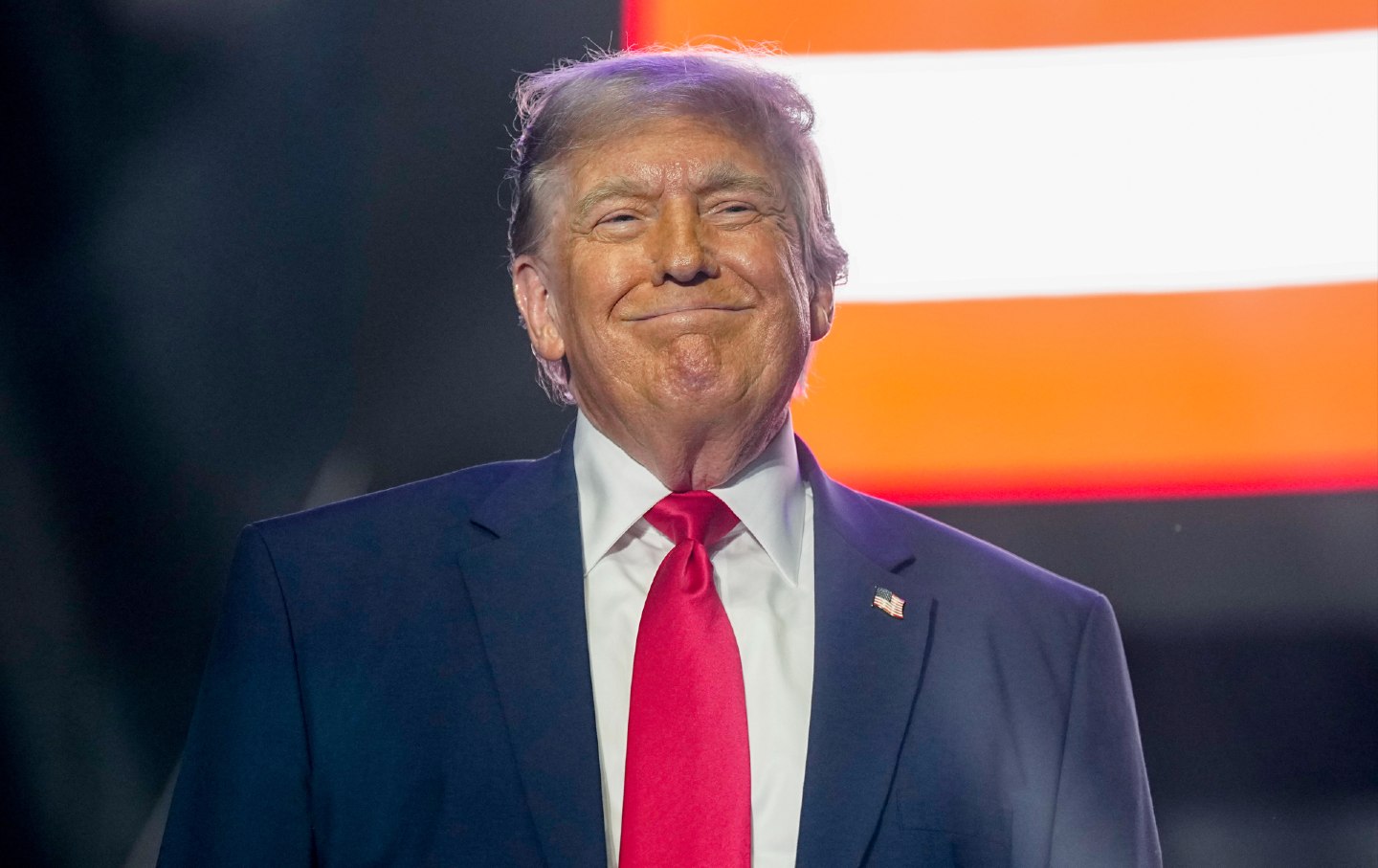
US President Donald Trump during a kickoff celebration for the Great American State Fair on the National Mall in Washington.
(Bonnie Cash / UPI/Bloomberg via Getty Images)On Monday, the Supreme Court vastly expanded the president’s power by ending the independence of the country’s independent executive agencies. It did this in a ruling that gives the president the power to fire the people who run these agencies “at will” rather than “for cause.” This change doesn’t just mean that Donald Trump and Elon Musk can chainsaw their way through the federal government. It means that Trump, or whoever is president after him, can undermine the entire regulatory structure that constrains the smash-and-grab capitalism favored by the Epstein class. It means that institutions that regulate business, banks, public health, and the environment are nothing more than puppets of the administration in charge.
There is, however, one key agency, and one alone, that is protected from the whims of the president: The Federal Reserve Board. That’s right, the institution that protects the monetary policy that capitalists rely on to make their billions is the one agency that can’t be messed with every time the president has a nutty. In a second case, the court ruled that the president does not not have the power to fire a board member of the Fed.
What makes the Federal Reserve Board so special? I have my theories, and all of them involve the justices’ business sense—and not their legal acumen.
The facially contradictory rulings arrived via two decisions, both written by Roberts, that were literally bound together with a rubber band when the court handed the opinions out to reporters. In Trump v. Slaughter, the court ruled, 6–3, that Donald Trump could fire Rebecca Slaughter from her position as a commissioner on the Federal Trade Commission. In Trump v. Cook, the court ruled, 5–4, that Trump could not fire Lisa Cook, a board member on the Federal Reserve.
Roberts would have you believe that the differences between the two outcomes stem from the differences in the two agencies. In Slaughter, Roberts argued that Trump can fire Slaughter whenever he wants because Congress does not have the authority to create an independent executive agency whose leaders cannot be fired at will by the president. He argued that such protections violate the constitutional separation of powers.
Roberts’s exact argument was rejected by the Supreme Court 90 years ago in a case called Humphrey’s Executor v. US. That case involved Franklin Delano Roosevelt trying to fire (wait for it) a commissioner on the FTC. Roosevelt, like Trump, didn’t really have a reason for firing the commissioner. He just felt that it was a bad idea to have a member of the opposition party on a commission that was tasked with implementing some of his New Deal policies. In Humphrey’s Executor, the court rejected Roosevelt’s attempt to give the president more power and upheld the independence of executive agencies.
That precedent didn’t matter to Roberts. He explicitly overruled Humphrey’s Executor, writing: “If anything more is left of Humphrey’s, the Court overrules it.”
As justification for this wholesale rejection of precedent, Roberts turned back to the Reconstruction era and adopted the arguments laid out by former Confederates eager to amplify the power of President Andrew Johnson in the face of a progressive Congress. The post–Civil War Congress had passed a law requiring Johnson to consult Congress not just about the appointment of officials but also about removing officials as well. Former Confederates objected, as did President Johnson. Roberts noted Johnson’s “resistance,” but skipped the part where Johnson lost. Roberts then claimed that his court is merely restoring the authority that the nation’s founders had originally given to the president.
In making these arguments Roberts ignored not only history and precedent but basic reality—which is to say, the fact that Congress, which set up these executive agencies through legislation, has relied on the idea that commissioners would be protected from the whims of the president when creating these agencies. But the three liberal justices were all over this gaping hole in Roberts’ argument. In dissent, Justice Sonia Sotomayor, who was joined by Justices Elena Kagan and Ketanji Brown Jackson, argued that Congress created these agencies with the intention that they’d be independent and that removing this independence changes the entire federal regulatory regime in one chaotic swoop.
Which it does. For the most part, Congress has created executive agencies such that some critical area of governance can be managed by people insulated from political pressure. It’s an attempt to let experts, not politicians, make decisions. If Congress had known that every one of these agencies would require its personnel to swear loyalty to a corrupt demagogue, it likely wouldn’t have created the agencies in the first place.
For Justice Neil Gorsuch, this wrinkle isn’t actually a problem—it’s a gift. As he wrote in his concurrence to Roberts’s majority opinion, Congress likely would not have created agencies like the FTC (or the EPA or literally all the other ones Gorsuch thinks should not exist) if it had known that such agencies would fall entirely under the whims of the president. For those reading between the lines, this is why Gorsuch (and probably all the other Republicans) will have no problem striking down regulations made by these agencies in the future, should Democrats ever win back control of the White House. Sure, a Democratic president can now fire everybody Trump has hired, but whenever those new Democratic appointees try to do anything, Gorsuch will be there waiting in the tall grass to strike them down.
If independent agencies are dead, and if they shouldn’t have been created in the first place (but for the alleged wrong turn the country made during Reconstruction and the New Deal), and if the president can fire everybody at will, then why the hell can’t he fire people on the Federal Reserve? According to Roberts, the Fed is special because… it is the modern incarnation of the First and Second National Bank.
The First National Bank was created by the first Congress to pay off the national debt from the Revolutionary War (there’s a rap battle in the musical Hamilton about this). It was a “quasi-public” institution, with members drawn from private institutions (regional directors of other banks) who couldn’t be fired at will by the president. Since the First National Bank (and eventually, the Second National bank, which was the successor national bank until President Andrew Jackson literally packed the Supreme Court to get rid of it) existed during the founding era, with no complaint from the president (except, again, Jackson!), Roberts argued that protecting the Fed’s commissioners from being fired does not offend the constitutional separation of powers.
It’s a neat story—if only it weren’t nearly untethered from facts or history. The reality is that the Federal Reserve is not a mere successor to the First or Second National Banks. It was created as an entirely new thing in American history, with a structure different from either of the earlier national banks’. And it wasn’t created in 1789 or even in the 18th or 19th centuries. The Fed was created by the Federal Reserve Act in 1913—some 80 years after the demise of the Second National Bank—and signed by President Woodrow Wilson.
Do you want to know what Wilson and Congress created the very next year? The Federal Trade Commission. Wilson signed the Federal Trade Commission Act in 1914. We’re talking about two agencies that were created by Congress with independent commissioners who could be appointed by the president but not fired by the president, except for cause. Both agencies were passed by the very same Congress and authorized by the very same president. That makes them legally indistinguishable from each other in terms of their impact on the separation of powers. By acting like the Fed goes all the way back to the founding while the FTC is some newfangled thing, Roberts is simply getting his history wrong, and assuming that only Doris Kearns Goodwin has the inclination to fact-check him.
Roberts isn’t a dumb man, for all his faults. He must know that everyone from Kearns Goodwin to Wikipedia will point out the historical relationship of the FTC and the Fed. So if he’s being willfully and publicly ignorant about the structural similarities between the two agencies, it’s worth asking why. Here again, another justice gives the key insight into Roberts’s thinking. In his concurrence in Cook, alleged attempted rapist Brett Kavanaugh gives away the game. Kavanaugh, who was more or less the deciding vote, wrote: “As the Court’s opinion explains and the Government agrees, the Federal Reserve occupies a unique role in the U. S. Government and maintains critical responsibility for the stability and success of the U. S. and world economies.”
The Fed’s independence stabilizes the US and the global economy. The FTC’s independence allows consumers to complain about the unfair business practices of billionaires. This is why one agency is “special” and the other is not. This is why the Fed gets to remain independent while all the other agencies will fall under Trump’s thumb.
Slaughter is the most consequential ruling in this term for how the government is allowed to function, and the result is a huge power grab for Donald Trump. He’ll crow about Slaughter but rage about the Supreme Court’s refusing to allow him to fire yet another Black person (Lisa Cook happens to be Black). He’ll act like a spoiled teenager complaining that the new pony he got for his birthday is hazel instead of white. But between this decision and 2024’s Loper Bright ruling (which eliminated the deference given to executive agencies), the Republicans on the Supreme Court have all but completed their long-term goal of destroying the administrative state.
Popular
“swipe left below to view more authors”Swipe →Most of the regulations that constrain business, protect workers and the environment, and set standards for public health and safety come through executive agencies. Every single one of those regulations is now suspect, and Trump can fire almost every single regulator in the federal government who doesn’t pledge fealty to him.
Except the Fed. Because Roberts and Kavanaugh didn’t feel like crashing the global economy and tanking their 401Ks today.
Become a Sustaining Donor This September
Between the reemergence of right-wing red-baiting and Donald Trump’s use of the chilling National Security Presidential Memorandum–7 to criminalize left political organizing, we’re seeing McCarthyism reborn before our eyes.
This assault on democracy cannot be ignored or wished away. Resisting it requires bravery in the face of threats and repression, a steadfast commitment to the truth, and the unwavering belief that we can—and will—overcome this darkness.
We must have an independent media that sets the record straight, unearths corruption and abuses of power, and advances a politics of justice and dignity for all if we’re to win this fight.
That’s why I’m writing to you today. This September, The Nation needs to add 100 monthly donors to sustain our progressive journalism. Your contribution makes the next investigative report, the next truth-speaking column, and the next pathbreaking essay all possible.
I hope you’ll support our work with a recurring donation today. If you donate $10 or more a month, we’ll send you a brand new “Hands Off the Free Press!” sticker to recognise your commitment to our cause. Please, donate today.
Onward,
Katrina vanden Heuvel
Editor and Publisher, The Nation
More from The Nation

Clavicular’s Charges Are One Thing. Rape Culture Is Another. Clavicular’s Charges Are One Thing. Rape Culture Is Another.
Braden Peters consistently acts as though the autonomy of women is a maladaptive trait, and dogmatically dismisses any claim to female equality as an outlying aberration.
Kimberly Guilfoyle Is a Master of Mafia Diplomacy Kimberly Guilfoyle Is a Master of Mafia Diplomacy
The US Ambassador to Greece is making suspicious deals for her buddies.
Missing Guardrails for AI Missing Guardrails for AI
Trump ignores the threat of extinction.

The First Amendment Lives for Another News Cycle—Maybe The First Amendment Lives for Another News Cycle—Maybe
In this week’s Elie v. U.S., our justice correspondent parses Trump’s attacks on CNN, MS NOW, and Politico. Plus: it’s time to impeach the judges!

Susan Collins Is Corrupt. She Still Might Be Reelected. Susan Collins Is Corrupt. She Still Might Be Reelected.
Despite being embroiled in scandal, the Maine senator is benefiting from Democratic Party divisions.

