As We Marched on Washington, I Felt Certain That Palestine Would Be Free
Saturday’s demonstration made it clear: We Palestinians are not fighting for our liberation on our own.
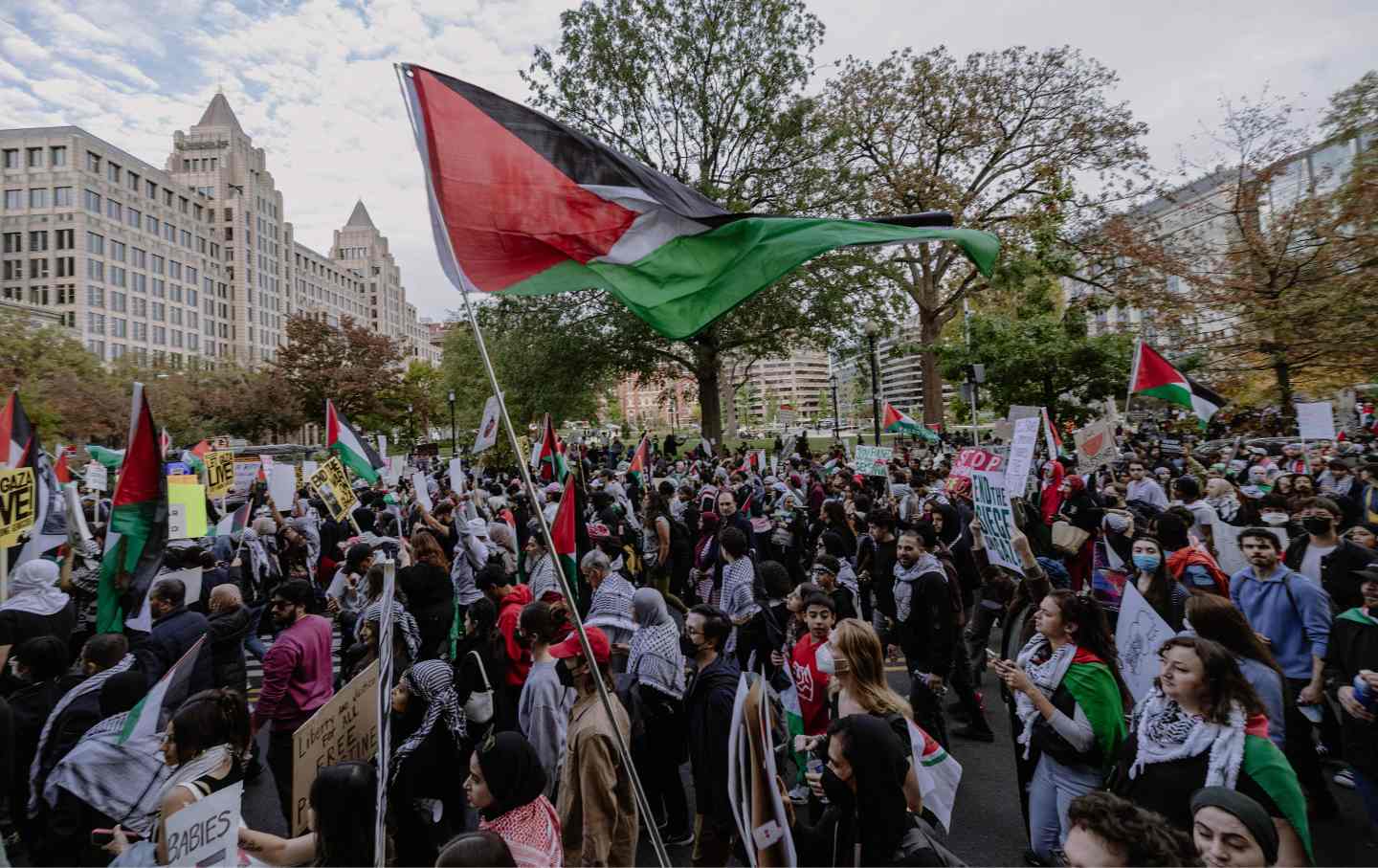
Thousands of people supporting Palestinian rights and demanding a cease-fire in the Gaza Strip as well an end to American aid to Israel protest on Pennsylvania Avenue in Washington on Saturday, November 4, 2023.
(Bill Clark / CQ-Roll Call, Inc via Getty Images)On Saturday, November 4, hundreds of thousands of pro-Palestinian demonstrators took over the streets of Washington, DC, demanding a cease-fire and an end to Israel’s brutal bombardment of the Gaza Strip in occupied Palestine that has killed over 10,000 people, including over 4,000 children. The march was widely reported to be the largest pro-Palestinian demonstration in the history of the United States, and was the culmination of weeks of protests in cities across the country and world.
I was one of the marchers. What I—what we—saw was that there is resounding support not only for a cease-fire in Gaza but also for Palestinian liberation and an end to the Israeli occupation. People from all over the country and hundreds of organizations signed on to support this movement, and cries of “Free Palestine” by the thousands in attendance made clear that justice is the demand of the majority—justice that comes only with the liberation of Palestine. US politicians who support Israel come what may can no longer say that they are acting in the interests of their citizens.
When I was only 13 years old, I saw my people in Gaza slaughtered by 500 tons of explosives in strikes that were covered drily on the evening news, as if our death was casual. I sobbed as mangled body parts were gathered and buried. To see this horror en masse, happening to faces that I recognized, broke me. Now, the world is watching as children have bombs dropped on their heads, as fathers search for their families under rubble, and as journalists are killed while sharing the truth of this “war.”
For the past month, we have witnessed the slaughter of our people in Gaza with the complete support of the Biden administration. In fact, Biden said he does not even believe the death count from Gaza, because it is overseen by the Hamas-led government. This prompted the Gaza health ministry to release the names of the Palestinians martyred, and at the march, we carried their names upon a scroll to the White House. Even in death, Palestinians cannot find peace. Our grief is constantly put on trial. But as we carried the names of children, mothers, uncles, and entire families, I felt, for the first time, that we were not alone in mourning our dead while defending our right to live. For the first time in the last month, time moved forward, and I was not frozen in grief.
Palestinians are not screaming to deaf ears; people everywhere are now aware of the decades of colonial violence against us. It is for that reason that this march was so meaningful. A tide is turning. People are no longer confused about who the oppressor is. They are showing solidarity with Palestine, and that makes me more sure than ever that Palestine will be free.
Every Palestinian, whether in Palestine or in the diaspora, has listened to the stories of our parents and grandparents being terrorized, caged, and dehumanized, going back to the Nakba of 1948. It has been 75 years since the colonial movement forcibly expelled over 750,000 Palestinians from their ancestral homes—leading to one of the world’s largest refugee crises—and committed a string of massacres that many scholars have called genocidal.
Like many Palestinians of my generation, I grew up in the shadow of this history. I lived almost everywhere besides Palestine, physically, spiritually, and emotionally disconnected from where I knew I belonged. (In the first grade, when asked to point out where I was from on a map, I was told that Palestine did not exist. How could that be? I am here. I am Palestinian.) But imagining a free Palestine is about more than having the world recognize our statehood. It’s about what it might be like if our lives were not limited by colonial forces. This is why we scream “Free Palestine”: so that one day our children will be able to scream “Palestine is Free” and truly mean it.
In many ways, the Nakba never ended. But, unlike in 1948, the world has woken up to the horror perpetrated by the colonial state. As calls for cease-fire and justice echoed in the heart of the US empire on Saturday, I was left with the deep conviction that Palestine will be free in my lifetime.
I wish to walk with my Jewish brothers and sisters in a land where there is no division of race or religion. I hope to see a Palestine devoid of the physical manifestations of colonial imagination—a free and equal country like the one imagined by Palestinians across the West Bank, Gaza, and the millions in the diaspora. But this Palestine will not look like the Palestine that existed before it needed liberation.
We are like the olive trees our ancestors planted, unshaken, unmoved, and forever a part of the land. We are not the children of darkness. We are on a path filled with light and moral clarity. We are a valiant people; we are survivors, and we are fighters. What was made clear on Saturday is that we are not fighting alone.