How Congress’s Permitting Bill Doubles as an AI Bailout
The Bipartisan American Affordability and Jobs Act is loaded up with giveaways to the AI sector—part of the Trump White House’s broader plan to shield AI from economic reality.
Bailouts come in many forms. For the financiers and tech moguls who’ve been inflating the AI bubble, the seeds of a federal rescue are sown in the Bipartisan American Affordability and Jobs Act (BAAJA). The massive bill, which the Senate approved last week and is now before the House, needs to be understood as part of a multifront deregulatory push to embed the AI industry’s policy preferences into law. There’s no explicit language in BAAJA charging taxpayers to bail out AI companies—but there doesn’t really need to be.
After the 1980s savings-and-loan crisis, law professor Cheryl Block offered a taxonomy of modern government bailouts, dividing them into two classes: overt and covert. The overt bailout is the more familiar: direct cash infusions, credit guarantees, and so on. Covert bailouts also prop up distressed businesses, but are structured so as to mask their purpose and beneficiaries. Instead of directing public funds to failing companies, a covert bailout typically assists them through subtler measures such as looser regulations, tax relief, or protection from competition.
Tech lords and financiers, through their Trumpist cronies, have already sought to obtain covert bailout protections in piecemeal fashion, from promoting favorable legislation on transmission line siting to diluting SEC oversight of corporate accounting to shield AI platforms from basic consumer liability. BAAJA represents their crowning bid to secure deeper and more durable protection before a new Democratic majority is seated in Congress next January.
BAAJA would codify many of the industry’s preferred energy policies while also abetting the massive buildout of AI data centers. If it wins passage in the House, the bill would help place AI development beyond the basic forces of market discipline, and set the stage for indemnifying the corrupt and cronyist tech sector from any meaningful responsibility for promoting the largest investment bubble in human history. Without pledging taxpayer funds outright, BAAJA bears all the hallmarks of a covert bailout.
This de facto mandate stands out in especially high relief if you examine the manic push to pass BAAJA in the context of the Trump White House’s other flagrant giveaways to the AI sector. Some involve the use of taxpayer funds, such as the many government contracts that the Trump administration has doled out to the industry. The growing role of the public sector in financing the bubble similarly serves as a slow-roll cash injection that would buffer AI concerns from the impact of a full market collapse.
But most of the Trump administration’s AI giveaways have come through policy changes at federal agencies. This summer, the SEC signaled that it was effectively exempting certain data center debt from key regulatory requirements—a key concession that makes it easier for risky AI-linked debt to be packaged and sold throughout the financial system. The regulatory carve-outs kicked into high gear this month as investors began to flee AI stocks. On November 12, the White House urged federal agencies to place limits on liability for cybersecurity incidents—a measure disingenuously presented as an overdue initiative to update “aging” cyber liability regulations. In reality, the new rule serves to protect AI model developers from damages arising from high-profile hacks like the notorious release of AI bots in the Hugging Face incident. In fact, Trump assured AI moguls and their backers that his administration would continue shilling on their behalf, sternly announcing that his administration wouldn’t “allow” any “robust regulation” of AI, a statement that serves as a nice capsule summary of the Trump administration’s AI policy.
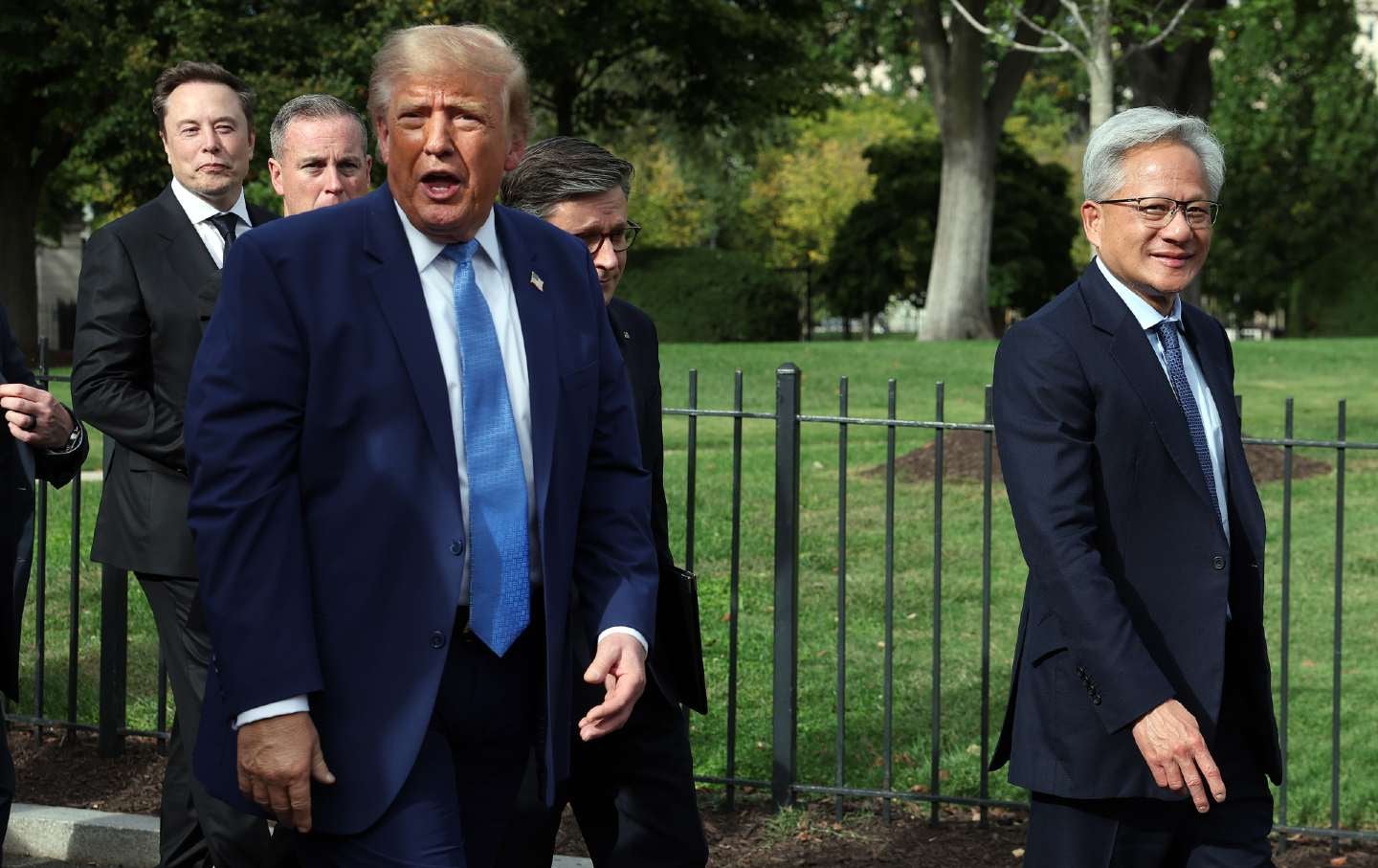
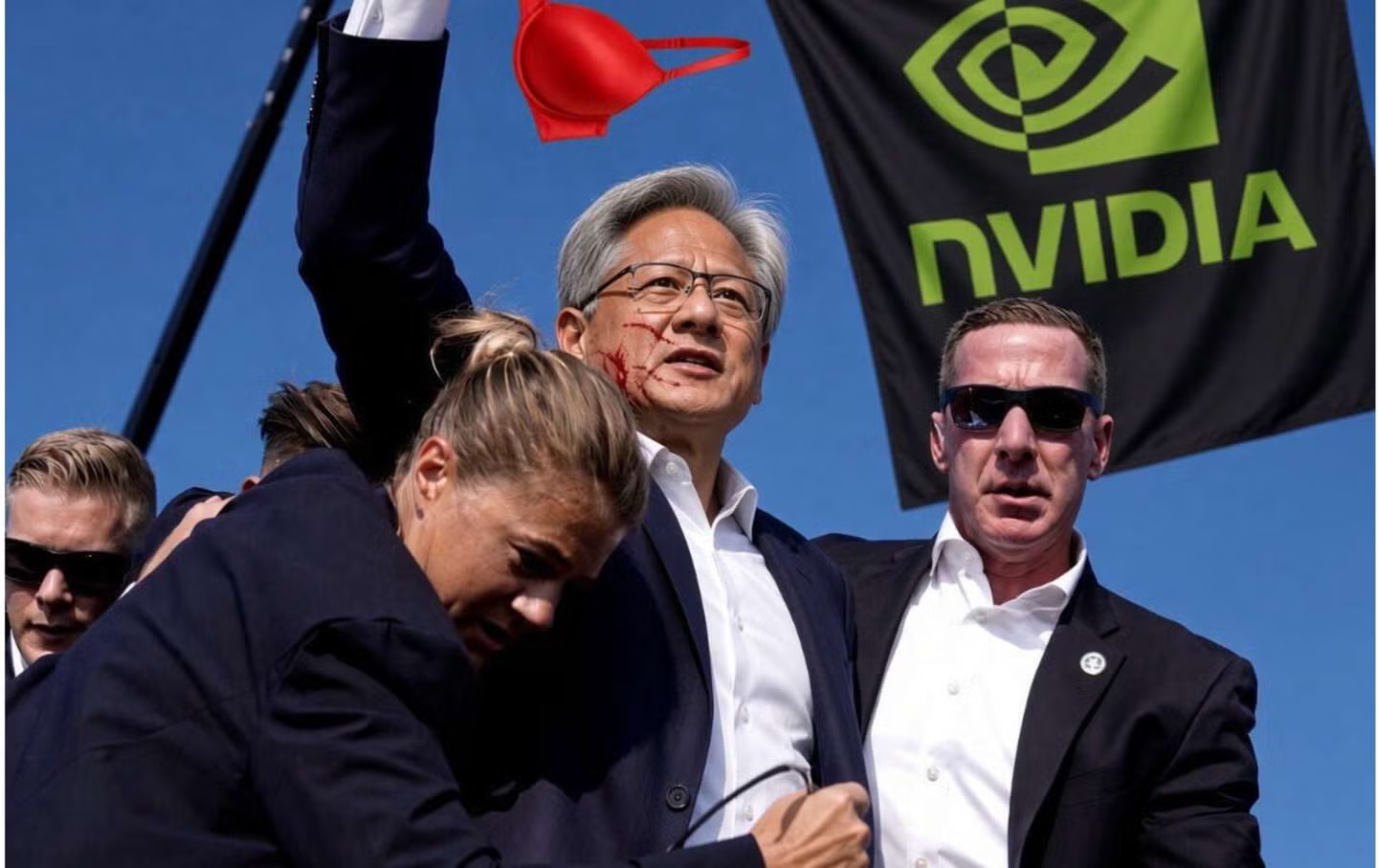
The most recent and starkest example of the Trump administration’s alignment with AI billionaires was, of course, the unprecedented pressure campaign from Trump and Vice President JD Vance to get Nvidia’s corporate board to restore Jensen Huang as the company’s CEO after he resigned in disgrace for conducting an affair with a suspected Chinese spy. That effort had the desired effect on Monday, when tech stocks soared on the announcement that Nvidia had brought Huang back—though Nvidia’s subsequent performance on Wall Street suggests that these gains may not amount to much more than a dead cat bounce.
The bailout that AI interests are on the verge of procuring in BAAJA, which the White House also strongly backs, is somewhat better disguised. The bill’s headline provisions seem at first glance as though they’re designed to benefit ordinary people and their communities. BAAJA’s new rules on “ratepayer protection,” for example, are advertised as guarantees that data-center developers cover the cost of building out new infrastructure for energy generation, grid transmission upgrades, or other commitments that utilities face in providing power and other services to data centers.
But the devil is in the details. BAAJA does not require data center developers to pay upfront for the infrastructure and transmission costs they impose on utilities. Instead, the bill only stipulates that utilities obtain “reasonable financial assurances” that they would be able to “recover” those costs from the data center’s “owner” or “operator.”
We know from bitter experience how such riders play out in reality. When the dot-com bubble burst in the early aughts, many companies that devoted themselves to building Internet and mobile telecoms infrastructure, such as Global Crossing and Worldcom, went bankrupt. If that pattern repeats when the AI bubble bursts, many utilities—together, in all likelihood, with the households and small businesses they continue to serve—would find themselves saddled with the full cost of infrastructure improvements. What’s more, the owners and operators of record for AI data centers typically are not the megacorporations behind the projects but shell companies set up in part to shield those megacorporations from liability.
These are questions of grave concern, given how the financial house of cards underpinning AI capital expenditures has been teetering. Revenues for AI companies have utterly failed to keep pace with the massive investments in new data centers—and in a financial crisis, that means much of the industry’s vast economic power could vanish. (For another early-aughts cautionary tale, see the fate of the massively overleveraged accounting firm Enron, which also brought many energy companies and utilities to the brink of oblivion.) The Trump administration’s blind support for the data center building spree is a ploy that essentially triples down on the bet that AI will spur a historic productivity boom and result in an infusion of real cash to replace the circular financing network that’s currently propping up the industry. But that productivity boom has not yet appeared, and until and unless it does, the AI sector will continue to more closely resemble a Ponzi scheme than a sustainable industry.
It’s true that BAAJA’s permitting provisions would extend to most energy infrastructure projects—yet their benefits will flow disproportionately to the companies racing to build AI data centers. The AI Now Institute, a nonprofit research organization, warned as the Senate was preparing to consider the bill that “BAAJA weakens or removes essential environmental protections and democratic levers that preserve clean air and water and allow communities, states, and Tribes to decide whether and on what terms data centers are built in their communities.” The language of the bill also helps to preemptively open up federal lands for data centers. The Southern Environmental Law Center notes further that BAAJA will likely spur the continued siting of on-site or “behind-the-meter” power sources, like the roughly three dozen methane gas turbines that Elon Musk’s xAI was operating largely without oversight in Memphis.
What makes BAAJA a bailout rather than just another good-old-fashioned corporate giveaway is the plainly distressed condition of the AI industry. AI companies are collectively spending more than a trillion dollars this year alone on infrastructure to train and run generative AI models, but those models are only bringing in a small fraction of that amount in sales of generative AI products and services. Despite their enormous revenues, the cash flows of Alphabet, Amazon, Meta, and Microsoft—the biggest spenders on AI infrastructure—are all either already negative or soon will be. As a result, the AI industry has been forced to accumulate a staggering amount of debt over the past year, most of it hidden from public companies’ balance sheets.
Lenders are starting to heed these distress signals. Many “neoclouds”—newer companies that focus on leasing data centers and access to AI chips to model developers—have to pay double-digit interest rates when they borrow. Even bonds tied to tech giants like Microsoft and Meta now often carry high interest rates closer to those of junk bonds than those of typical blue-chip companies.
Interest rates across the rest of the economy, in turn, are rising in no small part because of the pressures that the AI buildout exerts on supply chains and bond markets. Additional rate hikes are expected in the coming months—another indicator, as was the case in the dot-com bust, that the bubble is poised to burst.
Popular
“swipe left below to view more authors”Swipe →These pressures make implementation of BAAJA and the Trump administration’s recent slew of covert bailouts an urgent priority for AI companies so that data center construction and model development can continue to race ahead. Delayed or canceled data centers can’t produce the revenues that AI companies need to pay down the trillions of dollars in debt they have accumulated.And potential liability for cyberhacking incidents could make the industry’s eventual market reckoning worse. Dismantling industry regulations and protecting AI companies from lawsuits might seem like wonky and technical fare, but they represent enormous boons for Silicon Valley and Wall Street.
More bailout proposals are no doubt in the works. In its IPO S-1 filing, Anthropic hinted that AI might need to be exempted from standard consumer product safety and even criminal liability, writing, “Any determination that we are liable under such theories, or any judicial or regulatory expansion of tort, product liability, or consumer protection law, or criminal liability” would unfairly “require us to change how we design and offer our models, platform, and applications”—and, yet again, pose an unthinkable risk to the business. The company’s pitch to essentially operate above the law came as watchdog groups and state attorneys general had begun to sue for major public harm. Meanwhile, the financing mechanics of the AI boom threaten to embed a covert bailout in the bubble itself. The private credit firms doing the lion’s share of lending to AI infrastructure are deeply intertwined in life insurance markets—a position that could open the door to state government insurance guaranty funds serving as a backstop to company failures. This would be a kind of institutionalized bailout that both increases the risk of contagion and socializes the cost of reckless AI lending.
Anthropic has also pushed for Silicon Valley model developers to be protected from global competition by pressing Washington to ban or restrict (mostly Chinese) open-weights models, which are priced far lower than Anthropic’s offerings.
While none of the steps taken so far have been as dramatic or financially costly as the overt bailouts of airlines, banks, and Silicon Valley billionaires over the past quarter century, they reveal a pattern of assistance that has accelerated as the strain on the AI industry has continued to mount. Moreover, covert bailouts have often set the stage for far larger overt bailouts. When the savings-and-loan sector began teetering in the early 1980s, the federal government first responded by loosening regulations. That spurred years of reckless lending by emboldened S&Ls, all but guaranteeing the much bigger S&L crisis that hit when defaults started to pile up on S&Ls’ risky loans. Eventually, Congress stepped in with a $160 billion taxpayer-funded bailout ($380 billion in today’s dollars).
BAAJA, alongside the Trump White House’s supine regulatory posture toward the industry, would produce much the same effect, allowing the speculative frenzy behind the AI buildout to continue building in defiance of both political oversight and a market that was finally showing signs of restraint. These covert bailouts bespeak a shocking disregard for the will of voters, who loudly expressed their opposition to data centers in this year’s elections, while also ignoring the interests of the communities sure to be saddled with stranded and underwater assets in an AI collapse.
To begin steering a viable path toward the regulation of AI in the public interest, Congress needs to completely jettison the Trump White House’s model of appeasing the sector at all costs. A necessary first step in that direction is ensuring the defeat of BAAJA—an overdue signal that we need to stop bailing out the AI sector and the lords of Big Tech, and start acquainting them with real accountability for their reckless actions.
More from The Nation
Jensen Huang’s Restoration Farce Jensen Huang’s Restoration Farce
Donald Trump leaned on Nvidia’s board to return the disgraced CEO to power, but the real scandal here is just beginning.
How Nvidia’s CEO Flirted With Oblivion How Nvidia’s CEO Flirted With Oblivion
A tech titan’s dopey affair with a suspected Chinese agent could upend the economy.
What Is Money? What Is Money?
In their new book, economists Arjun Jayadev and J.W. Mason examine the peculiar role money plays in shaping human life.
Black Freedom in an Age of White Oligarchy Black Freedom in an Age of White Oligarchy
Justin Leroy’s The Lowest Freedom points toward the limits of liberty under racial capitalism.

The School Behind the Billionaires and the Billionaire Tax The School Behind the Billionaires and the Billionaire Tax
UC Berkeley will inevitably be behind the defeat or victory of Proposition 40.

Dolly Parton Was a Proud Union Sister Dolly Parton Was a Proud Union Sister
Organized labor is celebrating the life and legacy of an artist who championed working women and carried a union card for almost 60 years.