As Wildfires Worsen, a New Generation Is Joining the Fire Service
Young firefighters in Washington cite environmental concerns, workplace culture, and economic stability as draws to the profession.
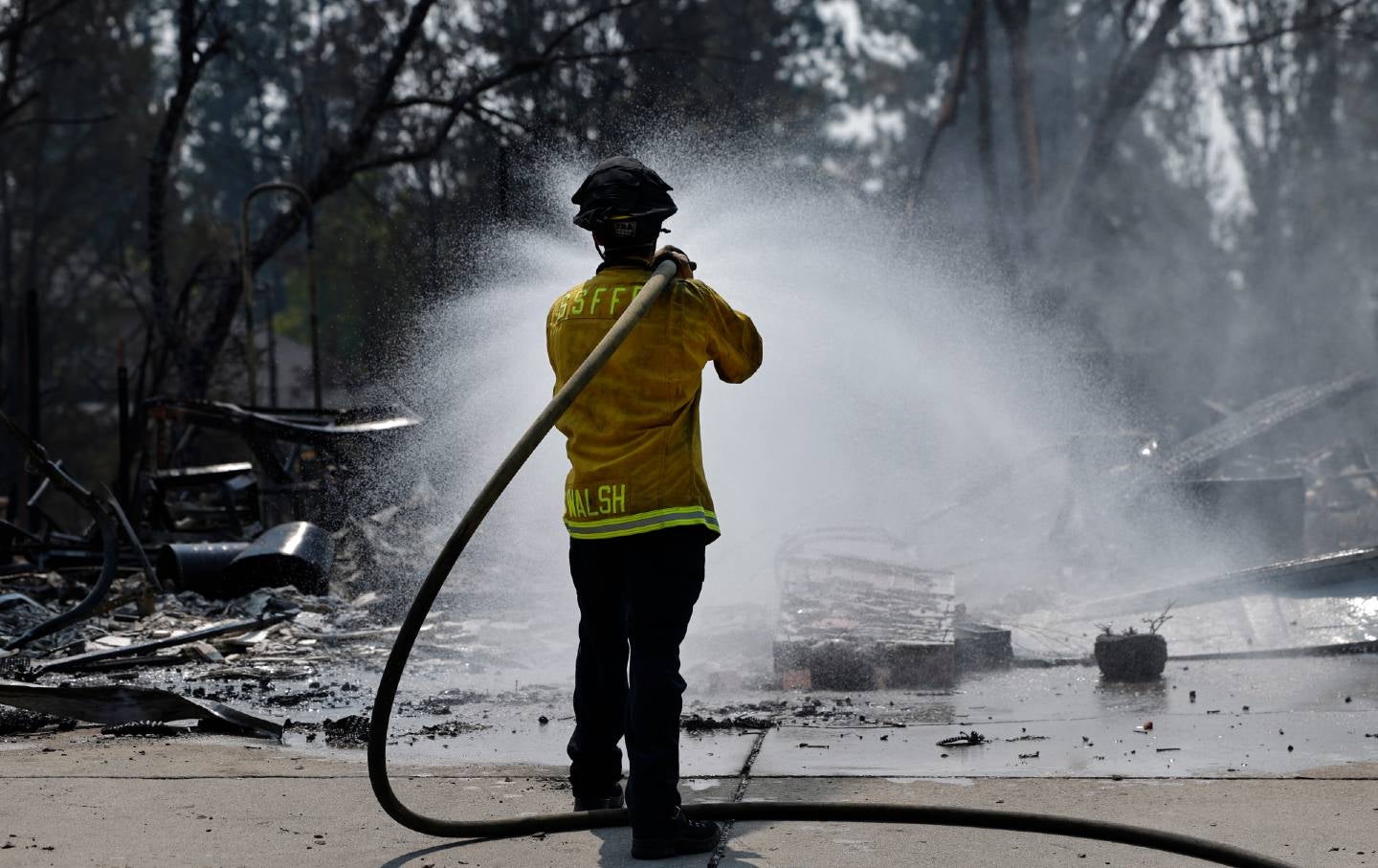
When he was growing up in Nine Mile Falls, it wasn’t unusual for Gabriel Sossaman’s late summer sports practices to be canceled because of poor air quality. His community—straddling the Spokane River and packed with evergreen trees—is no stranger to wildfire smoke. On multiple occasions as a child, Sossaman witnessed first responders descending upon his neighborhood to save it from flames..
By the time the Gray Fire swept over the region in August 2023—destroying more than 200 homes, including those of some friends—the now-23-year-old had seen enough. He decided to ditch his business degree at Eastern Washington University and become a firefighter. Soon thereafter, he enrolled in an EMT class cosponsored by the Cheney Fire Department. Today, he is a firefighter with Spokane County Fire District 3.
While overall fire service applications have gone down in recent years, Sossaman is just one of the many young people who have taken an interest in the fire service. At the top of their minds: climate change.
This summer, Sossaman and his family were forced out of their home during the Spokane Complex fires. In early August, the disaster forced more than 65,000 people to evacuate and destroyed more than 700 structures. Although an alleged arsonist set one of the three fires comprising the blaze, a combination of high temperatures, low humidity, and strong winds fanned the flames.
As of early September, more than 900,000 acres had burned across Washington in 2026 alone—one of the worst years on record. According to research led by the University of California, Los Angeles, wildfires in the Western United States have worsened significantly in the last few decades. Researchers say that climate change, along with forest management concerns, is a key factor.
“[Climate change] is a motivator for sure in the younger generation coming up now,” said Ryan Rodruck, a spokesperson for the Washington State Department of Natural Resources. “It’s getting hotter. That’s happening earlier in the season, and it’s going longer in the season.”
Haley Nonnemacher-Stiles, a 22-year-old volunteer with the same fire district as Sossaman, doesn’t think weather conditions will improve anytime soon. “We are not on top of climate change. All the way to October, it was 80 degrees,” said Nonnemacher-Stiles. “That’s insane.” According to a 2024 study, Washington’s average temperature climbed nearly two degrees Fahrenheit from 1900 to 2024, prolonging and intensifying the wildfire season.
Indeed, this past wildfire season was Washington’s most destructive on record, with around 1,000 structures or homes lost to flames. Nonnemacher-Stiles was working as a wildland firefighter for the first time this past summer and found herself combating the Spokane Complex fires. “It was crazy,” she said. “I just got thrown into the mix, and I was like, ‘OK, now I’m stuck here for 35 hours.”
Despite Nonnemacher-Stiles’s intense first experience on the job, she intends to apply to be a firefighter after she completes her associate’s degree in fire science from Spokane Community College.
Justin de Ruyter, who works for the Spokane Fire Department, has been in the fire service since 1997—first in Washington’s Cowlitz County, then in Portland. He said city departments like his were not built for wildfire, but now, metropolitan areas “all over the West” are grappling with wildfire threats.
“We’ve been seeing that in Washington, and we’ve seen it in Hawaii and several times in California,” de Ruyter said. “Communities that never really had wildfires are now experiencing them.”
But even though environmental concerns are driving young people into fire service, many are also turning to it for the flexible schedules and departmental culture. To Sossaman, the freedom outside of work and the prospect of forming “another family” were appealing aspects of the career. “It provided a home for me,” Sossaman said. “I’m part of something bigger than myself.”
Popular
“swipe left below to view more authors”Swipe →Tyler Lehnertz, 24, joined Portland Fire & Rescue in January for similar reasons. While many of the places he grew up hiking, hunting and fishing have burned in recent years, Lehnertz, whose father has worked for Portland Fire and Rescue for 30 years, said that it was the workplace culture that was the biggest draw for him.
Working 24- or 48-hour shifts and living together at the station, along with experiencing potentially traumatic experiences together, he explained, helps firefighters bond in a way that other professions do not. “Those are your roommates,” Lehnertz said. “Those are your people that you eat, sleep, and suffer with.”
As remote work has grown in popularity since the Covid-19 pandemic, concerns about social isolation have followed, leading many who came of age during the coronavirus to seek more human interaction in their careers.
Meanwhile, for those entering the workforce for the first time, firefighting offers a level of financial and job stability that are increasingly difficult to attain. According to Washington’s career board, the state’s firefighters’ “typical hourly rate is $53 per hour with a typical salary of $137,900 per year.”
“You get a lot of bang for your buck. You find a lot of meaning and you find family. At a time where I think people feel very isolated, your crew just becomes your people,” Tina Grubb, a 32-year-old Portland Fire & Rescue academy instructor, said.
Grubb said she has witnessed departmental shifts with the influx of young firefighters. The fire service has traditionally leaned more conservative, which Grubb said, might have made discussing topics like climate change or diversity and equity difficult. However, she has noticed the culture shifting.
Younger firefighters openly discuss seeing a therapist at the firehouse kitchen table, something she said was once unheard of. “They show up in a very subtle way,” Grubb explained. “They say: ‘Diversity and equity is important. Climate change is important. I care about what kind of foam we use at fire scenes. I care about what kind of materials are burning because I care about the planet.’” Today, Grubb sees the fire service transformed by “a different generation with different values.”