
Albanian Student Strikes Spur a Political Crisis
A new round of protests against the ruling party’s corruption has Prime Minister Edi Rama giving cops bonuses to crack down on dissent.
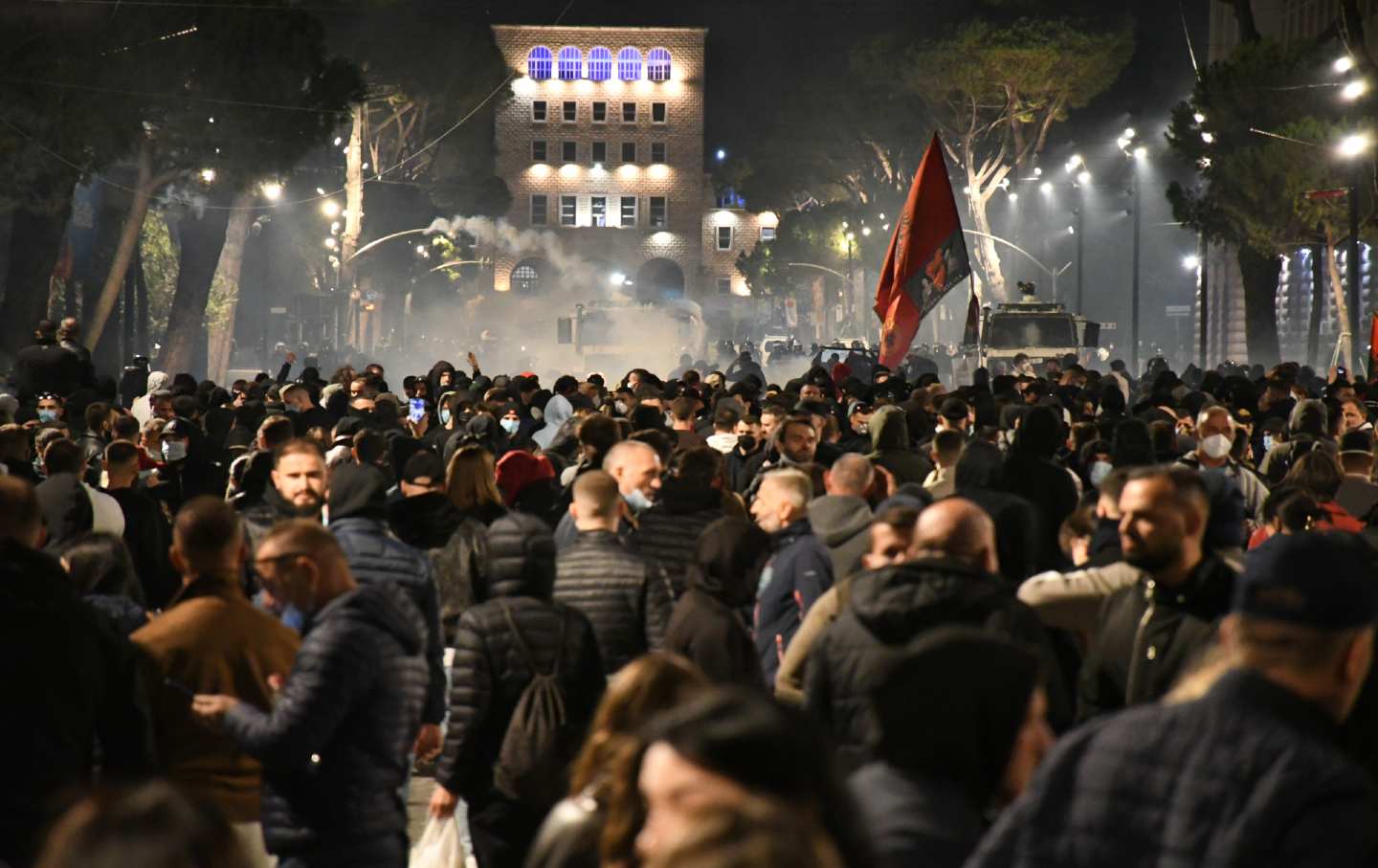
Police clash with protesters last week in central Tirana.
(Olsi Shehu/Anadolu via Getty Images)
For the past week, students in the Albanian capital of Tirana have been on strike—an action that’s spurred major clashes with police and widespread damage to government buildings and public property. In response, Albania’s Prime Minister Edi Rama has sought to step up the government crackdown, offering security forces extra money to suppress the worst political crisis of his 13 years in office.
The specter of a more intensive backlash does nothing to address the issues that sent Albanian students into the streets: increased education fees, poor school conditions and a lengthy list of government corruption scandals, including the possibly illegal sale of land to Jared Kushner for luxury property development. In lieu of endorsing reforms on all these issues, Rama chose violence.
The latest turn in Albanian protest politics will likely just ratchet up the mood of growing frustration among dissenters. For 130 days this summer, Tirana saw a wave of peaceful protests against Rama’s approval of the Kushner-backed resort project—a boondoggle that detractors have argued only benefits powerful oligarchs close to Rama’s government.
But what happened last week took everyone by surprise. The Albanian student union called for school strikes and planned a series of demonstrations at the Education Ministry in central Tirana. The protests kept growing, and eventually a handful of black-masked provocateurs began tearing out CCTV cameras and stoplights in the city center. The confrontation escalated from there: Restive protestors threw rocks, exploded fireworks, and burned dumpsters. The cops responded with tear gas, water cannons, and baton beatings. Not surprisingly, the response pushed more demonstrators into anger.
Toward the end of the week, things got ugly. Demonstrations and vandalism paralyzed the city; banks, government ministries, police stations, and Rama’s political party headquarters were battered and burned by bricks and Molotov cocktails. A pattern emerged: daytime protests mixed peaceful protestors with teenage Albanians throwing and breaking things; and nightfall brought pitched street battles between cops and more aggressive, older, and angrier crowds. Now cars and buildings were burning—and in one fracas with protesters, a cop was briefly set aflame.
By Sunday night, downtown Tirana scarcely had any stoplights, street lights, bus stops, or dumpsters that weren’t damaged. Streets were covered with rocks, broken glass, and smoke, while clouds of tear gas besieged rioters and confused tourists. At least 100 protestors and 50 police have been treated for injuries, and dozens of protesters have been hospitalized or arrested.
“You cannot negotiate with this,” said Rama, displaying a piece of broken concrete at a Monday meeting with police officers. “The moment the state negotiates with this, it has fallen.”
In the closed meeting—Rama has limited public appearances since the protests began in June—the president said he was willing to discuss complaints about his government’s track record. But he stressed that he wouldn’t entertain the demands of protest leaders.
“Dialog at any hour, on any day, anywhere, with anyone, except the political forces behind the violence that refuse to distance themselves from it,” he said. Given how long Albanians have been demonstrating against his government—and how widespread the protests have grown—Rama is essentially saying he’ll only negotiate with elites who are already likely to be in accord with his government anyway. Then came his bid to keep the security forces in crackdown mode: a pledge of across-the-board bumps in salary and a one-time bonus of about $2800 to cops clashing with rioters. Most protesters saw the offer as a flagrant bribe designed to shore up his increasingly unpopular government.
“Rama doesn’t have the money to educate students because politicians steal public funds and he sells our land to his friends and foreigners without debate,” said Agim, a 22-year-old barista and student who comes out to protest when his schedule permits. “But somehow he’s got millions of euros to bribe the police to protect him.”
Despite Rama’s resounding election victory last year over opposition leader Sali Berisha, any residual sense of him governing under a popular mandate has succumbed to the overt corruption of his regime—and his refusal to confront popular dissent is only compounding his isolation from the struggles of ordinary Albanians.
And amid conditions of government impunity and corruption, public cynicism mounts. “Berisha and Rama are seen in the same light,” said a local journalist who covers crime and corruption, and asked not to be named because of mounting threats against regime opponents. “They compete with each other to control a rotten system for their gain and to repay their oligarch backers and the cocaine mafia that controls Albania’s economy. There’s no good guys on either side. But one bad guy [Rama] is more palatable to the European Union.”
Popular
“swipe left below to view more authors”Swipe →In Albania’s relatively free press and political system, overt political repression is rare. But the journalist is far from alone in worrying about a crackdown. Lorenzo, a 24 year old waiter and protestor explains that facemasks and avoiding arrest is crucial.
“If the police arrest you, you can lose any scholarship or government job,” he said. “My mother is a nurse at a government hospital in Korča. If my face is photographed and the police identify me, she could lose her job. They’re threatening our families.”
In the 1990s, after Albania broke free from a brutal communist regime that ruled for 45 years, crushing dissent and immiserating the populace, the country fell into chaotic violence. Local gangs, former security commanders, and an influential cohort of organized crime bosses effectively lorded over the streets until peacekeepers from nearby Italy helped restore government control in 1999.
From that low point, Albania was able to transition into a fairly calm, peaceful, and democratic state, even as its economy floundered. As the government managed to deliver basic services, and secure basic freedom of movement and speech, street crime also abated, and a small but growing tourist economy took hold, seeking to exploit the country’s pristine beaches and stunning mountain ranges.
After Rama came to power in 2013, he was able to leverage Albania’s more stable footing into an investment-friendly economic agenda. He also embarked on the long path to Albania’s admission to the EU in 2030—a plan that most citizens of this former pariah state eagerly support.
Yet Rama’s reputation as a competent technocratic reformer was short-lived. Despite Albania’s progress toward a more open society, the country has never managed to break the feudal control of its economy by powerful families and clans. Corruption moved behind closed doors as officials and oligarchs divided public funds among them, and employed bribes to secure overpriced government contracts. The economy, particularly for young people, completely stagnated, leading to an exodus over the last decade of at least a half a million Albanians out of a total population of just under 3 million.
Albanian crime lords, meanwhile, acquired a major interest in Europe’s lucrative cocaine trade. Albanians played an outsized role in transporting cocaine from South America to ports in Europe, which they then leveraged into control of much of the wholesale trade across Europe. Albanian gangsters ran much of the traffic in cocaine and heroin in the United Kingdom e after waging a bloody gang war across London to drive out rival English and Kurdish gangs.
The proceeds and criminal fallout of this drug coup haven’t directly affected life in the Albanian homeland; —most Albanians can’t afford cocaine, and the local marijuana trade is peaceful enough. But the country is plagued with rampant money-laundering, as Albanian drug lords seek to transform billions in cocaine-related revenue into bank accounts and legal assets.
This means that there’s been a paper boom in the construction of restaurants, business, and apartments and resorts across the country. Tirana’s under a massive construction boom, with cocaine money springing for an estimated 12,000 new luxury apartment units that few Albanians can afford.
If Tirana was able to harness all the incoming drug money into something like a viable development plan, Rama might have been able to purchase a measure of social peace and stability. But this spending and development hasn’t led to better jobs or increased public funding of basic services. Instead, Albanians are facing the major signs of oligarch-bred inequality: soaring housing prices, expensive bars and restaurants that clearly lose money, and the surreal sight of 20-something guys with Manchester and London accents driving Bentleys around Western Europe’s poorest capital—all in the shadow of luxury apartment towers that no reasonable person expects to be inhabited.
Albanian students aren’t dumb; the corruption and predation of Rama’s regime have greatly disillusioned the rising generation of Albanians. The luckiest among them have emigrated to other European countries, settling in the UK, Belgium, Netherlands, Germany, Greece and Switzerland to work ordinary jobs that offer a future; the country’s emigre population is well into the hundreds of thousands. A 24-year-old truck driver named Luisi who’s turned out for the protests says he’s also thinking of leaving the country for Malmo, Sweden, where a cousin of his lives—and where Balkan organized crime has established a major hub. Luisi now supplements his modest $600-a-month salary by selling small amounts of marijuana and cocaine in clubs that he can’t afford to visit unless he’s working. His cousin assures him that “there’s work and I can make a lot of money.”
When I ask him what his cousin does, Luisi laughs “He’s a gangster bro, he wants me to come help him. I don’t know if I should. But I’ll never get a good job or buy a house in Albania.”
Luisi then starts to interview me: “How much does a commercial truck driver get paid in America? I don’t want to be a gangster with my cousin, but I can’t stay here.”
More from The Nation
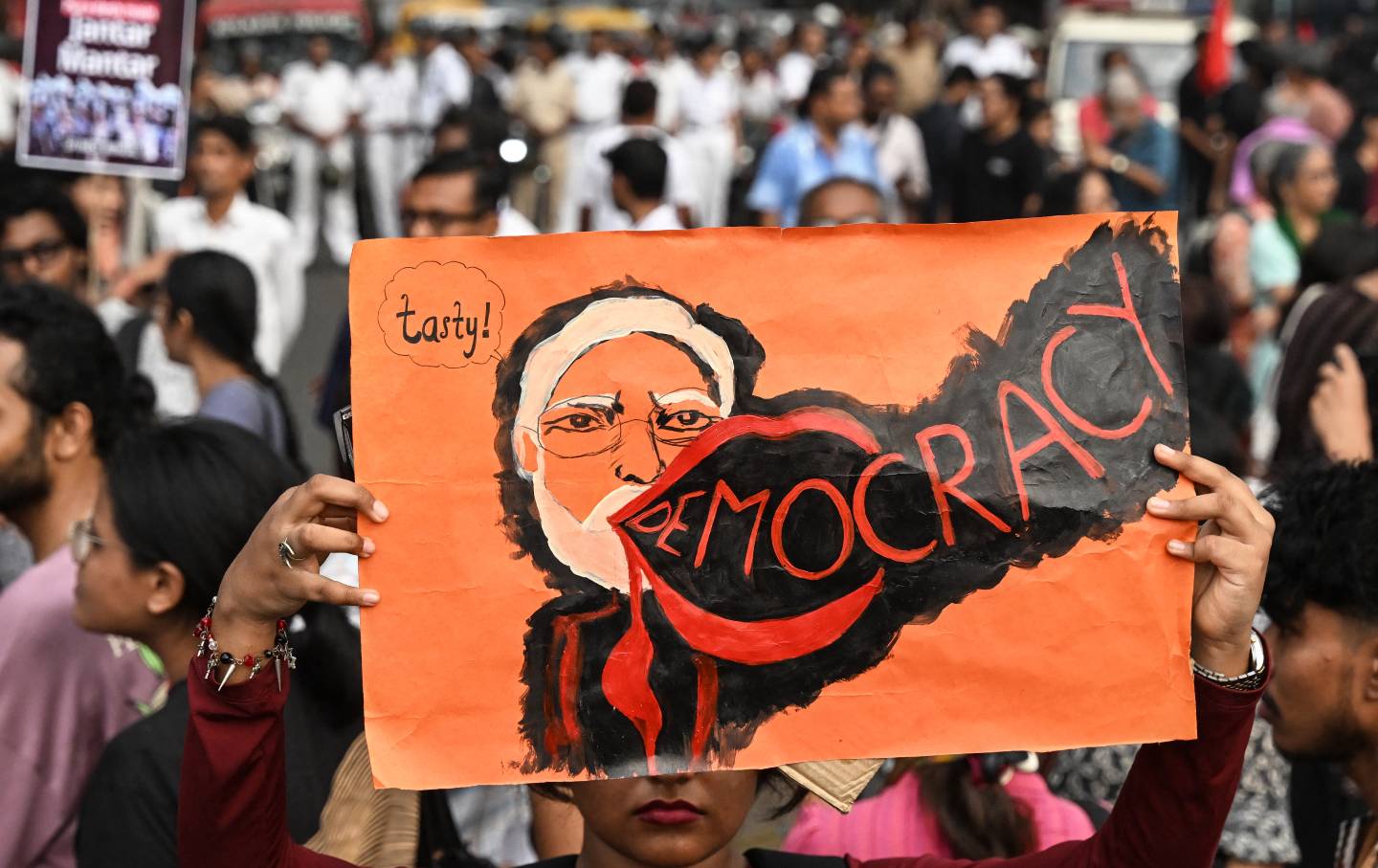
Inside India’s Gen Z Cockroach Janta Movement Inside India’s Gen Z Cockroach Janta Movement
Young Indians are challenging the purge of voter rolls by Modi’s right-wing government. Shrishti Khanna, who was detained by Delhi police while covering the protests, explains.
The Clarion Call of “NAZA” The Clarion Call of “NAZA”
Yuval Abraham and Rachel Szor’s new film not only documents the horrors of the present but give us a glimpse of a possible future too.
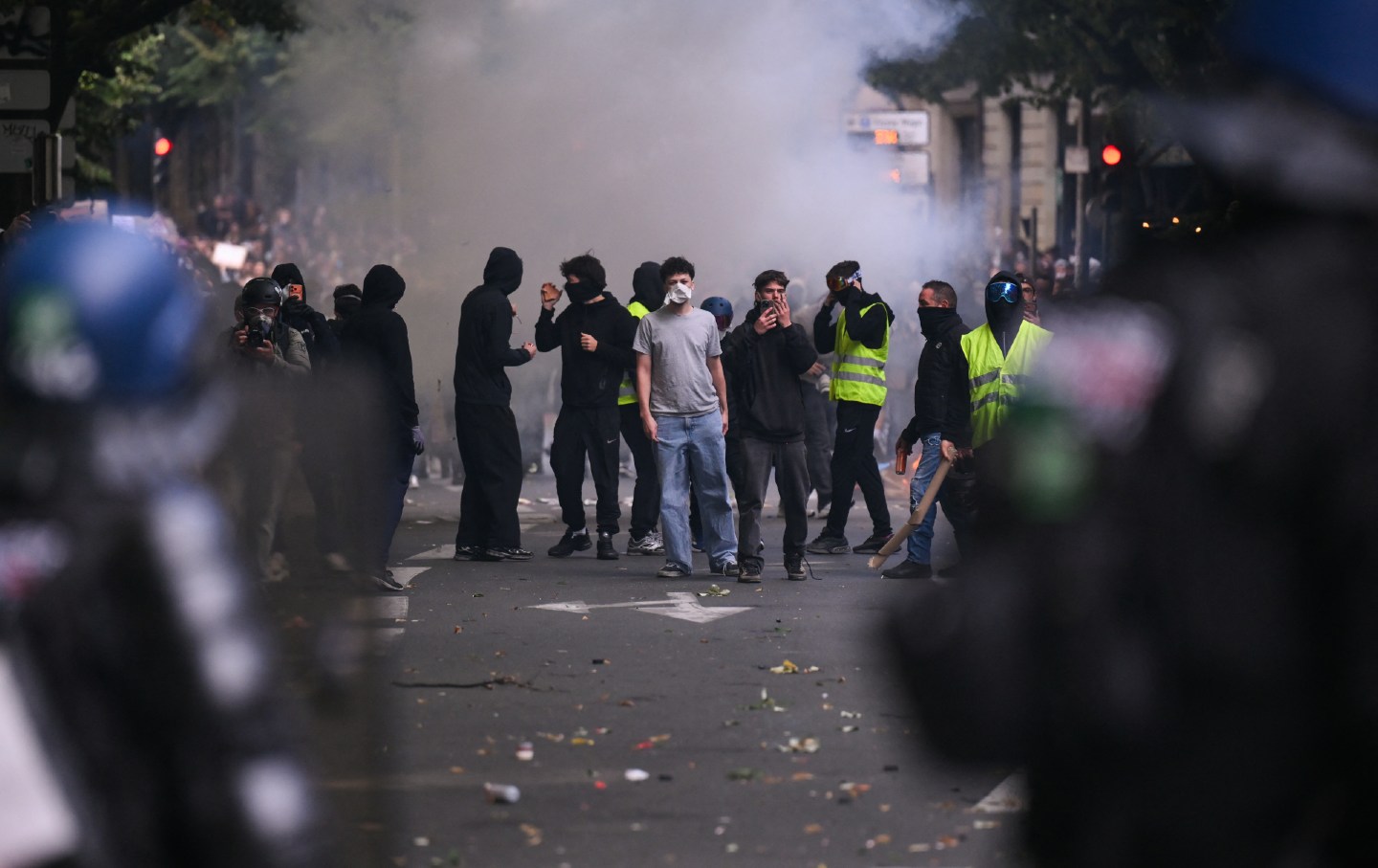
The Specter of Lepenism Looms Over France’s Social Crisis The Specter of Lepenism Looms Over France’s Social Crisis
Joining forces with the “yellow vests,” youth demonstrators are raising the alarm in a country falling to the far right.

Progressives Are Backing Puerto Rican Independence. It’s About Time. Progressives Are Backing Puerto Rican Independence. It’s About Time.
More and more leftists are concluding that statehood for the island is not enough.
The Saudi Phase of the Iran War Signals More Chaos to Come The Saudi Phase of the Iran War Signals More Chaos to Come
The conflict that Donald Trump has repeatedly proclaimed an unequivocal American victory keeps spiraling out of control.
Andy Burnham’s Speech to the Labour Party Conference Could Be the Start of a Positive Social-Democratic Politics Andy Burnham’s Speech to the Labour Party Conference Could Be the Start of a Positive Social-Democratic Politics
But the autumn budget to be released at the end of October will offer needed details.

