
Inside India’s Gen Z Cockroach Janta Movement
Young Indians are challenging the purge of voter rolls by Modi’s right-wing government. Shrishti Khanna, who was detained by Delhi police while covering the protests, explains.
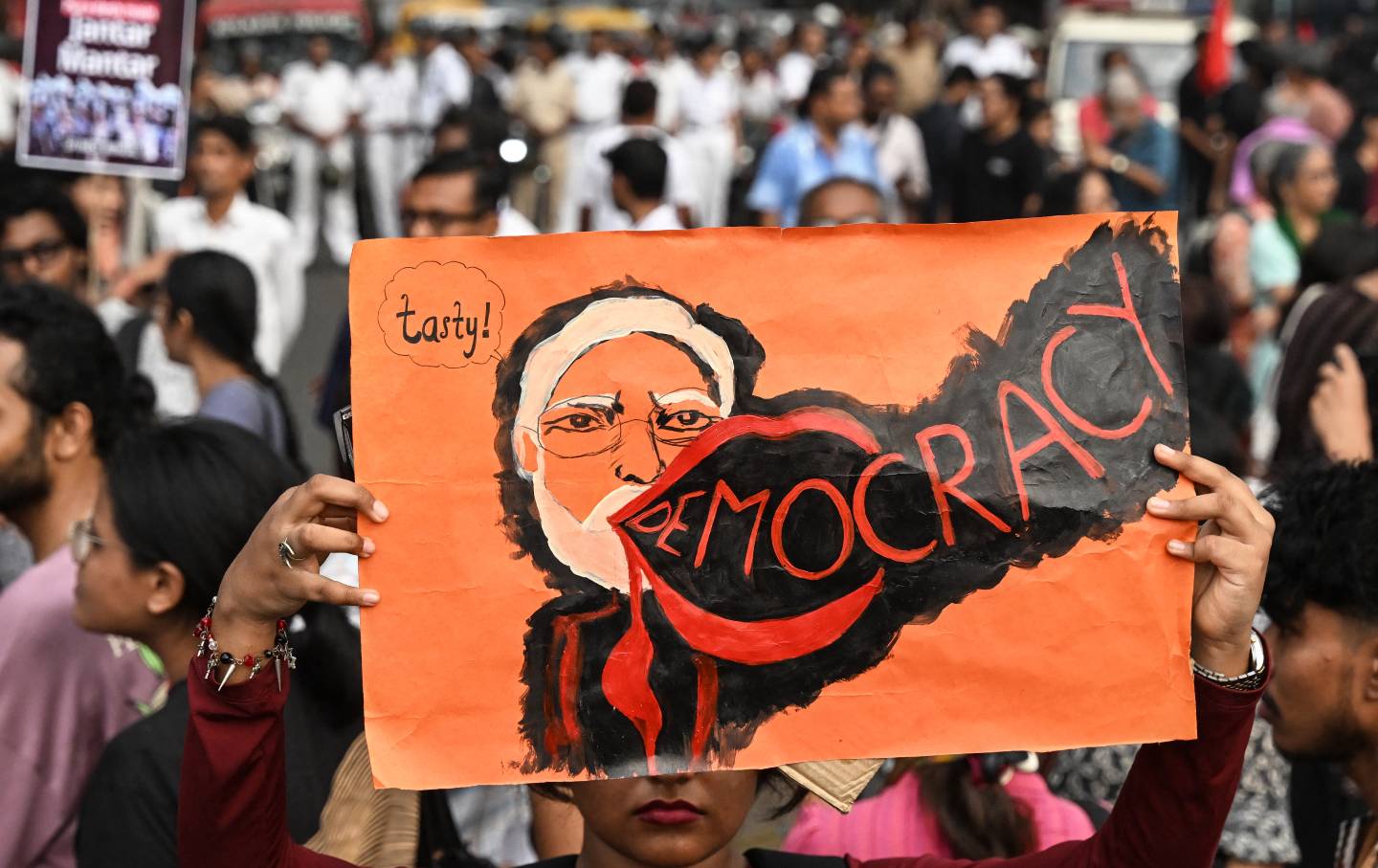
A student activist aligned with left-wing organizations holds a poster of Indian Prime Minister Narendra Modi amid the ongoing protest in solidarity with the youth-led Cockroach Janata Party demanding the resignation of the country’s chief election commissioner, Gyanesh Kumar, over alleged voter roll irregularities linked to the “special intensive revision,” in Kolkata on October 11, 2026.
(Dibyangshu Sarkar / AFP via Getty Images)Shrishti Khanna told me we would talk about developments in India that night. Then I didn’t hear from her.
When she resurfaced the next afternoon, she explained why: “I passed out after a tussle with the police.”
She had spent the previous days in Delhi documenting the youth-led protests as an independent journalist and increasingly found herself caught up in the state’s response to them. On October 10, police detained her and four other reporters near Jantar Mantar, the city’s designated protest site, and took them to a police station in Sarai Rohilla, several miles away in north Delhi. No one told them what offense or legal provision they were being held under, she says. They were told only that they would be released at sunset. The detention itself, she says, was rough: Three or four female officers lifted her off the ground and shoved her against a police van.
Now, she told me, she was home and “just sore everywhere.”
“Well, until the next call for mass gathering,” she added.
The protests have become a rare public challenge to Prime Minister Narendra Modi, whose Hindu nationalist Bharatiya Janata Party (BJP) has governed India since 2014. Many are organized by the Cockroach Janta Party, which began in May as an online joke after India’s chief justice, Surya Kant, likened jobless young people to cockroaches. Kant later said he meant holders of fake law degrees. By July, the movement had helped force the education minister to resign over leaked entrance exams.
Its current target is a nationwide revision of the electoral rolls that has deleted roughly 130 million names, according to Election Commission figures. The commission says it is removing the dead, the relocated, duplicates, and voters officials could not trace; critics say eligible citizens, disproportionately Muslims, have been struck off. Since protests demanding the chief election commissioner’s resignation began on October 2, Delhi Police have banned large gatherings, detained protesters, and opened an inquiry into harassment complaints from women journalists.
Khanna is a Mumbai-based writer and political activist whose work on India-Israel relations, authoritarianism, and digital surveillance has appeared in The Wire, The New Arab, and Azad Essa’s Hostile Homelands newsletter. I asked Khanna what has driven her generation into the streets.
—Shilpi Chhotray
Shilpi Chhotray: For readers in the US who are just meeting the Cockroach Janta Party: What is it, and why has it caught fire with young Indians?
Shrishti Khanna: The Cockroach Janta Party is a youth-driven protest movement that uses satire, Internet culture, and the language of political resistance to challenge the Modi government and what protesters see as the erosion of democratic rights in India.
I think part of its appeal is that it speaks a language young people already understand. Humor, memes, and political satire can make participation feel accessible, especially to people who haven’t previously been involved in organized politics.
SC: Your generation has grown up almost entirely under Narendra Modi. How has that shaped the young people now on the streets?
SK: For many young Indians, Modi’s government is not simply one political administration among several. It is the political environment in which they have grown up.
They have witnessed the normalization of Hindu majoritarianism, the shrinking space for dissent, attacks on universities and student movements, and the increasing use of state institutions against critics. They have also grown up in a political environment where television news, social-media algorithms, and political propaganda play an enormous role in shaping public opinion.
This creates a contradiction. Some young people have internalized the government’s political worldview because it is what they have been exposed to for most of their lives. Others are beginning to question the institutions and narratives they once considered normal.
I wouldn’t describe this generation as uniformly progressive or anti-government. Young Indians are politically divided. The significance of these protests is that some are beginning to challenge a political order that, for much of their lives, appeared almost permanent.
SC: Something that resonates with me as an Indian American is the generational divide over Indian politics. What happens when a young person’s political awakening puts them at odds with the people who raised them?
SK: In India, political ideology often enters the home through religion, caste, nationalism, and family expectations. So when a young person begins questioning the Modi government, Hindutva, or the treatment of minorities, it can become much more than a disagreement over electoral politics.
For some families, support for the BJP has become closely tied to their understanding of national identity, religion, and patriotism. Criticizing the government can therefore be interpreted as criticizing the family or even the nation itself. Young people may face pressure to remain silent, accusations of being anti-national, or restrictions on their participation in protests.
But I also think we should recognize that political disagreement within families is shaped by material dependence. A student who relies on their parents for housing, education, and financial support does not necessarily have the freedom to express dissent without consequences.
Political awakening can be isolating, but it can also lead people to build communities and political relationships outside the structures in which they were raised.
SC: Let’s get to the voter rolls. Roughly 130 million names have been removed. From the outside, that sounds bureaucratic. Why has it become a question of power for your generation?
SK: The voter-roll revision, or Special Intensive Revision, is not simply a bureaucratic exercise. It is a question of who gets to participate in India’s democracy and who gets excluded.
There are serious concerns that the exercise has disproportionately affected Muslims, marginalized communities, and eligible voters whose names have been removed despite their right to vote. These are often people who already face significant barriers when it comes to documentation and proving their eligibility.
What makes this particularly alarming is the timing. The BJP government has benefited politically from elections held after these revisions, which have taken place close to polling dates. When eligible voters are removed from electoral rolls, they can lose their opportunity to participate in an election that may determine who governs them for the next five years.
SC: And if those voters are later restored?
SK: Here’s the most disturbing part: Even if those voters are later found to have been wrongfully excluded, the election is not automatically conducted again. The BJP may already have won, formed the government, and consolidated its power. Restoring someone’s name to the electoral roll afterward does not restore the vote they were denied.
This raises fundamental questions about electoral legitimacy and whether voter-roll revisions are being used to facilitate electoral manipulation. We cannot establish that an election was rigged simply from the number of deletions, but wrongful exclusions on a significant scale, particularly if politically targeted, can undermine the fairness of the result.
SC: You’ve seen the state’s response up close. On October 10, you were detained while covering the protests. Take me through that day.
SK: On October 10, I was in Delhi documenting the protests as an independent journalist. I was near Deen Dayal Upadhyaya Marg, close to Jantar Mantar, at approximately 10:30 in the morning. I was not participating in the protest. I was there to report on what was happening, alongside other journalists.
Despite that, Delhi Police detained me along with four other reporters and took us to the police station at Sarai Rohilla. We spoke to Inspector C.P. Bhardwaj, but we were not given any clear explanation of why we had been detained. We weren’t informed of any specific offense or legal provision under which we were being held. Instead, we were simply told that we would be released at sunset.
What concerns me is that we were there in a professional capacity, documenting events of public interest. Our detention was subsequently reported by The Quint, and Digipub News India Foundation issued a statement condemning the detention of journalists, explicitly naming me. The question is why journalists carrying out their work were detained in the first place, and why the police could not provide a clear legal justification for restricting our freedom.
SC: When you messaged me, you said you were “just sore everywhere.” What happened?
SK: The police were very rough, and that was the case with not just me but everybody.
For me, there were three to four female police officers who came toward me when I was reporting, and they picked me up, all of them. I was lying down on the ground. I was resisting as much as I could, but they picked me up from everywhere. My pants were literally falling, and I had to scream that my clothes were falling, please help. They paused for a second, but then they shoved me against the police van. There were so many people being detained. It was a big crowd. They didn’t want me to go anywhere.
My knuckles are still sore because it hit my hand. My legs are still sore because they pulled my legs so much while detaining me. They shove you in the van in a manner that you may fall and hit something and get a really serious wound, which other people have gotten. Fortunately, I didn’t.
SC: What did you see happen to other protesters?
SK: Women were subjected to a lot of violence, and also sexual assault and groping. The groping and sexual assault, fortunately, did not happen to me.
My hair was fortunately tied up, but I saw people who had ponytails or longer hair have their hair pulled so officers could get a grip on them and pick them up. Female police officers dug their nails into the protesters while picking them up, so as to hurt them, control them, and not have them escape. And when the protesters were dragged, they were dragged on the roads, and the roads are, of course, very rough. So they have a lot of bruises all over their legs.
This is what I’ve witnessed firsthand, and what I experienced.
SC: Did that change how you see the state, or your role in documenting it?
SK: I wouldn’t necessarily say that being detained fundamentally changed my understanding of the state. It reinforced what I already understood through years of documenting state violence, political repression, and the criminalization of dissent in India.
Journalists, activists, students, Muslims, Dalits, Adivasis, and people from marginalized communities have experienced different forms of state repression for a very long time. My detention cannot be understood in isolation from that larger history.
But I think it’s equally important not to treat the detention of journalists as the only moment when state repression becomes worthy of attention. The people we are reporting on may be experiencing far greater consequences, often without the same visibility or institutional support.
SC: I first came across your work through your coverage of Indian solidarity with Palestine. Has documenting Palestine shaped how you see what’s happening here, or do you resist that comparison?
SK: Yes, absolutely. Reporting on Palestine has fundamentally shaped how I understand state violence, surveillance, and the role of journalism, including here in India.
Palestinians are subjected to systems of mass surveillance, facial recognition, automated targeting, and military control. These technologies do not remain confined to Palestine. India is particularly important here because it is Israel’s largest arms customer. The two countries have extensive military, intelligence, and surveillance cooperation.
And then there is what Israel has done to Palestinian journalists. Gaza has become the deadliest conflict for journalists ever documented by the Committee to Protect Journalists. These were people documenting what was happening to their own communities, often because international journalists were not even allowed into Gaza. Killing journalists also means destroying witnesses and the evidence they preserve.
SC: And in India?
SK: When I look at protests in India, I see some deeply concerning parallels in the methods of surveillance and repression, although the scale and circumstances are very different.
We have seen Delhi Police deploy facial recognition systems and surveillance vehicles at Jantar Mantar. We have seen journalists detained despite identifying themselves as members of the press. And we have seen how the language of national security and maintaining public order can be used to justify restrictions on protest and documentation.
For me, documenting Palestine has reinforced something fundamental about journalism: The state does not get to decide which violence is documented and which witnesses are allowed to speak. Journalism cannot simply reproduce the state’s version of events, particularly when the state itself is responsible for the violence being reported.
SC: Earlier you mentioned the normalization of Hindu majoritarianism. How are religious identity and Hindu-Muslim relations showing up among young protesters?
SK: Religion cannot be separated from contemporary Indian politics because Hindutva, the political ideology of Hindu majoritarianism, has been central to the BJP’s political project. Under Modi, Muslim identity has increasingly been treated as a political question, with controversies surrounding citizenship, religious expression, public space, and communal violence.
But young people do not all respond to this in the same way. Some reproduce the majoritarian politics they have grown up with. Others reject it and organize around constitutional rights, secularism, and solidarity across religious communities.
SC: Is that a challenge for the Cockroach Janta Party itself?
SK: One of the most important questions for a movement like CJP is whether it can move beyond opposing Modi personally and confront Hindu majoritarianism as a political structure.
A movement cannot meaningfully claim to defend democracy while remaining silent about the systematic marginalization of Muslims or the persistence of caste oppression. If young people are demanding voting rights and democratic accountability, those demands must extend to communities whose rights have been under attack for years, not only to those who have recently begun experiencing repression.
SC: Let’s talk about the name. It started as an insult from India’s chief justice. Why did the cockroach stick, and what does humor let young people do that conventional political language doesn’t?
SK: There is something politically interesting about taking an insult from someone in a position of institutional power and turning it into a collective identity.
The name itself is deliberately absurd. It plays on the naming conventions of Indian political parties, particularly the Bharatiya Janata Party, or BJP, while turning the cockroach into a symbol of political survival and defiance.
Humor allows young people to ridicule authority instead of fearing it. But humor also has limitations. A meme can bring thousands of people onto the streets, but it cannot necessarily explain why unemployment exists, how caste and class shape access to education, or how political institutions protect existing power structures.
I think the question is whether humor becomes an entry point into political education and organizing, or whether the movement remains dependent on viral moments. Because the state can survive being mocked. What threatens entrenched political power is sustained, organized resistance.
SC: The Congress party and other opposition parties are now marching over the voter rolls too. What happens when a youth-led movement starts to intersect with established parties?
Popular
“swipe left below to view more authors”Swipe →SK: There are both opportunities and risks. On one hand, established political parties have organizational networks, resources, parliamentary representation, and access to institutions that a new youth-led movement may lack.
On the other hand, there is always a danger that the movement’s demands become absorbed into electoral competition, particularly if political parties begin treating young protesters as a constituency to be mobilized rather than people with independent political demands.
SC: So what would it take for this moment to become lasting political power?
SK: I think we need to distinguish between opposing the BJP and building an alternative political project.
A movement cannot measure its success only by the resignation of a minister, the removal of an election official, or even a change in government. Those may be important victories, but they do not automatically transform the material conditions that produced the anger.
For this moment to become lasting political power, there needs to be sustained organizing beyond Delhi and beyond social media. There needs to be engagement with workers, farmers, students, Dalits, Adivasis, Muslims, and communities already resisting displacement, exploitation, and state violence. The movement also needs internal democracy, political education, and accountability to the people it claims to represent.
Ultimately, the question is whether young people are being mobilized for a moment or organized for a struggle that continues long after the headlines disappear.
More from The Nation
The Clarion Call of “NAZA” The Clarion Call of “NAZA”
Yuval Abraham and Rachel Szor’s new film not only documents the horrors of the present but give us a glimpse of a possible future too.
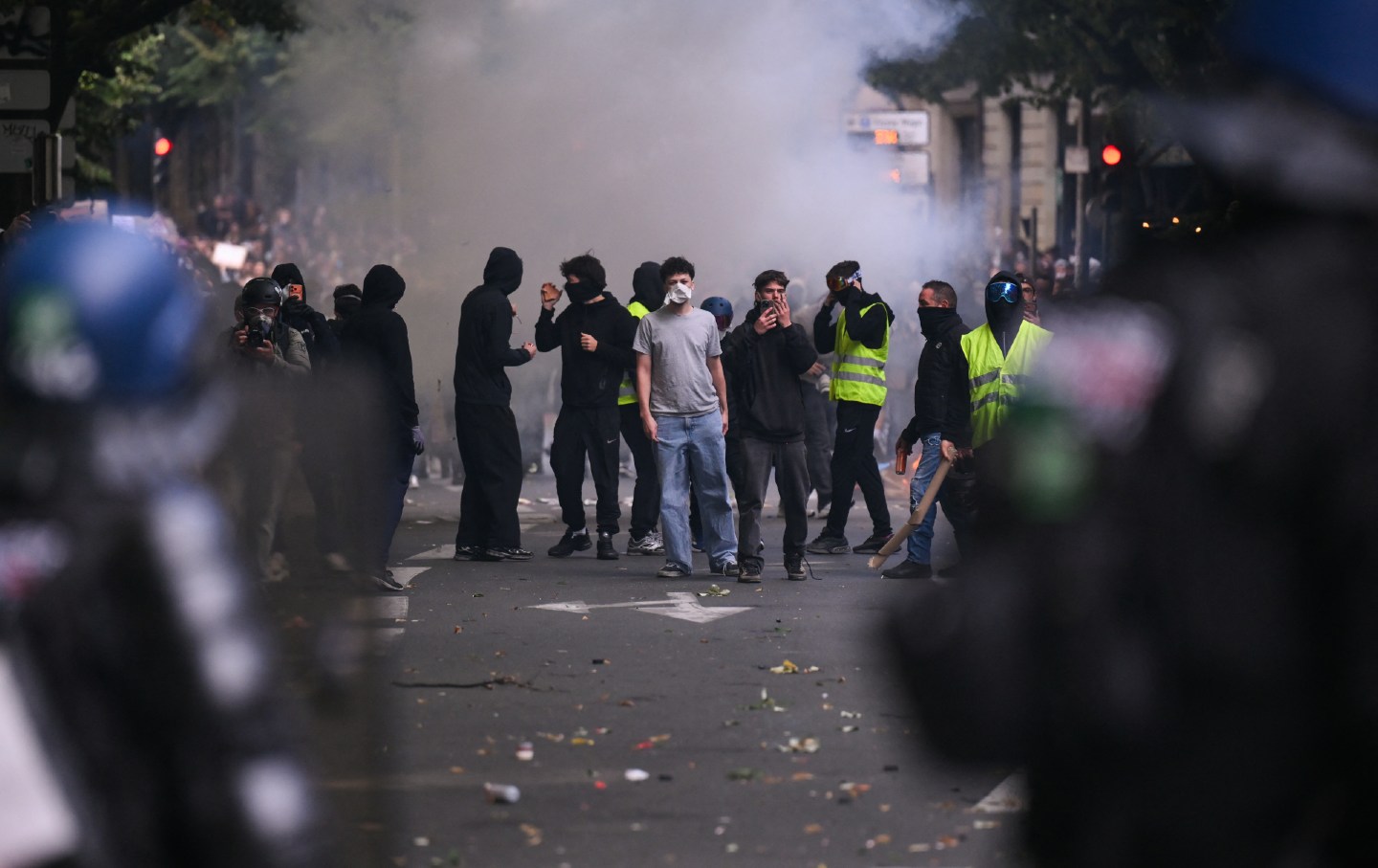
The Specter of Lepenism Looms Over France’s Social Crisis The Specter of Lepenism Looms Over France’s Social Crisis
Joining forces with the “yellow vests,” youth demonstrators are raising the alarm in a country falling to the far right.
Progressives Are Backing Puerto Rican Independence. It’s About Time. Progressives Are Backing Puerto Rican Independence. It’s About Time.
More and more leftists are concluding that statehood for the island is not enough.
The Saudi Phase of the Iran War Signals More Chaos to Come The Saudi Phase of the Iran War Signals More Chaos to Come
The conflict that Donald Trump has repeatedly proclaimed an unequivocal American victory keeps spiraling out of control.
Andy Burnham’s Speech to the Labour Party Conference Could Be the Start of a Positive Social-Democratic Politics Andy Burnham’s Speech to the Labour Party Conference Could Be the Start of a Positive Social-Democratic Politics
But the autumn budget to be released at the end of October will offer needed details.
Why Navi Pillay’s Receiving the Nobel Peace Prize Is So Important Why Navi Pillay’s Receiving the Nobel Peace Prize Is So Important
She believes that human rights and international law are universal principles that must be enforced regardless of violator’s ideology, ethnicity, or geostrategic alignment.

