
So What Is Socialism, Anyway?
In a world dominated by neoliberal market fundamentalism, “socialism” is what will make a more moderate, regulated form of capitalism work for most people.
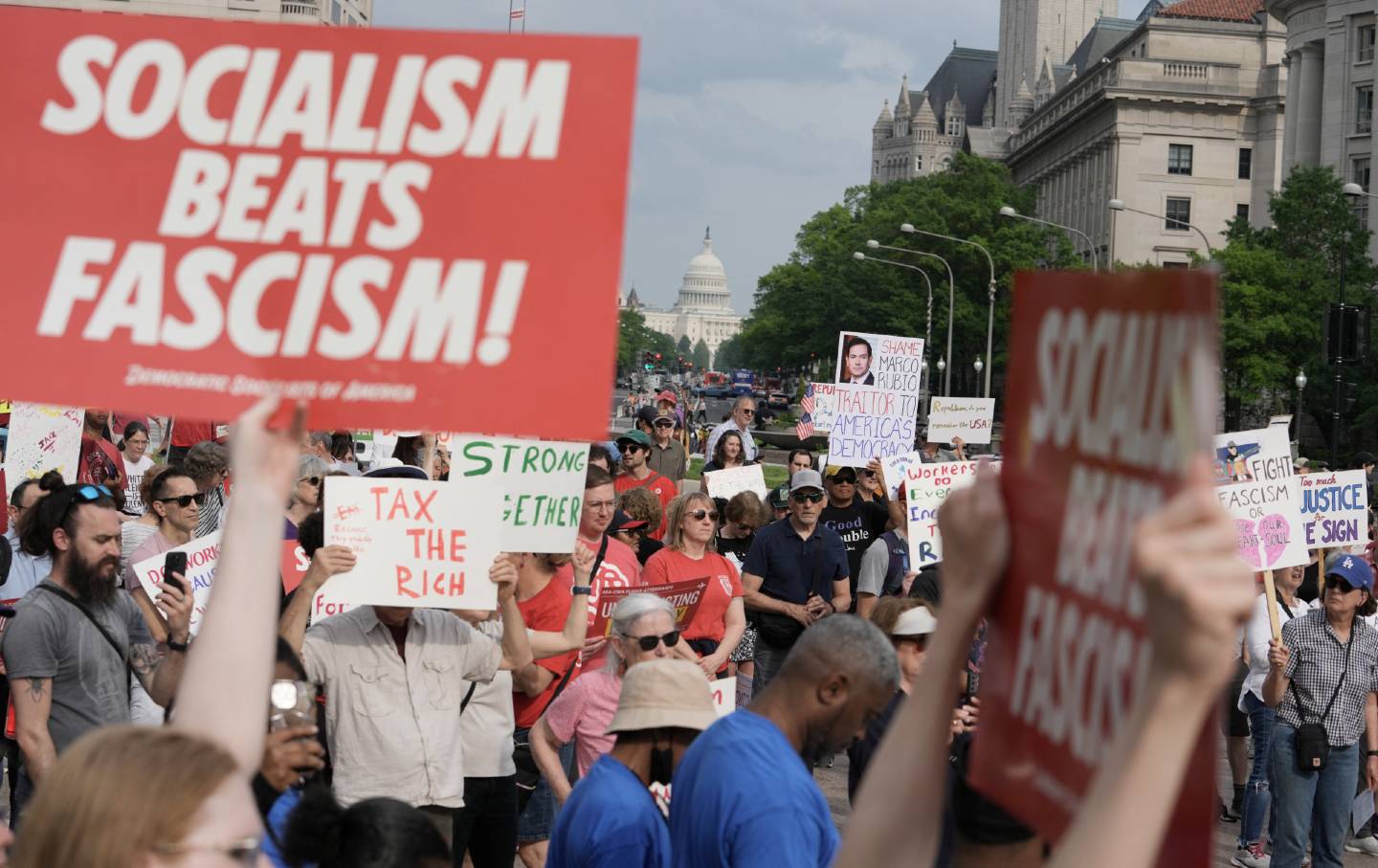
In electoral democracies, politics is most often about the future: making things better than they currently are. Hope pervades as the dominant emotion, accompanied by a tenacious sense that nothing will actually change. Thirty-five years after the collapse of actually existing communism, right-wing political leaders around the world have resurrected the hoary images of the Red Menace in demagogic populist appeals to their followers to stop the drift toward the left of young people fascinated by a language of progressive political possibilities.
Most Americans are opposed to what they think is socialism without having any clear idea of the variety of meanings attached to that word. In the last decade, a majority of the young have become disillusioned by the failure of the liberal elite and of liberalism more generally and have been gravitating toward something that they see as an alternative to the capitalist status quo. A year ago, a Gallup poll showed that only 54 percent of Americans favored capitalism, while 39 percent had a positive opinion of socialism. Democrats viewed socialism more positively than capitalism—66 percent to 42 percent, respectively—while independents were modestly more pro-capitalism than pro-socialism (51 percent vs. 38 percent). Republicans remained overwhelmingly pro-capitalist (74 percent vs. 14 percent). In earlier polls, three out of five Americans supported a national health plan, sometimes called Medicare for All, in which all Americans would get their insurance from a single government plan. Even more people favored the government providing free tuition to anyone attending a two- or four-year university. Two-thirds believed that taxes should be raised on the rich to curb the runaway polarization of wealth in the country.
Conservatives once again are deploying the word “socialism” as a weapon against the left. So, we might ask, what is socialism anyway? Why are young people calling themselves democratic socialists, and why are such candidates as Zohran Mamdani able to win elections? Have we arrived at a moment when it has become possible to separate the enduring appeal of socialism’s humanist values that have inspired so many in the past from the dark history of the Soviet experiment and the legacy of Stalinism?
While the right in the United States and Europe gleefully and without much reflection deploys the term socialism to denounce everything from social welfare programs to environmental regulations, it is possible to examine the word historically and distinguish the cluster of core meanings that still possess a power to animate and mobilize millions from its frequent and deliberate misuse. Like words such as “liberalism” and “conservatism,” socialism works, as literary critics would put it, as a “floating” or “empty signifier,” that is, a word with multiple, indeterminate, and contested meanings. Yet it has a history, and despite its frequent misuse—after all, even the Nazis called themselves “national socialists”—the word indicates an aspiration to move beyond capitalism toward a more egalitarian, socially just political and economic order.
At its most fundamental level, socialism is the political philosophy that believes that public policy ought to promote primarily the common good rather than simply individual or corporate interests. From the early 19th century, socialism involved democratic politics—the empowerment of all the people, social justice for all, and equality (not only of opportunity, as liberals believe, but of reward as much as is practically possible). Socialism, then, stood (and for many still stands) opposed to the proposition so central to classical liberal (now conservative) economic ideology that individual greed will magically produce the greatest good for the greatest number.
The indispensable critic of modern market economics, Karl Marx, argued that capitalism, with its enormous productive capacities as well as its fatal contradiction between the abundance and poverty it engendered, would eventually give way through revolution or evolution to the collectivist egalitarianism of socialism. Here his optimism and idealism may have gotten the better of his usually sober realism about the social world. More perceptively, he warned that social environments—in his words, modes of production—shape human ambitions and possibilities.
Along with the society of competition and greed that capitalism fostered, it also created a corresponding “human nature” that demanded ever-increasing accumulation, exploitation of the natural world, and the separation of individuals from their common purpose. While it nurtured the possibility of a more socially connected economy, capitalism daily tore asunder the empathetic bonds of men and women, rendering them egoistic atoms in a state of Darwinian competition. Such a system, particularly in its neoliberal variant, which proudly proclaims that the market can do everything if left to itself, perpetuates the class division between a wealthy minority and the vast majority without capital and assets. Capitalism operates for the benefit of the shareholders, and those who can pay, not for the general good. The material world and the moral world move in opposite directions.
For those who embrace its positive meaning, socialism is a utopia—not in the sense of an unattainable goal but rather of a direction in which people might direct their political desires. In what was practically a valedictory essay, the Marxist historian of socialism George Lichtheim (1912–1973) wrote:
Socialists are at a minimum committed to economic planning that goes counter to the operation of an economy in which private firms predominate and profits are distributed among shareholders and managers. A system of this kind necessarily perpetuates the class division between a wealthy minority and a propertyless majority. A capitalist economy, moreover, can only respond to “effective demand” backed by actual purchasing power. It operates for the benefit of paying customers only and does not recognize the existence of other people. In consequence it normally fails to satisfy basic material needs except in a roundabout way that is not to everyone’s taste. To put it crudely, the logic of the system entails the production of luxury goods for the few, rather than the provision of food, clothing, and decent housing for the many.
To most Americans, who by world standards are extraordinarily affluent, this stark statement of one understanding of capitalism may seem exaggerated. To the global poor, it reflects the lives they know.
Yet the normative assertion that society and the economy ought to work for the many, not only the few—the socialist critique of capitalism—has always been more potent and persuasive than the presentation of alternatives to the way economies work in our own time. The intermediate solution outside of the Soviet-style communist systems and neoliberal capitalism has been the welfare state: capitalist market economies but with state regulation and provision for the sick and less able in a democratic polity. Social democracy, or what Bernie Sanders calls “democratic socialism,” which runs from the American New Deal to Swedish socialism, preserves the market but directs state policy toward the public good with the conviction that individuals and markets may operate with a far different logic when left on their own. As Lichtheim understood, “Taken by itself this is a democratic rather than a socialist line of reasoning,” for it “leaves the wage relationship unaltered” and the means of production in the hands of capitalists. Certainly an advance on unfettered neoliberal capitalism, social democracy, nevertheless, must be distinguished from socialism, in which profits would go, not to the owners of capital, but to society at large.
The state ownership of Soviet-style “socialism” (what might more accurately be called “Stalinism”) and the state capitalism of fascism were understood by many Western Marxists to be perversions of the authentic social ownership of socialism. “If socialism were to become permanently identified with the kind of life imposed after 1945 on Eastern Europe,” Lichtheim wrote, “few sane people would want it.” For him, socialism meant the means of production were to be owned by the whole community and operated democratically.
Today, in our world of plutocrats and oligarchs with their political allies embedded in the state apparatus, it is unlikely that popular ownership of the means of production is attainable. In a more limited sense, socialism might be seen as the democratic intervention into the economic as well as the political sphere to reorient production and consumption toward public ends. The critics of Obama, Biden, and the Democratic left have a point. A healthcare system that eliminated fee-for-service medicine (which Obama did not propose) and provided guaranteed healthcare for all (which he did) would be a kind of socialism, whether administered by government or, as in Switzerland, by regulated nonprofit private insurers. Municipal services that work for the common good, such as fire departments and public schools, would be socialist, as are the national parks and the post office. Imagine if entry into the grandeur of Yosemite were calculated on a monetary basis. What would it cost to view El Capitan if we calculated a rare resource and high demand? And, by the way, can FedEx deliver a first-class letter from Ann Arbor to California for 50 cents and make a profit?
Socialism is defined both by its ends and its means. Its ends are policies defined by the public good, a movement toward greater democracy and equality, well-informed participation in politics and economics by its citizenry, and programs, both governmental and in the private sector, that aim toward greater material security for all. Inequality and unearned advantages and privileges conferred by the ownership of property are the enemies of socialism, and therefore policies aimed at the common good are in tension with the power of the propertied who shortsightedly look to the profit of corporations and individual owners of capital.
Popular
“swipe left below to view more authors”Swipe →The means to socialism, as the bitter experience of the Soviet Union perversely demonstrated, cannot be coercive but must be consensual. Socialism cannot be imposed; it has to be acceptable and accepted, that is, democratically chosen. That, of course, may be the greatest obstacle to a socialist future, given the naturalized hegemony of bourgeois normality.
Utopian or realist, socialists have to be frank that their values of equality and social justice run up against the desires of people already shaped by centuries of capitalism. Marxists believe that social environments shape human ambitions and possibilities, and consequently, along with the society of competition and greed that capitalism fostered, that competitive, individualistic system also created a corresponding “human nature” that demanded ever-increasing accumulation, exploitation of the natural world, and the separation of individuals from their common purpose. Socialist values run up against the way people currently think, feel, and want, embedded by the lived experience of capitalism.
The regulated economy of socialism would likely compel people to give up the search for ever-greater output, ever-higher standards of living, the latest iPhone, and increasing consumption of goods and exploitation of the natural world. And what about the majority of people around the world who have not yet attained minimal standards of comfort, health, or even survival? Both in the statist economies that imploded by 1989 and in democratic capitalist societies like Obama, Trump, and Biden’s America, there was and is, as Lichtheim reminded us, an “inherent conflict between two quite different and possibly irreconcilable goals: economic growth and social equality.”
It has been said that capitalism is intolerable and socialism impossible. That may be the inescapable dilemma of our age. But as historians continually remind us, nothing is fatally determined or inevitable. We should not mistake the present for the future. There is always a degree of choice, a rational, radical middle road to a better future. As someone who has studied the USSR and international socialism for over half a century, I have come to think that concepts like socialism and capitalism, which at first seem to define opposing economic systems, are, in fact, intimately, even fatally, connected.
The current debate in the United States around socialism does not in fact involve socialism in its classical meaning. Even among strong supporters of open borders, an end to the carceral state, and defunding the police, few are openly advocating nationalizing major industries or turning factories over to workers. Here, it is actually an argument between adherents of two competing ideas of capitalism: one, the neoliberal, libertarian model favored by the Republicans of a system responding almost exclusively to market imperatives and eschewing regulation and state interference; the other, advocated by most Democrats, proposes a return to New Deal Keynesianism, a capitalism that requires regulation in the interest of the people’s welfare and protection from naked market forces. Raising the red flag of fear, conservatives contend that responsible governmental regulation is “creeping socialism,” which will lead a free society along the “road to serfdom.”
Realistically, in a world dominated by neoliberal market fundamentalism, in which inequality between the top and bottom of society grows daily, “socialism” is what will make a more moderate, regulated form of capitalism work for most people. Looking at the past of failures and the present of confusion, socialism offers the possibility of a different logic to be applied to public policy, a democratic intervention into the economy, redirecting it toward a public good and the salvation of the planet. We have learned from the Soviet experiment that there is no real socialism without democracy, and we are daily coming to the realization that there can be no real democracy—the empowerment of all the people—without socialism.
More from The Nation

Will the GOP’s Big Money Save Jon Husted in Ohio? Will the GOP’s Big Money Save Jon Husted in Ohio?
Former senator Sherrod Brown is leading in most polls, but a tidal wave of spending may prop up the struggling incumbent.

James Talarico Is Preaching a Gospel of Pluralism James Talarico Is Preaching a Gospel of Pluralism
He’s not the only progressive doing it.

Even Republicans Are Waking Up to Trump’s Corruption Even Republicans Are Waking Up to Trump’s Corruption
And, somewhat shockingly, so are Democratic elites.

Mamdani Can No Longer Avoid the Issue of the NYPD Mamdani Can No Longer Avoid the Issue of the NYPD
The mayor has been able to put difficult questions about policing on the back burner—until now.
Why Democratic Leaders Keep Waging War on the Young Why Democratic Leaders Keep Waging War on the Young
The party's silver-haired establishment is caught up in an existential culture war.

