
Are Europe and Russia Slow-Walking to World War III?
Dangerous rhetoric has been escalating on both sides for some time now.
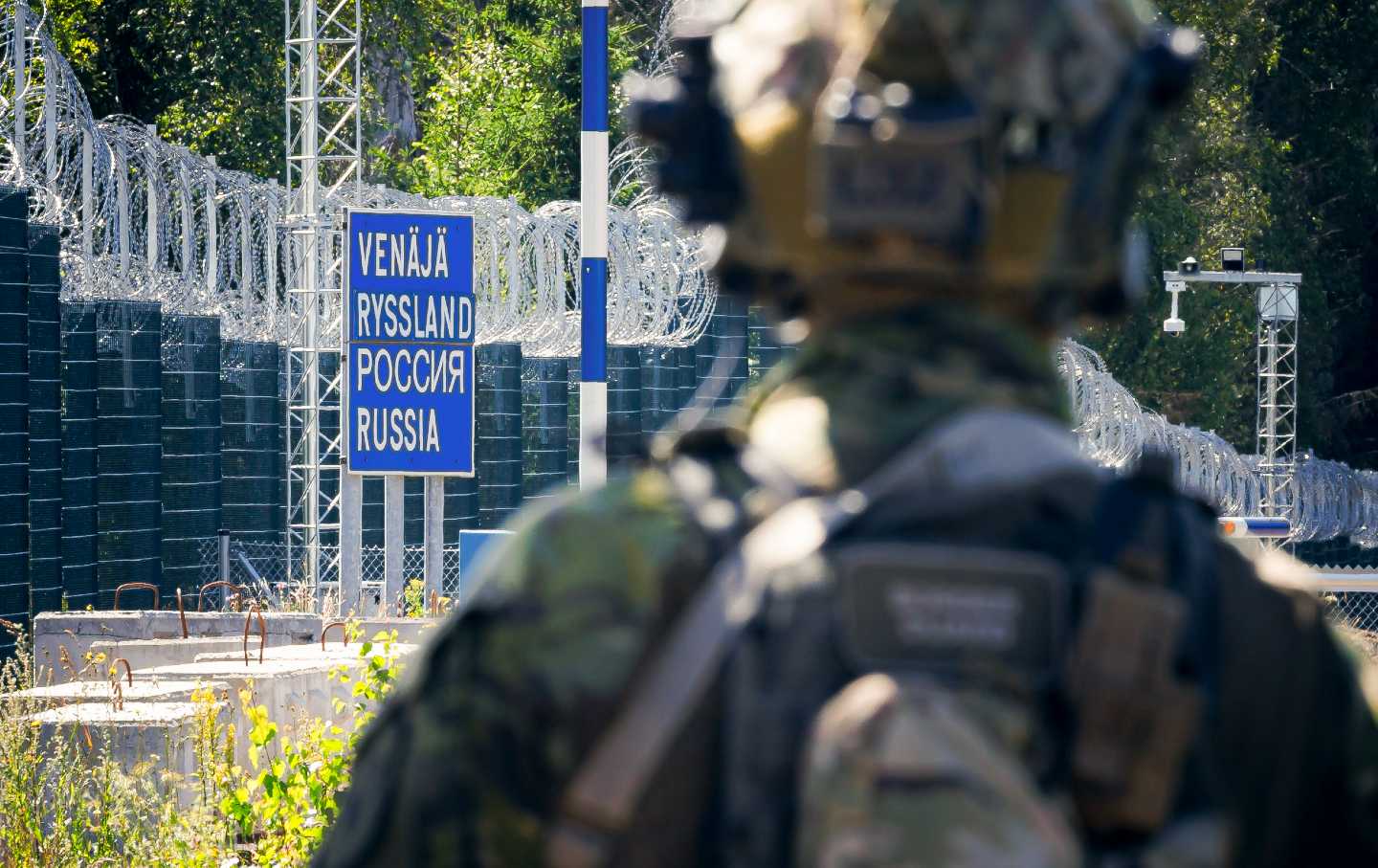
Putin’s recent declaration of Russia’s potential to “use all the weapons at our disposal” is the most explicit talk of nuclear war by a superpower since the Reagan administration invoked the prospect of “winnable nuclear war” over 40 years ago. How did we get to this point? Leaving aside the origin of the war with Ukraine, which Putin falsely continues to claim was forced upon Russia, dangerous rhetoric has been escalating on both sides for some time now.
To be sure, for Ukraine the threat from Russia is very real. But elsewhere the hyped-up language over the Russian threat is astonishing: “We are all eastern flank countries these days,” NATO’s top commander argues, while a British think tanker even claims, “The UK is a front-line state.”
European leaders have focused on two threats: the short-term potential for “hybrid” attacks from Russia, and the longer-term argument that “Russia’s well-oiled war machine” (in the words of NATO Secretary General Mark Rutte) justifies a massive military buildup.
Regarding “hybrid war,” intelligence officials warn of a potential attack on NATO that could come “within months.” The expressed fear is that Russia will somehow “test” the world’s most powerful military alliance, as if a simple poke from the Russian bear would “expose NATO as impotent.”
Russian leaders have long been obsessed about NATO. The notion that the Kremlin would now provoke a direct confrontation to find out whether NATO would invoke Article 5—“an attack on one is an attack on all”—beggars the imagination. Yet such imaginings are now running freely, in war games, “war fiction,” and realistic television portrayals. The threatening oratory has become so heightened that even leaders in the Baltic states—countries truly on the front lines—are now calling on Western leaders to tamp down their talk of an invasion. Those spinning the scenario whereby the Russian-speaking people of Narva, Estonia, are waiting to be happily liberated by Putin have rarely bothered to speak to the people who actually live there.
To be sure, warnings about the potential for arson or sabotage should be taken seriously. The speculation has been that Russia might attempt such actions to lessen European support for Ukraine. Yet history shows all too well that attacks on one’s soil tend to have the opposite effect and drive support for retaliatory action.
Indeed, the more realistic threat from Russia’s “hybrid war” is the ongoing attempt to use social media and other means as part of an “overall attempt to spread fear and uncertainty,” or in the more heightened language of British Prime Minister Burnham at the UN, through Russia’s “poisonous tide” of “disinformation.” Yet Russian disinformation can only exploit existing fissures in European society.
European leaders face the “unenviable task of persuading unprepared voters to cut welfare spending to fund defense.” Convincing voters to cut welfare spending—to pay more for guns and less for bread and butter—becomes more daunting when one realizes that Russia is hardly operating from a position of strength. Rather, we are told, “Putin is desperate,” or, as Mujtaba Rahman writes in The Guardian, “Russia is becoming more dangerous because it is becoming weaker.”
Before the war, Russia’s economy was suffering from a decade or more of declining living standards. Contrary to expectations, for a few years Russia’s economy boomed under “military Keynesianism.” Now, however, knowledgeable economists argue that “the wheels are coming off” the Russian economy. The war-induced labor scarcity fuels inflation, leading to crushing interest rates, which in turn pushes civilian industry into the ground. Before long, Russia will reach a hard stop, finding itself unable to continue to fund war spending, meet basic social obligations, and maintain fiscal stability.
True, Putin might well choose to demand full military mobilization. But, as no less than Sergei Sobyanin, the mayor of Moscow, bluntly stated, transitioning to a war economy would “kill the entire country.” Andrei Klepach, chief economist at Russia’s second-largest (and Kremlin-connected) bank, spoke candidly to fellow economists: “I am almost certain we will face a social crisis…. Our backwardness will grow with all the ensuing consequences.” (He was fired soon after his remarks were leaked.)
Yet Europe is not arming to combat a backward Russia facing social crisis. European allies increased their defense spending by 20 percent in 2025 compared to 2024—the largest annual increase since 1953. Germany is leading the way, pushing past the two postwar taboos of demilitarization and fiscal probity. German military spending in 2027 is slated to be as much as that of France and Britain combined—on its way to building the largest conventional military on the continent.
The buildup would appear to have little to do with any realistic threat from Russia, and everything to do with Germany’s hemorrhaging jobs due to competition from China, with Volkswagen alone planning to lay off 100,000 workers. As a headline in The Wall Street Journal declares, “Germany Is Reinventing Itself as a Weapons Factory.” Even the German Green Party—which once proclaimed itself pacifist and opposed to NATO—is now joining the pro-militarization chorus, with a recent party document promoting the benefits of economic “innovation through defense.”
The prospect that militarization will lead to a new German economic miracle is an illusion. Further still, military spending will inevitably divert funds from social welfare, at a time when job losses and a stagnant economy already weigh heavily. That in turn will provide more fuel for the extreme right, such as Alternative für Deutschland. The far right is gaining still more support when they appear to be the only ones calling for an end to the war in Ukraine—in their case, not because they are anti-war but rather pro-Putin.
Popular
“swipe left below to view more authors”Swipe →In short, is the greater threat to Europe from Russia, or from within? In his recent remarks, Putin himself speculated whether European leaders, because of “what’s happening in terms of social policy and living standards,” have to “shift the focus of attention of their citizens from domestic issues towards outside issues.”
That brings us back to Putin’s nuclear threat. Any such talk of deploying weapons of mass destruction is reckless. But it is imperative to note the escalating language on both sides. For instance, NATO war planners have long been obsessed with the Suwałki Gap, NATO’s “most exposed corridor,” where Russia, it is argued, could invade from its enclave in Kaliningrad. Predictably, as war planners do, they have beefed up their forces accordingly.
Yet there are war planners on the other side as well, and suddenly Russia’s isolated enclave of Kaliningrad appears most exposed. It was specifically regarding a potential invasion of Kaliningrad that Putin invoked the threat of nuclear weapons. (In what would be comical if the stakes weren’t so serious, some allege that Putin was responding to Sky TV’s portrayal—titled The Wargame—of a British attack on Kaliningrad.) Putin claimed that given NATO’s military advantage, Russia would not have “many means to counter such a threat,” and would need to use its “competitive advantage” of nuclear weapons.
Russia’s war in Ukraine, now well into its fifth year, needs to end. Yet a wider war, with potentially much greater consequences, must be avoided at all costs. At a minimum, channels of communication must be reopened (the German foreign minister just spoke with his Russian counterpart for the first time since February 2022). The Russian economy, and Russian society along with it, will suffer the consequences of this horrendous war for years to come. But European leaders must avoid following Russia’s lead by inflating the threat of war to divert attention from internal challenges and fissures. Instead, Europe should invoke the values upon which the European Union was founded in the wake of two world wars—an end to nationalism, militarism, and the foundation of a “social Europe” that takes care of its citizens. What better way to counter the threat from Russia?
More from The Nation

This Village Has Been Fighting Israel’s Demolition Orders for Years. It May Be on Its Last Stand. This Village Has Been Fighting Israel’s Demolition Orders for Years. It May Be on Its Last Stand.
A new order for Khan al-Ahmar’s destruction failed to attract the international attention that had protected it in the past, and residents fear they can no longer stop the bulldoz...
The Year I Taught in a Former Coal Mining Town The Year I Taught in a Former Coal Mining Town
Teaching in the South of France, I learned that equality was just a story teachers told about themselves.
Why French Students Are Revolting Why French Students Are Revolting
France’s education system is stretched to its limits, as student anger kicks off a hot fall protest season.
Revolution or No Revolution Revolution or No Revolution
Eight years after Armenia’s “Velvet Revolution,” Nikol Pashinyan’s government has deepened the country’s neoliberal trajectory while reorienting Armenia toward the West.
The GOP Sells the Mirage of a Hormuz Victory The GOP Sells the Mirage of a Hormuz Victory
The American action in the contested strait isn’t sustainable—and won’t alter the economic and political fallout from its closure.

Japan’s Far Right Is Courting Young Voters Japan’s Far Right Is Courting Young Voters
Sanseitō has attracted young voters through a robust social-media strategy, Charlie Kirk–like public speaking events, and anti-establishment messaging.

