
See No Evil
American courts and the War on Terror.
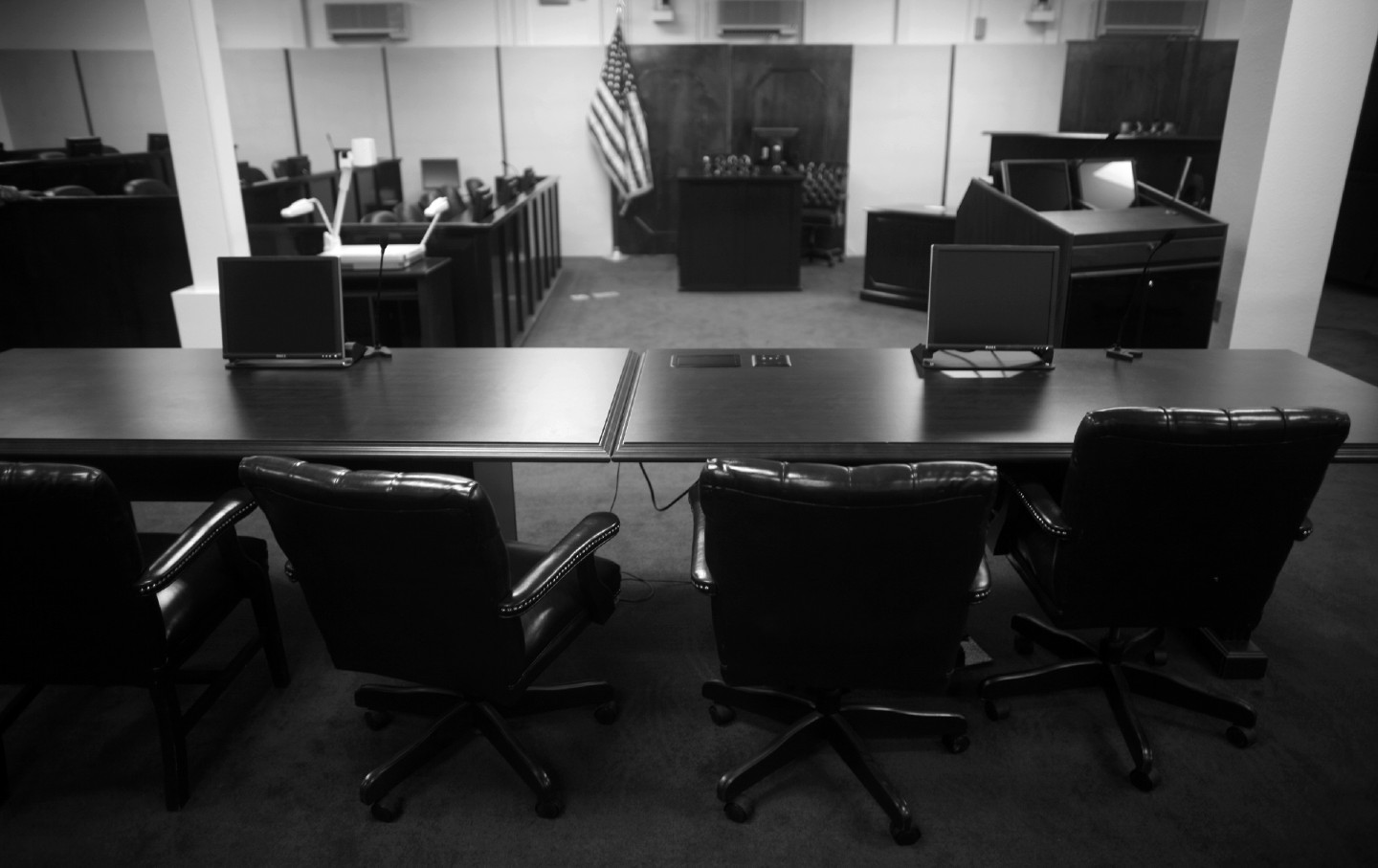
In August a federal appeals court threw out a jury verdict in favor of three men—Suhail Al Shimari, Asa’ad Zuba’e, and Salah Al-Ejaili—who alleged that US military police and US contractors had conspired to torture them at Abu Ghraib in the months after the US invasion of Iraq. The jury had awarded the men $14 million each in damages in recognition of the severity of the abuse they suffered, and the appeals court had affirmed the jury’s verdict, but in June the Supreme Court overturned the key precedent on which the appeals court’s affirmation rested. That decision shut down one of the few remaining mechanisms for obtaining accountability for human rights abuses in American courts, and it made the appeals court’s dismissal of the Abu Ghraib case inevitable.
But the tragic truth is that the case was probably doomed from the start—not because there was insufficient evidence to support the men’s claims, but because since the September 2001 terrorist attacks the federal courts have expanded a slew of jurisdictional, remedial, and procedural doctrines that together all but guarantee that human rights cases implicating national security are dismissed without regard to the evidence. The Abu Ghraib case traveled a twisted path through the justice system, coming before the appeals court a remarkable six times over a period of 18 years. During that time, the courts confronted many other cases involving human rights abuses committed by US intelligence agencies, military personnel, or government contractors, and they relied on these doctrines to dismiss almost all of them. The Abu Ghraib case just took longer to meet the same fate.
To look back on these cases now, a quarter-century into what George W. Bush labeled the “war on terror,” is to survey a bleak and disheartening landscape of judicial abdication, with the courts almost invariably placing national security policies beyond the reach of the law and human rights victims outside the sphere of judicial protection. Lawsuits filed by men who were once imprisoned and tortured in the CIA’s black sites were thrown out on the theory that they couldn’t be litigated without the disclosure of state secrets. Challenges to mass surveillance programs were turned away for the same reason, or because the challengers’ inability to prove conclusively that their own communications would be swept up—a near-certainty, given the scope of the programs—meant they lacked standing to sue.
A case concerning the drone killing of US citizens abroad was dismissed on the theory that it raised questions that are the exclusive province of the political branches, and another was rejected on the grounds that the due process clause does not provide a remedy for extrajudicial killings carried out in the service of national security. A slew of other cases involving serious abuses—including another case brought by men once imprisoned at Abu Ghraib—were dismissed after courts decided that the officials should be immune from suit. I litigated some of these cases and became intimately familiar with the diversity of ways in which courts can close their doors to even manifest injustice.
In the first years after 9/11, national security officials and their supporters in the legal academy would sometimes lament the emergence of “lawfare,” by which they meant human rights groups’ use of the courts to contest the lawfulness of national security policy and to force leaders to answer for abuses. They warned that the prospect of liability would deter officials from taking bold action—that it would dissuade them from getting chalk on their cleats, in Michael Hayden’s phrase, or from working the “dark side, if you will,” in Dick Cheney’s even more memorable one. John Yoo, who wrote the Justice Department memos authorizing torture, characterized human rights litigation as “another front” in the war on terror.
But anxiety about the possibility that American courts might hold officials accountable for the violation of fundamental legal norms has turned out to be entirely unwarranted. No senior government official has been held liable, criminally or even civilly, for the major rights violations perpetrated as part of the war on terror—not for torture, arbitrary detention, extraordinary rendition, mass surveillance, or extrajudicial killing. Nor have American courts grappled with the human consequences of the government’s policies, or (with very few exceptions) afforded victims an opportunity to confront the people most responsible for them.
An important legacy of the war on terror is the court-constructed legal regime that now insulates national security policy from review and shields national security officials from accountability. We can see the implications of it all around us. We can see it in the steady, AI-fueled expansion of government surveillance, in the readiness of ICE agents to fire their weapons in the streets of Minneapolis or Chicago, in the government’s shocking cruelty toward migrants and refugees, and in the murderous airstrikes against supposed drug traffickers in the Caribbean and Eastern Pacific. Government officials now violate the law with impunity, with little more than a wave to national security. Justice Department legal opinions—like the ones that Yoo wrote for the torture program—protect them from criminal prosecution, and the legal doctrines that the courts expanded during the war on terror shield them from civil liability as well.
All of this could have unfolded differently, and there were moments when it seemed like it might. After the Bush administration imprisoned an American as an enemy combatant, Justice Sandra Day O’Connor wrote a forceful opinion holding that the Fifth Amendment’s due process clause required that the prisoner be afforded an opportunity to contest his designation before a neutral tribunal. Justices John Paul Stevens and Anthony Kennedy wrote rightfully celebrated opinions affirming the rights of prisoners held at Guantánamo Bay. But it would soon become clear that these opinions were outliers. The Supreme Court took up surprisingly few cases relating to the war on terror, and the ones it took most often yielded new obstacles for human rights claimants and new protections for national security officials.
No one should underestimate how difficult it will be to reverse course. Legal reform is arduous and slow in the best circumstances, and the abdications and dismissals of the last quarter century have worn deep precedential grooves that courts are now conditioned to follow. Still, we can’t afford to resign ourselves to the legal regime we have inherited. We have to try to imagine, and then build, a justice system that better serves the values that should be central in our democracy—like due process, accountability, and the rule of law.
We have the blueprints and conceptual resources for this project already. We have them in the many post-9/11 lower court decisions that appeals courts overturned, in the appellate decisions that the Supreme Court reversed, and in innumerable dissents written by judges who forcefully rejected the proposition—implicit in many of the briefs the government has filed over these past 25 years—that the courts should make themselves mere bystanders to injustice.
These dissenters were right, of course. Turning a blind eye to so many post-9/11 human rights violations and abuses has not made us safer or stronger or readier or better at the hard business of navigating a complicated world. And for those of us who include in that hard business the obligation to own up to and learn from our mistakes, in many ways it has tied our hands.
More from The Nation
Israel’s Extremist Election Israel’s Extremist Election
The run-up to the vote on Tuesday is exposing the façade of Israeli democracy—and the fealty of the country's so-called opposition when it comes to matters of Jewish supremacy.
“NAZA” and Israel’s History of Automated Warfare “NAZA” and Israel’s History of Automated Warfare
As violent technologies like spyware, predictive targeting algorithms, and 2,000-pound warheads become ordinary instruments of military rule, once-abhorred practices become routin...

Brazil’s Workers’ Party Is Not Stopping Brazil’s Workers’ Party Is Not Stopping
With just a few days remaining before the runoff election, supporters of Lula’s party are doing everything possible to rally support behind the president.
Brazil’s Decision Brazil’s Decision
The moral compass and basic humanity of political leaders really does matter.
Albanian Student Strikes Spur a Political Crisis Albanian Student Strikes Spur a Political Crisis
A new round of protests against the ruling party’s corruption has Prime Minister Edi Rama giving cops bonuses to crack down on dissent.

