
Gaza’s Class of 2026
Gaza’s 2008 babies were born during an Israeli assault, grew up under blockade, and completed their final high school exams this summer during a genocide.
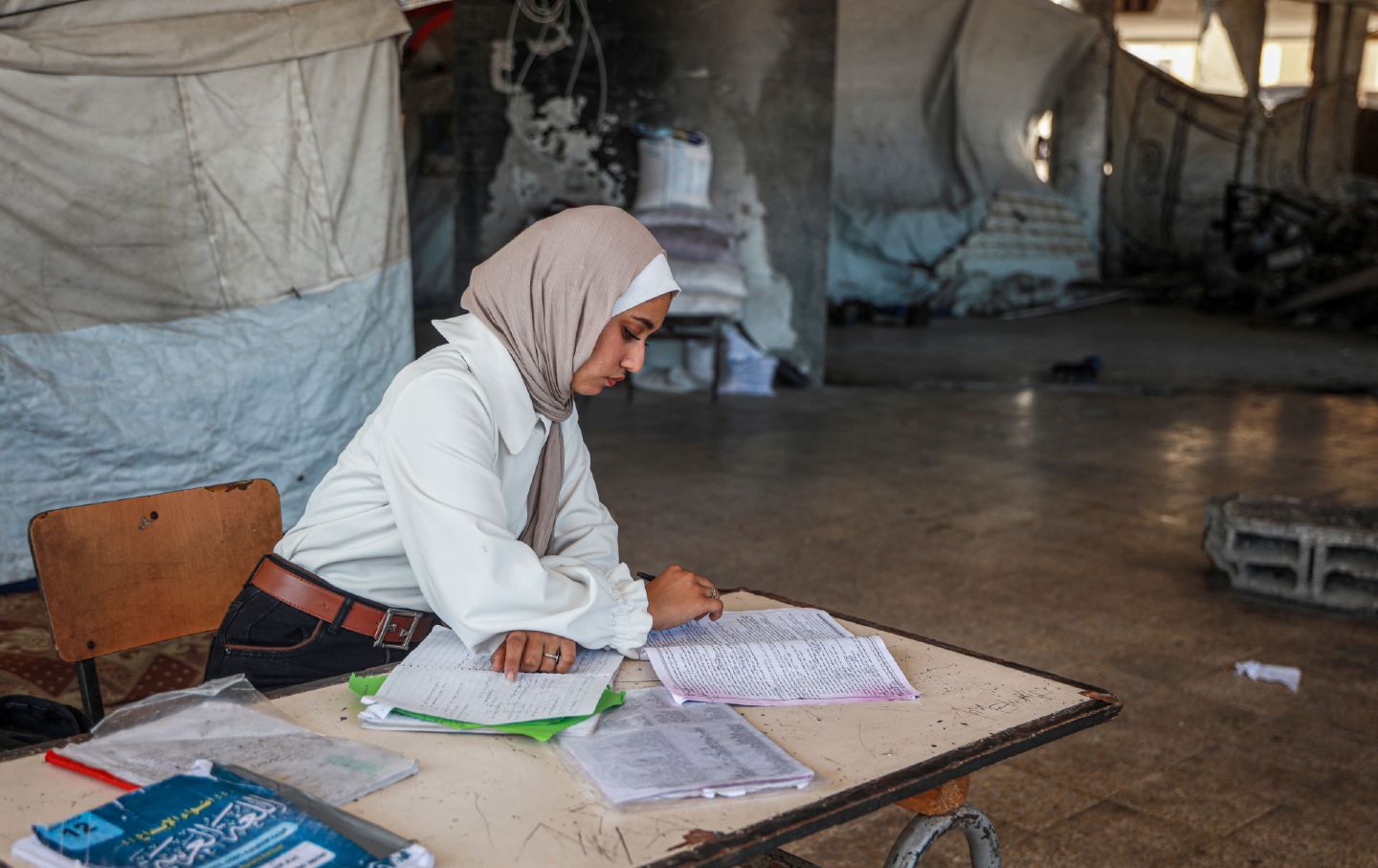
A student in Gaza’s class of 2026 reviews for her final high school exam, the tawjihi.
(Abdalhkem Abu Riash / Anadolu via Getty Images)For Palestinians, the tawjihi is more than a final school exam. It is the test that can shape what comes next: which university a student can attend, the subjects they can study, and, in a place where opportunities are already limited, what kind of future they can build.
Usually, the months before the tawjihi are filled with familiar routines: textbooks marked with notes, private lessons, long nights of studying, anxious parents, constant conversations about grades.
For the class of 2026, preparations for exams began the year they were born.
The number 2008 sounds ordinary until it is placed beside Gaza. Israel assaulted the Gaza Strip in December 2008 and January 2009. The students born that year spent the first months of their lives enduring bombardment and displacement. War was not something they encountered in a history lesson. It was the world they entered.
In 2012, when the students were learning their letters and numbers, Israel launched another assault on Gaza.
In 2014, they put on uniforms and entered their first classrooms, starting school during yet another major war.
These students grew up amid cycles of violence, blockade, and instability. The hum of drones became the soundtrack of daily life, so much so that a silent sky left the children puzzled.
By October 2023, the children born in 2008 were teenagers approaching their final stage of schooling, and the destruction of Gaza’s educational system was about to transform what should have been the standard run-up to the tawjihi—nervousness about university and the expectations of parents—into something they never imagined.
For many of these students, the final stretch toward the tawjihi, which was held on June 20, 2026, took place without functioning schools. Despite the immense hardship, 37,698 students in the Gaza Strip took the exam along with 51,499 students in the West Bank.
Since 2023, schools have been destroyed, damaged, overcrowded, or converted into shelters. Families have been displaced repeatedly and steady electricity and internet access is no longer a given. Books, stationery, and suitable places to study have become increasingly scarce.
So tents became classrooms.
Pieces of cardboard became desks.
Phones became libraries.
A student might spend hours looking for electricity to charge a phone that they had converted into a classroom, only to search in vain for an internet connection strong enough to download lessons or sit for a test.
Gaza’s 2026 tawjihi proceeded anyway.
The exams were conducted electronically for students in the Strip, as they had been in 2024 and 2025, since the destruction of Gaza had made sitting for them formally impossible. Students were expected to take the conventional exam, despite needing to arrange many of the basic conditions for taking it themselves.
For some, that meant studying from PDFs on phones. For others, it meant private lessons when their families could afford them, walking long distances to educational spaces, or searching—sometimes fruitlessly—for a place with electricity and stable connection.
For some students, studying competed directly with the demands of survival. Those students collected water, gathered firewood, cooked, washed clothes by hand, cared for younger siblings, and otherwise helped families who had lost their main providers. Their education was supposed to prepare them for the future, while daily life kept demanding their attention in the present.
In June, Al Jazeera reported on students preparing to sit for exams from cafés and other public places. Suwar Mohammad, a displaced student whose home in Gaza City had been destroyed, was living in a tent in Deir al-Balah. On the eve of her exams, she did not know where she would take them and was searching for a café with reliable internet.
Her uncertainty captures something essential about this year’s group of students. The question was not: Did I study enough? It was: Will the electricity stay on? Will the internet hold? Will my phone have enough battery? What happens if the connection cuts out halfway through the exam?
And behind those questions hid another problem: How could anyone concentrate while living under bombardment, surrounded by displaced families, aware of the constant violence?
For Gaza’s students, learning to navigate these insurmountable obstacles became part of the exam itself.
There is another way to understand the class of 2026: by looking for the students who are not there.
According to figures released by the Palestinian Ministry of Education in June 2026, 20,647 students have been killed in Gaza and the West Bank since October 7, 2023. More than 1,000 education workers have also been slain.
For graduating students, behind those figures are classmates who disappeared from attendance lists, friends whose names became memorial posts, and relatives who should have been sitting for the same exam but will never receive a certificate.
Some students in this generation were injured. Some lost parents. Some became responsible for younger siblings. Some survived while other members of their families did not.
The empty seats are part of the graduating class, too.
But, even for those who manage to take the test, a secure future is far from guaranteed. On June 22, Raghad Hussein Ashour, a Palestinian secondary-school student taking the 2026 tawjihi, was killed in an Israeli strike in Gaza City while returning from the exam, according to Palestinian reports and relatives.
Raghad grew up without her father, who died in Egypt from medical complications when she was a child. She was her mother’s only daughter and dreamed of becoming a doctor. Her aunt, Umm Mahmoud, described a young woman who worked relentlessly toward that dream. Raghad wanted to study medicine partly because she saw it as a continuation of the dream her father had once held for her.
Raghad was killed in a strike on a vehicle in Gaza City’s Al-Rimal neighborhood. A paramedic was also killed, and four civilians were injured.
For Raghad’s mother, there was no military explanation that could help her make sense of the loss. Her daughter had been on her way home from a school exam.
Raghad will not see her results.
She will not graduate.
She will never become a doctor.
Her story belongs to the wider record of Gaza’s students—not just as a classmate, but as a revealing example of how fragile even the most conventional step toward a livelihood has become.
Meanwhile, Yahya Nasman’s name appeared among Gaza’s successful tawjihi students with a score of 96.6.
But by the time his result was announced, Yahya was dead—killed alongside members of his family just days earlier.
His name remained on the list of graduates, but the boy who worked doggedly for that moment was not given the chance to live it.
For his family, the result arrived not as the celebration they had imagined, but as another reminder of the life that has been taken from them.
I received my own tawjihi results in 2023, the last year when Gaza’s examinations were still held under relatively normal conditions. I graduated with a score of 98. I remember the tension of waiting for a number that seemed capable of determining everything that would come next.
In 2026, I was no longer the student, but the sister of one.
When the results were announced on July 24, a message appeared on my phone informing me that my brother, Mohammed Ahmed Al-Wawi, had scored a 96.4.
Mohammed was born in that fateful year of 2008. He has specialized in science and has been an exceptionally strong student throughout his school years.
Though it can be easy, when writing about Gaza, to turn every successful student into a symbol of adversity overcome, Mohammed’s 96.4 cannot tell you how many hours of study were interrupted, how often “ordinary conditions” meant gazing at the pixels of a phone screen as drones flew overhead, or how much uncertainty clouded his final year. It cannot capture the student I have watched thrive, despite the conditions of his academic journey.
The same is true of every student in his cohort.
A 99.6 does not explain what my cousin Malik carried through these last years.
A 98 does not tell us what my cousin Raoum had to overcome.
And a passing grade cannot account for an education system devastated by war, cannot give back the missing teachers, the stolen hours, the schooling Gaza’s children should have had.
A student who did not pass cannot be described as having failed in any ordinary sense.
The tawjihi measures answers.
It does not measure displacement.
It does not measure grief.
It does not measure the hours spent searching for electricity, water, or internet.
It does not measure studying after your home has been destroyed, or while knowing someone you love has been killed.
It cannot measure the courage required to keep imagining a life beyond the present.
Gaza’s class of 2026 has spent almost its entire life growing up alongside war. They reached adolescence under ceaseless blockade and violence. They entered their final school years after October 2023, as much of the city and its educational system collapsed. They took their final exams in improvised spaces with inadequate resources.
This timeline matters because what happened to them was not one difficult school year. It was an entire young life spent without any constant other than instability.
Popular
“swipe left below to view more authors”Swipe →And yet, when the results appeared, their names were still there.
Their grades appeared with the rest of the nation’s.
Their plans to attend university still stand.
That matters.
The class of 2026 did not choose the circumstances in which it grew up. It did not choose to become familiar with the sounds of war before it learned language. It did not choose an education without classrooms, nor to sit a national examination without knowing whether electricity and internet access would hold.
But it kept going.
And Gaza’s children of 2008 graduated.
More from The Nation
Progressives Are Backing Puerto Rican Independence. It’s About Time. Progressives Are Backing Puerto Rican Independence. It’s About Time.
More and more leftists are concluding that statehood for the island is not enough.
The Saudi Phase of the Iran War Signals More Chaos to Come The Saudi Phase of the Iran War Signals More Chaos to Come
The conflict that Donald Trump has repeatedly proclaimed an unequivocal American victory keeps spiraling out of control.
Andy Burnham’s Speech to the Labour Party Conference Could Be the Start of a Positive Social-Democratic Politics Andy Burnham’s Speech to the Labour Party Conference Could Be the Start of a Positive Social-Democratic Politics
But the autumn budget to be released at the end of October will offer needed details.
Why Navi Pillay’s Receiving the Nobel Peace Prize Is So Important Why Navi Pillay’s Receiving the Nobel Peace Prize Is So Important
She believes that human rights and international law are universal principles that must be enforced regardless of violator’s ideology, ethnicity, or geostrategic alignment.
Writing About War as Bombs Fall Writing About War as Bombs Fall
While the Israeli government launched a well-orchestrated offensive of disinformation and hyperbole that would make the illegal permissible in the war on Gaza.

