
Hubert Harrison’s Brand of Black Radicalism
In this interview with Brian Kwoba, The Nation talks with the author about his new book on the legacy of a little-known but influential activist.
Hubert Harrison’s Brand of Black Radicalism
In this interview with Brian Kwoba, “The Nation” talks with the author about his new book on the legacy of a little-known but influential activist.
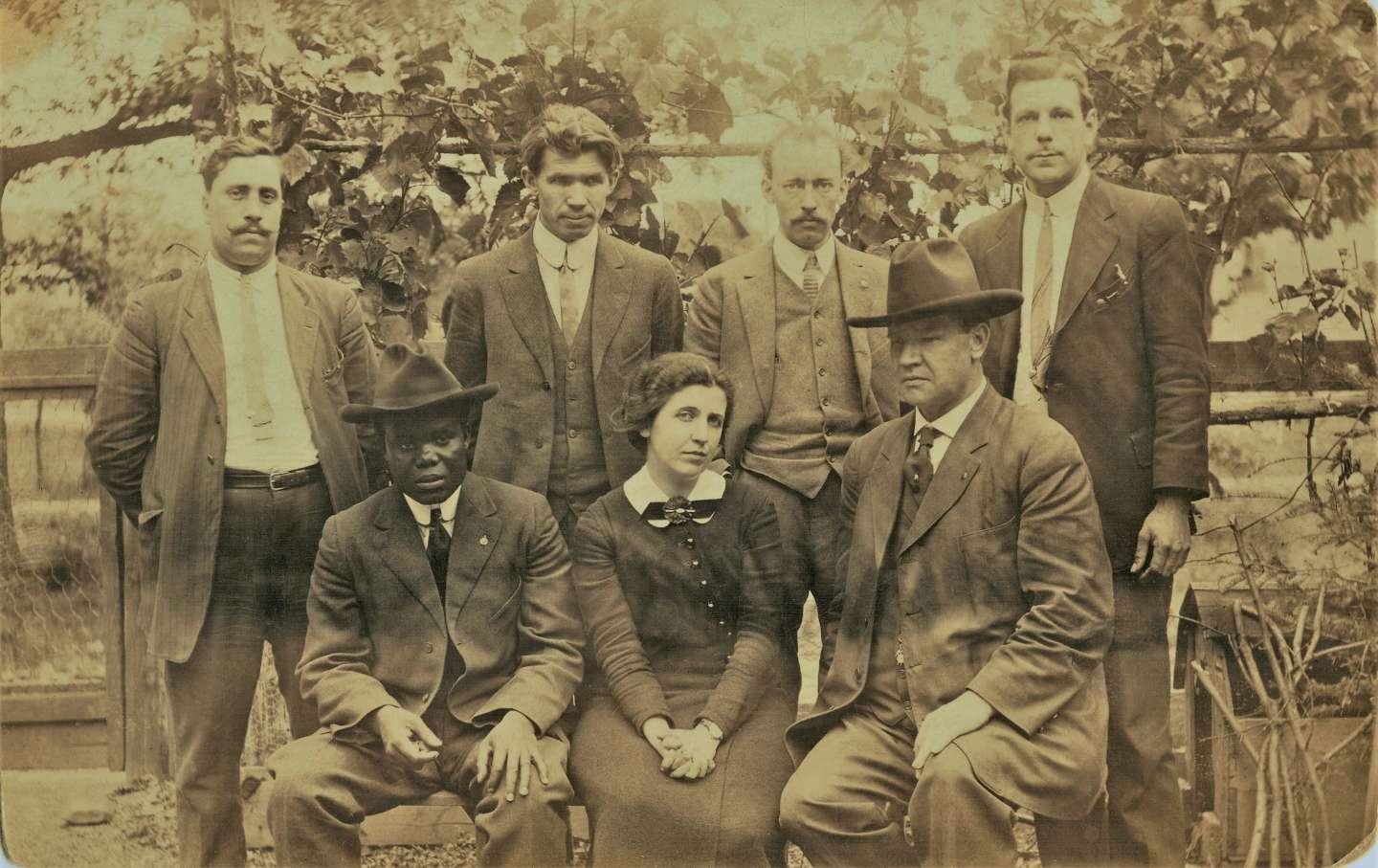
Hubert Harrison was a Caribbean-born educator and activist who was a prominent advocate for labor rights, free speech, radical internationalism, and free love in the Jim Crow era. He inspired and contributed to political organizations and cultural movements as diverse as the Socialist Party, the Marcus Garvey movement, and the so-called “Harlem Renaissance.” Harrison also wrote a number of pieces for The Nation in the 1920s as the magazine’s first regular Black book reviewer.
Now an acclaimed new book by Brian Kwoba, an associate professor of history and director of the African and African American Studies program at the University of Memphis, examines the life and thought of this unjustly neglected figure. Hubert Harrison: Forbidden Genius of Black Radicalism has won the 2026 Frantz Fanon Outstanding Book Award from the Caribbean Philosophical Association and the 2026 Phillis Wheatley Book Award from the Sons and Daughters of the United States Middle Passage. The Nation spoke with Kwoba about Harrison’s legacy and its significance for political transformation today.
—Peter Cole
Peter Cole: Hubert Harrison was an incredible figure, but few people know about him outside of Black-studies departments. So tell us who he was and why he mattered.
Brian Kwoba: In September 1912, a century before Occupy Wall Street, a Black orator’s booming baritone occupied the attention of a large crowd in front of the New York Stock Exchange building on Wall Street. It was the voice of Hubert Harrison; he was making the case for socialism. The New York Times described him as “an eloquent and forceful negro speaker” who had “shattered all records for distance” in his address on behalf of working people and against the robber-baron oligarchs of the Gilded Age.
After blazing a trail for Black activists in the Socialist Party, Harrison called for an anti-capitalist, anti-imperialist Colored International alliance in the face of European colonialism in Africa, Asia, and Latin America. Most spectacularly, Harrison’s Liberty League of Negro Americans catalyzed the rise of Marcus Garvey, who headed the largest international organization of Black people in modern history.
PC: How, when, and where did Harrison become radicalized?
BK: Harrison was born on the island of St. Croix in 1883 and moved to New York City in 1900 as a teenager. There he saw firsthand vast wealth inequality and heard constant reports on the national epidemic of white racist lynchings of African Americans. Like so many other Caribbean migrants who had come to the United States, Harrison was shocked by the intensity of the racial violence he found here.
PC: What was Harrison’s relationship with the Industrial Workers of the World, the wider labor movement, and the Socialist Party?
BK: Harrison held a number of the odd jobs available to a young Black immigrant in early-20th-century Manhattan. Eventually he secured a job as a postal worker and joined the postal workers’ union. But after he wrote op-ed pieces critical of Booker T. Washington’s conservatism, Washington’s “Tuskegee Machine” got him fired. Far from discouraging him, the retaliatory firing led Harrison to join the Socialist Party as a full-time paid organizer.
Harrison campaigned several times for Eugene Debs for president. He also wrote a series on “The Negro and Socialism” in the party’s International Socialist Review and articles in The New York Call analyzing race and class in the United States as seen through a historical-materialist lens. He then launched the Colored Socialist Club in Harlem, the party’s first official Black-led formation, to recruit Black workers and organizers. Unfortunately, the party failed to heed his call for special attention to the serious oppression of Black workers, who, he argued, formed the most proletarian element in the country.
This unsavory experience with what he called the “Southernism” (i.e., anti-Black racism) of the Socialists led him to support the more radical Industrial Workers of the World, which welcomed Black workers and Black labor leaders like Ben Fletcher into its ranks. Harrison was the only Black speaker to address strike rallies and union meetings alongside IWW leaders like Elizabeth Gurley Flynn and “Big Bill” Haywood during the Paterson Silk Strike of over 20,000 workers in 1913.
PC: Harrison became an influence on Marcus Garvey, who founded and led the Universal Negro Improvement Association. Tell us about that.
BK: When Garvey founded the Universal Negro Improvement Association in 1914, he aimed to build a Tuskegee-style industrial school in Jamaica. In 1917, shortly after Garvey got to Harlem, he joined Harrison’s Liberty League of Negro Americans. The Liberty League transformed Garvey by imbuing him with a “race-first” politics, a mass-movement (rather than school-building) orientation, and a model for including African Americans and African Caribbeans in a single organization. Eventually Garvey left the league, but he adopted key elements of Harrison’s model to expand the Universal Negro Improvement Association into the largest international organization of Black people in modern history. In other words, Marcus Garvey’s name would never have become attached to the global Black-nationalist movement without the decisive influence of Hubert Harrison.
At the same time, Harrison saw firsthand how Garvey’s monarchical, ultranationalist, imperial, and pro-capitalist fixations helped boost Garvey’s ego and mythical status but formed barriers to the project of liberating the Black working class from racial capitalism. If Harrison learned in the Socialist Party that class consciousness will never achieve its goal without a serious grounding in Black liberation, he learned from the Garvey movement that pan-African liberation will never achieve its goal without a deep grounding in class consciousness.
PC: Why did Harrison get so thoroughly erased from popular memory?
BK: This question is the elephant in the room. Harrison proved too hot to handle and too cold to hold, thanks to his incisive criticisms of all the forces and figures that might otherwise have kept his memory alive. Take, for example, the “Harlem Renaissance” narrative: Harrison argued that African Americans had a rich literary heritage from the 19th century onward and thus rejected the notion that a “renaissance” was suddenly underway in the 1920s. He maintained that after the wanton destruction of the First World War, the white cultural-entertainment industry had now turned for inspiration and rejuvenation to the artistic output of the postwar “New Negro” in Harlem. The industry sold handpicked examples of nonthreatening Black artists to white audiences as a “Negro renaissance.”
This idea, and its enshrinement as the hegemonic narrative about Harlem history in the early 20th century, deliberately excluded the many creative people—both within and beyond Harlem—who represented more visionary thinking, like that of the free-loving blues women, Garveyists, Black Marxists, and Harrison himself.
PC: You write that there are things about Harrison’s legacy that are not fully appreciated. Can you tell us what those are?
Popular
“swipe left below to view more authors”Swipe →BK: The most controversial and most generative of them concerns Harrison’s sexual politics, which were not only ahead of his time but apparently ahead of ours, too. Harrison developed a Black free-love politics at a time when such a concept was unthinkably risky and revolutionary.
Harrison’s was a time of strict sexual repression on the part of both church and state through the Comstock laws. White mobs lynched Black men often for the alleged sexual threat they posed to white women. In this sex-negative context, Harrison was one of the first figures in African American history to publicly call for legalizing contraception and offering publicly available courses on sex education; he also openly denounced the church and state repression of sexuality and defended a conception of love based on variety and freedom.
By connecting capitalism, white supremacy, the church, European colonialism, and women’s oppression to compulsory monogamy, Harrison articulated—in the 1910s!—a Black free-love politics that would begin to bloom quite spectacularly in the sexual experimentation that emerged within and alongside the artistic and cultural awakening of the Harlem of the 1920s.
In short, my book does more than simply resurrect a long-lost beacon of possibility from the Black radical tradition. Harrison’s “forbidden genius” offers a gem-filled kaleidoscope of visionary politics for radical transformation in the 21st century. So it’s high time that we reclaim it.
Become a Sustaining Donor This September
Between the reemergence of right-wing red-baiting and Donald Trump’s use of the chilling National Security Presidential Memorandum–7 to criminalize left political organizing, we’re seeing McCarthyism reborn before our eyes.
This assault on democracy cannot be ignored or wished away. Resisting it requires bravery in the face of threats and repression, a steadfast commitment to the truth, and the unwavering belief that we can—and will—overcome this darkness.
We must have an independent media that sets the record straight, unearths corruption and abuses of power, and advances a politics of justice and dignity for all if we’re to win this fight.
That’s why I’m writing to you today. This September, The Nation needs to add 100 monthly donors to sustain our progressive journalism. Your contribution makes the next investigative report, the next truth-speaking column, and the next pathbreaking essay all possible.
I hope you’ll support our work with a recurring donation today. If you donate $10 or more a month, we’ll send you a brand new “Hands Off the Free Press!” sticker to recognise your commitment to our cause. Please, donate today.
Onward,
Katrina vanden Heuvel
Editor and Publisher, The Nation
More from The Nation

Is Platonic Co-Parenting the Future of the Family? Is Platonic Co-Parenting the Future of the Family?
Disillusioned with the nuclear family and apprehensive of tethering their reproductive futures to the bleak hellscape of modern love, young people are seeking a different way.

Treat Spotify Like a Public Utility Treat Spotify Like a Public Utility
Music streaming platforms have way too much control over musicians and music lovers. It’s time to rein them in.

How Trump’s Crackdown on Speech Has Damaged the Student Press How Trump’s Crackdown on Speech Has Damaged the Student Press
I serve as editor in chief and president of The Stanford Daily. Our newsroom has keenly felt the effects of Trump’s campus crackdown, which is why we sued the federal government.

What’s the Matter With Effective Altruism? What’s the Matter With Effective Altruism?
President Trump has decried the techbro creed for indulging in AI doomerism, but its excesses are far worse than that.
As Morale Sags, More Military Service Members Are Having a Crisis of Conscience As Morale Sags, More Military Service Members Are Having a Crisis of Conscience
According to multiple GI rights organizations, service members are inquiring in unprecedented numbers about seeking conscientious objector status.

