Trump’s Disregard for International Humanitarian Law Won’t End When the Iran War Does
As political pressure to end the war grows, Americans must not overlook the president’s blatant violations of the rule of law, abroad and at home.
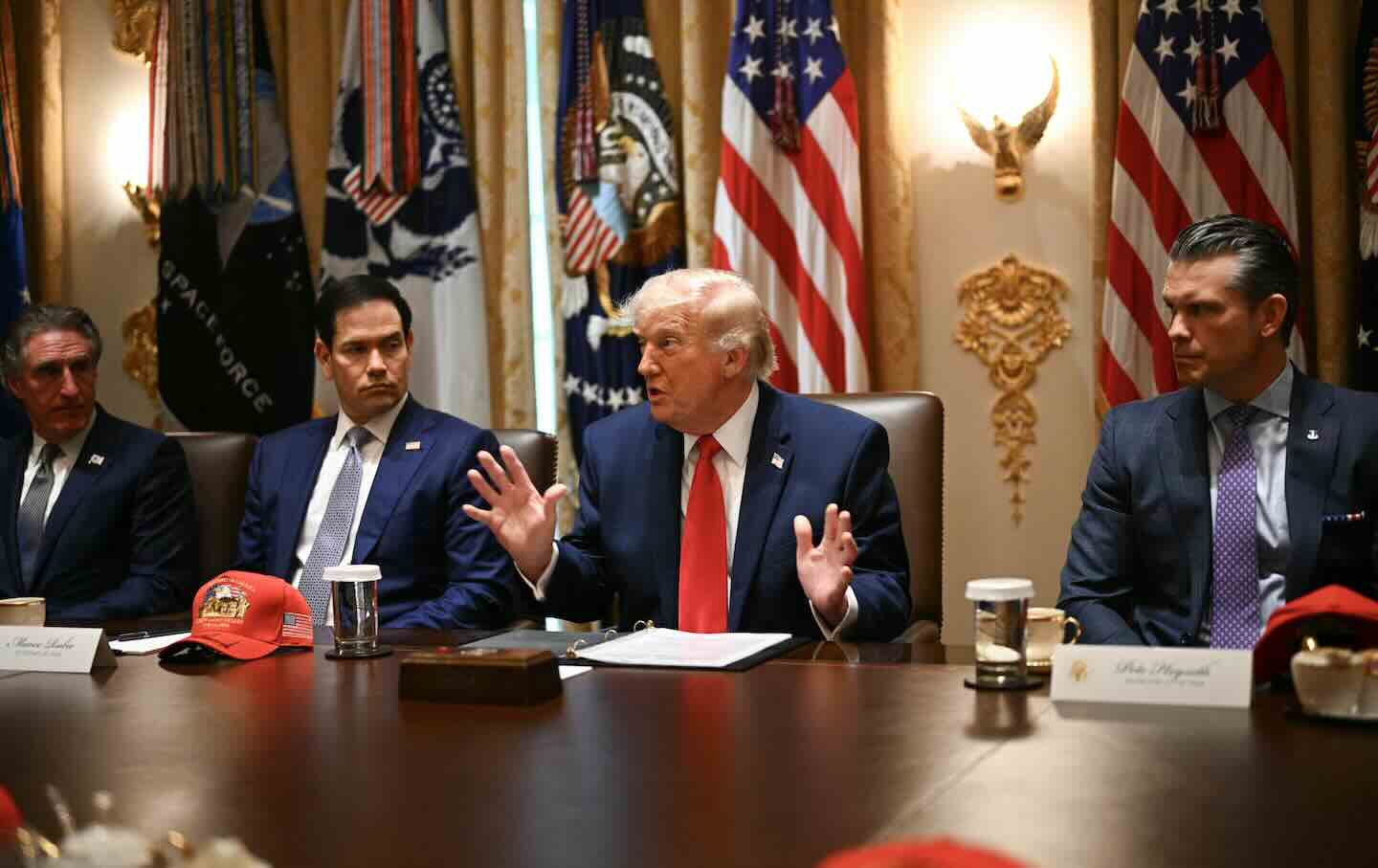
President Donald Trump speaks during a cabinet meeting at the White House on May 27, 2026.
(Kent Nishimura / AFP)
On Wednesday, the House of Representatives passed a resolution by a vote of 215-208 “seeking to halt Trump from taking further military action amid growing opposition to the war.” President Trump called the vote “meaningless” and lambasted the four Republican signers as “unpatriotic” and “GRANDSTANDERS” who “should be ashamed of themselves.”
This comes after Trump’s various failed efforts to secure a deal and end the war. To be clear, with growing concern from Democratic and Republican members of Congress, worry from allied nations, and anxiety from business leaders, Trump is under pressure to end the war. However, even if Congress clutches the reins, Americans and the rest of the world should be alarmed by Trump’s dangerous bravado and disregard for the rule of law.
We think an investigation is needed to understand just how dangerous Donald Trump is not only on domestic policy, but also on global affairs. As president of the United States, Trump has consistently shown disregard and contempt for the separation of powers, imposing tariffs, ignoring the Constitution, starting wars, and claiming budgetary control not authorized to a president. His conduct has been so brazen that even the US Supreme Court, which has shown a mystifying level of solicitude toward Trump, smacked his hands in the tariffs case. As Chief Justice John Roberts made clear in the court’s ruling, the “power to impose tariffs” has been vested with Congress for over 200 years.
However, neither time and tradition nor orderly governing appear to mean very much to a president who prioritizes corruption and cruelty over human rights, and war over diplomacy. For example, reaching a deal in Iran—or the attempt to—might obscure the many shocking ways that Donald Trump and his administration actively ignore international protocols, domestic laws, and trade diplomacy for violence.
Early in the Iran war, Defense Secretary Pete Hegseth reiterated his disdain for international humanitarian law. He said at a March press conference, “No more politically correct and overbearing rules of engagement, just common sense, maximum lethality and authority for warfighters.” In essence, the Trump administration has leveraged this “common sense” against the US Constitution, federal laws, and international treaties.
This preoccupation with lethality has been a fixation of Hegseth’s since his confirmation hearing, during which he refused to commit to abiding by the Geneva Conventions. These foundational legal instruments of international humanitarian law (aka the law of war) amounted to, in his words, “burdensome rules of engagement.” This has been a common thread throughout Trump’s second term and across his cabinet—from Kristi Noem to Pam Bondi—whether on the streets of Minneapolis or in other countries where it has launched unjustified wars.
Notably, polls show that the vast majority of Americans oppose the war in Iran and Trump’s handling of it. Barely one-third are in favor.
Yet, the Trump administration’s “maximum lethality” policy in conjunction with a disregard for international humanitarian and human rights law continues unabated. And it looks like the heartbreak of the parents of Reza Habashian, Mahdis Nazari, and Liana Mohammadi—three seven-year-olds who were among the approximately 156 people, including 120 schoolchildren, killed in back-to-back US missile strikes on a primary school in Minab, Iran, on February 28, 2026. The strike was apparently the result of highly outdated intelligence that the school was part of an adjacent Iranian military base.
It also looks like a 30-year-old Ethiopian migrant who lost his legs in an April 28, 2025, US attack on the Sa’ada migrant detention center in Yemen. He had come to Yemen to find work and help his family back in Ethiopia. “Now people carry me to the toilet,” he said to Amnesty International earlier this year. Another survivor of the strike, now living with one leg missing and a metal rod inside of his severely injured remaining leg, is in such pain that when he cannot take a painkiller, he wishes to die. Sixty-one African migrants, most or all from Ethiopia, did die in that April 28 attack.
And it looks like Chad Joseph and Rishi Samaroo. Both had been working in Venezuela—Mr. Samaroo cared for goats and cows and made cheese—and were on their way home by boat to Trinidad on October 14, 2025, when they were among the six people killed by a US missile strike. Chad Joseph leaves behind three children. According to the Trump administration, the US launched the boat strikes because those on board were trafficking drugs and “narcoterrorists,” members of designated terrorist organizations. Or at least the administration asserted, without evidence.
The attacks in Iran and Yemen violated international humanitarian law, which requires states to “[d]o everything feasible” to ensure that the objects of their attacks are military objectives, not civilian infrastructure and populations. Between open-sourced satellite imagery, readily available information on the internet (including the school’s website), and a UN investigation into a 2022 Saudi attack on the same detention facility, the non-military nature of the school and detention facility (for ten and five years, respectively) was readily discernable. The world’s intelligence superpower using information years out-of-date when current information is available to all is a far cry from the “all feasible precautions” required.
While the attacks on boats in the Caribbean Sea and Pacific Ocean have not violated international humanitarian law, they also are not part of an armed conflict. As such, they are human rights violations, extrajudicial killings that do not follow judicial or other legal processes. They constitute “arbitrary” deprivations of the right to life. As had been the practice for decades, suspicion of drug trafficking should lead to a law enforcement response—interdiction, arrest, and prosecution—not a military one.
Popular
“swipe left below to view more authors”Swipe →US military attacks on the Minab primary school, the Sa’ada detention center, and the boat carrying Trinidadian laborers do not constitute the only international humanitarian law violations and extrajudicial killings under this administration. Through the first week of May 2026, at least 190 people were killed in the boat strikes. And now by the time of the possible ceasefire with Iran, US and Israeli strikes on Iran have damaged or destroyed more than 1,000 schools and health facilities, according to the Iranian Red Crecent Society. To date, the United States and Israel have already killed more than 1,700 Iranian civilians.
While each attack must be analyzed based on its specific circumstances to determine whether it has violated international humanitarian law, the sheer numbers are highly suggestive that some entailed violations. Indeed, “over 100 international law experts warn: U.S. strikes on Iran violate UN Charter and may be war crimes.”
Simply put, the American government is at war abroad and also with itself. The Trump administration’s fetish with violence is not only at sea or with missiles landing on schools, hospitals, and clinics. His aggression is also at home with brazen violations of the rule of law, human rights, and human dignity. To address this, Congress must step in and restore and safeguard these quintessential values. And Americans must reject the cynicism being foisted upon them that violence equals strength and good judgment. Certainly, the Trump administration has disproven that.